The Night Our Champion Sons Became ‘Losers’, and the Gilded Breakdown That Redeemed Us All.
PART 1: THE ASH AND THE ECHO
The final buzzer did not merely sound the end of a game; it felt like an execution. The massive stadium lights of the state championship arena caught the exact moment our golden world evaporated into the freezing December air. On the scoreboard, the digits bled in a cruel, unblinking crimson: Visitors 28, Oakhaven Warriors 27. One point. A single, miserable point was all it took to strip the crown from our sons’ heads and turn a three-year undefeated streak into a historical footnote.
I stood at the edge of the tunnel, my hands gripping my designer handbag so tightly the leather groaned. Around me, the wealthy boosters of Oakhaven—parents who had invested tens of thousands of dollars in private coaching, elite camps, and performance supplements—stood in a paralyzed, collective stroke of shock. We were a town that didn’t know how to lose. We built our entire identity on the triumphs of our children.
When the double doors of the locker room finally swung open, the smell hit me first: a suffocating mix of damp sweat, deep-heat liniment, and the raw, acrid scent of absolute devastation.
My son, Caleb, our star quarterback, sat on the low wooden bench. His pristine white jersey was ripped at the shoulder, stained with the dark turf grass of a battlefield he had lost. His hands, the hands that sports analysts swore were destined for an Ivy League scholarship, were buried deep in his face. His shoulders shook in a silent, violent rhythm.
“Get up, Caleb,” Tyler, the team’s defensive captain, spat from across the room. Tyler was already stripping off his pads, slamming them against the metal lockers with a hollow, echoing clang. “Don’t sit there weeping like a freshman. You threw into triple coverage. You choked, man. Just own it.”
Caleb’s head snapped up, his eyes bloodshot, his jaw clenched so tightly the muscle twitched beneath a layer of dried mud. “Triple coverage? The line collapsed in two seconds, Tyler! I had no pocket, no time, and you let their tight end run sixty yards down the seam on the previous drive. Don’t put this entire stadium on my back!”
“Hey! Both of you, shut your mouths,” Coach Miller’s voice cut through the rising venom like a blunt axe. He stood in the center of the room, looking older than his fifty years, the clipboard in his hand trembling slightly. “We didn’t lose because of one throw, and we didn’t lose because of one missed tackle. We lost because we forgot that the other team wanted to breathe just as badly as we did. Now, clean up. The bus is waiting.”
The ride back on the old yellow school bus was a traveling tomb. The booster club had offered to charter a luxury coach, but after a loss like that, the school administration stuck to the budget. The luxury was gone; the illusion was shattered. Every mile we traveled down the dark, rural highway away from the state capital felt like a heavier descent into social exile.
I sat three rows behind Caleb, watching the back of his head. He hadn’t touched his phone. The screen remained dark, buzzing occasionally with notifications we both knew were filled with the sudden, volatile criticism of a town that only loved you when you were holding a trophy.
Then, thirty miles outside Oakhaven, the universe decided we hadn’t fallen far enough.
A sharp, metallic shriek erupted from beneath the chassis, followed by a violent shudder that sent several players sliding forward in their vinyl seats. The bus lurghed toward the gravel shoulder, its headlights flickering wildly before dying completely. A thick, foul-smelling plume of white smoke began to seep through the floorboards.
“Everyone off! Now!” Coach Miller shouted, coughing as he shoved the emergency door open.
We spilled out into the bitter, pitch-black country air, forty-five broken athletes, a handful of exhausted parents, and a driver swearing over a ruptured radiator. We were stranded in the middle of nowhere, surrounded by nothing but skeletal trees and the eerie, distant silhouette of a massive, rundown estate behind a rusted iron gate.
Stuck. Broke. Defeated. And that was the exact moment the real game began.
PART 2: THE RIFTS ON ROUTE 9
“Where the hell even are we?” Tyler muttered, shivering in his thin varsity jacket, his eyes scanning the dark perimeter.
“Route 9, about ten miles past the county line,” the driver called out, his phone illuminated by the harsh blue glare of his screen. “Tow truck says it’s going to be at least three hours. There’s a massive pileup on the interstate cutting off the local dispatch.”
A collective groan arose from the parents. My husband, Richard, immediately pulled out his phone, his voice dropping into his corporate executive register. “I don’t care about the dispatch, send a private limousine from the city. I’ll double the rate. My son is not spending the night on a ditch bank.”
“Put the phone away, Richard,” Coach Miller said, his voice dripping with an exhausted authority. “There are no limousines coming down this road tonight. Look behind you.”
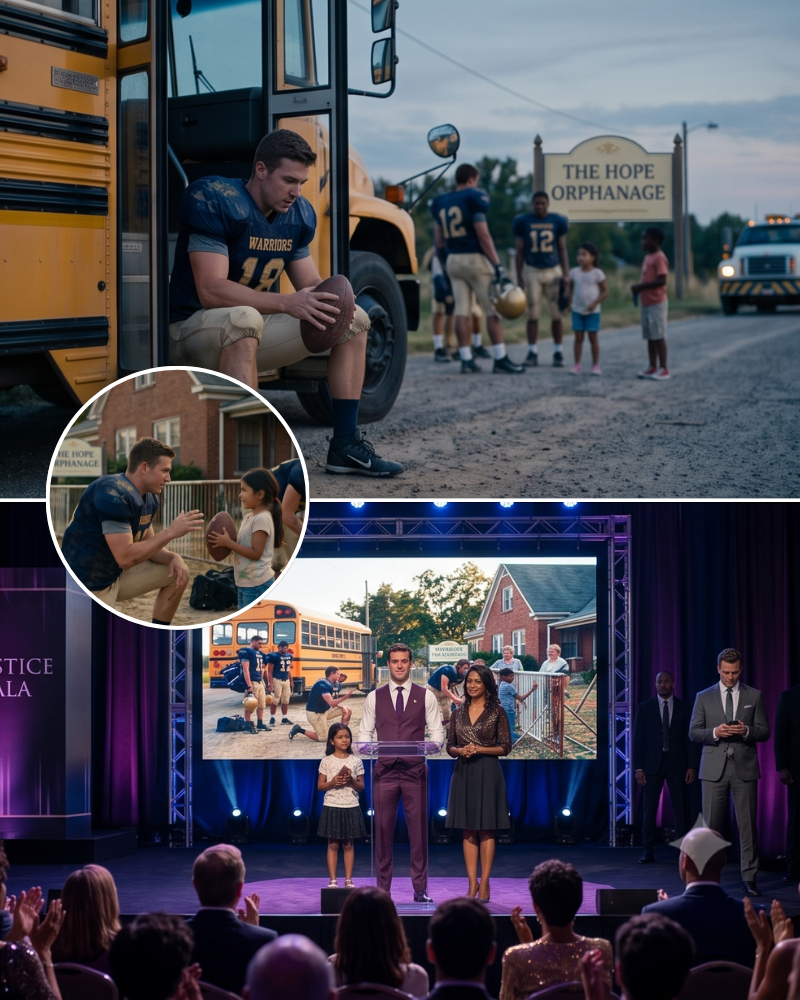
We all turned. Through the heavy iron gates of the estate, a single porch light flickered to life. A wooden sign, weathered by decades of harsh northern winters, hung crookedly from the stone pillar: St. Jude’s Hope Orphanage.
The front door of the main building opened, and a woman in a faded knitted shawl stepped out onto the porch, squinting into the darkness toward our smoking bus. She began walking down the cracked gravel driveway, her footsteps crunching softly in the silence.
“Everything alright out here?” she called out, her voice carrying a deep, maternal warmth that felt entirely out of place in our frozen environment. “I saw the smoke from the kitchen window.”
Coach Miller stepped forward, tipping his cap. “Radiator’s blown, ma’am. We’ve got a bus full of boys and a three-hour wait for a tow.”
The woman looked past the coach, her eyes lingering on the somber, mud-stained jerseys of the Oakhaven Warriors. A soft, knowing smile touched her lips. “Well, you can’t stay out here in the freeze. I’m Sister Margaret. Come inside. We have cocoa, a warm fire, and plenty of floor space.”
“We appreciate the offer, but we’ll just wait on the bus,” Tyler interrupted, his tone sharp, laced with the defensive arrogance of a boy who felt completely exposed. “We don’t need charity.”
“Tyler!” I snapped, my parental instinct overriding my own discomfort. “Watch your mouth.”
“No, she’s right, Mom,” Caleb suddenly spoke up, his voice low but carrying a heavy, dangerous resonance. He stepped out of the shadows, his eyes fixed on the crumbling facade of the orphanage. “Look at this place. We don’t belong here. We’re the Oakhaven Warriors. We belong in a hotel, or we belong at home. Not… here.”
Sister Margaret didn’t look offended. Instead, she looked directly into Caleb’s eyes, her gaze holding a terrifyingly calm clarity. “You might be warriors on a field, young man, but out here, you’re just cold. And pride is a terrible blanket.”
Before Caleb could respond, the heavy wooden doors of the orphanage cracked open further. Three small children—none of them older than seven—peeked out, their faces illuminated by the warm light of the hallway. One little boy, wearing a sweater three sizes too big, pointed a tiny finger at Caleb’s jersey.
“Look!” the boy whispered loudly to the girl next to him. “It’s the boy from the newspaper! The one who throws the big passes!”
Caleb froze. The internal logic of his entire world—a world where he was currently a catastrophic failure, a disappointment to his father, a pariah to his town—suddenly collided with the pure, unadulterated awe in that little boy’s eyes. To that child, the scoreboard didn’t exist. The interception didn’t matter.
“Come inside,” Sister Margaret repeated softly. “The children have been waiting for a miracle all night. I didn’t expect it to arrive in a broken school bus.”
PART 3: THE RECONSTRUCTION OF GODS
The interior of St. Jude’s smelled of old wood, floor wax, and simmering cinnamon—a stark, domestic contrast to the sterile, high-tech athletic facilities our sons were accustomed to. The main common room was sparse, the furniture worn down to the springs, but a massive stone fireplace roared with a welcoming heat.
The initial twenty minutes were excruciating. The players huddled together in one corner of the room like an occupying army, their large, padded frames making the small room feel even tighter. They held their heads high, maintaining the fragile armor of their athletic superiority, while twenty-odd orphans watched them from the opposite wall with wide, silent eyes.
“This is ridiculous,” Richard whispered to me, his eyes scanning the water stains on the ceiling. “The atmosphere is depressing. Caleb shouldn’t be dwelling in a place of failure right after a loss. It’s psychologically damaging.”
“Richard, look at him,” I whispered back, nodding toward our son.
Caleb hadn’t sat down. He was standing near the fireplace, his eyes fixed on a little girl with crutches who was struggling to pull a heavy wooden crate of broken toys across the braided rug. Her name was Leo, a six-year-old with fierce, determined brown eyes.
Without a word, Caleb crossed the room. The heavy thud of his cleats against the hardwood made the other children gasp. He dropped to one knee in the dust, his massive hand coming down on the edge of the wooden crate.
“Need a hand with that, captain?” Caleb asked, his voice softer than I had heard it in years.
Leo looked at him, then at the ripped ’18’ on his jersey. “You’re the quarterback,” she stated flatly. “You lost the game. I heard the radio in the kitchen.”
A suffocating silence fell over the room. Tyler let out a harsh, cynical laugh from the corner. “See? Even the kids know you choked, Caleb.”
Caleb’s chest rose and fell heavily. The old Caleb, the pampered star of Oakhaven, would have walked out. But he looked at Leo’s small, braced legs, and then down at the crate of toys that were missing wheels, arms, and gears.
“Yeah,” Caleb said, his voice steady, though a raw emotion flashed in his eyes. “I lost the game. I made a really bad choice at the very end. But right now, I’m pretty good at lifting heavy things. So, where does this go?”
Leo pointed to a long, dilapidated iron fence visible through the frosted windowpane outside—a fence that enclosed the orphanage’s small, dark playground. “The wind blew the gate off the hinges last week. All our footballs roll into the ditch now. Sister Margaret says we don’t have the money to hire a man to fix it.”
Caleb stood up. He turned around to face the corner where his teammates were sitting. The elite veneer was gone from his face, replaced by a strange, hard intensity.
“Tyler,” Caleb called out, his voice ringing through the room. “Get your gear on.”
Tyler scoffed, crossing his arms. “For what? There’s no field here, Caleb.”
“No, but there’s an iron gate out there that’s off its hinges, and a playground that looks like a hurricane hit it,” Caleb said, stepping toward him. “You’ve spent the last three years bragging about how much weight you can bench press. Let’s see what that strength is actually worth when there are no scouts watching.”
Tyler’s eyes narrowed, his ego pushed to the brink. “You think you can lecture me because you had a sudden burst of guilt?”
“I’m not lecturing you,” Caleb hissed, his voice dropping into a dangerous, intimate register. “I’m telling you that we’re sitting here crying over a plastic trophy while these kids don’t even have a safe place to run. Now, are you an athlete, or are you just a guy who looks good in a uniform?”
Coach Miller stood back, a subtle, profound expression crossing his face as he watched the leadership of his team shift from tactical assignment to raw, human logic.
Ten minutes later, the entire Oakhaven Warriors team was outside in the freezing dark, illuminated only by the headlights of a parent’s SUV. They weren’t running drills; they were working.
Tyler and Caleb stood side by side in the mud, their hands gripping the freezing, heavy iron of the playground gate. Their muscles strained, their breath turning into thick plumes of white steam as they hoisted the massive structure back onto its rusted concrete anchors.
“Hold it steady!” Tyler barked, his fingers turning blue against the metal. “Don’t let it drop, Caleb!”
“I’ve got it!” Caleb roared, his boots sinking into the wet earth as he bore the weight. “Just get the bolt through the bracket! Move!”
Behind them, the rest of the team had formed a human chain, clearing away fallen tree branches, repairing the broken wooden slats of the sandbox, and patching the holes in the perimeter fence. The children of St. Jude’s stood on the porch, wrapped in blankets, their cheers echoing through the cold night air—a sound that was entirely different from the transactional roar of the stadium crowds. This wasn’t applause for a point scored; it was gratitude for a burden shared.
PART 4: THE GILDED REDEMPTION
By three in the morning, the yellow school bus was finally idling smoothly, its radiator replaced by the rescue crew. The playground fence stood straight and true, its freshly bolted iron gates locked securely against the winter wind.
The farewell was quiet. Sister Margaret stood at the bus doors, pressing a small, handwritten note into Coach Miller’s hand. Leo ran up to Caleb one last time, handing him a old, defaced football that had been signed by every child in the orphanage with a black marker.
“Keep it,” she said, her chin held high. “So you don’t forget how to catch next season.”
Caleb let out a genuine, breathless laugh, tucking the worn leather under his arm like the most valuable treasure he had ever possessed. “I won’t forget, Leo. Promise.”
When we finally entered the town limits of Oakhaven the next afternoon, the atmosphere was toxic. The local sports blogs had already published scathing articles about the “Collapse of a Dynasty.” The school board was reportedly calling for an emergency meeting to review Coach Miller’s contract. The parents in the booster club were furious, their group chats filled with demands for accountability and accusations of weakness.
Two days later, the annual Oakhaven High Sports Gala was held in the grand ballroom of the Solstice Hotel. It was a black-tie affair, designed to be a coronation ceremony for a state title that never arrived. The room was beautiful, filled with deep plum velvet drapes, ice sculptures, and the wealthy elite of our suburban enclave.
Richard sat next to me, his expression grim as he watched the school principal take the podium. “They’re going to announce the termination of Miller’s contract tonight,” Richard whispered, checking his phone. “The boosters have already pulled their funding for the new indoor facility. They want blood.”
The principal cleared his throat, his face rehearsed into a mask of corporate regret. “It is with a heavy heart that we acknowledge this season did not conclude with the victory we spent three years preparing for. As an institution excellence-driven, we must evaluate our leadership—”
“Excuse me,” a voice interrupted from the back of the ballroom.
The entire crowd turned. Caleb stood up from the players’ table. He wasn’t wearing his varsity jacket; he was in a sharp, dark suit, his expression completely devoid of the boyish arrogance he had carried all year. He walked slowly toward the stage, his boots clicking against the polished floorboards.
“Caleb, please take your seat,” the principal said, his voice tightening. “This is an administrative address.”
“No, sir, it’s a team address,” Caleb said, stepping up onto the stage and taking the microphone directly from the principal’s hand.
A murmur of controversy rippled through the audience. The boosters leaned forward, expecting a tearful apology or an emotional breakdown from the boy who had thrown the fatal interception.
Instead, Caleb looked directly into the crowd, his eyes finding the wealthiest donors in the front row.
“For three years, this town told us that our only value was our ability to keep a scoreboard green,” Caleb said, his voice echoing powerfully through the high-ceilinged room. “My dad told me that if I didn’t get that state ring, my entire future was compromised. We were treated like gods, but we were trained to be parasites—feeding on your applause, completely blind to the world outside our stadium.”
“Caleb!” Richard shouted from our table, his face flushing crimson with public embarrassment. “That’s enough!”
“No, Dad, it’s not,” Caleb said, holding his father’s gaze with an iron resolve. “The night our bus broke down on Route 9, we were losers. We were crying over a piece of gold-plated plastic. But then we met kids who had actually lost everything—their parents, their homes, their security. Kids who didn’t care about our stats, but cared that their fence was broken.”
Caleb gestured to the tech crew at the back of the room. The massive LED screen behind him, which was supposed to show a highlight reel of our victories, flickered and changed.
It displayed a video taken by the local reporter that night. It showed Tyler, covered in mud, laughing as he pushed a little boy on a newly repaired swing. It showed Caleb kneeling in the dirt, his expensive quarterback hands guiding Leo’s tiny fingers onto the laces of a football. It showed forty elite athletes working like laborers in the dark, rebuilding a sanctuary for children who had been forgotten by the world.
The ballroom went completely, suffocatingly silent. The wealthy boosters looked at the screen, then at their sons, who were all standing up at their tables, their heads held high, refusing to look ashamed.
“We didn’t bring home the state trophy,” Caleb concluded, his voice dropping into a quiet, absolute clarity. “But we found our humanity roadside. We found out that real winning isn’t about being revered by a town that only loves you when you’re on top. It’s about being needed by people who have nothing. If that makes us ‘losers’ in the eyes of Oakhaven, then we are proud to lose.”
He placed the microphone back on the podium, took the worn, marker-signed football from his jacket pocket, and set it right in the center of the stage.
The silence lasted for three agonizing seconds. Then, from the corner of the room, Coach Miller began to clap. Tyler stood up next, slamming his hands together with a deafening roar. One by one, the players joined in, until the entire ballroom erupted into a thunderous, uncontrollable standing ovation that shook the glass chandeliers.
Richard sat next to me, his phone sliding from his hand onto the linen tablecloth, his face completely drained of its corporate certainty. He looked at the stage, then at his son, finally realizing that the boy he had tried to mold into a corporate asset had grown into something infinitely larger: a leader.
The Warriors didn’t get their rings that year. The funding for the indoor facility was permanently canceled. But every Saturday since that night, a yellow school bus—paid for entirely by the players’ own summer job money—drives down Route 9 to St. Jude’s Hope Orphanage.
They left their arrogance in that stadium locker room, and they generated an empire of hope on a broken playground. That was the game they finally won. And that was the victory no one could ever take away from them.