THE NIGHT OUR PERFECT AMERICAN FAMILY DIED IN THE DARK—And The Rented Boardwalk That Saved Us All.
PART 1: THE ECLIPSE OF PERFECTION
We had curated the perfect life with the surgical precision of an architectural blueprint. If you drove down Whispering Pines Lane on that particular Sunday morning, you would have seen us through the floor-to-ceiling glass of our pristine, suburban Connecticut home: a family perfectly staged for a luxury lifestyle magazine. My wife, Sarah, was arranging organic heirloom tomatoes into an artisanal wicker picnic basket. Our sixteen-year-old daughter, Chloe, was beautifully detached, her face bathed in the pale glow of her iPhone. Our ten-year-old son, Leo, was wearing a pristine, miniature Ralph Lauren polo shirt, mindlessly tapping a brand-new tennis racket against his shin. And I, David—the patriarch, the hedge fund partner, the man who measured his self-worth by the flawlessness of his family’s calendar—was packing the trunk of our pristine Audi SUV.
We were supposed to spend the day at the exclusive Ridgefield Country Club for the annual summer gala and family picnic. It was a required social performance. I needed the board of directors to see my beautiful, successful family. I needed them to see that the recent market volatility hadn’t left a single scratch on the polished veneer of my life.
“Chloe, put the phone in your bag,” I called out, my voice carrying that practiced, low-frequency authority I used in boardroom meetings. “Today is about family connection. No screens until we get back.”
Chloe didn’t look up. Her thumbs moved with terrifying velocity. “The country club has Wi-Fi, Dad. And honestly, no one under forty actually wants to sit on a blanket and watch forty-year-old men talk about their portfolios.”
“Chloe, watch your tone with your father,” Sarah said, though her voice lacked any real conviction. She was staring at her own reflection in the polished stainless-steel refrigerator doors, adjusting a strand of her flawlessly highlighted hair. There was a distance in her eyes that had been widening for the past eighteen months, a cold, unspoken estrangement that we both hidden beneath a mountain of packed schedules and home renovation projects.
“I’m just saying what everyone thinks,” Chloe muttered, finally dropping the phone into her purse with a heavy, theatrical sigh. “We’re not a family. We’re a marketing campaign.”
Before I could address the sharp, sudden sting of her words, the ambient light in the kitchen changed. It didn’t just dim; it died. The crisp, golden June sunshine was instantly swallowed by a terrifying, bruised-purple shadow that swept across the manicured lawn. The air pressure dropped so rapidly my ears popped. Then came the siren—the low, mechanical wail of the township’s emergency weather system broadcast across the valley.
“What is that?” Leo asked, his voice losing its structured calm, the tennis racket dropping to the floor with a hollow clatter.
The emergency broadcast system on the kitchen television overrode the morning news with a piercing, high-pitched screech. “The National Weather Service has issued a Tornado Warning for Fairfield County. A severe, fast-moving supercell capable of producing destructive winds and flash flooding is moving directly over Oakhaven. Seek shelter immediately in an interior room or basement.”
A thunderclap exploded directly above the house, so violent that the glass panes in our custom windows rattled in their frames. The sky outside turned a sickening, unnatural shade of greenish-black. Rain didn’t fall; it slammed against the house like a wall of water thrown from a bucket.
“Get away from the windows!” I shouted, the alpha-male instinct taking over as the lights flickered twice and then went completely dark. The sudden absence of the hum of the refrigerator and the air conditioning made the house feel instantly foreign, vast, and hostile.
“The basement,” Sarah said, her voice trembling slightly as she grabbed Leo’s hand. “David, the basement, now!”
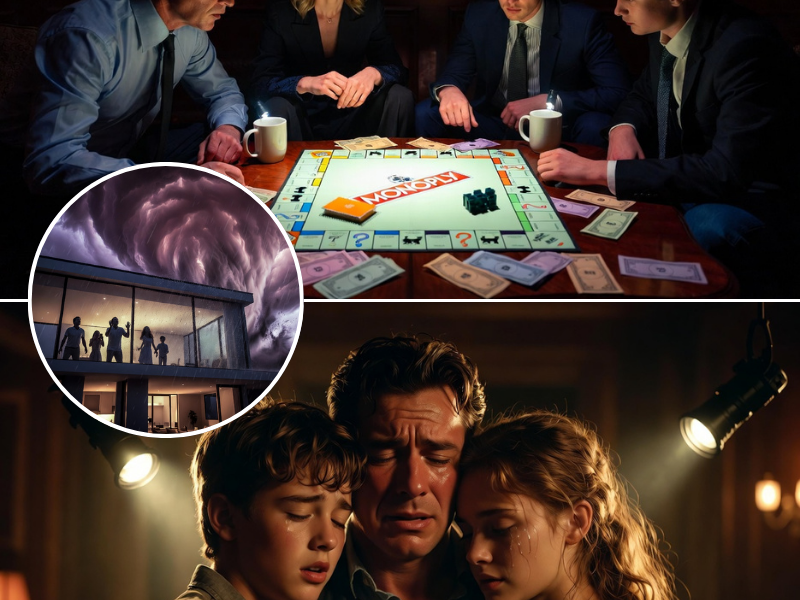
We scrambled down the dark wooden stairs into the finished basement—a space usually reserved for my wine collection and a home theater we rarely used. As the heavy door shut behind us, another deafening roar of thunder shook the foundation. We were trapped. The country club gala was gone. Our perfect Sunday was canceled.
In the pitch black of the basement, lit only by the weak beam of my phone’s flashlight, Sarah turned to me, her face pale and sharp in the shadows. “Well, David,” she said, her voice dripping with a bitter, long-dormant resentment that the storm had somehow shaken loose. “You wanted us to connect. No screens, no distractions. Now look at us. What are you going to market now?”
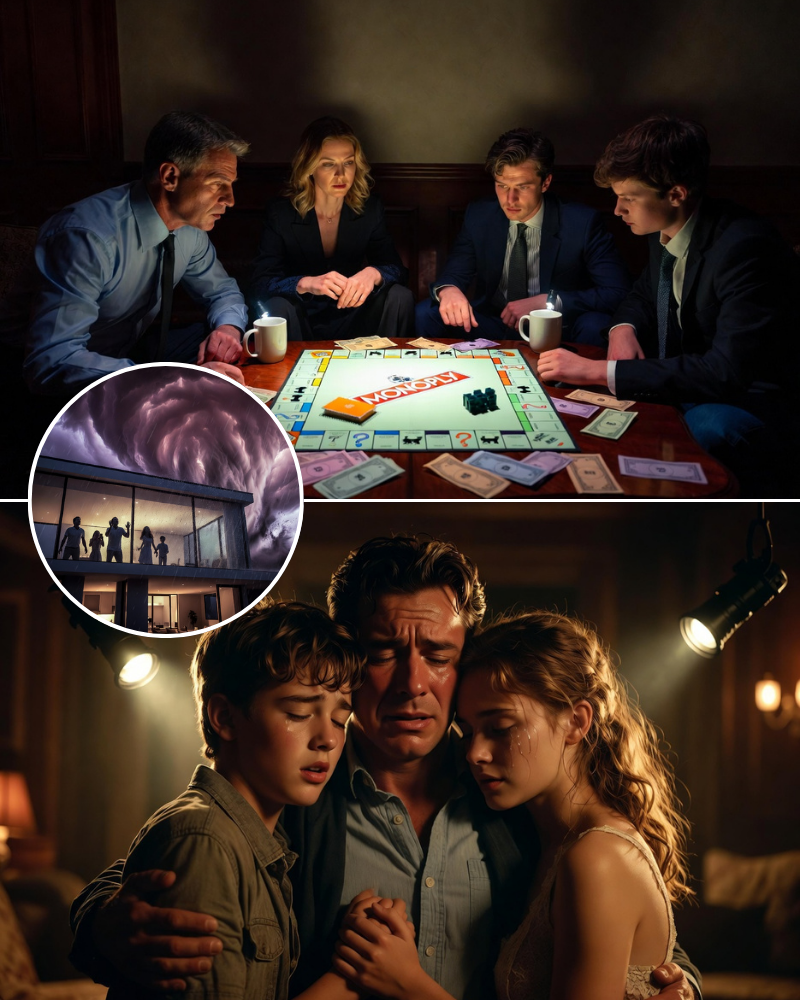
PART 2: THE ANCIENT BLUEBOARD
The storm raged above us for two hours, a relentless, roaring beast that tore shingles from our roof and uprooted the century-old oak tree at the edge of our driveway. We could hear the heavy branches scraping against the siding of the house like desperate fingers trying to get in. Inside the basement, the darkness was absolute, save for three small, dying flashlights we had managed to scavenge from the emergency kit.
The physical confinement quickly forced our internal rifts into the light. Without the distraction of their electronic devices—which had entirely lost signal—my family sat on the leather theater seats like strangers stranded in a subway station.
“I can’t believe this,” Chloe muttered, her arms tightly crossed over her chest. “My entire life is on that phone. I was supposed to live-stream the country club gala with Avery. Now I’m stuck in a cave.”
“Stop complaining, Chloe,” I said, my patience completely eroded by the loss of control over the day. “A storm is an act of God. We are safe. That’s all that matters.”
“Safe?” Tyler, my twelve-year-old son, looked up from his flashlight, his voice carrying an edge of anxiety that surprised me. “Dad, the whole house is shaking. What if the roof caves in? What if we get trapped down here forever?”
“Don’t be dramatic, Tyler,” Sarah said from the darkness. She was sitting three seats away from me, her posture rigid. “Your father has insurance for everything. Even the roof. He can always buy a new one.”
The sarcasm in her voice was a sharp blade. I swung my flashlight toward her, the beam illuminating the cold, elegant lines of her face. “What is that supposed to mean, Sarah? I didn’t cause the storm.”
“No, David, but you certainly love the disaster control, don’t you?” She turned her head toward me, her eyes flashing in the weak light. “You love managing the optics. You’re so busy insuring our life that you’ve forgotten to live it. Look at these boys. They don’t even know how to talk to you without a schedule or a sports field between you.”
“That’s unfair!” I stood up, my head nearly hitting the low ceiling of the utility space. “I work eighty hours a week to provide the life we have! This house, the club, the private schools—that doesn’t just happen by magic, Sarah!”
“We don’t want the house, Dad!” Chloe shouted, her voice cracking with an emotional depth she usually hid behind her armor of teenage indifference. “We wanted you. But you’re never actually here. Even when you’re sitting at the dinner table, you’re looking through us, checking the stock tickers on your watch.”
The truth of her words hit me like a physical blow. I opened my mouth to defend myself, to deploy the standard corporate logic I used to settle disputes at the firm, but the words died in my throat. The internal architecture of my identity—the provider, the protector, the successful patriarch—was cracking from the inside out.
Seeking an escape from the suffocating psychological weight of the conversation, I moved the flashlight beam toward the old cedar storage closets at the back of the basement. I needed a distraction, something, anything, to stop the bleeding of our family dynamic.
I yanked the heavy wooden door open, the scent of cedar and old dust rushing out. My flashlight beam cut through the clutter—old winter coats, ski boots from vacations we barely remembered, and stacks of financial documents from a decade ago. But at the bottom of a stack of old board games, my eyes caught a glimpse of a faded, blue cardboard box.
It was a 1984 edition of Monopoly. The box was battered, its corners torn and held together by yellowed Scotch tape. It belonged to my childhood, a relic from a time before I knew what a hedge fund was, back when money was just paper and winning was just a matter of rolling double sixes.
I pulled it out, blowing a thick layer of dust off the cover. “Look at this,” I said, my voice sounding hollow in the small room.
Tyler looked up, his curiosity piqued despite his fear. “What is it?”
“It’s a game,” I said, walking back over and setting the battered box on the low coffee table in the center of the seating area. “A real game. No batteries, no Wi-Fi. Just dice and paper.”
Sarah looked at the box, and for a fraction of a second, the hard, defensive lines around her mouth softened. “My god, David. I haven’t seen one of those since we were in college.”
“Let’s play,” I said, looking around at my family. It wasn’t a suggestion; it was a desperate plea for survival. “Let’s just play the game.”
PART 3: THE CAPITALISM OF THE SOUL
We sat in a circle on the plush carpet around the low mahogany coffee table, illuminated by the combined light of three flashlights propped up in coffee mugs. The ancient Monopoly board was warped in the center, a miniature mountain range running between Baltic Avenue and the Income Tax space. The paper money was crisp but yellowed at the edges, smelling faintly of my grandmother’s attic.
“I want the thimble,” Chloe said, her voice losing a fraction of its teenage cynicism as she reached for the small, pewter token. “It feels old. Like it actually belonged to someone.”
“I’m the top hat,” Tyler declared, grabbing the piece and planting it firmly on the ‘GO’ square. “Dad’s always the top hat because he thinks he’s the boss.”
“I’ll be the racecar,” I said, ignoring the small jibe. I began sorting the money, handing out the pristine, pastel-colored bills. “Four five-hundreds, one one-hundred, one fifty, one twenty, one ten, one five, and five ones. Everyone check your bank.”
Sarah took her seat across from me, choosing the silver wheelbarrow. She looked at her stack of money with a quiet, analytical expression. “You always did love being the banker, David. It’s where you feel safest—controlling the distribution of wealth.”
“It’s just a rule of the game, Sarah,” I muttered, shaking the pair of red plastic dice in my palm. The sound of the dice rattling was a sharp, percussive rhythm against the background roar of the storm outside. I rolled. A four and a five. “Nine. Connecticut Avenue. I’ll buy it.”
As the game progressed over the next hour, the cardboard map became a mirror for our family’s hidden warfare. The lightheartedness we had initially felt quickly evaporated, replaced by a tense, psychological battle where every property purchase and rent payment felt like a personal statement.
Sarah played with a ruthless, silent efficiency. She bought up the green properties—Pennsylvania, North Carolina, Pacific—and immediately began building houses. She didn’t talk; she simply collected her rent with a cold, level gaze that mirrored her emotional withdrawal over the past year.
Tyler was chaotic, buying everything he landed on until he ran out of cash, his anxiety over the game mirroring his real-life fear of failure. Chloe was conservative, hoarding her cash, refusing to trade, fiercely protecting her small corner of the board like a fortress.
And I played exactly the way I lived. I bought the utilities, the railroads, and the high-value dark blue properties: Park Place and Boardwalk. I wanted the monopoly. I wanted the complete control of the board. I wanted to build hotels that would bankrupt anyone who dared to land on my territory.
“That’s eight hundred dollars, Chloe,” I said, as her thimble landed squarely on my hotel on Park Place. My voice carried that sharp, aggressive edge I used when closing a deal at the firm. “Pay up.”
Chloe stared at her dwindling stack of bills, her lower lip trembling. “I don’t have it, Dad. I only have four hundred left.”
“Then you have to mortgage your utilities, or trade me your railroads,” I said, leaning forward. “That’s the logic of the game, Chloe. You have to pay your debts.”
“It’s just a stupid game, David!” Sarah suddenly snapped, slamming her hand down on the board, causing the houses on Marvin Gardens to scatter. “Look at you! You’re playing against your own daughter like she’s a competitor at a corporate acquisition! You’re trying to ruin her just to prove you’re the smartest man in the room!”
“I am playing by the rules!” I shouted back, the pressure cooker of the last forty-eight hours finally exploding. “The rules are what keep everything from falling apart! I didn’t create the market, I didn’t create the storm, and I didn’t create the rules of this game! But I am the one who has to manage it all so you can sit in your beautiful kitchen and complain about my hours!”
“We don’t care about the kitchen, David!” Sarah screamed, standing up, her shadow towering monstrously against the basement wall under the flashlight beam. “I don’t care about the country club! I wanted a husband! I wanted a father for my children! Do you know what it’s like to live with a ghost? To sleep next to a man who is constantly calculating the ROI on his own marriage?”
The word hung in the air like a poisonous gas: ROI. Return on Investment.
“You think I don’t feel it?” Tyler suddenly sobbed, his face buried in his hands. The twelve-year-old boy was shaking violently now, his flashlight dropping to the carpet, casting a long, chaotic shadow across the ceiling. “Every time I miss a goal in soccer, Dad looks at his watch. Every time I get a B on my report card, he asks me what my plan is for the next semester. I’m only twelve! I don’t have a plan! I just want to play!”
The silence that followed his outburst was louder than the thunder above us. The flashlights propped in the coffee mugs began to flicker, their batteries dying, casting the room into a dim, amber twilight.
I looked at my son, his shoulders shaking with raw, unadulterated grief. I looked at Chloe, who was silently wiping a tear from her cheek, her protective armor completely gone. I looked at Sarah, whose eyes were wide with a mixture of anger and deep, devastating sorrow.
The cardboard empire between us—the paper hotels, the pastel bills, the properties I had so aggressively acquired—felt utterly worthless. I had won the board, but I had completely lost my family.
PART 4: THE PROPERTY OF THE HEART
The flashlights finally died, leaving us in the thick, velvet darkness of the basement. Outside, the fury of the storm had finally begun to pass, the roaring wind dissolving into a steady, rhythmic patter of gentle rain against the foundation stones. But inside the room, the silence was the heaviest thing I had ever felt.
I sat in the dark for a long time, the cold plastic dice still clutched in my right fist. My knuckles hurt from how hard I was squeezing them.
“I’m sorry,” I whispered.
The words felt small, entirely inadequate for the structural damage I had caused over the years. But they were the only words I had left. The corporate logic, the defensive legal strategies, the financial arguments—they had all been burned away by my son’s tears.
“I’m sorry, Tyler,” I repeated, my voice cracking in the dark. I reached out blindly until my hand found his small, trembling shoulder. I pulled him close, and for the first time in three years, I didn’t offer him advice or a strategy for improvement. I just held him while he cried into my chest. “I’m so sorry. You don’t need a plan. You’re twelve. You’re my son, and you are exactly who you need to be.”
I felt a movement on my left. Chloe slid out of her seat and sat down on the floor beside us, leaning her head against my shoulder. Her hand reached out and found mine, her grip tight and desperate.
“I don’t hate you, Dad,” she whispered into the darkness. “I just… I just missed you.”
Sarah didn’t speak for a long time. In the shadows, I could hear her drawing a long, ragged breath. Then, I felt her presence move toward us. She didn’t sit on the floor, but she reached out, her hand resting gently on top of mine and Chloe’s. Her fingers were warm, the old, icy barrier between us melting in the shared vulnerability of the dark room.
“We were all performing, David,” Sarah said softly, her voice carrying a deep, unvarnished honesty that I hadn’t heard since our college days. “Not just you. I was performing the perfect wife, the perfect mother, because I was terrified of what would happen if we stopped moving. I thought if we stood still, we’d realize we had nothing left.”
“We don’t have nothing,” I said, squeezing her hand, my tears finally breaking through my own rigid armor, mixing with the dust on my face. “We have this. We have right now.”
We stayed like that for another hour, huddled together on the floor of the dark basement, listening to the rain. We didn’t talk about the country club gala, or the missed university scholarships, or the market volatility. We talked about things that didn’t cost a single dollar: the time Tyler had fallen into the pond at his grandmother’s house, the terrible song Chloe had written when she was eight, the first apartment Sarah and I had shared where the radiator clanked all night.
We laughed. Real, deep, unrestricted laughter that didn’t care about the optics or the neighbors.
When the emergency crew finally cleared the main road and restored the town’s power grid at five in the morning, the basement lights flickered back to life with a harsh, blinding brightness. We all blinked, looking at each other like survivors of a shipwreck.
The Monopoly board was still sitting on the coffee table. My hotels on Boardwalk and Park Place were still standing, dominating the dark blue properties. Sarah’s green properties were filled with houses. Chloe’s thimble was still sitting on Park Place, technically bankrupt.
Tyler looked at the board, then up at me, a small, mischievous grin appearing on his face. “So, Dad… do I still owe you eight hundred dollars?”
I looked at the paper money, then at my beautiful, messy, exhausted family. I reached out, my hand turning the entire board over, scattering the plastic hotels, the pastel bills, and the pewter tokens across the carpet in a chaotic, glorious mess.
“The bank is closed, Tyler,” I said, pulling him into a playful headlock while Chloe laughed and Sarah smiled—a real, genuine smile that reached her eyes. “The game is over. Let’s go upstairs and make some breakfast.”
The Oakhaven Country Club gala went on the following weekend, but our names weren’t on the guest list. The boosters gossiped about our absence, wondering why the partner of the firm had suddenly pulled his family away from the social circle. They thought we were falling apart. They thought our family was experiencing a crisis.
They didn’t understand that the perfect suburban Sunday had to die so that we could finally live. We lost the country club, we lost the status, and we lost the artificial perfection we had spent a lifetime building. But as I stood in my kitchen that morning, helping my son flip pancakes while my daughter argued with her mother about music, I looked at the mess on the counter and smiled.
We had lost the board. But for the first time in my life, we had finally won the game.