THE BLOODLINE IN THE BLINDSIDE: How A Forgotten Book And Three Gray Eyes Shattered A High-Society Empire
PART 1: THE BLOODLINE IN THE SQUARE
I was exactly six days away from marrying Noelle Stanton when the carefully curated illusion of my perfect life dissolved on a crisp autumn afternoon in Philadelphia.
We were walking through Rittenhouse Square. The air was crisp, smelling of fallen leaves and expensive roasted coffee. Noelle was in her element, an aristocratic vision in a tailored cream coat, her voice a melodic hum as she discussed the placement of white roses and the seating arrangements for our reception in the grand Bellevue ballroom. I was barely listening. The quiet, ordinary happiness of the families moving through the park around us felt like a foreign language—a life I had somehow missed while climbing the ruthless ladder of corporate succession.
Then, Noelle’s hand suddenly tightened on my arm. Her grip became white-knuckled, her elegant stride breaking as she tried to sharply steer me across the cobblestone street.
“Let’s go this way, Evan,” she said quickly, her eyes darting toward the fountain. “The light is better for a walk down Walnut.”
I followed her frantic gaze instead. And there, standing by the edge of the grass, was Rachel.
It had been four long years. Rachel looked thinner now, her face bearing the faint, shadowed lines of exhaustion, looking older than the vibrant woman I had loved and lost. Her dark hair was twisted into a rushed, messy knot at the nape of her neck, and her hands were locked firmly around the handlebar of a wide, industrial-sized gray stroller.
Three children sat beneath the shared canopy. Triplets. They were roughly the same age, bundled in matching faded blue jackets.
As I froze, the little girl sitting in the middle turned her head. She looked straight at me and smiled.
My lungs emptied. Her eyes were not simply similar to mine; they were an exact, terrifying genetic mirror. They possessed the same rare, piercing cold-gray color, the same distinct dark ring encircling the iris, and even the slight, faint break in the left eyebrow—a scar from a childhood fall that I carried to this day.
An impossible, suffocating thought formed in my mind, locking my joints.
Rachel looked up. She recognized me instantly. But she didn’t look at me with the guilt of an ex-lover who had moved on; she looked past me at Noelle, and her face drained of all color. What crossed her features was pure, unadulterated fear. Without uttering a word, Rachel spun the heavy stroller around and began pushing it toward the opposite side of the park, moving as fast as she could without causing the children to panic.
“Rachel!” I called out, my voice cracking the quiet afternoon air.
“Evan, stop it!” Noelle hissed, grabbing my jacket with both hands, her fingernails digging through the wool. “Don’t you dare humiliate us in public. Walk away.”
That word stopped me for half a second. Us.
I hadn’t accused Noelle of anything. I hadn’t even voiced the maddening realization spinning in my head. Yet, she had instantly positioned her body between me and Rachel, her eyes flashing with a defensive panic that told me she already understood exactly what I was about to discover.
A society photographer near the fountain lifted his camera, recognizing the prominent faces of the Stanton-Vance merger. Noelle shifted her posture subtly, instantly playing the part of the devoted, wounded bride trying to hold back a reckless, unhinged fiancé.
I pulled myself free from her grip and ran after Rachel. People turned to stare, their whispers trailing behind me like dry leaves.
By the time I reached the edge of the park, Rachel had already vanished into the thick crowd near the subway entrance. But in her haste, her diaper bag had struck the metal frame of the stroller. An old, crumpled envelope had slipped out, sliding across the concrete.
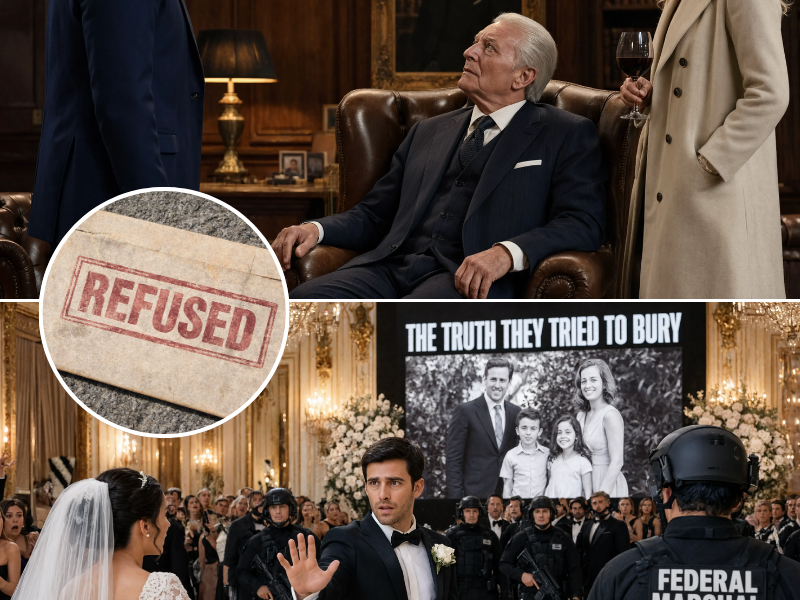
I picked it up. My name was written across the front in a messy, hurried handwriting I knew by heart. Stamped across the center in dark, indelible red ink was a single word: REFUSED. Below it ran a faded blue postal routing code from four years ago.
With trembling fingers, I tore the envelope open. Inside was a black-and-white sonogram image and a letter dated days before Rachel had completely vanished from my life.
The first line read: The doctor found three heartbeats, Evan. I am terrified. I need to see your face before I decide what comes next. Please don’t hate me.
I read the sentence twice, the little girl’s gray eyes burning into my memory.
“That letter proves nothing,” Noelle’s voice cut through the noise of the street. She had caught up to me, her breathing shallow, her eyes fixed on the paper in my hands.
I slowly turned to look at her. The air between us grew freezing cold. “I haven’t read it out loud, Noelle. I never told you it was a letter.”
Noelle stiffened, her aristocratic composure fracturing for a fraction of a second before she recovered. “I made an assumption, Evan. It’s obvious. Your unstable ex-girlfriend is clearly staging a scene to ruin our wedding week. She wants money.”
I didn’t argue with her. I didn’t raise my voice. The silence inside my chest was absolute. I simply folded the letter, slipped it into the breast pocket of my coat, and walked away, leaving my fiancée standing alone on the sidewalk.
By the time I reached my apartment, the photograph from the park was already circulating on the city’s premier society blogs. Noelle’s publicist had worked with terrifying speed; a formal statement had already been released, calling the children “innocent” and requesting privacy for a “highly sensitive, private family matter.”
It was brilliant PR. It made Noelle look like a compassionate, magnanimous saint before anyone even knew the truth. It also implicitly framed Rachel and me as the volatile, scandalous threats to Noelle’s perfect, impending wedding.
I walked into my study, unlocked the heavy iron safe in the corner, and pulled out a small black lacquer box. Inside lay the only thing I had left of Rachel—the breakup letter she had supposedly sent me four years ago.
That second letter had been cold, detached. It stated she had chosen another man, warned me never to contact her again, and claimed that any future stories about a pregnancy would be nothing but lies to extort my family. For four years, that letter had been the anchor of my resentment. The handwriting looked identical to the one in my coat pocket, down to the fluid curve of the signature.
I took both letters, got into my car, and drove straight to the modest apartment of Rachel’s sister in South Philadelphia.
When the door opened, Rachel was there, standing in the cramped hallway, still wearing her worn sneakers. She didn’t let me speak. I simply walked past her, laid both letters side by side on the laminate kitchen table, and pointed at them.
Rachel didn’t sit down. She lifted the cold breakup letter toward the window, the grey afternoon light illuminating the ink. She studied the signature, her hands beginning to tremble so violently the paper rattled. Then, she looked up at me, her eyes flashing with a quiet, lethal anger that was infinitely colder than shouting.
“Evan,” she whispered, her voice shaking with four years of buried agony. “I never wrote this. I never sent this to you.”
PART 2: THE ARCHITECTURE OF A LIE
The small kitchen became an isolation chamber. Outside, the distant rumble of the city continued, but inside, the air was thick with the realization of a stolen lifetime.
“If you didn’t write this,” I said, my voice barely above a whisper, “then who did?”
Rachel dropped the forged letter onto the table, her silver-gray eyes—the exact match of the children sleeping in the adjacent room—staring at me with a raw, bleeding intensity. “I waited for you at the diner on 4th Street for three days, Evan. I sent that sonogram to your apartment by certified mail. It came back a week later with that horrible red stamp. Refused. Your father’s assistant called me the next morning. She told me that if I ever tried to contact you again, your family’s legal team would ensure my sister lost her residency at the hospital. They said you knew about the babies, and that you had called them an ‘expensive mistake’.”
A sickening wave of nausea washed over me. My father. My family’s firm, Vance & Sons. Four years ago, we were on the verge of bankruptcy, surviving entirely on the brink of collapse until the Stanton family offered a lifeline—a massive corporate merger disguised as a high-society marriage between Noelle and me.
“I never saw that mail, Rachel,” I said, the words feeling heavy and useless against the gravity of what had been done. “I swear to you, I never knew. My father… he told me you had cleaned out your apartment and moved to California with someone else. He handed me this breakup letter himself.”
“And you believed him?” she spat, the tears finally breaking through her defensive wall. “You knew how much I loved you, Evan! But you chose the company. You chose the legacy.”
“I chose what I thought was the truth!” I shouted, the control I had maintained for years finally snapping. I slammed my fist onto the table, rattling the coffee mugs. “I lived in hell for four years thinking you hated me! I sat in boardrooms and negotiated contracts while my own children were being born in secret? Do you think I wanted this sterile, suffocating life?”
Rachel turned her face away, her shoulders shaking as she wept quietly. “It doesn’t matter what you wanted, Evan. It’s done. Look at the news. Noelle’s publicist is already turning my kids into a media circus. They’re calling them ‘bastards’ on the forums. They’re using my family to make her look like a saint.”
I stood up, the internal architecture of my life—the duty to the firm, the respect for my father, the upcoming wedding—completely collapsing into ash. “Who signed the refusal stamp, Rachel? Do you have the original receipt?”
She walked over to a drawer, her movements robotic, and pulled out a faded carbon copy of the certified mail receipt from four years ago. I snatched it from her hand and looked at the signature line next to the REFUSED box.
It wasn’t my father’s handwriting. It wasn’t his assistant’s either.
It was a sharp, elegant, slanted signature with a distinct flourish at the end of the ‘S’.
Noelle Stanton.
She hadn’t just discovered the secret recently. She had been the architect of the wall built between me and my children before the ink on our engagement contract was even dry.
My phone vibrated in my pocket. It was a text from my father: Come to the estate immediately. Bring the papers you took. We need to contain this before the market opens tomorrow.
I looked at Rachel. I looked toward the bedroom door, where the faint sound of a child’s soft cough echoed through the apartment.
“Stay here,” I told her, my voice dropping into a register of absolute, cold finality. “Don’t talk to the press. Don’t answer the door for anyone.”
“What are you going to do, Evan?” she asked, her eyes wide with fear.
“I’m going to go see the people who stole my life,” I said, pulling my coat tight around my chest. “And I’m going to burn their house down.”
PART 3: THE COLD CALCULUS OF A BRIDE
The Vance family estate in Main Line was a fortress of limestone and old money, surrounded by perfectly manicured hedges that looked like prison walls in the dark. When I pushed past the butler and entered the grand library, the air smelled of premium scotch and cigars.
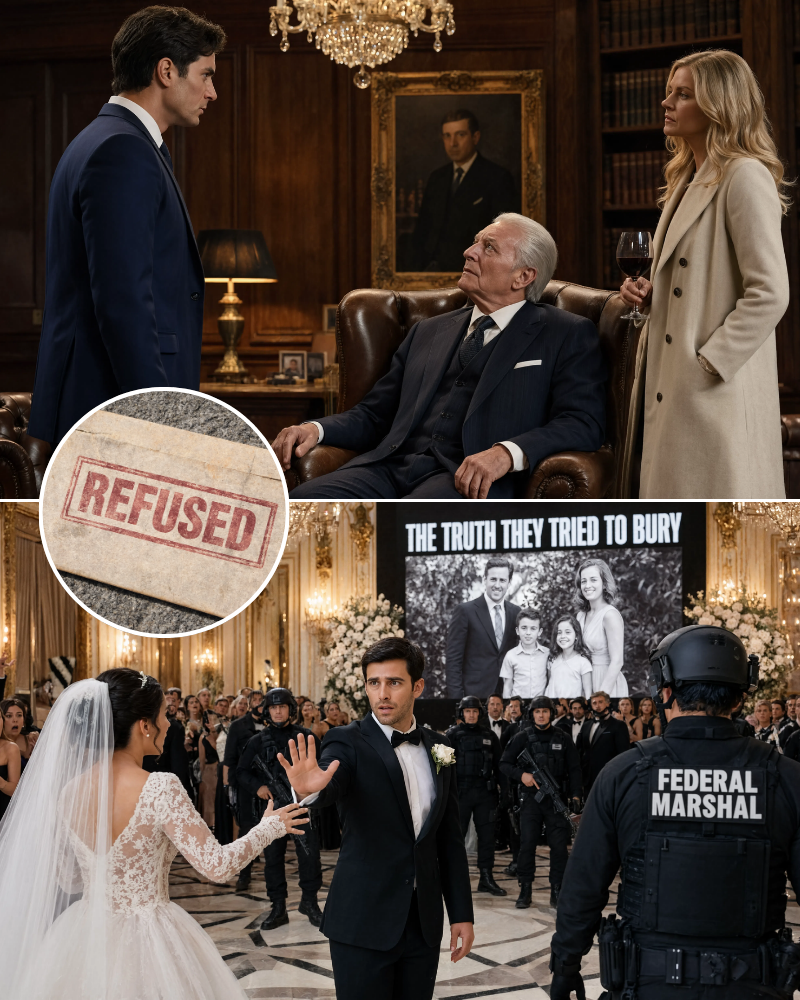
My father, Charles Vance, sat in his leather armchair, his face etched with the stern, unforgiving authority that had governed my entire existence. Noelle sat opposite him on the velvet sofa, a glass of white wine in her hand, her posture as flawless as it had been in the park. Her publicist, a sharp-faced woman named Victoria, was pacing the Persian rug, talking rapidly into a Bluetooth earpiece.
“Sit down, Evan,” Charles commanded, not looking up from his financial tablet. “The stock is down two points after-hours because of that ridiculous photograph. Victoria is handling the narrative, but we need you to sign this clarified pre-nuptial agreement before midnight.”
I didn’t sit. I walked to the center of the room and tossed the two letters, along with the certified mail receipt, onto the mahogany desk directly in front of my father.
“Look at the signature, Charles,” I said, omitting the word ‘Father’ entirely.
Charles glanced at the receipt, his eyes narrowing slightly, but his expression remained completely unchanged. He didn’t even blink. “We did what was necessary to preserve the merger, Evan. You were infatuated with a girl from a nobody family. She would have ruined your focus, ruined the firm’s reputation, and cost us the Stanton capital. We saved you from yourself.”
“You stole my children,” I whispered, the sheer monstrousness of his casual admission vibrating through my bones.
“They are an administrative complication,” Noelle cut in, her voice cool, smooth, and entirely devoid of empathy. She took a slow sip of her wine and looked up at me. “Let’s be realistic, Evan. You didn’t know they existed, so you didn’t lose anything. We are six days away from the biggest merger in the state’s recent history. I’ve spent two years planning this wedding. I am not letting some low-class girl from South Philly ruin my life.”
I turned to look at the woman I was supposed to marry. Her beauty felt skeletal now, a hollow shell masking a terrifying vacuum of a soul. “You signed the refusal stamp, Noelle. You forged her breakup letter. You knew she was pregnant with triplets, and you locked her out.”
“I protected my investment,” Noelle said, standing up, her cream coat catching the lamplight. She walked over to me, her eyes drilling into mine. “Yes, I intercepted the mail. Yes, I paid a professional to mirror her handwriting. Because you belonged to me, Evan. Your name, your position, your future—it was all bought and paid for by the Stanton group. Do you honestly think anyone will care about this four-year-old sob story once we control forty percent of the regional market?”
“I care,” I said.
“Then you’re a fool,” she hissed, her civilized facade finally cracking to reveal the ruthless corporate predator underneath. “Look at the narrative Victoria just put out. The city loves me. I am the graceful bride-to-be dealing with her fiancé’s complicated past. If you try to back out now, we will pull every dollar of liquidity out of Vance & Sons by Monday morning. Your father will go to prison for the structural deficits we covered, and I will personally ensure that your little street-girl is tied up in custody battles she can’t afford until she’s bankrupt. You will stay in line, Evan. You will put on that tuxedo, you will walk down that aisle at the Bellevue, and you will smile for the cameras.”
My father nodded in agreement from his chair. “She’s right, son. The calculus is simple. You have no choice.”
I looked at the two of them, the architects of my gilded cage. I felt a strange, sudden lightness in my chest—the profound relief of a man who had finally seen the bottom of the abyss and realized he no longer feared the fall.
“You’re right,” I said, my voice dropping into a calm, level register that seemed to make Noelle blink in confusion. “The calculus is very simple.”
I reached down, picked up the forged letters and the receipt, and slipped them back into my coat.
“I’ll see you at the Bellevue, Noelle,” I said softly, turning toward the door.
“Smart boy,” Charles muttered, pouring himself another scotch.
They thought they had won. They thought my silence was submission. They didn’t understand that a man who has lost four years of his children’s lives has absolutely nothing left to lose.
PART 4: THE LIQUIDATION AT THE ALTAR
The Grand Ballroom of the Bellevue Hotel was a sea of glittering diamonds, white roses, and the soft, rhythmic hum of a live string quartet. It was the social event of the season. Three hundred of the East Coast’s elite sat in the gilded chairs, their murmurs filling the vast space beneath the crystal chandeliers.
I stood at the altar, wearing the bespoke black tuxedo Noelle had chosen for me. My hands were folded in front of my body, my expression neutral.
Across the room, the heavy double doors swung open.
The crowd stood as the orchestra shifted into the wedding march. Noelle stepped into the aisle, a breathtaking vision in a custom Vera Wang gown of French lace, her long silk veil trailing behind her like a royal shroud. She walked with the absolute confidence of a conqueror, a triumphant smile pinned to her face as the society cameras flashed from the balconies.
Beside me, my father stood as the best man, his chest expanded with pride, leaning in to whisper, “Well done, son. The market opens in an hour. We’re safe.”
I didn’t answer him. I watched Noelle reach the altar. Her father handed her to me, and as she took my hands, she leaned in slightly, her eyes glittering with victory behind the sheer lace of her veil. “See?” she whispered. “I told you I always win.”
The priest began the liturgy, his voice droning on about commitment, legacy, and honor. Every word felt like a farce, a hollow joke echoing through a cathedral of lies.
“If any person can show just cause why these two may not lawfully be joined together,” the priest read, his voice filling the cavernous room, “let them now speak, or else hereafter forever hold their peace.”
The standard, ceremonial pause followed. The room was perfectly still, waiting for the silence to pass so the vows could begin.
“I can,” I said clearly.
The microphone clipped to my lapel carried my voice into every corner of the grand ballroom.
The priest froze, his book dropping an inch. A collective, sharp gasp rippled through the three hundred guests. Noelle’s smile didn’t fade instantly; it hardened, turning into a rigid, terrified mask.
“Evan,” my father hissed from behind me, his hand reaching out to grab my shoulder. “What the hell do you think you’re doing?”
I stepped back from the altar, pulling my hands away from Noelle’s grip. I gestured toward the tech booth at the back of the balcony, where my mother’s former head of security was currently sitting at the media console.
“Turn on the screens,” I commanded.
The massive digital projector screens on either side of the altar—which were supposed to display a romantic montage of our courtship—flickered and died. A second later, they illuminated in blinding, high-definition clarity.
It wasn’t a photo of Noelle and me. It was a giant, high-resolution scan of the certified mail receipt from four years ago, with Noelle’s distinctive, slanted signature magnified for every donor, board member, and journalist to see. Next to it appeared the professional graphologist’s report, detailing the exact methodology used to forge Rachel’s handwriting on the breakup letter.
And in the center of it all was the sonogram—the three tiny, undeniable heartbeats that the Stanton family had tried to erase from existence.
“What is this?” a senior board member shouted from the front row.
“This,” I spoke into the microphone, my gaze locked onto Noelle’s pale, trembling face, “is the contract of our marriage. It’s a record of forgery, harassment, and the systematic theft of my children’s lives.”
“Turn it off! Cut the power!” Charles roared, lunging toward the audio deck, but he was instantly blocked by two men who had quietly entered through the back doors—federal investigators from the SEC, accompanied by Naomi Bell.
“Don’t touch the equipment, Charles,” Naomi announced, her voice booming through the secondary speakers. “We’ve spent the last forty-eight hours filing the paperwork. The Stanton group’s emergency liquidity has been flagged as a fraudulent asset transfer intended to cover the structural deficits of Vance & Sons. The federal freeze went live ten minutes ago.”
The ballroom erupted into absolute, unbridled chaos. Guests stood up from their chairs; reporters rushed the stage, their cameras flashing frantically as Noelle’s father began shouting at my father, their multi-million-dollar alliance disintegrating into a public, screaming match.
Noelle ripped her veil off her face, her eyes wild with a mixture of rage and ruin. “You ruined us!” she shrieked, her voice cracking over the sound of the panicked crowd. “You threw away your entire career! You have nothing left, Evan! You’re broke! You’re finished in this city!”
I looked down at her, the expensive lace of her dress already trailing in the dust of the stage. I felt no anger left in me. Only a vast, clean expanse of freedom.
“I have my children, Noelle,” I said quietly, unclipping the microphone from my lapel and letting it drop to the floor with a heavy, hollow thud. “And you can keep the money.”
I turned my back on the shouting tycoons, the flashing cameras, and the entire gilded world I had spent thirty years trying to please. I walked down the center aisle of the Bellevue ballroom, my stride long and untroubled, the crowd parting before me like the Red Sea.
As I pushed through the heavy glass exit doors and stepped out into the crisp, cool Philadelphia air, I tore the black silk bowtie from my neck and threw it into the gutter.
Thirty minutes later, I walked back into the quiet square of Rittenhouse. The autumn wind was blowing leaves across the empty grass. I walked past the fountain, past the benches, and headed straight toward the small apartment in South Philly.
I didn’t have a corporate title anymore. My bank accounts were tied up in the legal fallout of my family’s collapse, and the name Vance was currently trending on every financial news network in the country. But as I reached the building, climbed the worn wooden stairs, and knocked on the door, my heart was beating with a steady, living rhythm I had never felt before.
The door opened. Rachel stood there, her eyes wide as she looked at my untied collar and my bare hands.
Behind her, in the hallway, the little girl with my gray eyes and my broken eyebrow was awake, holding an old teddy bear, looking out at the world with curiosity.
“Evan?” Rachel whispered.
“The bank is closed, Rachel,” I said, a genuine, tired smile finally breaking across my face as I stepped inside, shutting the door on the gilded cage forever. “I’m home.”