I Bought A $40 Antique Book on Beacon Hill—And Accidentally Unlocked My Gilded Family’s Multi-Billion-Dollar Murder Secret.
THE WHISPER OF THE PAPER TOMB
PART 1: THE ASHES OF VIVIENNE
They say the dead bury their dead, but in New England, we bury them in leather-bound books and trust funds.
It was a miserable, rain-slicked Tuesday in Boston when I stepped into The Penitent’s Page, a claustrophobic antiquarian bookshop tucked away in the gas-lit shadows of Beacon Hill. The air inside smelled of rotting paper, damp wool, and the slow, quiet decay of history. I wasn’t looking for anything specific—just a sanctuary from the freezing rain and the relentless, suffocating pressure of my family’s expectations. Being a Sterling meant carrying a name gilded by generations of old money, political influence, and an unblemished reputation. But to me, it felt like carrying a gilded corpse.
My fingers brushed along the spine of a massive, 1928 edition of The Count of Monte Cristo, bound in cracked morocco leather with tarnished gold tooling. It looked exhausted, abandoned. I bought it for forty dollars from a blind shopkeeper who didn’t even bother to look up when the brass bell chimed my departure.
It wasn’t until I returned to my brownstone, poured a double neat of scotch, and opened the heavy cover that I felt the anomaly. The back cover was too thick. A subtle, structural stiffness that shouldn’t have been there. With a pocketknife and a racing pulse, I carefully sliced through the aged marbled endpaper.
A hidden compartment. And inside, wrapped in black silk, lay a single silver-gelatin photograph and a letter yellowed by decades of confinement.
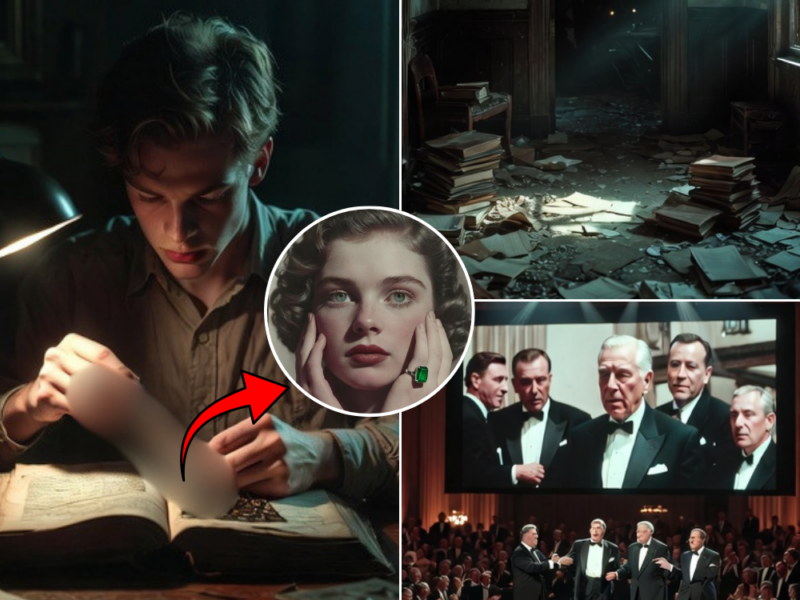
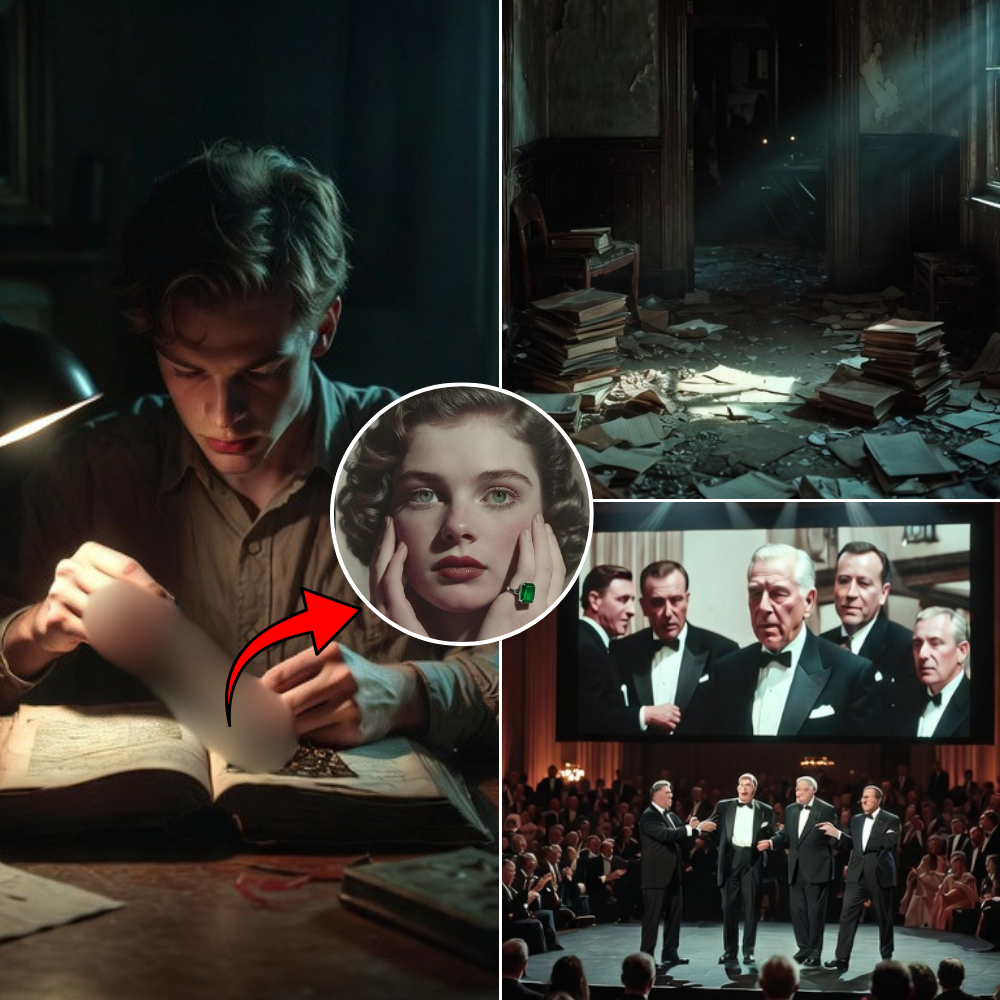
I pulled the photograph out first. My breath caught in my throat. A young woman in her early twenties stared back at me, frozen in a stark, black-and-white 1950s contrast. She was breathtaking—sharp cheekbones, a defiant tilt of the chin, and a pair of piercing, unmistakable silver-gray eyes. My eyes. The exact, uncanny gaze that mirrored my own in the glass every morning. But it was the vintage Cartier tennis bracelet on her wrist that made my blood turn to ice. It was the identical piece currently resting in my mother’s jewelry safe, supposedly a family heirloom passed down through a lineage that never included this woman.
My mother, Eleanor, had always maintained that her own mother, Vivienne, had died in a tragic, catastrophic fire at the family’s summer estate in Maine back in 1965, long before I was born. There were no photos of her. “The fire took everything, Julian,” my mother would always say, her voice dropping into that rehearsed, icy cadence she used whenever the past threatened to intrude. “We do not dwell on the ashes.”
My hands shook as I unfolded the letter. The ink was a faded, elegant midnight blue fountain pen script. The date at the top read: October 14th, 1968.
Three years after the fire.
“My dearest Eleanor,” the letter began, the elegant cursive trembling slightly across the linen paper. “If you are reading this, it means Arthur has finally gone to the grave he dug for me, and someone has found the strength to dismantle his lies. They told you I died in the flames at Cliff House. They lied to you, my darling girl. Your father didn’t lose me to the fire. He set the fire to burn away my name, so that he could lock me within the white walls of Blackwood Sanitarium under a stolen identity. He took my sanity because I discovered how the Sterling fortune was truly baptized—in the blood of his business partner. Do not trust the family wealth, Eleanor. It is a debt paid in human souls. And remember, the woman who raised you after the fire… she is not your aunt. She is—”
Suddenly, my phone on the desk erupted into a loud, jarring ring. The caller ID flashed a name that made the room turn cold: Eleanor Sterling. My mother.
I picked it up, my heart hammering against my ribs like a trapped bird. “Hello, Mother.”
“Julian,” her voice came through the line, sharp, aristocratic, and instantly demanding. “Where have you been? Your father and I have been waiting at the club for forty minutes. Mr. Harrison is here from the firm, and he expects to discuss your transition into the senior partnership tonight. Do not tell me you’ve forgotten.”
I looked down at the photograph of the woman with my eyes. I looked at the red lipstick text of a dead woman writing from a living tomb.
“I haven’t forgotten, Mother,” I said, my voice dangerously calm, the internal logic of my entire reality shattering into a million jagged pieces. “But before I come to the club, I need to ask you a question. Tell me about the fire in 1965. Tell me exactly who died in that house.”
There was a sudden, heavy silence on the line. I could hear the distant clinking of crystal glasses and the murmur of high society from her end, but between us, the air grew dead.
“Julian,” my mother whispered, her tone dropping into a freezing, razor-sharp hiss I had never heard before. “Where are you right now, and what exactly have you found?”
Part 2: The Architecture of Silence
The grand dining room of the Somerset Club was an exercise in old-money opulence. Oil paintings of long-dead patriarchs lined the mahogany walls, their painted eyes staring down at the current generation of vultures. When I walked in, still holding the leather-bound book inside my briefcase, the air felt thick with deception.
My mother sat at the center table, her posture rigid, her pearls gleaming like rows of tiny, cold teeth. My father, Arthur Sterling III, was deep in conversation with a senior partner, his laughter loud, boisterous, and entirely hollow.
As I sat down, the waiter immediately poured a glass of Cabernet, but I didn’t touch it. I stared directly at my mother.
“You’re late, Julian,” Eleanor said, not even looking up as she sliced her filet mignon. “Mr. Harrison had to leave for another engagement. You missed a critical opportunity to secure your seat at the table.”
“I think I found a different table, Mother,” I said softly, leaning forward.
Graham, my older brother who had always been the golden boy of the family firm, let out a short, dismissive chuckle. “Still playing the brooding intellectual, Julian? You’re thirty years old. It’s time to stop browsing dusty bookshops and start billing hours.”
“Shut up, Graham,” I said, my voice deadpan.
The table went quiet. Arthur lowered his glass, his eyes narrowing into two slits of cold fury. “Watch your tone, boy. You are speaking to your brother in public.”
“And I’m speaking to my mother about a woman named Vivienne,” I replied, placing my hands flat on the white linen tablecloth.
I watched the exact millisecond the aristocratic veneer fractured on my mother’s face. Her fork rattled against the porcelain plate. Her eyes, usually so controlled, widened in a flash of pure, unadulterated terror. She looked at Arthur, a silent, desperate communication passing between them.
“We do not speak that name in this family,” Arthur said, his voice dropping into a low, rumbling growl that had intimidated judges and politicians for forty years. “Your grandmother died in a tragic accident. It is ancient history. Leave it in the ground.”
“She didn’t die in the ground, Father,” I said, leaning closer, my heart thumping wildly but my voice remaining as cold as stone. “She died in Blackwood Sanitarium. In 1968, she was still alive. Three years after you held a funeral for an empty casket.”
Eleanor slammed her napkin onto the table, standing up so abruptly her chair scraped loudly against the hardwood. “Excuse us, gentlemen,” she said, her voice trembling despite her best efforts to contain it. “Julian, come with me. Now.”
She led me into the private conservatory at the back of the club, a glass-walled room filled with exotic orchids and the steady, rhythmic patter of rain against the ceiling. The moment the heavy oak doors shut behind us, she turned on me, her face contorted with a mixture of rage and panic.
“Where did you get that name?” she hissed, her fingers gripping her Chanel handbag so tightly the leather creaked. “Who have you been talking to?”
“I bought a book, Mother,” I said, opening my briefcase and pulling out the yellowed letter, keeping it just out of her reach. “A book containing a letter written by your mother. To you. Except you never got it, did you? Because Grandfather intercepted it. Or maybe… maybe you did get it. Maybe you knew the whole time.”
Eleanor stared at the elegant cursive of her mother’s handwriting, and for a second, she looked entirely small, stripped of the Sterling armor. “You don’t understand the world we live in, Julian,” she whispered, her voice cracking. “You think the truth is a beautiful thing? The truth is a bomb. If people find out what your grandfather did to build this firm, the lawsuits alone will liquidate every asset we own. The name Sterling will become synonymous with fraud and murder.”
“So you traded your own mother’s freedom for a trust fund?” I asked, disgust rising in my throat like bile. “She was locked in an asylum, Eleanor! Alive! Calling out for you!”
“I was twenty years old!” she screamed, her voice echoing off the glass walls. “My father told me she had lost her mind! He told me she was dangerous! By the time I found out the truth, she was already gone. He had her legally erased, Julian! There was nothing I could do except protect the family that remained.”
“And the woman who raised you?” I asked, recalling the final, unfinished sentence of the letter. “The woman I called ‘Grandmother’ my entire childhood? Who was she?”
Eleanor looked away, her jaw trembling, staring out into the rain-drenched gardens. “She was Arthur’s mistress,” she whispered. “The daughter of the business partner he ruined. He didn’t just take his money, Julian. He took his daughter, renamed her, and put her in my mother’s bed to keep her silent.”
I stepped back, horrified by the absolute, systemic depravity of the legacy I was supposed to inherit. “You’re all monsters,” I whispered.
“We are survivors,” Eleanor snapped, her aristocratic mask snapping back into place, her eyes turning back into two chips of ice. “And you will keep this silent, Julian. Because if you ruin this family, you ruin yourself. You have thirty minutes to destroy that letter and come back to the table, or I will ensure you are cut off from the estate entirely. Not a dime. Not a house. Nothing.”
She turned and walked out, the click of her heels sounding like the ticking of a countdown clock. I stood alone among the orchids, holding the dead woman’s words, realizing that the architecture of silence was much larger than I had ever imagined.
Part 3: The Ghost of Blackwood
The drive to the ruins of Blackwood Sanitarium took four hours through the desolate, fog-shrouded hills of western Massachusetts. It had been abandoned in the late 1980s, left to rot after a series of state investigations into patient abuse. Now, it stood like a gothic fortress of decaying brick and shattered glass, swallowed by overgrown ivy and dark, oppressive pine trees.
I killed the engine of my car and sat in the silence, the worn football-sized book resting on the passenger seat. The letter had mentioned a specific location within the records room—a hidden safe behind the old superintendent’s office. If my grandfather had used his immense wealth to erase a woman from existence, he would have kept the receipts. Men like Arthur Sterling never destroyed their leverage; they just hid it where no one would dare look.
I forced open a rusted basement window, the scent of mildew and stagnant water instantly hitting my lungs. My flashlight beam cut through the heavy gloom, illuminating peeling green paint and old gurneys rusted to the floorboards. It felt like walking into a mass grave of forgotten souls.
It took me an hour to find the administrative wing. The floorboards groaned beneath my boots, every sound amplified in the vast, empty corridors. When I reached the superintendent’s office, I found it ransacked—file cabinets overturned, papers scattered like autumn leaves. But I wasn’t looking for the obvious files.
I approached the heavy oak paneling behind the dilapidated desk. I began tapping the wood, listening for the hollow echo. Thud. Thud. Hollow.
With the crowbar I’d brought, I pried the wood away. Splinters flew into the dark air, revealing a small, rusted iron wall safe. It had no combination lock—just a heavy, vintage keyhole. I reached into my pocket and pulled out the small brass key that had been taped to the back of the photograph I found in the book.
I inserted the key. It resisted for a second, decades of grime fighting against the mechanism, before turning with a loud, satisfying click.
The heavy iron door swung open. Inside lay a single, thick manila folder stamped with a word that made my skin crawl: CLASSIFIED – INVOLUNTARY CONFINEMENT.
I opened it under the beam of my flashlight.
Patient Name: Jane Doe #409.
Admission Date: November 12, 1965.
Admitting Physician: Dr. E. Vance (funded by Sterling Holdings).
Real Identity: Vivienne Sterling.
Page after page of medical reports detailed the systematic administration of heavy sedatives and experimental shock therapies. She wasn’t insane. The early reports clearly stated: “Patient demonstrates high cognitive function, persistent lucidity, and continues to assert her true identity as the wife of Arthur Sterling. Recommend increased dosage of Thorazine to suppress delusional narratives regarding corporate malfeasance.”
“You shouldn’t have come here, Julian.”
I spun around, my flashlight beam catching a figure standing in the doorway. It was Graham. He stood there in his expensive cashmere coat, his hands buried deep in his pockets, flanked by two burly men in dark suits—the private security firm my father kept on retainer.
“How did you find me, Graham?” I asked, keeping my voice low, my fingers gripping the manila folder tightly against my chest.
“Mother called me the second you left the club,” Graham said, stepping into the room, his boots crunching on the shattered glass. “She knew you wouldn’t destroy the letter. You always were the righteous one, Julian. The poet. The boy who thought truth mattered more than power.”
“She was our grandmother, Graham!” I shouted, the horror of the files vibrating in my voice. “Look at this! They lobotomized her with drugs to keep her from telling the police that Grandfather murdered his partner! They kept her here for twenty-three years until she died alone in a room that smelled like industrial bleach!”
“I know,” Graham said flatly.
I froze. “You knew?”
“Of course I knew,” Graham said, taking a slow, calculated step toward me. “Father told me when I turned twenty-five. It’s the price of admission into the inner circle, Julian. Every great American empire is built on a crime. The Rockefellers, the Carnegies, the Sterlings. We don’t apologize for the foundation; we just live in the mansion.”
“He killed a man, Graham. He locked his wife in a madhouse.”
“And he built a multibillion-dollar firm that employs thousands of people, funds universities, and pays for the roof over your head,” Graham hissed, his professional veneer finally cracking to reveal the cold, predatory ambition underneath. “Give me the folder, Julian. If you walk out of here with those papers, the federal prosecutors will dismantle Luma House by Monday morning. The stock will crash to zero. The family name will be destroyed. Everything we are, everything we own, gone.”
The two security men stepped forward, their shoulders broad, their faces expressionless.
“And if I refuse?” I asked, my heart hammering against my ribs, my eyes darting toward the broken window behind the desk.
“Then you don’t leave this building,” Graham said softly, his voice dropping into a chilling, absolute certainty. “And my father will write a very touching statement about how his youngest son, tragic and unstable, wandered into an abandoned asylum and suffered a fatal fall. Just like his grandmother.”
I looked at my brother, the golden boy, the future senator, realizing that the sickness hadn’t ended with my grandfather. It had passed down through the bloodline, pure and toxic.
I clutched the folder to my chest, took a deep breath, and made my choice.
Part 4: The Final Liquidation
The Grand Ballroom of the Plaza Hotel was a sea of glittering diamonds, champagne towers, and the soft, rhythmic hum of a string quartet. It was the Oakhaven Centennial Gala, the grandest social event of the decade. Every major political figure, CEO, and journalist in the state was in attendance to celebrate eighty years of the Sterling Family Foundation.
At the head table, my father sat like a king on his throne, his silver hair perfectly coiffed, his chest expanding with pride as he accepted congratulations from a passing senator. Eleanor sat next to him, her face a rigid, beautiful mask of high-society perfection. Graham stood to the side, sipping scotch, his eyes constantly scanning the entrance doors. They thought they had contained the fire. They thought I was buried in the dark woods of the Berkshires.
At precisely 8:30 p.m., the heavy double doors at the main entrance swung open.
The whispers began instantly. I walked down the center aisle of the ballroom, still wearing my mud-splattered boots, my dark jeans, and a tattered tweed jacket. I looked like a ghost that had wandered into a royal court. In my right hand, I carried the heavy, weathered copy of The Count of Monte Cristo. In my left, I held the thick, classified manila folder from Blackwood Sanitarium.
Richard stood up from the head table, his face turning an ugly shade of purple. “Julian,” he hissed, stepping forward to intercept me before I reached the VIP section. “What is the meaning of this? Get out of here. You are embarrassing this family.”
“The family embarrassed itself sixty years ago, Father,” I said, my voice calm, carrying over the music through the sheer force of its stillness.
I bypassed him entirely, walking straight toward the main stage where the large projector screen was currently displaying a digital slideshow of the family’s historical achievements. The master of ceremonies tried to step in front of the microphone, but I pushed past him, my grip firm.
“Ladies and gentlemen,” I spoke into the microphone. The feedback shrieked once, silencing the entire room of two hundred elite guests. The string quartet stopped playing. “Welcome to the real Sterling legacy.”
“Security! Turn off his microphone!” Eleanor screamed from the table, her aristocratic composure completely shattering.
Two large security guards moved toward the stage, but before they could reach me, Naomi Bell stepped out from the wings of the stage, accompanied by three federal agents from the Securities and Exchange Commission and a federal marshal.
“Do not touch him,” Naomi announced, her voice booming through the speakers. “We are serving a federal warrant for the seizure of all assets belonging to Sterling Holdings and the immediate arrest of Arthur Sterling III for corporate fraud, insider trading, and conspiracy.”
The room erupted into absolute chaos. Guests gasped; women clutched their pearls, and cell phones were instantly pulled out as reporters in the crowd realized they were witnessing the biggest social collapse in New England history.
“This is an outrage!” Arthur roared, standing up, his hands shaking with a mixture of rage and terror. “You have no evidence! You have nothing but the delusions of an unstable boy!”
“I have the words of the woman you murdered in life, Father,” I said into the microphone, my gaze locking onto his terrified eyes.
I connected my phone to the stage’s media console. The grand slideshow of historical family triumphs vanished. In its place, the giant LED screen displayed the silver-gelatin photograph of Vivienne Sterling—the beautiful woman with my silver-gray eyes. Next to her face, the document from Blackwood Sanitarium appeared in crystal-clear high definition: the admission papers, the forced heavy sedatives, and the signature of Arthur Sterling approving the systematic erasure of his own wife.
“This is Vivienne Sterling,” I told the silent, horrified audience. “My grandmother. She didn’t die in a fire in 1965. She died in an asylum in 1988 because she discovered that this entire empire was built on fraud and blood. For sixty years, this family traded her freedom for your respect. Tối nay, đống đổ nát này sẽ được thanh lý hoàn toàn.”
Graham rushed the stage, his face contorted with fury. “You ruined us! You destroyed everything we built! You have nothing left, Julian! You’re broke! You’re finished!”
I looked at my brother, the golden boy who had agreed to become a monster just to inherit a stolen throne. I looked at my mother, who was currently weeping into her lace napkin, and my father, whose hands were being cuffed behind his back by the federal marshals.
“I have my name,” I said quietly, stepping away from the microphone. “And for the first time in three generations, it actually belongs to a human being.”
I walked down the stage, leaving the leather-bound book and the old, scuffed football-sized files on the podium. The crowd parted for me in absolute silence, a sea of wealthy, terrified faces looking at the man who had burned down the mansion just to clear the air.
As I stepped out into the cool, rain-washed New York night, the fresh air hit my face. The stock ticker on the corner of the street was already flashing the news: Sterling Holdings shares suspended. The empire was gone. The wealth was liquidated.
But as I reached into my pocket and felt the cold steel of the brass key that had unlocked the truth, I smiled. I was finally free. And the dead were finally at peace.