THE MARGUERITE MIRROR: When Classless Betrayal Meets Cold Corporate Retribution.
PART 1: THE MARGUERITE MIRROR
They say the wealthiest families don’t air their dirty laundry in public. They don’t have to—they simply use it to strangle you while the cameras are rolling.
My husband’s mistress had written “FORMER WIFE” in thick, mocking strokes of crimson lipstick across my late mother’s antique ballroom mirror, just moments before our annual charity gala was set to begin. I stood frozen in my midnight-blue silk gown, watching my own reflection split clean down the middle beneath those bleeding red letters. The humiliation had been meticulously staged, curated like a piece of dark performance art for the two hundred elite donors currently filtering into the room. Around me, the social landscape shifted instantly; women held chilled champagne glasses near their painted lips, entirely forgetting to drink, while several corporate board members suddenly found the veins in the marble floor utterly fascinating. No one rushed to wipe it away. In our world, a scandal is merely a spectator sport until the bodies start piling up.
My mother-in-law, Eleanor Whitaker, stepped up beside me, the diamonds at her throat catching the chandeliers as she let out a soft, purring sigh. “Well, darling,” she murmured, her voice carrying beautifully across the quiet room so the nearby reporters wouldn’t miss a syllable, “maybe someone was finally brave enough to say the truth out loud. Perception is everything in high society, isn’t it?”
Before I could breathe, my husband, Graham, placed his hand firmly against the small of my back. To the crowd, it looked like the tender, protective gesture of a supportive spouse. In reality, his fingers dug hard into my spine, a silent, heavy warning meant to paralyze me.
“Don’t act wounded over simple words, Olivia,” Graham whispered, his breath warm against my ear, dripping with a clinical, calculated coldness. “Smile. The press is watching. Don’t make a scene.”
That was the exact second the remaining warmth inside my chest turned to pure ice. I didn’t cry. I didn’t scream. I understood the trap perfectly because I had spent a lifetime watching the Whitakers operate. If I wept, Graham’s crisis team would instantly whisper to the board that my grief had rendered me “emotionally fragile.” If I turned and attacked his mistress, I would be branded the hysterical, jealous wife. And if I walked out of my own gala, Graham would smoothly step onto that stage, assume the microphone, and present himself as the stable, grieving son-in-law who should rightfully assume sole control over my mother’s multi-million-dollar estate trust. The affair wasn’t a secret anymore; it was an acquisition strategy.
So, I stopped looking at the lipstick. I started looking at the chess pieces in the room.
Madison Lane was standing near the grand ice sculpture at the champagne bar, wearing a breathtaking gown of pale gold satin. She wore that perfectly practiced expression of mild, elegant shock that beautiful women employ when they know a photographer’s lens is trained on them. Her official title on the gala committee was ‘Event Consultant,’ though everyone in Manhattan society knew she was the woman Graham intended to install in my home, my bed, and my company the moment I was disposed of. She was beautiful, her lipstick an exact match for the crimson smear on the mirror, but it was her hands that caught my attention. She wore short, immaculate white satin gloves.
The gloves were a tell. They had to be. Because three weeks ago, on the night my mother passed away in the quiet room at St. Catherine’s Hospice, her signature heirloom sapphire ring had vanished from her bedside table. My mother had always promised me that ring; my initials were crudely engraved inside the platinum band, and there was a highly specific, crescent-shaped flaw beneath the lower claw of the setting. When I realized it was missing, Graham had sighed, telling me that grief makes people lose things. Eleanor had dismissively suggested my mother had probably given it away to a nurse in a drug-induced state of confusion. I had stopped asking questions after that. Thieves always listen most carefully when they think you are getting close to the truth.
Madison kept nervously touching the heavy diamond necklace at her throat, but her eyes never left my face, waiting for the crack in my facade. I realized then that every single player in this room already knew the script. They had rehearsed my downfall, and they were simply waiting for me to deliver my cue.
I turned away from the mirror, my heels clicking sharply against the marble as I walked toward Harlan Price, the general manager of Sterling House. He had served my mother faithfully for twenty-two years, and his face was currently the color of ash.
“Mr. Price,” I said, ms voice cutting through the localized silence with absolute authority. “Do not clean the mirror.”
Graham’s hand instantly dropped from my back, his posture stiffening. Eleanor gave a sharp, thin laugh, stepping forward. “Olivia, really? Are you genuinely demanding a full security intervention over a bit of cosmetic vandalism? Don’t be dramatic. It’s embarrassing.”
Madison stopped touching her necklace, her gloved hands tightening around her champagne flute as Graham took a predatory step closer to me. “Olivia, let it go. Don’t make this worse than it already is,” he warned, a dangerous edge creeping into his voice.
I looked up, meeting his eyes with a calm that genuinely seemed to startle him. “Worse for whom, Graham?”
No one answered. I turned back to Harlan. “Preserve every single second recorded by the security camera directly facing the Marguerite Mirror. My mother installed that specific feed after the gallery attempt years ago. As you know, that system bypasses the house servers and archives directly into the secure cloud controlled exclusively by her estate trust.”
The entire ballroom fell into a suffocating, dead silence. I could actually hear the shallow, rapid rhythm of Madison’s breathing from five feet away. Graham tried to laugh it off, turning to a group of nearby investors, muttering something about a childish prank and my ongoing emotional stress. Eleanor stepped in, claiming my grief had made me unstable, while Madison herself approached me, her white-gloved hands folded meekly in front of her, offering a soft, rehearsed apology as if she were the true victim of the evening’s tension.
I did not accuse her of stealing the ring or sleeping with my husband. I simply told Harlan to continue serving dinner because I would not let their cruelty cost the hospice families a single dollar.
At exactly eight o’clock, I walked up the steps to the stage, standing directly beneath the massive, oil-painted portrait of my mother. I spoke for ten minutes about her legacy, her charity, and the future of the foundation. When I announced that we had exceeded our fundraising goal by three million dollars, the room erupted into a thunderous, standing ovation.
Through the applause, I watched Graham standing near the back of the room, positioned directly beneath the defaced mirror he had expected to use as my public grave. He had wanted the world to remember me broken, weeping, and unhinged beneath his mistress’s insults. Instead, two hundred of the city’s most powerful people watched me seamlessly protect my family’s honor while he stood guard over a cheap scandal.
At 8:03 p.m., the heavy mahogany doors at the side of the ballroom swung open.
My mother’s longtime corporate attorney, Naomi Bell, marched into the room, her leather portfolio tucked firmly under her arm. She wasn’t alone. Walking directly behind her was a senior forensic accountant from the firm we shared, and two uniformed detectives from the Newport Police Department.
The color instantly drained from Graham’s face. Madison’s hand flew to her throat, her eyes darting in sheer panic toward Eleanor. For the first time that evening, the three of them looked less like a powerful, calculating family dynasty and more like common thieves trying desperately to remember exactly what they had touched.
Harlan Price stepped into the center of the room, holding a high-resolution tablet. He bypassed Graham entirely, walking straight toward Naomi, the lead detective, and me.
“The footage has been isolated and securely extracted from the trust archives, Ms. Bell,” Harlan stated clearly, turning the screen toward us.
The first frame showed the empty, quiet ballroom at 6:41 p.m., the lighting dim before the guests arrived. Two minutes later, the screen showed the service door opening. Madison Lane walked in, carrying a tube of red lipstick. But it wasn’t her reflection that made the detective lean forward. It was the fact that before she raised her hand to deface the glass, she reached into her evening bag with her bare, ungloved right hand—revealing a massive, unmistakable sapphire ring glinting perfectly under the security light.
I looked at Graham, his chest heaving as the entire logic of his hostile takeover dissolved into a criminal reality. I gave him the smallest, coldest smile of my life.
PART 2: THE UNRAVELING ALIBI
The heavy silence that followed the revelation on the tablet was punctuated only by the distant clinking of ice in crystal glasses. Two hundred of New York’s elite stood frozen, caught between the instinct to politefully look away and the primal urge to witness the implosion of the Old Money Whitaker family.
Detective Vance, a stone-faced man whose trench coat looked starkly out of place against the black-tie opulence of Sterling House, stepped closer to Madison. “Miss Lane,” he said, his voice flat and unyielding. “I need you to remove your right glove.”
Madison took a sharp step backward, nearly colliding with the grand ice sculpture. The pale gold satin of her dress rustled aggressively. “This is absurd! Olivia is having a psychotic break right in front of you all! She’s been unhinged since her mother died. Graham, tell them! Tell them she’s insane!”
Graham finally found his voice, though it sounded reedy, stripped of its usual corporate confidence. “Detective, this is a private family matter. My wife is grieving, and she is clearly being manipulated by malicious counsel. Naomi, I suggest you advise your client before I have the board remove you from the estate’s payroll.”
Naomi Bell didn’t even blink. She opened her leather portfolio with a crisp, terrifying precision. “Actually, Graham, the board no longer answers to you. As of four o’clock this afternoon, three of the majority institutional investors have signed a voting proxy over to Olivia, following the discovery of massive liquidity drains from the charity’s primary account.” She looked up, her smile razor-thin. “But let’s let Detective Vance finish his work first, shall we?”
“Graham!” Madison shrieked, her poise completely evaporating. “Do something!”
“Show me your hand, Miss Lane,” Detective Vance repeated, stepping into her personal space.
With a trembling, vicious motion, Madison ripped the white satin glove from her right hand. She didn’t drop it this time; she threw it onto the marble floor. There, resting against her pale skin, was my mother’s ring. The deep, velvet-blue sapphire caught the ballroom’s crystal chandeliers, casting a sharp, mocking glint across the room. The unique, crescent-shaped flaw beneath the lower claw was unmistakable.
A collective murmur rolled through the crowd. I heard someone whisper, “My God, she actually stole it from the deathbed.”
Eleanor Whitaker stepped forward, her face twisted in a mask of aristocratic rage, though her target was no longer me. She turned on Madison, her voice a poisonous hiss. “You stupid, common little girl. You wore it? You actually wore the stolen property to the very house it belongs to?”
“You told me to!” Madison screamed back, her face turning an ugly shade of blotchy red under the heavy makeup. “You said Olivia was too much of a coward to ever check the safe! You said she’d be too embarrassed by the affair to even look at me!”
“Silence!” Eleanor roared, her posture rigid. She turned back to the detective, instantly trying to sever her family from the wreckage. “Detective Vance, this girl was hired as an independent contractor. Whatever petty thievery she committed is entirely her own doing. The Whitaker family has no part in this sordan affair.”
“Is that so, Mother?” I asked, speaking for the first time in ten minutes. I walked toward them, the heavy train of my midnight-blue gown sweeping behind me like a shadow. “Harlan, play the second clip. The one from last Tuesday at 2:00 AM.”
Harlan tapped the tablet. The screen changed to the interior of Graham’s private office at the top of the house. The video was clear. It showed Eleanor sitting in the leather armchair, sipping Scotch, while Graham handed Madison a stack of internal Luma House financial ledgers.
The audio expanded through the room’s speakers. “If we tank the valuation before the public offering by staging a massive leadership scandal,” Graham’s voice rang out from the recording, “Carlisle Vale can buy the remaining public shares for pennies. Olivia won’t even have the liquid capital to fight the divorce.”
Then Eleanor’s voice followed, cold and dry: “Make sure the girl does it publicly. If Olivia breaks down on camera, the board won’t even hesitate. Just ensure my name stays off the paperwork, Graham. I won’t have the family legacy tarnished by your sloppy execution.”
The ballroom became so quiet you could hear the hum of the air conditioning. Graham looked at his mother, then at me. His hands were shaking so violently he had to pocket them.
“Olivia,” Graham stammered, his eyes darting toward the exit, which was now blocked by two uniform officers. “Olivia, please. We can talk about this in private. It was a mistake. A joke. We were just running hypotheticals…”
“A joke that cost my mother’s charity three hundred thousand dollars in unrecorded ‘consulting fees’ paid directly to Madison’s offshore account?” I asked, stopping inches from him. I could smell the expensive gin on his breath. “A joke that involved stealing a dying woman’s ring? You didn’t just betray our marriage, Graham. You tried to liquidate my life.”
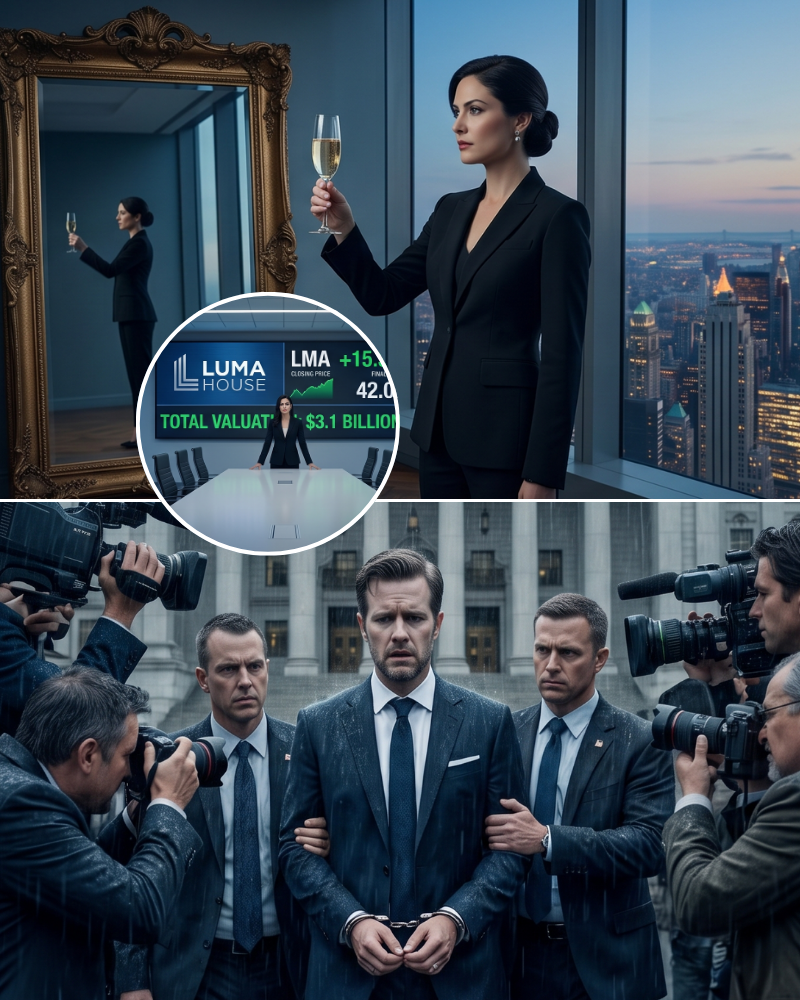
Detective Vance stepped between us, placing a heavy hand on Madison’s shoulder. “Madison Lane, you are under arrest for grand larceny and grand theft. Please step forward.” He then turned his cold, gray eyes toward my husband. “Mr. Whitaker, I suggest you don’t leave the premises. We have a warrant to seize your personal devices, and the federal investigators are already waiting at your office.”
As the officers led a sobbing, hysterical Madison away, her gold dress catching on the velvet ropes, I looked at my husband and his mother. They looked small. For the first time in my life, the great, terrifying Whitakers looked utterly pathetic.
PART 3: THE BOARDROOM COUP
By nine o’clock the following morning, the pristine glass facades of Luma House corporate headquarters in downtown Manhattan were surrounded by news vans. The stock tickers on Wall Street were already flickering in violent shades of red; Luma House stock had dropped six percent in pre-market trading, driven by the sensational headlines of the high-society scandal.
Inside the executive boardroom on the 40th floor, the atmosphere was a toxic blend of panic and absolute tension. Twelve board members sat around the expansive mahogany table, their faces grim. At the head of the table sat Graham, his tie slightly askew, coffee cups piling up around him. Eleanor sat directly behind him in the gallery, her back rigid, her pearls serving as her only armor.
“The numbers are clear, Olivia,” Graham said, his voice carrying a manic, desperate edge as I walked into the room, flanked by Naomi Bell and three independent financial auditors. “The company is bleeding value because of the spectacle you created on television. The shareholders are panicking. The institutional funds are threatening to pull out before the public offering.”
I quietly took my seat at the opposite end of the table. I didn’t look like a woman whose life had been overturned forty-eight hours ago. I wore a tailored black Dior suit, my hair pinned back with clinical precision. On my right hand, the heirloom sapphire ring gleamed under the fluorescent lights, returned to its rightful owner.
“The market isn’t panicking because of the scandal, Graham,” I said, my voice calm, filling the room with an undeniable authority. “The market is reacting to the discovery of systemic embezzlement within Carlisle Vale’s management. Let’s not confuse the disease with the diagnosis.”
Eleanor slammed her manicured hand on the table. “How dare you! The Whitaker family funded the initial expansion of this firm! Without our capital, your patents would still be rotting in a university basement, Olivia!”
“Without your capital, Eleanor, I would have found investors who didn’t plan to rob me,” I replied, turning my gaze to the board members. “Gentlemen, ladies, thank you for coming on such short notice. Before Mr. Whitaker proposes his motion to suspend my CEO status due to ’emotional distress,’ I think it’s necessary we look at the forensic audit completed at dawn.”
Naomi Bell stepped forward, distributing thick bound folders to every person at the table.
“What is this?” asked Marcus Vance, one of the oldest board members and a longtime ally of the Whitaker family.
“That, Mr. Vance, is the paper trail of the ‘Investor Relations’ fund that Graham has been managing for the last two fiscal years,” Naomi explained, her tone sharp and professional. “As you can see on page twelve, over four hundred thousand dollars were moved from the Luma House R&D budget into a shell company registered in the Cayman Islands under the name ‘ML Consulting.’ The sole proprietor of that company is Madison Lane.”
Graham slammed both hands on the table, standing up. “This is a setup! Those were legitimate marketing and communications expenses! We were preparing the ground for the European expansion!”
“By buying three-carat diamond earrings from Cartier?” I asked, my voice cutting through his shouts. “By paying for an eleven-thousand-dollar-a-night presidential suite during a week when Luma House supposedly had no operations in that region? Or perhaps by purchasing short options against our own stock through an anonymous broker just four days ago?”
A collective gasp echoed across the room. Shorting your own company’s stock before a major public offering wasn’t just unethical—it was a federal crime.
“You shorted the stock, Graham?” asked Marcus Vance, his voice turning cold. He looked at my husband with a mixture of disbelief and deep disgust. “You tried to tank the company value on purpose?”
“No! Marcus, listen to me, it was a hedge! A standard financial hedge!” Graham stammered, his face turning an ugly, mottled purple. He looked at his mother, but Eleanor was staring out the window, her jaw clenched, completely abandoning him to save her own skin.
“It wasn’t a hedge, Graham,” I said, leaning forward, my hands folded neatly over my folder. “It was insider trading and corporate sabotage. You wanted the value to drop so your firm, Carlisle Vale, could buy out the minority shareholders and force me into a weak settlement during the divorce. You wanted to own me, and when you couldn’t do that, you decided to dismantle me.”
I turned to the board members. “The forensic team has already delivered these documents to the Securities and Exchange Commission and the Southern District of New York. A federal freeze has been placed on Graham’s corporate assets as of thirty minutes ago.”
Graham collapsed back into his leather chair, the reality of his total ruin finally breaking through his narcissistic armor. His eyes were wide, hollow, and terrified.
“Now,” I said, looking around the table. “I believe there was a motion on the floor to discuss the leadership of Luma House. Shall we vote?”
Every single hand at the table went up. Not to remove me—but to strip Graham of his board seat, his executive privileges, and his access to the building.
“Meeting adjourned,” I said quietly.
PART 4: THE FINAL LIQUIDATION
The rain had finally stopped when I returned to Sterling House that evening. The grand mansion, which had belonged to my family for three generations, felt peaceful for the first time in years. The circus was gone. The news vans had moved on to the federal courthouse where Graham was currently being processed for arraignment.
I stood in the grand entrance hall, the scent of fresh lilies filling the air. Harlan Price met me at the door, taking my coat with a quiet, respectful nod.
“The house is secure, Ms. Olivia,” Harlan said softly. “Mrs. Whitaker is in the drawing room. She refused to leave until she spoke with you.”
“Thank you, Harlan,” I said. “Please ensure the staff is dismissed for the evening. I want this to be a private conversation.”
I walked into the drawing room. The fire had burned down to embers, casting long, dramatic shadows across the family portraits on the walls. Eleanor Whitaker sat in the wingback chair by the hearth, a glass of sherry in her hand. She looked older, the sharp, aristocratic lines of her face sagging under the weight of the family name’s absolute ruin.
“You’ve been very efficient, Olivia,” Eleanor said, not looking up as I entered. “The papers are calling it the ‘Whitaker Implosion.’ My grandfather built the foundation of Carlisle Vale. In less than forty-eight hours, you’ve turned it into a federal crime scene.”
“Graham turned it into a crime scene, Eleanor,” I replied, taking a seat opposite her. I didn’t pour myself a drink. I didn’t need one. “He was just sloppy enough to think I wouldn’t look at the ledgers because I was too busy mourning my mother.”
Eleanor finally looked at me, her eyes flashing with a residual venom. “You think you’ve won an empire, but you’re entirely alone. You’ve destroyed your marriage, you’ve alienated the only family you had left, and you’ve dragged our name through the mud. What is the value of Luma House if you have no legacy to leave it to?”
“The value of Luma House is that it belongs to me,” I said, my voice deadpan and steady. “And as for legacy, my mother’s charity will actually reach the families who need it, instead of funding your son’s penthouses and diamonds. That is all the legacy I need.”
I pulled a final document from my bag and set it on the low table between us.
“What is this?” Eleanor asked, her eyes narrowing.
“A formal eviction notice and a lease termination for the Upper East Side penthouse,” I said calmly. “The property is owned by the estate trust. Since Graham has violated the morality and fraud clauses of the pre-nuptial agreement, his residency rights are dissolved. And since your name is co-signed on his personal accounts, the federal asset freeze extends to your lifestyle allowances as well.”
Eleanor gasped, the sherry spilling slightly over her fingers. “You can’t do this. I am a Whitaker!”
“And this is the Whitaker house no longer,” I said, standing up. “You have until noon tomorrow to have your personal belongings removed. Harlan will supervise the movers. Anything not removed by twelve o’clock will be donated to the charity foundation.”
She stared at me, her lips trembling, the terrifying matriarch reduced to an old woman facing the reality of her own choices. She realized, finally, that the cold, calculating machine she had tried to destroy had simply learned the game from her—and played it better.
Without another word, Eleanor stood up, her posture cracked, and walked out of the room. The heavy front door of Sterling House clicked shut moments later.
I walked back into the ballroom. The staff had cleaned the space, but the Marguerite Mirror remained exactly as I had left it. The words “FORMER WIFE” were still written across the glass in fading crimson lipstick. I had explicitly told Harlan not to clean it yet.
I stepped up to the glass, looking at my own reflection behind the red stains. My face was calm, my posture relaxed. The phantom weight of the past eight years—the gaslighting, the quiet undermining, the constant feeling that I had to apologize for my own success—had vanished.
I took a silk handkerchief from my pocket, stepped close to the mirror, and slowly, deliberately wiped the first letter away. Then the next. Until the glass was perfectly clean, reflecting nothing but a woman who had stood her ground against the wolves and won.
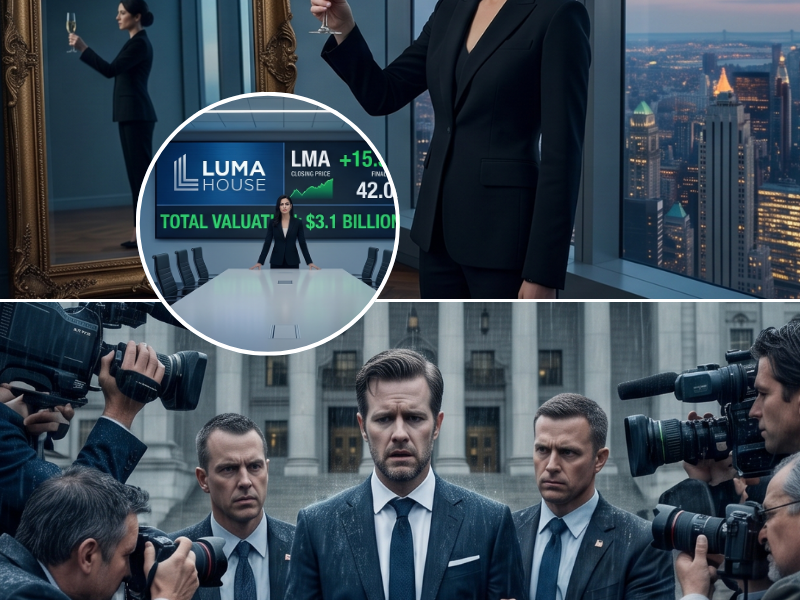
The public offering went through on Monday morning. Luma House opened at forty-two dollars a share, valuation skyrocketing to $3.1 billion by the closing bell. The headlines no longer talked about the affair; they talked about the absolute, untouchable stability of the firm’s leadership.
I poured myself a single glass of champagne, stood by the window overlooking the city, and raised a silent toast to the woman in the reflection. The empire was safe. And it was entirely mine.