Shift Up’s DEI Hiring Controversy Explodes as Stellar Blade Fans Question the Future of BLOOD RAIN
STELLAR BLADE FANS JUST HIT THE PANIC BUTTON — SHIFT UP HIRED A FORMER PLAYSTATION EXECUTIVE WITH A DEI-FOCUSED BACKGROUND. 🚨
The man now running Shift Up’s global communications spent 13 years at PlayStation — and fans immediately started digging into his past, his DEI/ESG credentials, and even the games he previously promoted.
Then something on his professional profile reportedly changed… and suddenly the internet started asking a much bigger question: Is Stellar Blade: BLOOD RAIN really safe from the same culture-war battles that fans thought Shift Up had escaped?
🔥 Click the link to see what happened — and why the community is absolutely losing it.
A new global communications hire from PlayStation has triggered a fierce online backlash among Shift Up fans — but the evidence does not yet show that the executive has any direct role in changing Stellar Blade’s creative direction.
For a studio whose identity has become closely associated with stylized characters, unapologetic fan service and games designed primarily around Asian audiences, Shift Up has found itself at the center of a culture-war controversy it probably did not expect.
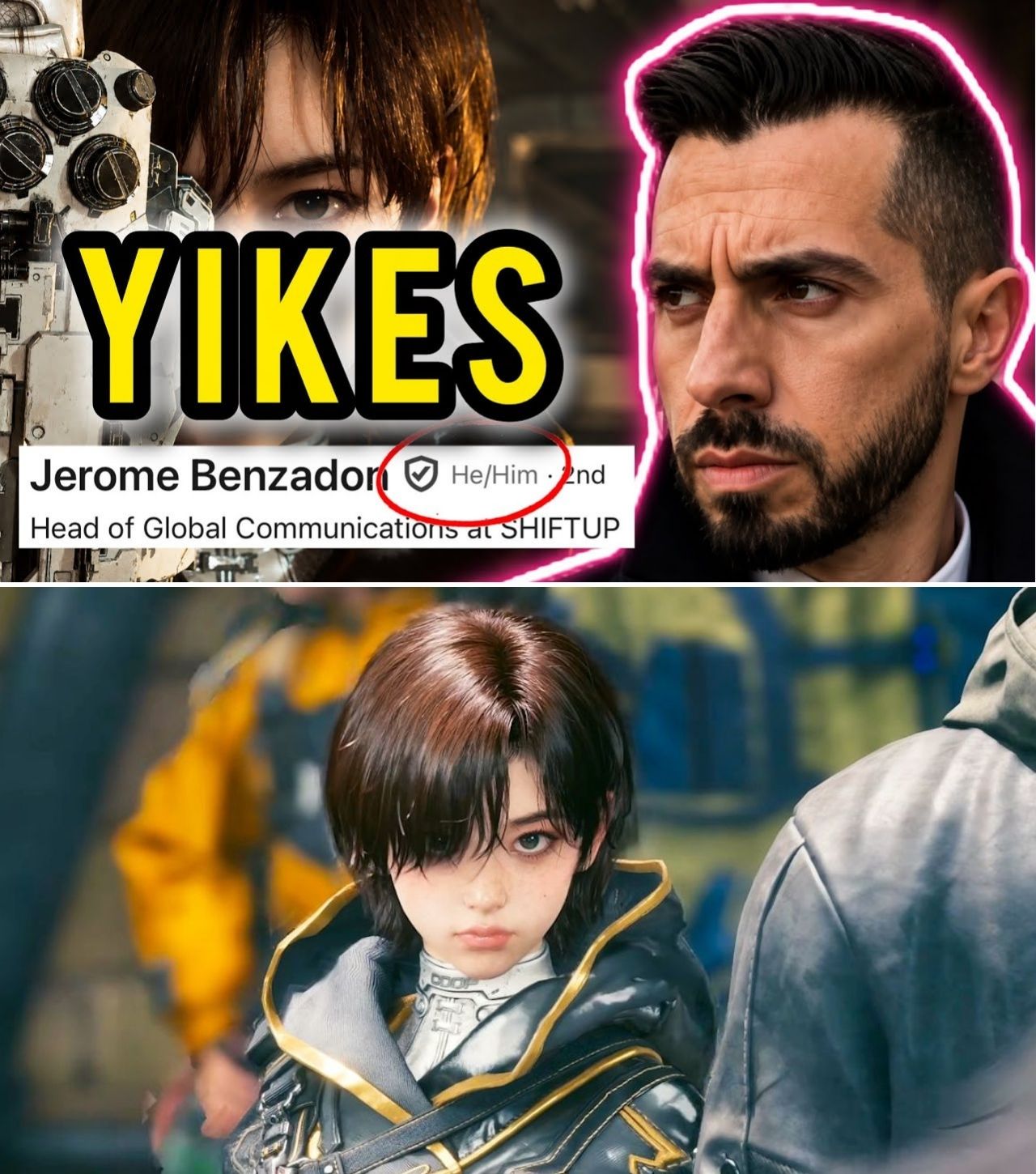
The Korean developer behind Stellar Blade and Goddess of Victory: NIKKE recently hired veteran games-industry communications executive Jerome Benzadon as its new Head of Global Communications.
Benzadon spent approximately 13 years at Sony Interactive Entertainment/PlayStation and has more than two decades of experience in video-game communications, including previous work connected to Ubisoft and THQ. His new position at Shift Up covers global communications and publishing strategy for the company’s projects, including Stellar Blade: BLOOD RAIN and upcoming projects associated with Shinji Mikami.
On paper, it looks like a conventional executive hire.
Online, however, the reaction has been anything but conventional.
Within hours of the appointment becoming public, sections of the Stellar Blade and NIKKE communities began circulating screenshots of Benzadon’s professional background, focusing particularly on references to DEI — diversity, equity and inclusion — and ESG.
The resulting reaction has ranged from concern and skepticism to calls for Shift Up to fire him.
But there is a critical distinction between what is known and what fans fear.
There is currently no public evidence that Benzadon has ordered changes to BLOOD RAIN, censored characters, rewritten its story or imposed DEI requirements on Shift Up’s developers.
That has not stopped the controversy from becoming one of the gaming industry’s latest online flashpoints.
Who is Jerome Benzadon?
Benzadon is not a game designer.
That distinction is important.
His professional background is primarily communications, public relations and corporate messaging. His publicly available LinkedIn profile describes more than 20 years of communications experience in the video-game industry, while his recent announcement says he will lead global communications at Shift Up.
Benzadon announced the move on August 19, saying he was excited to join Shift Up and help build global communications strategies around the company’s projects.
He specifically mentioned Stellar Blade: BLOOD RAIN and Shinji Mikami’s upcoming project.
He also described himself as a longtime fan of Shift Up, referencing his enthusiasm dating back to Destiny Child. His social-media activity has similarly shown enthusiasm for the studio and its games.
That would ordinarily be a fairly unremarkable executive announcement.
Instead, players immediately began examining his previous professional credentials.
Why the DEI controversy started
The controversy centers on how Benzadon’s professional profile described some of his areas of expertise.
Reports circulating online stated that his previous profile included a reference to a focus on DEI, while other discussions highlighted his connection to ESG-related work.
A LinkedIn page indexed by search engines also identifies “ESG” within his professional information.
That was enough to trigger a major reaction among sections of the Stellar Blade community.
Why?
Because Stellar Blade has become something of a symbolic game in the ongoing debate over representation and censorship in modern gaming.
The game’s protagonist, Eve, was intentionally designed around a highly stylized and conventionally attractive aesthetic. The title’s outfits and character designs became a major part of the game’s marketing and online identity.
Some Western critics have questioned or criticized that approach, while a significant portion of the game’s audience has embraced it precisely because they believe Shift Up has refused to follow trends they associate with Western AAA game development.
Consequently, the arrival of a communications executive associated with DEI immediately triggered fears that the studio could eventually change direction.
Those fears intensified because the executive came from PlayStation.
The PlayStation connection made everything louder
Benzadon’s 13-year history at PlayStation is arguably more significant to the controversy than his actual job title.
Sony was the original publisher of Stellar Blade when the game launched on PlayStation 5 in 2024.
That relationship became complicated in the eyes of some fans after players discovered differences between early promotional material and the final version of certain costumes.
The issue generated considerable online discussion about whether Sony had influenced the game’s presentation.
Now, with Shift Up moving toward greater independence in publishing its own games, fans had hoped the studio would have more control over its creative and marketing decisions.
Shift Up has already confirmed that it plans to publish its next Stellar Blade title itself rather than relying on Sony Interactive Entertainment. The company has said this will allow it to lead marketing strategies that more directly reflect the identity of the Stellar Blade IP.
Against that backdrop, hiring a former PlayStation communications executive created an almost perfect recipe for online suspicion.
To some fans, it looked like Sony’s influence might be returning through the back door.
There is, however, no evidence establishing that this is what happened.
The community reaction was immediate
The reaction on Reddit and Steam has been intense.
A discussion in a gaming subreddit focusing on the controversy attracted hundreds of votes, with users debating whether Benzadon’s previous DEI-related experience should be considered relevant to his new position. Some commenters argued that his background represented a warning sign, while others pointed out that global communications is not the same thing as creative development.
Steam discussions surrounding Stellar Blade have been similarly divided.
Some users announced that they would no longer purchase Shift Up games because of the appointment. Others argued that the backlash was premature because Benzadon does not control game development.
One Steam thread specifically noted that a Head of Global Communications would generally be responsible for messaging, public relations and brand strategy rather than directly controlling a game’s artistic direction.
Another community discussion went even further in the opposite direction, arguing that the entire controversy was manufactured outrage over a communications specialist who had not actually demonstrated any intention of changing Shift Up’s games.
That divide is important.
The community isn’t actually reacting to something Benzadon has done to BLOOD RAIN.
It is reacting to what some players think he could do.
Then came the profile change
The controversy became even more explosive after users reported that references to DEI and ESG had been removed or changed on Benzadon’s LinkedIn profile.
Several Reddit posts focused specifically on the alleged removal.
For critics, the timing looked suspicious.
If those descriptions were previously present and disappeared after the appointment became controversial, some interpreted the change as an attempt to distance Benzadon from his DEI background.
Others reached the opposite conclusion.
They argued that a professional updating his LinkedIn profile after changing employers is hardly extraordinary, and that a screenshot of an earlier profile does not prove that he is secretly planning to impose ideological requirements on Shift Up.
There is also an important complication: “ESG” can refer to different things depending on context.
It can describe environmental, social and governance practices within corporate management and reporting. It does not automatically mean that someone is an activist attempting to change the creative content of video games.
Likewise, having professional experience related to DEI does not demonstrate that an executive intends to censor a particular game.
That distinction has largely disappeared in the social-media debate.
The Concord connection added fuel
Another element of the controversy involves Concord, Sony’s short-lived multiplayer shooter.
Benzadon’s previous professional social-media activity included posts associated with Sony’s games and projects, including Concord. Some critics have interpreted that as evidence that he supported a title they consider a symbol of failed corporate decision-making.
But this argument is considerably weaker than it first appears.
Benzadon worked in communications at Sony.
Promoting or speaking positively about a Sony first-party product while working for the company is hardly unusual.
In fact, Reddit users themselves have pointed out that expecting a Sony communications executive to publicly attack one of Sony’s games would be unrealistic.
Whether that explanation satisfies Stellar Blade fans is another question.
What does his new job actually mean?
The title Head of Global Communications is significant, but it is not equivalent to creative director, game director or chief content officer.
The position is primarily about how a company communicates with the outside world.
That can include:
Public relations
Media relations
Product announcements
Crisis communications
Social-media strategy
Global marketing coordination
Corporate messaging
Brand positioning
Those responsibilities can influence how a game is presented.
They do not necessarily determine how a character is designed or what the game’s story contains.
That distinction becomes particularly important with BLOOD RAIN, which is still relatively early in development.
Shift Up has previously said the next Stellar Blade title is progressing and is intended to expand upon the original game’s systems and side content. Information shared by the studio indicates that the sequel is still in development and that significant aspects of its gameplay and interface are being changed.
There is currently no verified announcement saying that Benzadon has been given authority over character design, censorship or narrative development.
Why fans are nevertheless nervous
The concern is less about one executive and more about a pattern.
Some gamers have become deeply suspicious of corporate DEI initiatives because they believe Western publishers have sometimes allowed marketing and corporate priorities to influence creative decisions.
Whether that criticism is justified in individual cases varies widely.
But the distrust is real.
And Stellar Blade happens to have become one of the franchises most associated with that cultural divide.
Fans who see Shift Up as an alternative to Western AAA publishers therefore interpret any connection to the traditional Western games-industry establishment as potentially threatening.
A communications executive from PlayStation with DEI-related experience is almost guaranteed to attract attention in that environment.
The same hire at a completely different studio might barely generate discussion.
At Shift Up, it has become headline material.
The irony: Benzadon may actually be exactly what Shift Up needs
There is another interpretation that has received considerably less attention.
Shift Up is becoming a global publisher.
The company has ambitions beyond Korea, and its games have already developed international audiences.
That creates a need for executives who understand Western media, international marketing and global communications.
Benzadon’s experience could therefore be highly valuable.
He spent more than a decade at PlayStation and has worked across major gaming companies. His expertise in global communication could help Shift Up market its games more effectively in North America and Europe.
That doesn’t automatically mean Westernization of the games.
It could simply mean better communication.
Indeed, some community members have suggested precisely that — arguing that hiring someone with Western industry experience for communications could help Shift Up protect its creative identity by making it better equipped to deal with Western criticism and media expectations.
That possibility is considerably less dramatic than the “DEI takeover” narrative.
It may also be closer to reality.
The real test will be BLOOD RAIN
Ultimately, none of the current arguments can answer the most important question.
What will Stellar Blade: BLOOD RAIN actually look like?
The game was revealed earlier this year with a new protagonist, Evie, and a different setting and tone. Shift Up has said it wants to retain important elements from the original while expanding the gameplay, interface and side content.
If the finished game retains the visual style and character designs that made the original Stellar Blade famous, the current controversy may quickly disappear.
If major changes occur, critics will almost certainly point back to the Benzadon appointment.
But even then, proving causation would be difficult.
Game development involves dozens or hundreds of decisions made over years.
A communications executive joining a project does not automatically explain a character redesign, costume change or narrative decision.
A controversy with no verdict yet
The Shift Up controversy is therefore simultaneously real and overblown.
The backlash is real.
The hiring is real.
Benzadon’s PlayStation background is real.
His professional history includes references that players associate with DEI and ESG, and those references became a major topic of discussion after his appointment.
The community reaction is also substantial, with angry discussions appearing across Reddit, Steam and social media.
What is not established is the leap from those facts to the claim that Shift Up has been “taken over” by DEI or that BLOOD RAIN is destined to be censored.
There is currently no credible evidence proving that.
In fact, Benzadon’s own public comments emphasize his enthusiasm for Shift Up’s games, while his new role is explicitly focused on global communications.
For now, the controversy is therefore less a story about what Shift Up has changed than a story about what fans are afraid Shift Up might change.
And that distinction matters.
Because if BLOOD RAIN launches with the same unapologetic identity that made the original Stellar Blade such a lightning rod, this entire episode may eventually look like a massive overreaction.
But if the franchise begins moving in a direction its core audience never wanted, gamers will remember the August 2026 hiring controversy.
For Shift Up, the safest response may ultimately be the simplest one:
Let the game speak for itself.
The next Stellar Blade has a massive audience watching.
And right now, they aren’t just watching Evie.
They’re watching Shift Up.