
Mortal Shell II: Proxima’s “Infinite Stagger” Build Is Making Night Mode Look Broken
🚨 PROXIMA MAY HAVE JUST BROKEN NIGHT MODE IN MORTAL SHELL II!
Night Mode is supposed to make enemies faster, stronger and far more dangerous — but one Proxima setup can apparently keep enemies trapped in Stasis and repeated stagger loops, leaving even bosses struggling to fight back. 😳
The crazy part? You don’t need some fully maxed-out endgame setup to make the loop work. Once Biosampler, Stasis and the right upgrades start feeding into each other, Proxima can turn Night Mode from a survival test into a stun-lock showcase…
🔥 Here’s how the “infinite stagger” Proxima build works — and why players are calling her completely busted 👇
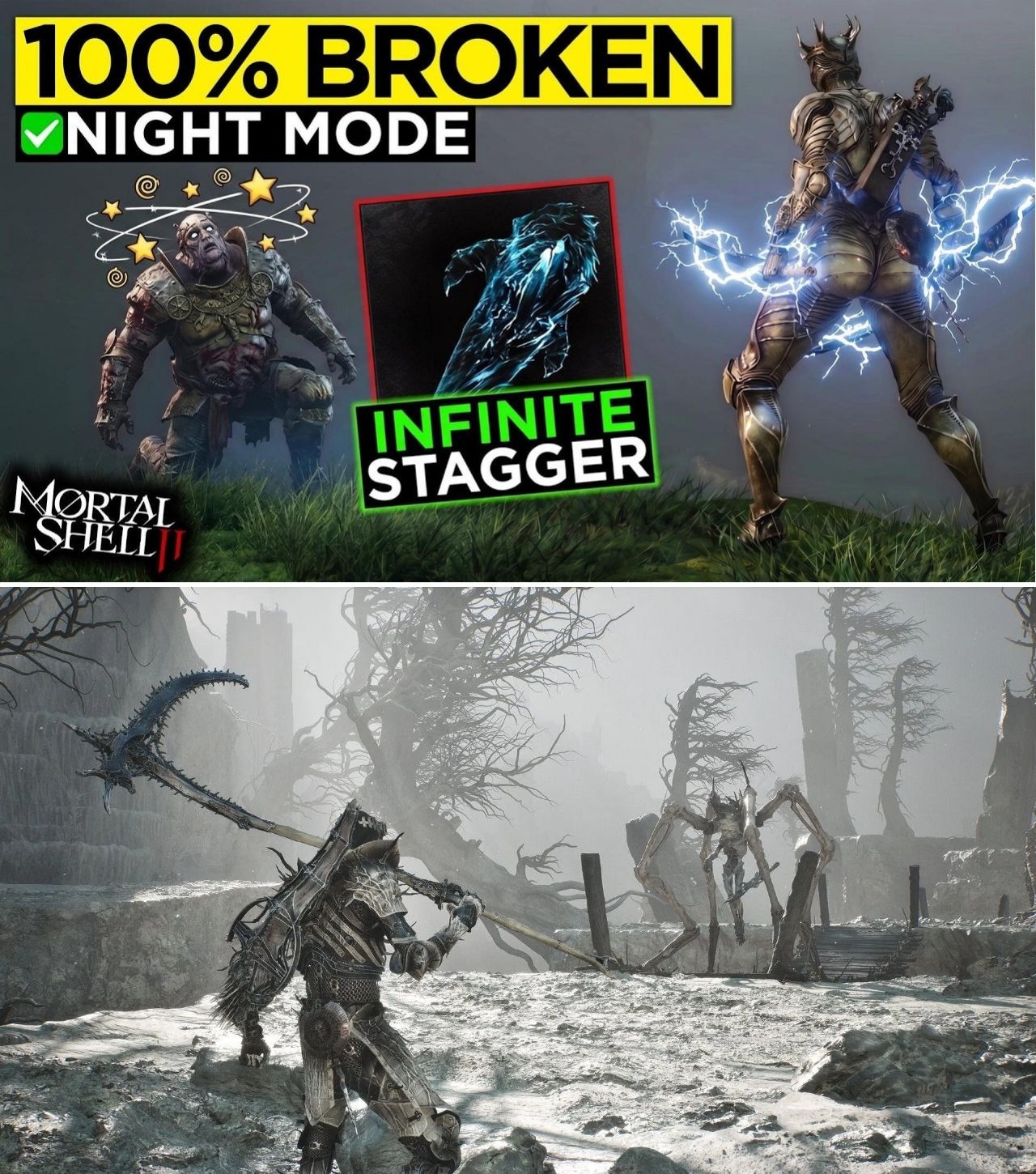
Night Mode is supposed to be one of Mortal Shell II’s biggest tests.
The mode makes the world considerably more dangerous: enemies become faster and stronger, while the increased difficulty is offset by improved Gloom and Coin rewards.
For many players, that trade-off is exactly what makes Night Mode interesting.
For Proxima players, however, the equation can look very different.
A growing number of build guides and community discussions are pointing toward a particular interaction involving Biosampler, Stasis, stagger damage, Resolve management and Grisha Remnants that can keep enemies under near-continuous control.
The result has been described by players as an “infinite stagger” setup.
That description is obviously dramatic — it doesn’t mean every enemy in the game is literally incapable of moving under every circumstance.
But against many enemies, elites and even bosses, the combination can create extremely long control chains.
One recent build guide specifically describes Proxima as capable of continuous Stasis effects that can permanently stun bosses and elite enemies, while another community player reported being able to stagger-lock bosses by repeatedly using Biosampler after unlocking the appropriate Proxima upgrades.
And that raises an interesting question:
If Night Mode makes enemies faster and more aggressive, what happens when your build simply refuses to let them attack?
Why Proxima Is So Good at Controlling Enemies
The answer starts with her signature ability:
Biosampler
Proxima’s Biosampler is much more than a standard gap closer.
Current guides describe it as a hook-like ability that can pull lighter enemies toward Proxima, while larger or immovable targets instead pull Proxima toward them. It also deals damage and can apply Lightning, with upgraded versions adding further crowd-control effects including Stasis and stagger pressure.
That distinction matters.
A normal gap closer gets you into combat.
Biosampler can potentially get you into combat while simultaneously creating the opening for your next attack.
And once the Proxima skill tree is developed around that ability, the interaction becomes much more dangerous.
Current build guides prioritize abilities such as Attunement, Biohazard, Seizure, Shell Shock and Discharge, depending on whether the player wants more Resolve efficiency, Lightning pressure, Stasis/stagger control or defensive utility.
The result is effectively a loop:
Biosampler → Stasis → attack → stagger → recover Resolve → Biosampler again.
And if you can repeat the first step before the enemy fully recovers?
That’s where the trouble begins.
Stasis Is the Real Star
The most important word in this build might not actually be “stagger.”
It’s Stasis.
Community players have repeatedly singled out Proxima’s ability to apply Stasis as one of the reasons she feels so powerful.
In a recent Reddit discussion asking players to name their favorite Shells, one Proxima player described Biosampler as particularly powerful because it can force a stagger animation while also applying Lightning and Stasis. Another player said that, with the right build, Proxima can “virtually stun-lock bosses.”
That’s significant because Night Mode’s primary advantage is enemy aggression.
Faster attacks.
More pressure.
Less room for error.
Stasis attacks that rhythm at its foundation.
If an enemy is slowed or held in a vulnerable state, the additional speed provided by Night Mode becomes much less relevant.
You don’t necessarily need to react faster than the enemy.
You need to keep the enemy from acting.
The Basic Proxima Loop
The core concept is surprisingly simple.
1. Build Resolve
Biosampler consumes Resolve, so the build needs enough regeneration and efficiency to keep the ability available.
That’s why Attunement is such an important early investment in several current Proxima builds. Guides specifically recommend it for reducing Biosampler’s Resolve burden and improving ability uptime.
2. Fire Biosampler
Use the ability to close the distance or pull the target into the desired position.
3. Apply Stasis
With the appropriate Proxima upgrades, Biosampler becomes a source of Stasis and stagger pressure rather than simply mobility.
4. Attack during the opening
This is where the weapon choice matters.
You aren’t trying to play a conventional neutral game.
You’re exploiting the window created by Biosampler.
5. Rebuild Resolve
Continue attacking and use the build’s resource-generation mechanics to prepare another Biosampler.
6. Repeat
If the target is still under sufficient control when Biosampler becomes available again, the next cast can extend the sequence.
And suddenly:
The enemy never gets a clean turn.
Grisha Remnant Makes the Idea Even More Ridiculous
This is where the Proxima build connects with one of the other major community discoveries we’ve recently seen.
Grisha Remnant.
The item can be equipped as a passive effect that gives melee attacks opportunities to trigger a Grisha summon. Current guides also describe the Remnant as scaling with additional copies, making it increasingly valuable for players pursuing a Grisha-focused build.
And if you’ve already seen the community’s current Grisha Remnant farming methods, you’ll understand why this matters.
Players have discovered repeatable ways to accumulate Remnants far beyond what a normal playthrough would provide.
That means Proxima can potentially combine:
Biosampler control
Stasis
stagger damage
Grisha Remnant procs
Resolve regeneration
into one extremely aggressive control package.
One current community build description specifically calls out continuous Grisha Remnant use alongside Biosampler as the core of a setup capable of permanently stunning enemies.
This isn’t simply a damage build.
It’s a control build.
Why Night Mode Actually Makes the Build Look Better
There is an important irony here.
Night Mode makes the game harder.
But its increased enemy aggression can actually make a control-focused Proxima build feel even more valuable.
GameSpot’s current beginner guide confirms that Night Mode increases enemy speed and strength while improving Gloom and Coin rewards.
Normally, that means:
Enemy attacks come faster → you have less time to react.
But Proxima changes the equation:
Enemy attacks come faster → you need even more control → Biosampler becomes even more valuable.
You’re essentially removing the enemy’s advantage rather than trying to compete with it.
And that’s why some players are describing Proxima as an answer to Night Mode rather than simply another viable Shell.
The Community Is Already Calling Proxima “Busted”
This isn’t just coming from build websites.
Reddit discussions around the game’s first week repeatedly mention Proxima’s ability to trivialize difficult encounters.
One player who had completed the game with Proxima said her Biosampler was “busted,” highlighting its quick activation, forced stagger, Lightning damage and Stasis.
Another community comment simply summarized the experience as:
“You can virtually stun-lock bosses and slow them, if done right.”
There’s also evidence that players are moving to Proxima specifically because they find the full-release difficulty considerably harsher than the earlier beta.
One Reddit player struggling with the game’s increased difficulty reported that switching to Proxima essentially stopped the problem.
That doesn’t prove Proxima is objectively the strongest Shell.
But it does show something important:
Players are independently arriving at the same conclusion about her control potential.
The Current Proxima Skill Priorities
There isn’t one universally agreed Proxima build, and that distinction is important.
Different guides are currently emphasizing slightly different weapons and Tarstone combinations.
However, there is considerable overlap around the ability tree.
Attunement
One of the most important early investments.
The goal is straightforward:
More Biosampler uptime.
Several current guides recommend starting Proxima’s progression with Attunement because the entire combat loop depends on being able to use her signature ability repeatedly.
Biohazard
Biohazard increases Biosampler’s offensive output and Lightning-stack application.
That makes it particularly useful for players who want the ability itself to contribute more damage rather than merely provide crowd control.
Seizure
Seizure is especially relevant to the control version of Proxima.
Current build documentation associates it with Stasis, splash effects and stagger damage, making it one of the key pieces for the “keep them locked down” playstyle.
Shell Shock
Shell Shock helps connect Proxima’s defensive mechanics with Resolve and Lightning generation.
That matters because the build lives or dies by resource uptime.
Discharge
Discharge further rewards successful Biosampler connections by creating additional Lightning pressure.
It’s more relevant to the damage-oriented versions of the build than a pure control setup, but it fits naturally into the same loop.
What About Weapons?
This is where current guides differ.
One current Proxima guide recommends Great Martyr’s Blade with the Triarch Repeater, pairing it with Voltaic Crown and Acolyte’s Stone for a burst-oriented approach.
Another current NG+ build instead recommends Axatana, Duality Stone, Voltaic Crown and Acolyte Stone, leaning much harder into Lightning, speed and repeated control.
A separate early-game guide recommends Axe & Dagger because it is available earlier and works well with Proxima’s aggressive ability loop.
So there isn’t a single “mandatory” weapon.
The important principle is:
Don’t build the weapon first and then force Proxima around it.
Build around Biosampler uptime, then choose the weapon that best exploits the openings it creates.
The Axatana Version Is Particularly Interesting
For players who already have access to the Axatana, its fast moveset fits naturally into Proxima’s control loop.
A current NG+ build uses:
Proxima
Axatana
Duality Stone
Voltaic Crown
Acolyte Stone
Auspicious Stone
Headsman Stone
The build prioritizes Attunement, Exoshell, Lightning Ampereon, Biohazard, Seizure, Shell Shock and Discharge, with Biohunter replacing one point in Seizure for extended boss fights.
The reason for the weapon choice is straightforward.
Axatana’s faster attacks give you more opportunities to capitalize on the windows Biosampler creates.
You’re not waiting for one enormous attack.
You’re constantly applying pressure.
And every additional interaction gives the build another chance to trigger its various effects.
But Don’t Confuse “Stun-Lock” With Invincibility
This is where the viral version of the build needs some context.
Proxima is powerful.
She is not immortal.
Grafted Armor provides a chance to mitigate incoming damage and prevent stagger when the mitigation activates, but current guides explicitly caution that the starting chance is not reliable enough to replace normal defensive play.
There are also enemies that can disrupt the rhythm.
Multiple enemies are particularly dangerous.
One Reddit discussion about Proxima praised her ability to control individual targets while noting that aggressive multi-enemy situations can still cause problems across the game.
And the community is currently reporting balance problems in both directions.
Some players consider parts of the game excessively punishing.
Others have already found Shells and builds that trivialize large portions of it.
That’s exactly why Proxima is so interesting right now.
She’s sitting at the center of a larger debate over Mortal Shell II’s difficulty curve.
The “Infinite” Part Is About the Loop, Not Literally Infinite Stagger
This distinction matters.
There is no evidence that Proxima possesses a button that simply freezes every enemy forever.
What players are calling “infinite stagger” is essentially a repeatable control loop.
If:
Biosampler remains affordable,
Stasis keeps the enemy vulnerable,
stagger damage repeatedly fills the relevant threshold,
and the player can generate enough Resolve,
then the next Biosampler can arrive before the opponent has fully regained control.
That’s why the loop can look infinite.
It’s not one effect lasting forever.
It’s a sequence of effects that keeps replacing one another.
And against the right target, that can be almost indistinguishable from a permanent stun.
This Is Especially Brutal Against Bosses
Normal enemies are one thing.
Bosses are another.
Bosses are designed around recognizing attack patterns, learning timing windows and surviving long enough to punish mistakes.
A build that repeatedly removes those windows changes the entire encounter.
Current community testing specifically reports Proxima being able to stagger-lock bosses when Biosampler’s Resolve cost and stagger-related upgrades are optimized.
Another current build guide claims the setup can handle bosses without giving them meaningful opportunities to attack, although such demonstrations should be treated as build-specific rather than evidence that every boss is universally trivial.
And that distinction is important.
Not every boss will behave identically.
But if a build can consistently create repeated Stasis and stagger windows against major targets, it dramatically reduces the mechanical demands of the fight.
Night Mode May Be the Ultimate Test
If you’re wondering whether the build is genuinely powerful, Night Mode is the obvious place to test it.
The mode increases enemy speed and strength.
It also improves resource rewards.
So instead of using Proxima to make an already manageable normal-mode encounter easier, you’re putting her into the environment specifically designed to punish slow reactions.
If Biosampler can still maintain the control chain there, the argument becomes much stronger.
And that is exactly what recent Proxima build testing is attempting to demonstrate.
One current build report specifically claims that its Proxima setup can incapacitate enemies even in NG+ Knight Mode, using repeated Biosampler/Stasis pressure.
That’s an important escalation.
Normal mode?
Maybe it’s just a strong build.
NG+ Knight Mode?
Now you’re testing whether the mechanic itself is fundamentally too efficient.
Could Proxima Get Nerfed?
It’s certainly possible.
But it’s important not to present that as confirmed.
As of the latest available information, there is no verified developer announcement specifically stating that Proxima’s Biosampler or Stasis interaction is being nerfed.
What we do know is that the developers have already been issuing balance updates, and the community has been actively reporting balance concerns. A PS5 player posted Balance Patch 1 notes stating that further updates are planned and that future patches will expand features including Night Mode and Tarstones.
That means the system is still moving.
And Proxima’s popularity makes her a natural candidate for future balance scrutiny if the developers decide that the current control loops are too strong.
But for now?
The build is live.
The Best Way to Think About Proxima
Don’t think of Proxima as a traditional damage Shell.
Think of her as a combat controller.
Her objective isn’t simply:
“How fast can I kill this enemy?”
It’s:
“How long can I prevent this enemy from playing the game?”
Biosampler establishes control.
Stasis extends the opening.
Stagger creates another interruption.
Grisha Remnant can add another layer of disruption.
Lightning adds damage while the target is compromised.
Resolve regeneration lets the process start again.
And suddenly the enemy is caught in a loop where every attempt to recover creates another opportunity for Proxima to interrupt.
That’s why the build feels so oppressive.
The Bottom Line
Proxima isn’t necessarily the only overpowered Shell in Mortal Shell II.
The community has also identified powerful setups around Eredrim, Smert and other Shells, and player opinions on the strongest Shell vary considerably.
But Proxima has one particularly nasty advantage:
She can attack the enemy’s ability to fight back.
Her Biosampler can initiate the encounter, apply Lightning and, with the appropriate upgrades, contribute Stasis and stagger pressure.
Add Resolve management, the right weapon and potentially Grisha Remnant, and the result can be a control loop that keeps enemies staggered far longer than they were probably designed to be.
That becomes especially significant in Night Mode.
The mode makes enemies faster.
Proxima makes them slower.
Night Mode makes them stronger.
Proxima makes it harder for them to attack.
Night Mode increases the stakes.
Proxima simply keeps hitting Biosampler.
And that is the fundamental reason this build is generating so much attention right now.
If you can prevent the enemy from taking its turn, how difficult is the game really?
For some Proxima players, the answer appears to be:
Not very.