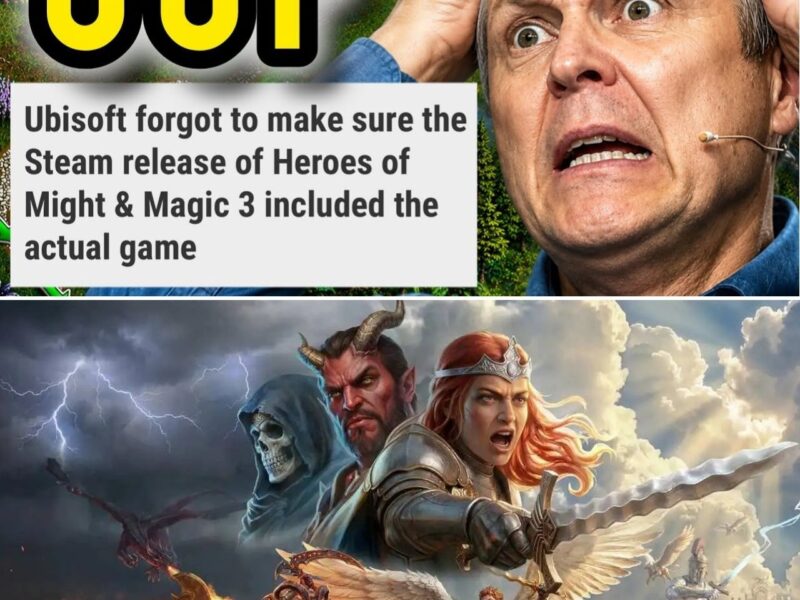
Ubisoft Just Sold a Game… Without Including the Game
🚨 UBISOFT JUST SOLD PEOPLE A GAME… WITHOUT ACTUALLY GIVING THEM THE GAME.
You paid $10. Steam said the purchase was complete. The download finished almost instantly.
Then you opened it… and there was NOTHING.
Just a 23.49 KB “dummy executable” that opened Command Prompt. 💀
And somehow, this wasn’t discovered until actual customers started downloading it.
How does a major publisher put a game up for sale, collect the money, and forget the one thing customers actually paid for?
The full Ubisoft disaster — and the absolutely brutal reaction from Heroes III fans — is here 👇
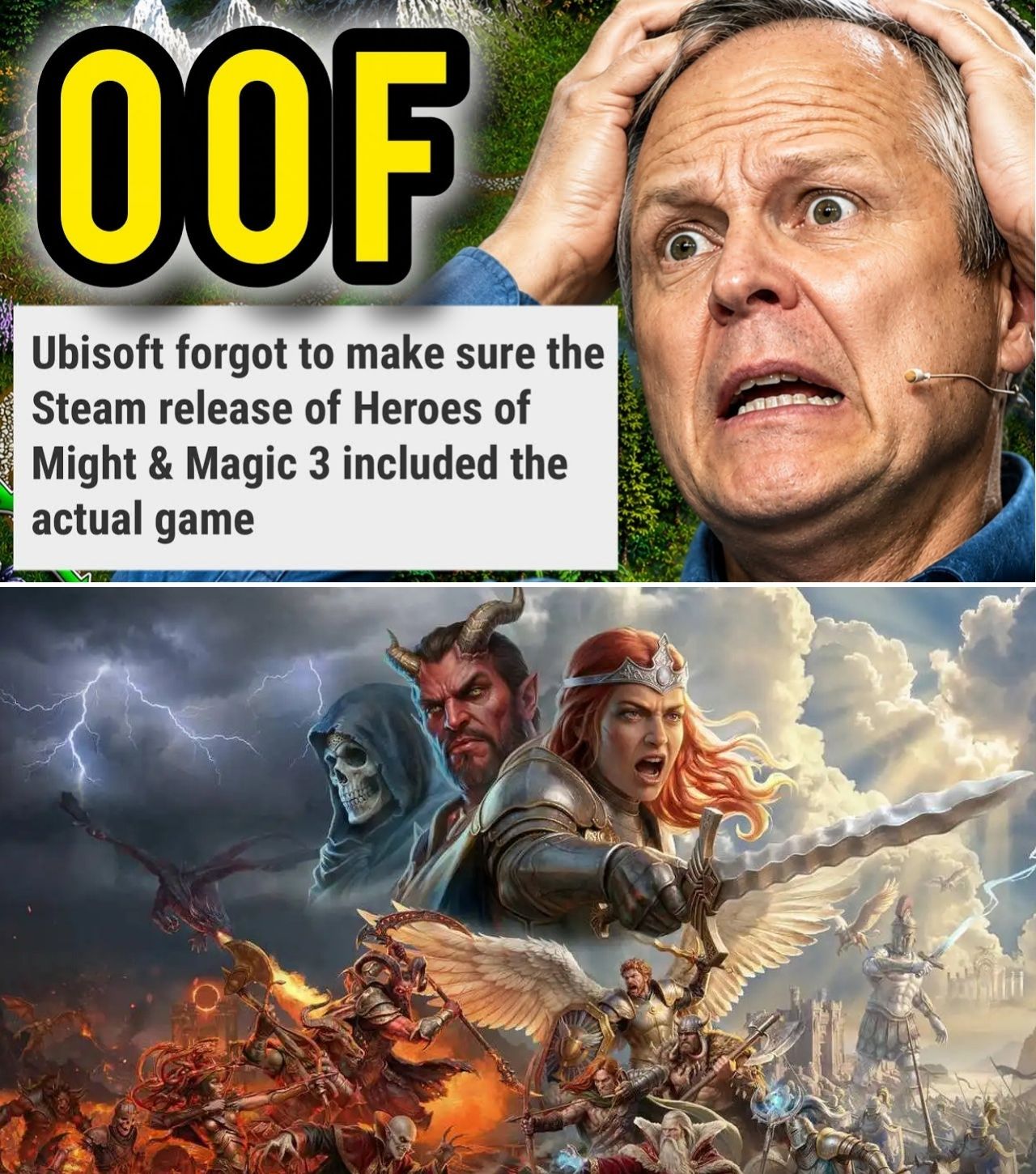
Ubisoft Just Sold a Game… Without Including the Game
Ubisoft’s Steam launch of Heroes of Might & Magic III Complete turned into an internet punchline after early buyers discovered they had downloaded a 23.49 KB dummy executable instead of the actual game.
There is a very simple rule when selling a video game:
You should probably include the video game.
Ubisoft somehow managed to make that rule look optional.
On August 25, the publisher finally released the original Heroes of Might & Magic III on Steam in its Complete Edition, including the base game and its two major expansions, Armageddon’s Blade and The Shadow of Death.
For longtime fans, it was supposed to be a straightforward victory.
Instead, some of the first customers who paid roughly $10 discovered that their new purchase weighed just 23.49 KB.
The game itself was nowhere to be found.
What they received instead was a single Heroes3.exe file.
And when they tried to launch it, they didn’t get the legendary strategy game.
They got a Command Prompt window.
The executable identified itself as a “Dummy executable” and told users to make sure they were on the correct Steam branch.
It was the kind of mistake that sounds impossible until screenshots start appearing.
And then the screenshots started appearing everywhere.
$10 for 23.49 KB
The first clue that something had gone catastrophically wrong was the download itself.
Heroes of Might & Magic III is a game from 1999. Nobody expected a modern 100GB installation.
But 23.49 KB is not “small.”
It is essentially a placeholder.
Players quickly discovered that the installation did not contain the expected game files. Instead, Steam had delivered the tiny executable and little else.
The absurdity immediately became fuel for the Steam review section.
One of the most popular reviews joked that players had received “23.49 KB of pure nostalgia” and called it the “Best CMD prompt simulator of 2026.” The reviewer later updated the post to acknowledge that the remaining roughly 770 MB had finally arrived and that the game was working — while deliberately leaving the negative review as a monument to what users dubbed the “23KB era.”
Another reviewer essentially asked how Ubisoft could possibly mess up a release of a game that had already been functioning for more than two decades.
That reaction says something important about why this particular failure resonated so strongly.
Players weren’t dealing with a complicated new AAA game.
They were dealing with Heroes III.
A 27-year-old classic.
The basic expectation was that Ubisoft would simply put the existing game files on Steam and let people play.
The Internet Did What the Internet Does
Once players realized the download was essentially empty, the jokes spread rapidly.
Reddit users began discussing the possibility that Ubisoft had failed to update the public Steam release branch, resulting in customers receiving the dummy executable instead of the final build. One widely circulated Reddit post summarized the situation almost perfectly: Ubisoft apparently forgot to update the release branch, leaving Steam to distribute a 23 KB executable.
That explanation is plausible, especially because the executable itself reportedly contained the instruction to check the Steam branch.
But there is an important distinction here.
Ubisoft has not publicly provided a detailed technical postmortem confirming that exact sequence of events.
So while the branch theory has become a popular community explanation, it should remain a theory rather than a confirmed account of what happened internally.
The confirmed part is much simpler:
The Steam release initially delivered the wrong content.
Customers paid for Heroes III.
They received a dummy executable.
And Ubisoft subsequently fixed it.
Steam Reviews Became the Perfect Punchline
The Steam review section became a running commentary on the disaster.
Some users were genuinely angry.
Others appeared to be having the time of their lives.
That combination is what made the incident unusually viral.
One review simply treated the situation as a joke, celebrating the tiny download as if Ubisoft had created a revolutionary new game consisting entirely of a command prompt. Another user wrote that the classic game itself was “untouchable” and made clear that the negative rating was directed at the release rather than Heroes III itself.
That distinction matters because Heroes III remains enormously beloved.
Many players were not angry because they thought the game was bad.
Quite the opposite.
They were angry because they wanted to play it.
A reviewer on Steam described the original as one of the greatest games ever made, then questioned how Ubisoft could manage to break a product that had been working for more than 25 years. Another recommended the GOG version instead, where the Complete Edition was already functional.
That is perhaps the most brutal criticism Ubisoft could receive.
The community wasn’t asking for a revolutionary new feature.
They were asking for the game to exist.
Then Came the Fix
Fortunately for Ubisoft — and anyone who actually wanted to play Heroes III — the situation did not last long.
Approximately 11 hours after the release, a roughly 770 MB update arrived, adding the missing content. Ubisoft subsequently acknowledged the problem, thanked players for bringing it to the company’s attention and apologized for the inconvenience.
The game now works.
That is important context.
This was an embarrassing launch failure, not evidence that Ubisoft permanently sold customers a nonexistent product.
The company corrected the problem the same day.
But that doesn’t erase the bizarre first impression.
For several hours, the Steam version effectively became Heroes of Might & Magic III: Command Prompt Edition.
And the internet had already taken screenshots.
Why Wasn’t This Caught Before Launch?
This is the question that makes the story more interesting than a simple “Ubisoft forgot the files” joke.
How does a release like this get through quality assurance?
The exact answer remains unknown.
But the basic process raises an obvious issue.
At some point before a game becomes publicly available, someone should normally download the public build and launch it.
Not an internal developer build.
Not a staging build.
Not a test branch.
The actual version customers are about to receive.
If that happened here, the problem should have been immediately obvious.
There was no subtle graphical glitch to discover.
No obscure crash that only occurs after 30 hours.
No rare compatibility issue.
The entire game was missing.
The public package was approximately 23.49 KB.
And the only executable reportedly announced that it was a dummy.
That is why the community response has focused so heavily on the release process itself.
The funny question is:
Who pressed the button?
The more serious question is:
Who was supposed to check what happened after the button was pressed?
Only Ubisoft knows exactly where the process failed.
And the Timing Could Not Have Been Worse
There was another reason this particular mistake attracted so much attention.
Ubisoft wasn’t quietly re-releasing an obscure PC game on an ordinary Tuesday.
The Heroes franchise was already at the center of a major Ubisoft announcement.
The company had just unveiled a new Heroes of Might & Magic III Remake, planned for 2027, giving the classic franchise a major spotlight.
At the same time, Ubisoft released the original Complete Edition on Steam.
For fans, that was potentially excellent news.
The Complete Edition finally brought the original game and its two major expansions to a platform where many PC players already have their libraries.
The official Steam listing describes the package as the original 1999 game together with Armageddon’s Blade and The Shadow of Death.
Instead of simply celebrating, however, fans were suddenly asking why the supposedly complete edition was missing the most important component.
The actual game.
The Remake Now Has an Unwanted Comparison
None of this proves anything about the upcoming remake.
That distinction is important.
A distribution mistake involving a decades-old PC title does not establish that the remake is going to have technical problems.
The remake is a separate project with a different development pipeline.
But the timing still matters from a public-relations perspective.
Ubisoft is asking longtime Heroes fans to trust it with one of the most beloved games in the franchise.
Those fans are naturally going to scrutinize the remake.
They will look at the art direction.
They will compare the new mechanics with the original.
They will question design decisions.
And now, for at least a little while, someone will inevitably make the same joke:
“At least remember to include the game this time.”
The internet is not known for forgetting things like that.
Even the Community’s Anger Has a Twist
Perhaps the strangest part of the story is that the disaster appears to have brought the Heroes III community together more than it divided it.
Players were laughing at Ubisoft.
They were sharing screenshots.
They were making jokes about the 23 KB download.
They were posting absurd reviews.
But underneath the comedy was genuine excitement that the Complete Edition had finally arrived on Steam.
The Steam community page now contains discussions about mods, translations, technical fixes and Heroes III customization. The release has moved on from the initial crisis, with users already discussing how to get the most out of the new Steam version.
Even the negative reviews demonstrate how much affection remains for the underlying game.
People were willing to spend money on a 1999 strategy game.
They were willing to complain loudly when it didn’t work.
And many immediately returned to playing once Ubisoft fixed it.
That’s not exactly a hostile audience.
It’s a passionate one.
Ubisoft’s Embarrassment Is Probably Temporary
From a business perspective, the incident is unlikely to become a major catastrophe.
The issue was fixed within hours.
The actual product is now available.
There is no indication from the reporting so far of a broader security incident, corrupted customer data or permanent loss of purchases.
In practical terms, this was a spectacularly embarrassing deployment mistake.
But embarrassing does not necessarily mean disastrous.
The bigger problem is reputational.
Ubisoft has spent years trying to convince players that its major franchises still deserve their trust and attention. A mistake this easy to understand gives critics an almost perfect punchline.
The publisher didn’t accidentally ship a game with one broken texture.
It accidentally shipped the absence of the game.
That distinction makes the story infinitely more shareable.
The 23 KB Era Is Already Over
Technically, there is now very little left to fix.
The approximately 770 MB update has arrived.
The actual game works.
The Complete Edition is available.
The dummy executable has been replaced by what customers expected in the first place.
But the damage to Ubisoft’s meme economy is already done.
Somebody paid $10 for Heroes III.
Steam downloaded 23.49 KB.
A command prompt appeared.
The community collectively asked:
“Where’s the game?”
And Ubisoft eventually answered:
“Oops.”
For most players, this will probably become a funny footnote attached to the Steam release of a legendary strategy game.
But for Ubisoft, it is also a reminder of something surprisingly basic.
In an industry where publishers spend years and millions of dollars developing, marketing and promoting games, sometimes the most important part of the launch checklist remains the simplest:
Make sure the customer actually receives the game.
This time, Ubisoft eventually did.
It just took the community to notice that it hadn’t.