
How To Have The Perfect Start In Blood Of Dawnwalker In Under 2 Hours — Early Legendary Gear & More
You Can Get INSANELY Strong Gear Almost Immediately in Blood of Dawnwalker… 👀
Most players are spending their first two hours simply following the story.
Meanwhile, there’s an early-game route that can leave Coen with powerful gear, extra Skill Points, and a Legendary weapon far earlier than you might expect.
The crazy part? Some of these rewards are sitting surprisingly close to where your journey begins — but the game gives you almost no reason to go looking for them.
There’s also a dangerous optional encounter that can punish you badly if you rush it too early…
So what should you actually do first?
Which rewards are worth spending your limited Time Segments on?
And how can you build a much stronger Coen before the main story really gets going?
The first two hours can completely change how your playthrough starts. 🔥
👇 Here’s the early-game route you need to know before you waste those first precious hours.
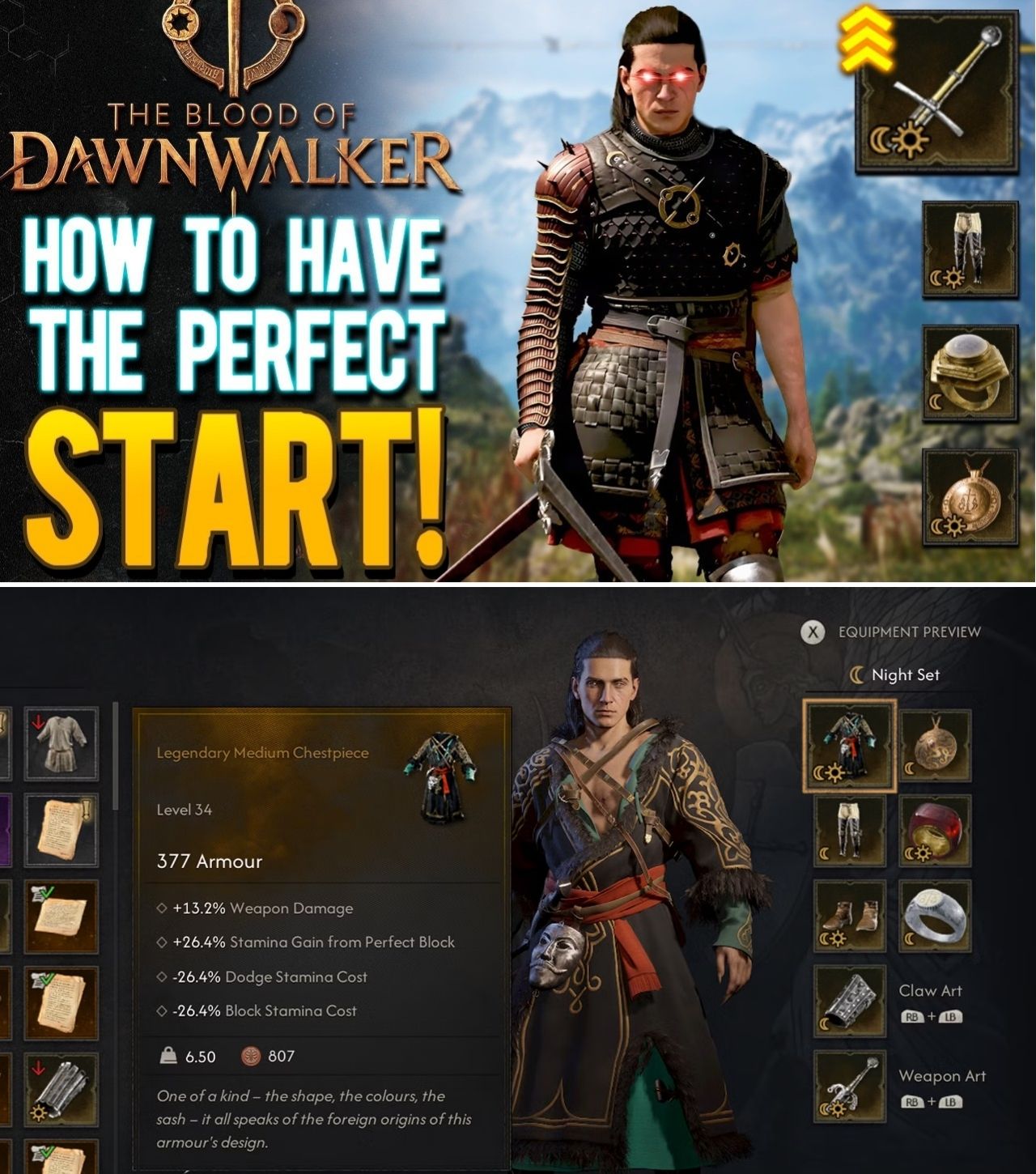
The opening hours of The Blood of Dawnwalker can be deceptively dangerous.
Coen begins his journey with limited equipment, a relatively small collection of abilities and plenty of reasons to stay close to the story. But the game is designed around exploration, optional encounters and a constantly moving clock, meaning players who simply follow the main path can easily miss some of the strongest early rewards.
That has made one particular early-game strategy increasingly popular: spend the opening portion of the game preparing Coen properly before committing too deeply to the main story.
The idea is not to exploit a glitch or break the progression system. Instead, it is about understanding how Dawnwalker distributes its early rewards — and knowing which optional activities provide the biggest return for the time they consume.
One of the most important discoveries is Durandal, a Level 15 Legendary Longsword obtainable through the optional quest The Cursed Chasm. Current guides place the weapon near the starting region and describe it as one of the strongest weapons players can obtain shortly after the prologue.
But Durandal is only part of the equation.
The Biggest Mistake: Treating The Opening Like A Linear RPG
Unlike a conventional action RPG, The Blood of Dawnwalker does not necessarily reward players for rushing through the main storyline.
After the prologue, Coen has a 30-day deadline. However, time does not simply disappear while the player wanders around the open world. Instead, certain activities consume Time Segments, meaning players have considerable freedom to explore between those major commitments.
That creates an unusual strategic opportunity.
Rather than immediately burning through story objectives, players can use the opening portion of the game to gather equipment, explore nearby locations, collect resources and unlock useful abilities.
Current beginner guides emphasize the importance of managing the time system rather than treating it like a conventional real-time countdown.
The result is a very different opening rhythm:
Explore first. Upgrade Coen. Pick valuable optional objectives. Then push the story.
For players who want a smoother first playthrough, that can make a significant difference.
Durandal Is The Big Early Prize
The centerpiece of this early route is The Cursed Chasm.
The optional quest can be discovered through an innkeeper in Svartrau City, although players can also stumble across the location directly while exploring the area around the Coward’s Path Shrine. The quest ultimately leads to a ruined chasm containing the lost treasure of Knyaz Skender.
And that treasure includes Durandal.
Current guides identify Durandal as a Level 15 Legendary Longsword, making it dramatically more powerful than the ordinary weapons many players will have during the opening stages of the game.
There is, however, an important catch.
The enemies guarding the reward are not designed to be completely trivialized by a brand-new character.
The encounter culminates in a fight against an Echo, accompanied by Vidmos. The enemies can hit extremely hard if Coen arrives underprepared, and current testing suggests that attempting the encounter at a very low level can result in enemies significantly outclassing the player.
That means the best approach isn’t necessarily:
“Run directly to Durandal the moment the world opens.”
Instead, players should use the opening stretch to improve Coen enough that the fight becomes manageable.
The Cursed Chasm Has More Than Just A Sword
Another reason the route is attractive is that The Cursed Chasm isn’t simply a weapon pickup.
Completing the quest rewards 100 EXP and one Skill Point, in addition to Durandal. The location also contains additional loot, including the Treasure Map: Silver Cache, which leads into another quest, Finders Keepers.
That makes the activity unusually efficient for an early-game detour.
One optional objective can potentially provide:
A Legendary Longsword
A Skill Point
Experience
Additional loot
A Treasure Map leading to another reward
For a game built around limited time and meaningful choices, that kind of reward density matters.
Don’t Ignore The Area Around The Chasm
Players who make the trip to The Cursed Chasm should also resist the temptation to immediately grab Durandal and leave.
PowerPyx specifically recommends looting the surrounding area before departing, including a nearby gold barrel that can trigger Finders Keepers. The same guide also points out that Ancient Circle: North-West Pass is located further through the area.
That is exactly the type of efficiency the two-hour opening route is built around.
Instead of making several separate trips across the map, players can stack objectives geographically.
Go somewhere once.
Complete everything valuable nearby.
Then move on.
It is a simple concept, but particularly important in Dawnwalker because the game deliberately forces players to make decisions about what deserves their limited time.
Ancient Circles Can Also Improve The Opening
Ancient Circles are another important piece of the early progression puzzle.
Current guides identify 13 Ancient Circles throughout the game, with these locations capable of providing skill-related rewards and other valuable items.
That makes nearby Ancient Circles particularly attractive when planning an efficient opening route.
The important point isn’t that players need to collect every single one immediately.
They don’t.
The smarter strategy is to prioritize locations that are naturally close to objectives you’re already completing.
That turns exploration into progression rather than wasted travel.
Skill Points Matter More Than Players Might Expect
A powerful weapon can immediately make Coen feel stronger, but Skill Points are arguably even more important for building a long-term character.
Dawnwalker divides Coen’s capabilities between his human and vampire sides, with different approaches available depending on the time of day and his current state.
That means players should think carefully before spending early Skill Points simply because a new ability looks interesting.
The game supports multiple approaches to combat and exploration rather than forcing every player into the same build.
For example, Coen’s vampire progression includes Shapeshift, which allows him to transform into a wolf for faster exploration at night. Guides identify it as part of the Vampirism skill tree, while the daytime counterpart is Mercurial Fervour.
That makes movement abilities especially valuable for players who intend to explore aggressively.
A faster character can cover more ground between major objectives, reach optional locations more easily and spend less time simply travelling.
Use The Vampire Side Strategically
One of the most interesting elements of the early-game route is that Coen isn’t simply a swordsman.
He is a human during the day and a vampire at night.
That distinction fundamentally changes how exploration works.
The Vrakhir form can also be useful when navigating difficult terrain. Current Durandal guides specifically mention using Vrakhir traversal tools, including Clawride, to descend into the chasm more quickly.
This is another example of why understanding the game’s systems can save significant time.
A player who approaches every location like a conventional open-world RPG may spend minutes searching for paths.
A player who understands Coen’s movement options can sometimes approach the same location from an entirely different angle.
But Don’t Turn The Two-Hour Route Into A Race
There is one major misconception surrounding “perfect start” guides.
The objective isn’t necessarily to complete as much content as physically possible in 120 minutes.
It is to make those first decisions count.
The game’s time system is specifically designed around meaningful choices. Certain quests and activities consume Time Segments, so rushing into every optional objective can actually be counterproductive.
The best opening route therefore depends partly on the player’s build, difficulty and comfort with combat.
Someone playing on a higher difficulty may want to spend more time acquiring experience and learning Coen’s combat mechanics before attempting The Cursed Chasm.
A more experienced player may be comfortable going for Durandal much earlier.
Current guides generally point toward roughly Level 11 as a more manageable point for the Echo encounter, although lower-level attempts are possible for players willing to accept the additional difficulty.
Why This Route Is Becoming So Popular
The appeal of the strategy is simple.
It gives players a feeling of control over a game that intentionally creates uncertainty.
Instead of entering every new story sequence wondering whether Coen has enough equipment, players can establish a stronger foundation first.
A Legendary Longsword provides immediate offensive power.
Additional Skill Points open up more progression options.
Ancient Circles and optional locations provide further opportunities for upgrades.
And completing nearby objectives together minimizes unnecessary travel.
None of this guarantees an effortless playthrough. Dawnwalker remains a game where enemy encounters can punish careless play, particularly early on.
But it can remove some of the unnecessary friction.
The Perfect Opening Is About Efficiency, Not Power Alone
The most important lesson from the current early-game guides is that The Blood of Dawnwalker rewards players who think about routes rather than individual rewards.
Durandal is undoubtedly attractive, but the real advantage comes from combining several systems.
Explore the starting region.
Identify valuable optional objectives.
Collect nearby rewards.
Use Ancient Circles when they’re on the way.
Spend Skill Points deliberately.
Take advantage of Coen’s human and vampire abilities.
And most importantly, pay attention to how many Time Segments each activity consumes.
That approach can produce a dramatically stronger Coen without requiring players to grind endlessly.
The early hours are therefore less about becoming overwhelmingly powerful and more about avoiding inefficient decisions.
And with Durandal waiting inside The Cursed Chasm, there is at least one particularly tempting reason not to follow the obvious path.
For players starting The Blood of Dawnwalker at launch, those first two hours may be far more important than they initially appear.