Don’t Miss The Best Start In The Blood Of Dawnwalker: Essential Early-Game Tips You Need To Know
DON’T START BLOOD OF DAWNWALKER WRONG… 👀
The first few hours can set up your entire run — and the game barely tells you what you should prioritize.
There are easy early rewards, powerful upgrades, hidden opportunities, and even a Legendary weapon you can grab surprisingly early.
But there’s a catch…
Some activities consume precious Time Segments, while others don’t. And if you waste those early opportunities, you may end up making the rest of the game harder for yourself.
So what should you do FIRST?
Which areas are worth exploring?
Which skills should you prioritize?
And when should you go after that early Legendary gear?
Here’s the perfect early-game checklist before you start burning through your 30-day countdown. 🔥
👇 Check the full guide before making your first big decisions.
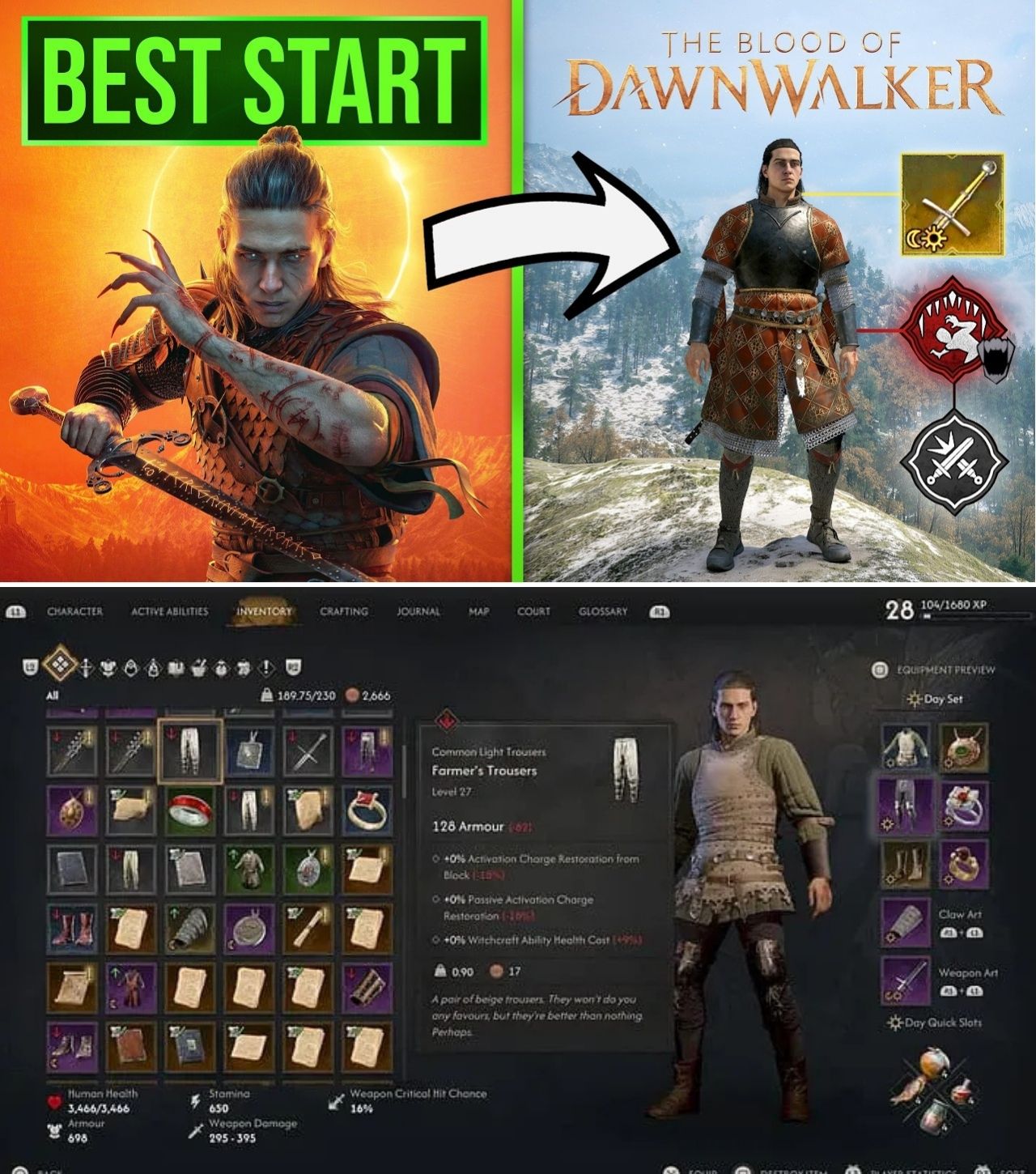
Don’t Miss The Best Start In The Blood Of Dawnwalker: Essential Early-Game Tips You Need To Know
Starting The Blood of Dawnwalker can be surprisingly overwhelming.
The game drops Coen into a dangerous open world, gives players a 30-day objective, three distinct progression paths and a huge number of optional activities — then largely leaves it up to the player to decide what matters.
That freedom is one of the game’s biggest strengths.
It can also make the opening hours easy to waste.
Fortunately, several launch-era guides and player discoveries now paint a much clearer picture of how to approach the beginning of the game. The key is not simply to rush toward the main story. Instead, players should use the opening hours to establish a strong foundation, unlock useful upgrades and explore efficiently before committing their limited time to major activities.
And perhaps most importantly, players should understand one rule early:
Exploration itself does not consume Time Segments.
That changes almost everything.
Don’t Be Afraid To Explore First
The 30-day countdown sounds terrifying when you first encounter it.
But The Blood of Dawnwalker is not constantly draining the clock while Coen walks around the map.
According to PC Gamer’s extensive beginner advice, players can spend considerable time exploring without immediately advancing the countdown. Time is primarily consumed when Coen commits to specific activities.
That means there is little reason to sprint blindly from one main quest marker to another.
Instead, players should investigate the surrounding area first.
Look for points of interest.
Find towers.
Check nearby camps.
Locate shrines.
Identify optional objectives.
And only then decide which activities are actually worth spending time on.
This is particularly important because some rewards can be collected simply by exploring, while others require Coen to commit a Time Segment.
The distinction becomes one of the most important concepts to understand during the opening hours.
Climb The Scouting Towers
One of the easiest early improvements is also one of the most useful.
Scouting Towers can reveal points of interest across the surrounding region. PC Gamer recommends climbing them at night, when Coen can take advantage of his vampire abilities, with towers helping reveal locations that would otherwise remain hidden.
GamesRadar similarly recommends visiting the towers around Laslea and the Marshes early in the game.
The advantage isn’t simply having a prettier map.
Revealing points of interest gives players a much better understanding of where optional rewards, activities and potential quests are located.
That makes subsequent exploration considerably more efficient.
Instead of wandering around hoping to discover something useful, Coen can begin working through a deliberately planned route.
Clear The Nearby Soldier Camp
Another straightforward early objective is the soldier camp outside Laslea.
GamesRadar recommends clearing this camp because it provides a useful collection of early rewards and better equipment.
It isn’t necessarily the most spectacular loot in the entire game.
That’s not the point.
Early combat encounters can provide experience, equipment and resources while simultaneously helping players learn Dawnwalker’s directional combat system.
For a new player, that combination is valuable.
You aren’t simply fighting enemies for the sake of fighting them.
You’re building familiarity with Coen’s combat while improving the character you’ll take into harder encounters.
Learn The Perfect Block Timing
Combat in The Blood of Dawnwalker has a mechanic that becomes extremely important once enemy encounters become more demanding.
PC Gamer recommends watching the directional shield indicator rather than simply trying to guess the exact moment an enemy attack lands.
When the shield turns orange, that’s the cue for a Perfect Block. Players can then combine it with Perfect Riposte for a powerful counterattack.
This is one of those mechanics that can dramatically change the difficulty curve.
A player who constantly blocks normally may survive.
A player who learns to recognize Perfect Block timing can start controlling encounters instead.
That is particularly useful when tackling optional enemies guarding valuable rewards.
Don’t Ignore Swordmastery
Coen’s progression is divided across Swordmastery, Witchcraft and Vampirism, with each tree supporting a different part of his identity.
Swordmastery is particularly important because it remains useful throughout the day and night.
Current launch guides recommend finding Swordmastery Manuals through sources such as Bandit and Soldier Camps or blade instructors.
This is important because simply collecting Skill Points isn’t enough.
Higher-tier progression can also depend on Manuals, meaning players who want to develop a particular combat style should actively search for them rather than assuming the skill tree will automatically unlock everything.
Your Vampire Abilities Are Not Just For Combat
One of the biggest mistakes new players can make is treating Coen’s vampiric abilities purely as combat tools.
They aren’t.
They also change how quickly and efficiently you can navigate Vale Sangora.
One particularly useful example is Shapeshift, which allows Coen to transform into a wolf and gain Haste during nighttime exploration.
Its daytime counterpart is Mercurial Fervour.
These abilities can make exploration substantially more convenient, particularly when you’re trying to move between optional objectives without wasting real-world time.
The larger lesson is that Dawnwalker rewards players who think about Coen’s two identities together.
Human abilities aren’t simply “day abilities.”
Vampire abilities aren’t simply “night combat abilities.”
Each side can influence how efficiently you approach the entire game.
Don’t Waste Blood
Blood is another resource that becomes increasingly important as Coen embraces his vampire nature.
PC Gamer recommends looting human and animal corpses because they can provide blood consumables, while drinking blood also contributes to Corruption. Certain vampiric progression opportunities are connected to acquiring Vrakhiri blood.
That means players shouldn’t automatically walk away from every defeated enemy.
Looting can provide resources that support Coen’s survival and progression.
The same applies to animals.
Wolves, boars and other creatures can also become useful sources of experience and blood-related resources.
And there’s another major advantage:
Killing enemies does not itself consume a Time Segment.
PC Gamer specifically highlights enemy hunting as an efficient way to gain experience without advancing the countdown.
That makes opportunistic combat an attractive way to strengthen Coen while exploring.
Go After Durandal Early — But Don’t Rush Blindly
If there’s one early-game reward that has captured players’ attention, it is Durandal.
The Legendary Longsword can be obtained through The Cursed Chasm, an optional activity in the Briar Sloughs area.
Current launch guides describe Durandal as one of the earliest major Legendary weapons players can obtain. Insider Gaming reports finding the weapon during the first hour of its playthrough, along with additional high-quality equipment including Artisanal Bracers and the master-tier Rebel’s Sturdy Coat of Plates.
But there is an important warning.
The Cursed Chasm isn’t a free loot chest.
Players must deal with an Echo wraith and its minions, and the encounter can be extremely dangerous for an underprepared Coen. The activity also consumes two Time Segments.
So the smart strategy isn’t necessarily to sprint there immediately after gaining access to the open world.
Instead, prepare first.
Improve your equipment.
Learn the combat system.
Pick up some Skill Points.
Then make the trip.
That way, the reward becomes an early power spike rather than an unnecessary death march.
Ancient Circles Are Worth Planning Around
Ancient Circles are another major part of an efficient opening.
Current guides identify 13 Ancient Circles throughout Vale Sangora. They provide high-rarity equipment and skill-related rewards, but they can only be activated during the day and each activation consumes a Time Segment.
That creates an important strategic rule:
Don’t activate an Ancient Circle simply because you happen to find one.
Look at your route.
Ask what else is nearby.
If an Ancient Circle is next to another important objective, combining those activities can make your time investment much more efficient.
This is the broader philosophy that makes Dawnwalker different from many open-world RPGs.
The question isn’t simply:
“What reward do I get?”
It’s:
“Is this reward worth the Time Segment I’m spending?”
Sell Valuable Loot Instead Of Hoarding Everything
Money can also become surprisingly useful early on.
PC Gamer specifically recommends selling silver found during exploration at the shop in Svartrau, describing it as a fast way to build up money.
That means players shouldn’t automatically fill their inventory with valuables and forget about them.
Regularly converting excess loot into useful currency can give Coen more flexibility when purchasing equipment, supplies and other resources.
At the same time, don’t sell everything indiscriminately.
Quest items, upgrade materials and unique equipment should obviously be treated differently.
The goal is to turn genuinely disposable valuables into resources you can immediately use.
Spend Skill Points With A Plan
Another common beginner mistake is spending Skill Points simply because an ability is available.
The current skill system makes planning more important.
Swordmastery, Witchcraft and Vampirism each serve different roles, and higher-tier abilities can require Manuals or other conditions. Current guides also emphasize that training skills itself can advance the clock, meaning Skill Points and Time Segments should be considered together.
This creates an interesting decision.
You may have enough Skill Points for an upgrade.
But should you activate it right now?
If doing so costs valuable time, perhaps not.
The best early build therefore isn’t necessarily the one with the most abilities unlocked.
It’s the one that gives you useful abilities without wasting the limited resource that controls the entire adventure.
The Real Secret: Plan Around Time
Ultimately, the best opening strategy in The Blood of Dawnwalker isn’t about following a perfect checklist.
It’s about understanding what the game considers valuable.
Exploration is relatively cheap.
Committed activities are expensive.
Combat can provide experience without advancing the clock.
Scouting Towers can reveal useful locations.
Ancient Circles can provide excellent rewards but consume Time Segments.
The Cursed Chasm can provide Durandal and additional loot, but the encounter requires preparation.
And Skill Point progression can itself consume time.
Once those rules become second nature, the 30-day countdown becomes far less intimidating.
Instead of panicking whenever the clock moves, you start asking a much more useful question:
“What is the best thing I can accomplish with this Time Segment?”
That is the mindset that can turn the opening hours from a confusing scramble into a highly efficient start.
And for new players, that may be the single most important lesson of all.
Because in The Blood of Dawnwalker, the biggest early-game mistake isn’t necessarily choosing the wrong weapon or skill.
It may simply be spending your time on something that wasn’t worth it.