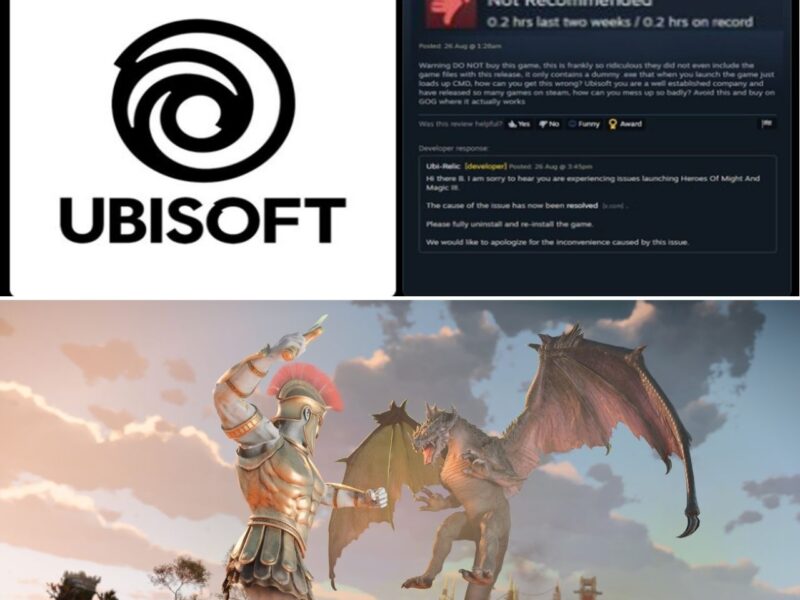
How Did Ubisoft Actually Release Heroes III on Steam Without the Game?
🚨 HOW DID UBISOFT ACTUALLY MANAGE TO RELEASE A GAME… WITHOUT THE GAME?
This wasn’t a broken quest. It wasn’t a server outage. Players weren’t greeted by crashes or missing textures.
They downloaded 23.49 KB. That’s it.
One tiny Heroes3.exe file. Then a CMD window telling them: “Dummy executable. Ensure that you are on the right Steam branch.” 💀
And that message may be the biggest clue of all…
Because if the community is right about what happened behind the scenes, this wasn’t simply “someone forgot to upload a file.”
So who approved the release?
Who checked the Steam build?
And how did nobody notice that the actual game was missing?
The bizarre explanation — and why fans are asking how Ubisoft’s release pipeline allowed this to happen — is here 👇
How Did Ubisoft Actually Release Heroes III on Steam Without the Game?
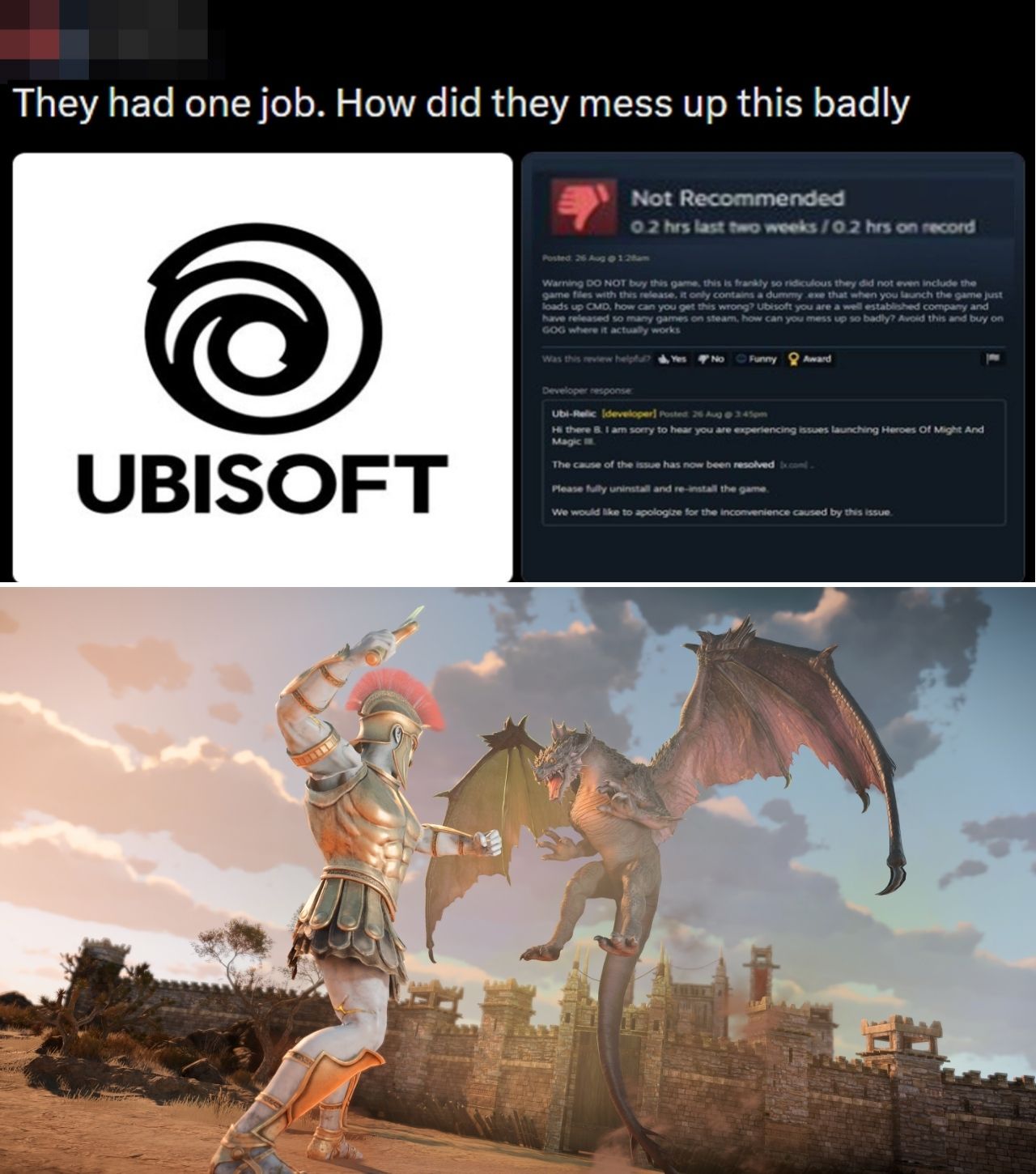
For several hours, Ubisoft’s $9.99 Steam release of Heroes of Might & Magic III Complete contained little more than a 23.49 KB executable — and the error has left players wondering how such a basic mistake made it through a modern publishing pipeline.
There are bad game launches.
Then there are launches where players discover that the game itself apparently never made it into the download.
That is exactly what happened when Ubisoft released Heroes of Might & Magic III Complete Edition on Steam this week.
The long-awaited Steam version of the classic 1999 strategy game went live on August 25, shortly after Ubisoft announced a new Heroes of Might & Magic III remake. Fans rushed to download the $9.99 release, expecting the original game alongside its Armageddon’s Blade and The Shadow of Death expansions.
Instead, some early buyers received a download weighing just 23.49 KB.
Inside was a file called Heroes3.exe.
It did not launch Heroes III.
It launched a command prompt.
The message reportedly read: “Dummy executable. Ensure that you are on the right Steam branch.”
And that second sentence may be the biggest clue to the entire incident.
The Weirdest Part Wasn’t the Missing Game
At first glance, the explanation seems almost embarrassingly simple: Ubisoft forgot to upload the game.
But technically, that may not be the whole story.
The dummy executable itself appears to have been deliberately created as a placeholder. That is important.
A random missing file would produce an error.
A deliberately compiled “dummy executable” suggests there was an expected workflow in which a placeholder build existed before the real release build was supposed to replace it.
And the executable’s own instruction — “Ensure that you are on the right Steam branch” — points toward exactly that possibility.
Several players on Reddit and Steam quickly began speculating that the public release branch had not been updated correctly before Ubisoft made the game available. One Reddit post specifically described the incident as Ubisoft apparently forgetting to update the release branch, resulting in Steam distributing the 23 KB dummy executable.
A Steam Community discussion reached a similar conclusion independently.
One player wrote that the original version with expansions was finally on Steam but suggested that “the public branch is wrong,” because launching the release simply produced the dummy-executable message. Other players confirmed they were seeing the same thing.
That is still a community diagnosis, not an official Ubisoft explanation.
But it is arguably more interesting than simply saying someone “forgot the files.”
What Is a Steam Branch?
For players who don’t work with game distribution systems, the word “branch” can sound more complicated than it is.
Steam games can have different builds or branches used for development, testing, beta releases and public distribution.
Developers may maintain one version internally while another version is made available to customers.
That means a game can theoretically have all of its correct files sitting somewhere in a development or staging environment while the public-facing branch still points to something else.
If that is what happened here, the problem wasn’t necessarily that Ubisoft had no finished game.
The problem may have been that the wrong build was exposed to customers.
That distinction matters.
It would mean the actual game files existed, but the Steam configuration used at launch did not point players toward them.
Again, Ubisoft has not publicly laid out a detailed technical postmortem explaining exactly which step failed.
But the evidence available to players makes the theory plausible.
And the dummy executable is difficult to ignore.
The 23.49 KB Download Was the Smoking Gun
The first obvious warning sign was the download size.
Heroes III is a 1999 PC game, so nobody expected a massive modern installation.
But 23.49 KB is not merely small.
It’s effectively nothing.
Players quickly realized that the installation consisted of a single executable rather than the expected game data. Steam reviews began appearing almost immediately.
One player called the release a “23.49 KB” version of the game and joked that it was the “Best CMD prompt simulator of 2026.” Another sarcastically described the download as “23.49 KB of pure nostalgia.”
The jokes spread because the error was so visually obvious.
There was no ambiguity.
There was no complicated troubleshooting procedure.
There was no debate over whether a graphics driver was causing the problem.
The file simply wasn’t there.
And Steam Didn’t Stop It
That naturally produced another question among players:
How did Steam allow this to happen?
Some community discussions quickly shifted from Ubisoft to Valve, with users asking why a store platform would allow a release to go live when the downloadable content was effectively empty.
The answer is less dramatic than some of the jokes suggest.
Steam is fundamentally a distribution platform. Developers and publishers are responsible for submitting and configuring the content they want distributed.
A platform does not necessarily know that a 23 KB executable is “wrong” simply because the game is expected to be much larger.
There are legitimate games, demos, launchers and utilities that can be extremely small.
A Steam backend can distribute a build because it has been designated for release; it doesn’t inherently understand that the publisher intended another branch or depot to be used.
That makes human and internal quality-control checks especially important.
And that brings the focus straight back to Ubisoft.
Where Was the Final Pre-Launch Check?
This is ultimately the question that has fascinated the community.
Not:
“Why did the game break?”
But:
“Why did nobody notice that there was no game?”
A normal release process can involve multiple stages: development builds, QA testing, certification, staging, store configuration, deployment and final verification.
The exact workflow varies from company to company.
But one basic sanity check should be relatively easy:
Download the public version.
Install it.
Launch it.
Confirm that the game actually starts.
If the public build really contained only the dummy executable, that check should have exposed the problem almost immediately.
And because the dummy executable literally instructed users to check the Steam branch, the incident appears particularly suggestive of a deployment or branch-selection mistake.
The irony is that the placeholder itself may have been working exactly as designed.
It was never supposed to be the finished game.
The mistake was apparently allowing players to receive it.
The Timing Made Everything Worse
The error might have been forgotten quickly under normal circumstances.
But Ubisoft had chosen this exact moment to make Heroes III the center of attention.
During Gamescom, the company announced a new Heroes of Might & Magic III remake.
The remake is planned for 2027 and is being developed using Ubisoft’s Snowdrop engine. It is intended to modernize the classic with updated visuals and other technical improvements while retaining the fundamental identity of the original.
Ubisoft also shadow-dropped the original Heroes III Complete Edition on Steam.
That was potentially a smart move.
Fans who had been waiting for the definitive classic version on Steam suddenly had an official option containing the original game and both major expansions.
Instead, the first few hours became a public demonstration of Ubisoft apparently shipping the wrong thing.
The community reaction was therefore about more than one missing download.
Some fans were already debating whether the remake would preserve what made the original special. Now the franchise’s big comeback moment was accompanied by a remarkably avoidable technical embarrassment.
Steam Reviews Turned Into a Crime Scene
The Steam review section quickly became a mixture of genuine frustration and comedy.
Some players warned others not to buy the game because the initial release contained only the dummy executable.
Others left negative reviews specifically explaining that they loved Heroes III but were rating the release, not the underlying game.
That distinction is important.
One highly visible reviewer essentially argued that the original game itself deserved no criticism because it had already been a classic for decades; the negative rating was directed at Ubisoft’s Steam release because the product could not actually be played.
Other users simply embraced the absurdity.
“Best CMD prompt simulator of 2026” became exactly the kind of joke that thrives on Steam because it simultaneously describes the technical failure and mocks the publisher.
The reviews also demonstrate something Ubisoft should probably care about: longtime fans were not necessarily angry because they disliked Heroes III.
They were angry because they really wanted it to work.
Ubisoft Eventually Fixed It
The incident did not remain unresolved.
Approximately 10 to 11 hours after the initial release, players reported receiving a roughly 770 MB update that finally added the missing game files. The game could then be downloaded and played normally.
Ubisoft also acknowledged the problem and apologized to players.
That changes the severity of the incident considerably.
This was not a permanently broken release.
There is no evidence that Ubisoft intentionally sold customers an empty product.
And there is no reason to conclude from this single incident that the upcoming remake is suffering from the same problems.
What it does demonstrate is a release-process failure that should have been caught before the game became publicly available.
The Bigger Lesson for Ubisoft
The strange thing about this story is that there is no complicated villain.
There is no sophisticated hack.
There is no mysterious exploit.
There is no massive technical failure requiring months to repair.
The game was eventually fixed with an update.
That is precisely why the incident became so funny.
Modern game development is incredibly complicated. A major AAA release can involve thousands of assets, multiple platforms, certification requirements and enormous teams.
But sometimes the most damaging mistake is also the simplest.
Did the public version contain the actual product?
For several hours, the answer was apparently no.
And that is the kind of mistake an enormous organization can find surprisingly difficult to explain because it raises questions about communication between teams rather than technology itself.
Was the correct build ready?
Was it uploaded?
Was the wrong Steam branch selected?
Did QA test the final public build?
Did someone verify the store package immediately before launch?
Those are questions only Ubisoft can definitively answer.
A Funny Disaster — For Now
The good news is that the actual Heroes III Complete Edition is now where it was supposed to be.
Players can access the classic game and its expansions on Steam, rather than a 23.49 KB command-prompt simulator.
The bad news is that the internet has already archived the evidence.
For Ubisoft, this will probably become a funny launch-day anecdote rather than a lasting product disaster.
For the Heroes community, however, it is a reminder of just how quickly expectations can turn into skepticism.
The company wanted fans to celebrate the return of one of strategy gaming’s most beloved classics.
Instead, the first question became:
“How did you forget to put the game in the game?”
Until Ubisoft provides a more detailed explanation, the exact technical failure remains uncertain.
The strongest community theory points toward a wrong or unupdated Steam release branch, supported by the dummy executable’s own warning and reports from Steam and Reddit users. But that should remain a theory, not a confirmed postmortem.
What is confirmed is considerably simpler.
Ubisoft announced Heroes III.
Ubisoft put it on Steam.
Players downloaded it.
And for roughly half a day, the download didn’t contain Heroes III.
In the brutally efficient language of the internet, there may be no better summary than this:
The game was ready. The Steam page was ready. The price was ready.
The actual game files apparently weren’t.