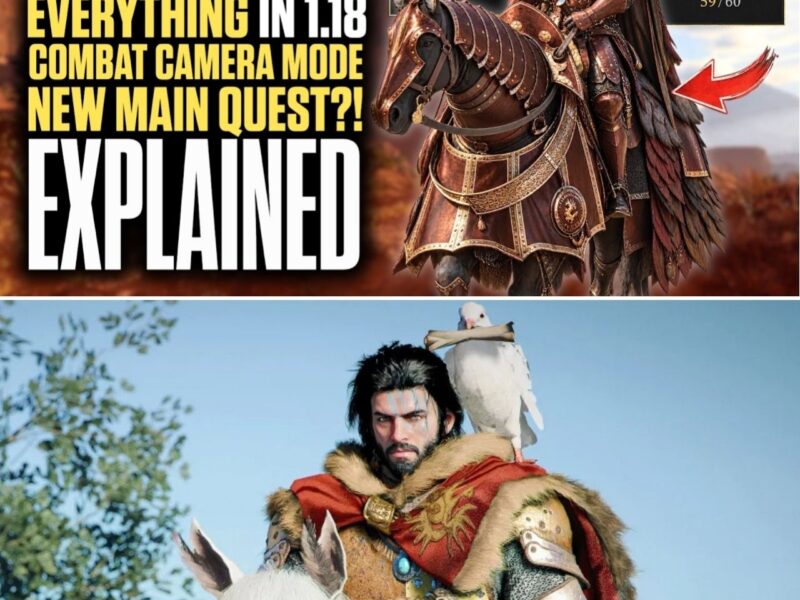
Crimson Desert 1.18 Really Added a New Main Quest? The Truth About the New Quests Category, Combat Camera Modes and Everything Else
🚨 WAIT… DID CRIMSON DESERT 1.18 SECRETLY ADD A NEW MAIN QUEST?!
Players opened the new Quests Knowledge category and immediately started wondering if Pearl Abyss had slipped new story content into Update 1.18 — but the truth is even more interesting. And the new Manual / Semi-auto / Auto combat camera system could completely change how lock-on fights feel.
There are also changes to Research, the map fog, horse gear, Force Current, Knowledge rewards and several combat-related fixes that are easy to miss…
👇 So what REALLY changed in Update 1.18 — and is there actually a new main quest? Find out here! 🔥
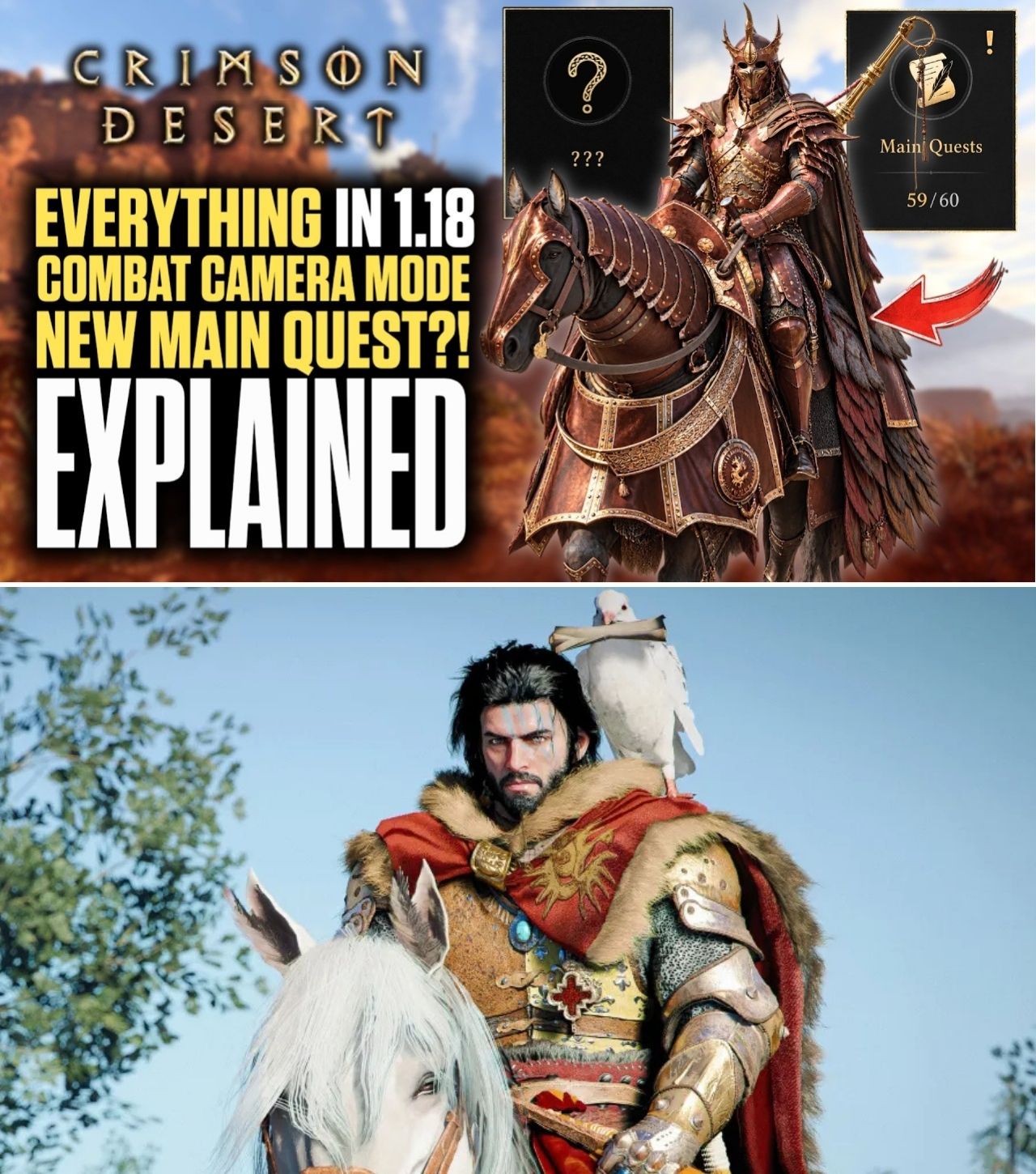
Crimson Desert 1.18 Really Added a New Main Quest? The Truth About the New Quests Category, Combat Camera Modes and Everything Else
Crimson Desert Update 1.18 has sparked confusion among players after a new “Quests” category appeared inside the Knowledge system. Despite the potentially misleading appearance, Pearl Abyss did not add a new main questline in the patch. Instead, the update reorganizes quest-related Knowledge, introduces three lock-on camera modes and quietly improves several exploration, combat and progression systems.
At first glance, Update 1.18.00 looks like a relatively modest patch.
The official description from Pearl Abyss emphasizes bug fixes, stability improvements and quality-of-life changes rather than a major content expansion. But once players began exploring the updated menus, one particular addition immediately caught attention:
Quests.
The new category appears inside Crimson Desert’s Knowledge system and includes Main Quests, Faction Quests, Investigation Quests, Research Quests, Daily Life Quests, Guide, Archive Records and Constellations.
For players who saw “Main Quests” suddenly appear as part of a newly added category, the obvious question was whether Pearl Abyss had quietly inserted another main-story mission.
The answer is no.
But that does not mean the update is insignificant.
In fact, Update 1.18 touches several systems that players interact with constantly — including the combat camera, map exploration, Research, Knowledge progression, mount management and an early story-related puzzle.
No, Update 1.18 did not add a new main quest
This is the first point that needs to be cleared up.
The new Quests Knowledge category is not a new questline.
Pearl Abyss’ official patch notes specifically describe it as a new Knowledge category containing eight subcategories. Certain quest Knowledge entries can also be granted retroactively if the associated quest has already been completed.
That means a player loading an existing save should not expect to suddenly receive a brand-new main mission simply because the “Main Quests” section now exists.
Instead, the update gives players a dedicated location for tracking Knowledge associated with quests.
That distinction is important because Crimson Desert has an enormous amount of optional content.
The more quests players complete, the harder it becomes to remember which Knowledge entries they have obtained and which ones are still missing.
The new category is essentially a tracking and organization tool, not a hidden story expansion.
VULKK’s detailed analysis of the patch makes the same distinction: the eight subcategories are not newly added quests, but a UI improvement designed to help players identify what they have already collected and what they may still be missing.
Why players could easily mistake it for new content
The confusion is understandable.
The category contains Main Quests as one of its sections.
That sounds like new content until the player actually examines what the system is doing.
The key word is Knowledge.
Crimson Desert does not simply use its Journal as a traditional list of unfinished missions. Knowledge is a broader progression system that records information discovered through exploration, interactions and quests.
By giving quest-related Knowledge its own category, Pearl Abyss is effectively creating a searchable index for that information.
For completionists, that could be considerably more useful than another quest marker.
A player trying to achieve a near-complete Knowledge collection can now open the Journal and work through specific quest-related categories instead of attempting to remember where an individual entry originated.
And because some completed quests can grant their associated Knowledge retroactively, returning players may find that the new section is populated even without replaying those missions.
The real headline: three lock-on camera modes
If the new Quests category caused confusion, the Lock-on Camera Rotation overhaul is arguably the more consequential gameplay change.
Before Update 1.18, players had essentially two choices: the feature was either enabled or disabled.
Version 1.18 replaces that with three distinct options:
Manual
Semi-auto
Auto
Pearl Abyss confirms the change in the official patch notes.
The new system can be found under the game’s input settings.
And for anyone who regularly fights bosses using lock-on, the difference between these three modes could be substantial.
Manual: maximum camera control
Manual is effectively the continuation of the previous Enabled setting.
When locked onto an enemy, the player can continue rotating the camera using the right stick or mouse.
This is the best choice for players who want maximum freedom.
You maintain the benefits of lock-on while still being able to look around the battlefield.
That can be particularly useful when fighting multiple enemies.
A hard lock-on can keep one opponent centered while other threats approach from outside the player’s immediate field of view.
Manual gives the player the ability to look around rather than allowing the camera to completely dictate their perspective.
Pearl Abyss explicitly identifies Manual as the equivalent of the previous Enabled setting.
Semi-auto: the new middle ground
This is arguably the most interesting addition.
Semi-auto allows players to rotate the camera while locked onto an enemy, but only within a limited range.
The goal is to keep the target visible without completely removing camera control.
In practical terms, this creates a compromise between traditional action-game lock-on and fully manual camera movement.
The target should remain within view, but the player still has enough freedom to adjust their perspective.
For players who previously found the old lock-on behavior too restrictive but still wanted the benefits of targeting, Semi-auto could become the preferred setting.
Community analysis has already identified this as the major new option, describing it as a mode that allows camera adjustment within a range while preventing the locked target from moving completely behind the player.
Auto: classic hard lock-on
Auto takes the opposite approach.
Once a target is locked, the camera automatically faces it and the player cannot manually rotate the camera.
This corresponds to the previous Disabled behavior of Lock-on Camera Rotation.
For one-on-one boss fights, this could be useful.
The player does not have to worry about manually keeping the camera aligned with the enemy.
But there is an obvious trade-off.
Against multiple opponents, the camera can become more restrictive.
That is why the three-mode system is more useful than simply adding a stronger lock-on.
Players can now select the behavior according to the encounter.
Which camera mode should you actually use?
There is no universal winner.
For boss fights and one-on-one encounters, Auto may be attractive because the target stays firmly in focus.
For general exploration and fights involving several enemies, Manual offers the greatest freedom.
And for players who want a compromise, Semi-auto is arguably the setting worth testing first.
It preserves target visibility while allowing some camera movement.
The important point is that this is a genuine gameplay customization option rather than a cosmetic menu change.
Players who disliked the old lock-on system now have a third choice.
Mounted ranged combat also gets fixed
The camera changes arrive alongside a small but important lock-on fix.
Pearl Abyss addressed an issue where players could sometimes fail to lock onto targets with a ranged weapon while riding a mount.
That is particularly relevant because Crimson Desert allows players to combine mounted traversal with ranged combat.
A lock-on failure in that situation could make a mechanic that should feel seamless suddenly unreliable.
The patch does not introduce a new ranged combat system.
It fixes the existing one.
That distinction is important when evaluating what 1.18 actually contains.
Research is no longer paid for with Silver
Another change that could have a much larger economic impact than its short patch-note description suggests is the adjustment to Research.
Before Update 1.18, Research consumed Silver.
Now it uses Camp Funds instead.
That effectively changes the economic pressure around the system.
Silver is one of the game’s major currencies and can be used for numerous purchases and investments.
Camp Funds, by contrast, are directly connected to the player’s camp economy.
The result is that Research now places more emphasis on camp management.
Instead of asking whether a particular research project is worth spending Silver on, players need to think about how effectively they are generating and managing Camp Funds.
For players who have neglected camp development, the change could be especially noticeable.
The map now tells you what you haven’t actually explored
Update 1.18 also addresses one of Crimson Desert’s more annoying exploration problems.
The game’s map can reveal large areas after players interact with bells, but that does not necessarily mean the player has personally explored every part of those regions.
Previously, distinguishing between “revealed” and “actually explored” could be difficult.
Version 1.18 introduces different fog visuals.
Areas that have not been revealed by a bell retain a darker fog.
Areas revealed through the bell but not yet personally explored receive a lighter fog effect.
That may sound like a minor visual change.
For completionists, it is not.
Instead of wandering around a region wondering whether a small unexplored section remains hidden somewhere, players can now use the map itself to identify the difference.
With the amount of side content and Knowledge scattered throughout Pywel, this should make 100-percent exploration considerably more manageable.
The Kilnden Workshop quest has been improved
One of the more specific changes concerns an early main-story sequence.
During Chapter IV, players encounter The Price of Knowledge → Mysterious Pot → Kiln Repair at the Kilnden Workshop.
Version 1.18 changes the interaction so that broken kiln pieces can be reattached using Force Current, the upgrade to Force Palm.
This is another example of Pearl Abyss improving an existing quest rather than adding a new one.
The patch does not create another Chapter IV mission.
It makes an existing interaction more intuitive by connecting it to an ability players already acquire.
For players who previously struggled to understand how the repair interaction was supposed to work, this should eliminate some unnecessary friction.
More Knowledge improvements are hiding in the patch
The Quests category is only one part of the Knowledge changes.
The update also improves the way certain animal Knowledge can be acquired.
For some animals, players can now gain Knowledge by picking them up instead of killing them.
That may seem like a small change, but it fits the larger philosophy behind the patch.
Knowledge collection is being made less dependent on one specific interaction.
The wording of certain boss Knowledge entries has also been improved.
And Pearl Abyss adjusted the Knowledge system so that Mysterious Invitation can be obtained after completing Read the Memory Beneath Delesyia Castle.
Again, none of this represents a new main quest.
It is about making the existing Knowledge system more coherent.
Horse gear is now easier to manage
Mount customization receives a similarly understated quality-of-life improvement.
The Stable can now be used to equip horse gear directly.
That means the Stable becomes a more complete mount-management interface.
The patch also addresses situations in which certain special mounts could become stuck while trying to cross low ledges.
For players who spend a lot of time traveling across Pywel, these may not be headline-grabbing changes, but they reduce some of the friction associated with mount management.
The update fixes more than it adds
This is perhaps the best way to understand Version 1.18.
It is not a major content expansion.
VULKK’s patch analysis explicitly describes 1.18 as lacking new major content or a major system overhaul, instead focusing on improvements to existing systems.
The official patch notes likewise lead with bug fixes and stability improvements.
Beyond the headline features, Pearl Abyss addressed issues involving:
Trading stalls and missing merchants.
High-value trade goods.
Quest progression.
Knowledge acquisition.
Mount behavior.
Ranged lock-on while mounted.
Quick-slot behavior.
Equipment and other gameplay interactions.
Graphics and rendering issues.
Stability and unexpected crashes.
There was also a follow-up 1.18.01 hotfix on August 16 addressing four additional issues, including a problem involving NPC interaction while the lantern was lit, housing items from older versions not displaying, unexpected game closures and incorrect map-area displays.
So the version players should effectively be looking at now is the 1.18 release plus that immediate hotfix.
Why the “new main quest” rumor matters
The confusion surrounding the Quests category is actually a useful reminder of how Crimson Desert handles progression.
Its Knowledge system is extensive enough that a new organizational layer can initially look like new content.
That is particularly easy to misunderstand when the category itself contains Main Quests.
But the official documentation is clear.
Update 1.18 did not add a new main questline.
It added a new Knowledge category for quests, including Main Quests as one of its eight subcategories.
For players expecting a surprise story chapter, that may be disappointing.
For completionists, however, the change could be far more useful than another isolated mission.
The community seems more interested in the camera
Community reaction has also highlighted the lock-on camera change.
A Reddit post containing the official 1.18 patch notes received hundreds of upvotes, while discussions around the update have focused on the new camera behavior, Knowledge organization and quality-of-life improvements.
The reason is easy to understand.
Camera behavior is something players experience every time they fight.
A new Knowledge category may matter when completing the Journal.
A camera setting can change every boss fight.
The addition of Semi-auto therefore has the potential to become one of the patch’s most meaningful changes despite requiring no new content.
The best way to approach Update 1.18
For returning players, there are several things worth checking immediately.
First, open the Journal → Knowledge menu and inspect the new Quests category.
Second, go into the input settings and test all three Lock-on Camera Rotation modes rather than automatically sticking with the previous setting.
Third, check your Research options, because their resource requirement has moved from Silver to Camp Funds.
Fourth, inspect the map’s new fog distinction if you’re trying to finish unexplored areas.
And finally, visit a Stable if you’re managing horse equipment.
None of these require restarting the game.
None requires a new character.
And none represents a hidden new main quest.
So what REALLY changed in 1.18?
The simplest answer is:
More than the headline suggests, but less than the rumors imply.
There is no secret new main-story chapter.
There is no major new region.
There is no new playable character.
Instead, Pearl Abyss has taken several systems already present in Crimson Desert and made them easier to use.
The Quests Knowledge category makes progression easier to track.
The Manual / Semi-auto / Auto system gives players much greater control over combat camera behavior.
Research using Camp Funds changes the game’s economy.
The new fog system improves exploration tracking.
Force Current makes an existing Chapter IV interaction more straightforward.
And mount and Knowledge improvements remove several smaller sources of friction.
That makes 1.18 a very different kind of update from a major content drop.
It is a polish-and-organization patch designed around how players are actually using the game.
And while that may not be as flashy as a new boss or storyline, it could have a more noticeable effect on everyday play.
For players returning to Pywel after a break, the biggest surprise may therefore not be discovering a secret new quest.
It may be discovering that several systems they already knew have quietly become much easier to live with.