Black Flag Resynced Tricks Gamers? The Remake-Fatigue Debate, Simplified Combat and Ubisoft’s Microtransaction Problem
🚨 UBISOFT MAY HAVE JUST REMADE BLACK FLAG — AND REMOVED SOME OF THE THINGS THAT MADE IT GREAT. 🏴☠️💀
Black Flag Resynced looks gorgeous, reviews are mostly positive, and Ubisoft says it faithfully modernizes a beloved classic… so why are longtime fans accusing the remake of simplifying combat, removing iconic mechanics and stuffing a $60 game with microtransactions?
The hidden-blade combat is different. Enemy weapons are gone. Unarmed fighting is largely gone. And suddenly the question isn’t “Is this a good remake?”
It’s “Did Ubisoft remake Black Flag… or remake it for a completely different player?”
🔥 Click the link to see why the “Resynced” debate is getting VERY uncomfortable for Ubisoft.
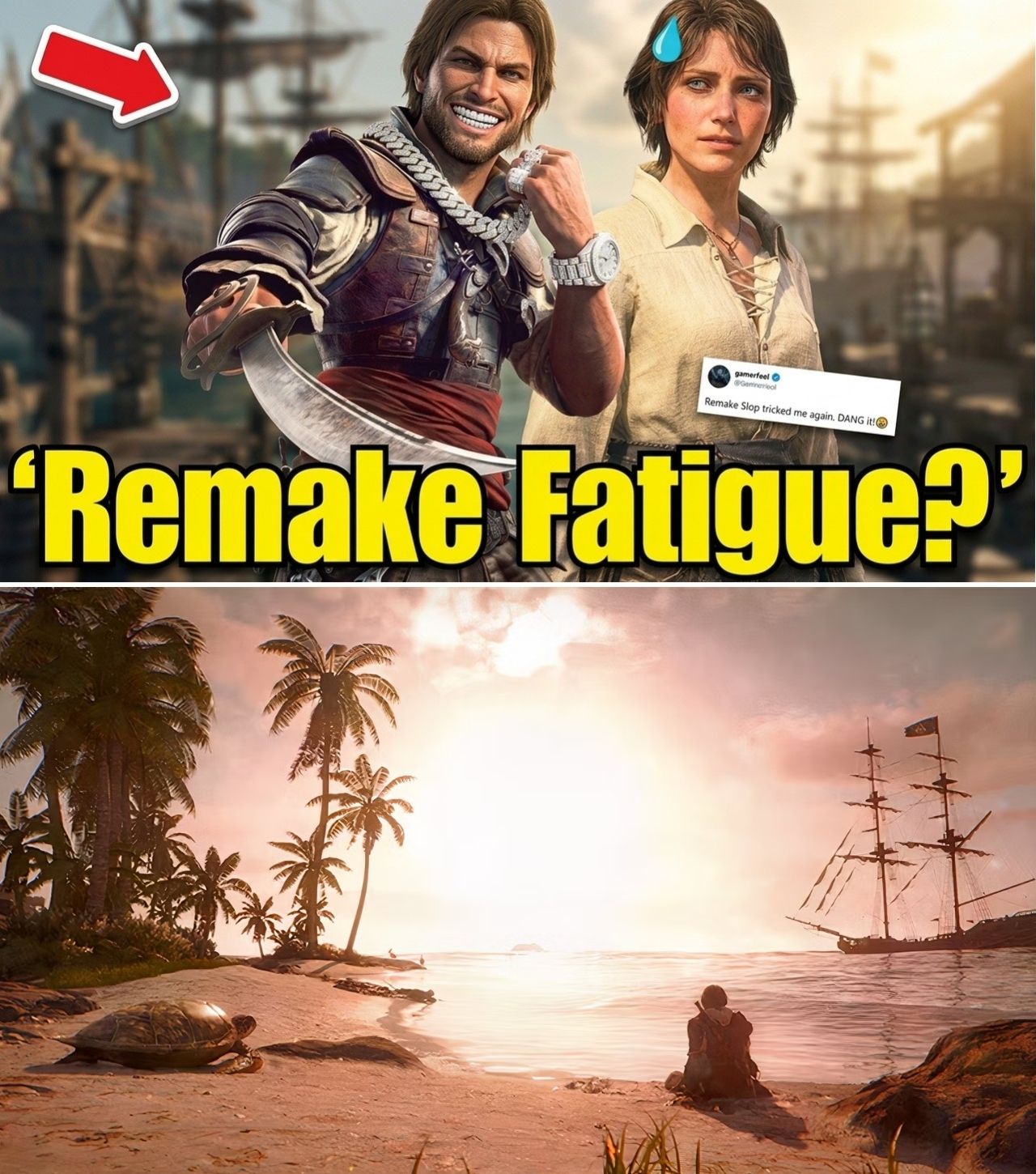
Assassin’s Creed IV: Black Flag Resynced has been praised as a beautiful and ambitious remake — but players are increasingly questioning whether Ubisoft improved the classic or stripped away some of the mechanics that made Edward Kenway’s adventure special.
For a game built around nostalgia, Assassin’s Creed Black Flag Resynced has created a surprisingly modern controversy.
The remake of Ubisoft’s beloved 2013 pirate adventure launched July 9, 2026, promising to rebuild the classic experience for current-generation hardware while preserving what made the original so popular.
The formula sounded almost impossible to criticize.
Take one of the most beloved Assassin’s Creed games ever made.
Give it modern visuals.
Improve the animation.
Rework the combat.
Expand the story.
Modernize stealth and parkour.
Add new missions.
Keep the beloved Jackdaw and Edward Kenway.
Sell it for $59.99.
What could go wrong?
Quite a lot, according to some longtime fans.
The game has generally received positive reviews, and one report says Ubisoft has already sold around 2 million copies.
But at the same time, negative Steam reviews have focused on a growing list of microtransactions, while players on Reddit and Steam have repeatedly complained that the remake’s new combat system actually removes options compared with the 2013 original.
That creates an uncomfortable paradox.
Resynced may be a successful remake.
It may also demonstrate why fans are becoming increasingly suspicious of the remake-heavy AAA business model.
Ubisoft promised a modern Black Flag — not simply a prettier one
The first thing that needs to be established is that Ubisoft never intended Resynced to be a simple graphical remaster.
The company describes it as a ground-up remake, rebuilt with the latest version of its Anvil engine. Ubisoft also emphasized that original developers returned to help recreate Edward Kenway’s adventure.
The studio made significant changes to combat, parkour, stealth, missions and the world itself.
There are new missions and expanded character stories.
Blackbeard and Stede Bonnet receive additional material.
Environmental layouts have been updated.
The mission structure has been modified.
The game also removes the original’s more intrusive modern-day sequences and introduces optional Animus elements instead.
Ubisoft’s objective was clearly not preservation at all costs.
It wanted to create the version of Black Flag that it believed modern audiences would enjoy.
And that distinction is at the heart of the controversy.
The biggest problem: the remake actually removes gameplay options
One of the most frequently repeated complaints from veteran players concerns combat.
The original Black Flag was not particularly complicated.
Edward could counter enemies, execute them and chain kills together.
It was flashy.
It was easy.
It was arguably too easy.
But it gave the player an enormous amount of visual spectacle and freedom.
The remake takes a different approach.
Combat has been redesigned around parrying, dodging, light and heavy attacks, and contextual finishers.
On paper, this should make fights deeper.
Some critics, however, argue that the opposite happened.
PC Gamer’s review pointed out that while the new combat is arguably more engaging than the original’s counter-and-instant-kill system, the remake actually reduces Edward’s combat options.
That is a remarkable criticism for a remake.
The developers attempted to modernize the combat.
But in doing so, they removed some of the toys players used to enjoy.
Edward’s hidden blades are no longer a primary combat weapon in the same way.
Players cannot freely steal enemy muskets, sabers or heavy weapons.
The original’s unarmed combat and weapon-disarming mechanics have also largely disappeared.
That isn’t speculation.
Players have repeatedly pointed out the loss of those systems in Steam and Reddit discussions.
And that is where the “simplified gameplay” accusation comes from.
More complicated combat doesn’t necessarily mean deeper combat
This is perhaps the strangest part of the debate.
Ubisoft’s new system is mechanically more contemporary.
But several reviewers have described it as simplified.
One review from But Why Tho? described the combat as a streamlined version of the recent Assassin’s Creed system, with one primary attack button, heavy attacks, dodges, parries and takedowns. The reviewer considered it functional but repetitive.
Another review at Too Much Gaming was much harsher, describing the combat as essentially repeatedly attacking until an enemy becomes vulnerable to a takedown.
Gadgets 360 similarly criticized the sword combat while noting that the remake’s parkour and stealth systems have been significantly modernized.
The criticism isn’t necessarily that the new combat is difficult.
It’s that it can feel less expressive.
In the original, an enemy could drop a weapon.
Edward could pick it up.
A heavy enemy could be disarmed.
A musket could become part of the player’s arsenal.
A fight could evolve organically depending on what was happening around the player.
In Resynced, the player has a more tightly controlled combat language.
It may be cleaner.
It may be easier to balance.
But for some fans, it is less interesting.
Reddit is split — and that’s important
The online reaction isn’t remotely unanimous.
One Reddit comparison posted after launch praised Resynced for adding manual combos, dodge and kick mechanics while acknowledging that the original still had superior weapon variety, hidden-blade combat, musket combat, heavy weapons and unarmed fighting.
Another Reddit user who gave the remake a 9/10 said the visuals were stunning but specifically missed the original counter-kill system and the ability to pick up weapons and muskets.
Meanwhile, another player who finished roughly 71 hours called Resynced an excellent remake and argued that Ubisoft had successfully modernized a classic while preserving its core.
That split is revealing.
The argument isn’t really:
“Black Flag Resynced is bad.”
It’s:
“Is the new version actually better than the old one?”
Those are two very different questions.
The parkour debate is similar
The original Black Flag used the older Assassin’s Creed parkour philosophy.
Movement was heavily contextual.
The player had considerable control over Edward’s climbing and traversal states.
Resynced instead adopts a more modern system influenced by later Assassin’s Creed titles.
There are manual jumps, wall ejects and a more fluid traversal system.
Gadgets 360 described the remake’s parkour as more fluid and arguably the best the series has offered since the RPG era, while acknowledging that it sacrifices some of the technical precision associated with the older games.
That trade-off essentially summarizes the entire remake.
Old Black Flag: more deliberate, sometimes clunky, but distinctive.
Resynced: smoother, more accessible, but potentially less mechanically expressive.
Neither philosophy is objectively correct.
But longtime fans may understandably prefer the one they originally fell in love with.
Ubisoft also removed some of the original’s frustrations
Not every change should be viewed negatively.
One of the remake’s improvements is its approach to mission failure.
The original Black Flag contained several tailing sequences where being detected could immediately cause a mission failure.
Resynced reduces the number of those missions and allows detection to transition into combat or pursuit instead of automatically forcing a restart.
That is exactly the kind of modernization that makes sense.
The remake also removes some of the original’s dated modern-day segments, streamlining the experience around Edward and the Caribbean.
Accessibility improvements are another significant benefit.
An accessibility review praised features including extensive control remapping, subtitle customization and changes to underwater sections, while also criticizing some of the new combat’s accessibility limitations.
So the remake isn’t simply removing things.
It is replacing old systems with new ones.
The question is whether the exchange is worth it.
Then comes the remake-fatigue argument
This controversy is bigger than Black Flag.
Over the past several years, AAA publishers have increasingly turned toward remakes and remasters.
There is a straightforward economic reason.
A known IP reduces marketing risk.
A beloved game already has an established audience.
The characters are recognizable.
The story already has proven appeal.
And nostalgia itself becomes part of the marketing campaign.
For Ubisoft, Black Flag is arguably the perfect candidate.
It is widely considered one of the strongest Assassin’s Creed games.
Its pirate setting remains popular.
Its naval combat became one of the franchise’s most celebrated features.
And Edward Kenway remains one of the series’ most recognizable protagonists.
But that also creates a problem.
Why spend years waiting for something new when the publisher can sell you something you already loved?
That is the fundamental criticism behind remake fatigue.
And Resynced has arrived at precisely the moment when consumers are increasingly questioning how much nostalgia-driven AAA gaming they actually want.
But the $59.99 price makes the debate more complicated
Ubisoft’s U.S. store lists the Standard Edition at $59.99, while the Deluxe Edition costs $69.99.
On the surface, that isn’t an outrageous price for a major modern remake.
In fact, compared with many $70 AAA releases, $60 can look relatively reasonable.
But the comparison becomes less comfortable when players remember that the original Black Flag remains widely available.
The consumer is therefore effectively being asked:
Do you want to buy the classic game again, rebuilt with modern technology and redesigned mechanics?
For newcomers, the answer may easily be yes.
For someone who still owns the 2013 version, the value proposition is much harder.
And then Ubisoft added another ingredient.
Microtransactions.
The microtransaction controversy is real
This is where the “cash grab” accusation gains some credibility.
Ubisoft’s store lists a series of paid DLC items for Black Flag Resynced.
The current store listings include resource packs, map packs, naval packs and character packs, with individual items listed at prices such as $4.99 and $9.99.
That doesn’t automatically mean the base game is incomplete.
And Ubisoft has explicitly defended the system.
In response to criticism over the microtransactions, Ubisoft said the paid DLC was not required to experience the “full, complete experience” of the game.
That distinction is important.
Optional cosmetic or convenience purchases aren’t the same thing as locking campaign content behind a paywall.
But consumer frustration doesn’t necessarily disappear simply because the purchases are optional.
Players are looking at a $59.99 remake of a 13-year-old game.
Then they see a storefront containing additional paid content.
For some, that creates the impression that Ubisoft is monetizing nostalgia as aggressively as possible.
The irony is that Ubisoft explicitly wanted to avoid the RPG formula
There is an interesting contradiction here.
Ubisoft has been very clear that Black Flag Resynced is not an RPG.
There are no traditional levels or gear scores.
The publisher has emphasized that the remake remains an action-adventure experience rather than following the RPG structure of Origins, Odyssey and Valhalla.
That is actually good news for many longtime fans.
The franchise spent years moving toward enormous RPG systems.
Resynced is deliberately moving back.
But then Ubisoft introduces weapons, upgrades, customization and paid DLC.
The result is not the full RPG formula.
It is something more restrained.
And that may be exactly why some players feel the game has become streamlined without becoming genuinely deeper.
Critics and players aren’t even arguing about the same problem
This is where the online debate gets messy.
Some players are complaining about:
Simplified combat
Removal of weapon pickups
Removal of unarmed fighting
Different parkour
Changed animations
Streamlined stealth
Others are primarily concerned about:
Microtransactions
Paid DLC
Ubisoft’s broader monetization strategy
Remake fatigue
And another group simply loves the remake.
One recent Reddit post from a player who started the franchise with Resynced described the game as an excellent introduction and said it encouraged them to explore older Assassin’s Creed titles.
That is arguably the most important defense of the remake.
A remake doesn’t necessarily exist for the people who played the original in 2013.
It may exist for the people who didn’t.
For new players, Resynced may actually be the better Black Flag
This point can get lost in nostalgia.
Someone who has never played Black Flag isn’t comparing two combat systems.
They aren’t missing the old musket pickups.
They aren’t remembering how Edward moved in 2013.
They simply see a gorgeous pirate adventure with modern controls, updated visuals, additional story content and improved accessibility.
From that perspective, Resynced could be the definitive way to experience Edward Kenway’s story.
One review called it a “thrilling and well-designed remake,” praising the redesigned missions, expanded story and visual overhaul.
That doesn’t mean longtime fans are wrong.
It means the target audience may have changed.
And that may be the real trick
Perhaps Black Flag Resynced isn’t trying to convince you that the original was bad.
It is trying to convince you that you need a new version anyway.
That’s a very different sales proposition.
The original remains beloved.
The remake doesn’t have to replace it.
It simply has to persuade enough people that a modern interpretation is worth purchasing.
And early sales suggest Ubisoft may have succeeded.
Reports indicate the remake reached approximately 2 million copies sold, while critical reception has generally been favorable.
That makes the “cash grab” accusation harder to sustain as a simple commercial-failure narrative.
If anything, Ubisoft has demonstrated that there is still substantial demand for premium remakes of beloved Assassin’s Creed games.
But commercial success doesn’t settle the creative argument
A game can sell millions and still make questionable design decisions.
The opposite is also true.
A brilliant game can sell poorly.
So sales shouldn’t determine whether the remake improved Black Flag.
The more interesting test is what happens when players compare the two versions directly.
And that’s where Resynced has a genuine weakness.
Some of the most celebrated features of the original have not merely been modernized.
They have been removed.
Weapon pickups.
Certain hidden-blade interactions.
Unarmed combat.
Enemy disarming.
Some of the old combat animations.
Those aren’t technical limitations.
They are design choices.
And players are perfectly justified in asking why a remake would remove options from a game that already had them.
The original’s “simple” combat may have been smarter than it looked
There is an important distinction between mechanical complexity and player expression.
The original Black Flag combat was mechanically simple.
Counter.
Attack.
Dodge.
Shoot.
Disarm.
Pick up weapon.
Kill.
But those simple systems interacted in entertaining ways.
The player could improvise.
The remake’s combat is arguably more structured.
Parry this.
Dodge that.
Reduce the enemy’s shield.
Wait for the takedown prompt.
Execute.
It can be more technically modern while feeling less expressive.
That is why some players describe it as simplified.
Not because there are fewer buttons.
But because there may be fewer meaningful choices.
The most revealing criticism may come from PC Gamer
PC Gamer’s review essentially captures the contradiction.
The new combat is objectively more sophisticated than the original’s famously easy counter-kill system.
Yet the remake removes many of the tools that made Edward fun to control.
That is an important distinction.
Better-designed combat doesn’t automatically produce a better Black Flag experience.
The game isn’t merely a generic action game.
It’s a pirate fantasy.
Edward is supposed to feel like a resourceful pirate who can improvise with whatever weapon is available.
If the player is locked into a much smaller combat vocabulary, something about that fantasy inevitably changes.
So is Black Flag Resynced a cash grab?
The factual answer is:
There isn’t enough evidence to call it simply a cash grab.
The game contains substantial new work.
There are redesigned missions.
New story content.
Updated environments.
A rebuilt engine.
Modernized combat.
New accessibility features.
Additional gameplay systems.
And a significant visual overhaul.
Those are not the characteristics of a simple remaster designed to extract money for minimal effort.
But criticism of Ubisoft’s monetization is legitimate.
The game costs $59.99.
The Deluxe Edition costs $69.99.
And Ubisoft sells additional paid packs and DLC.
That makes it understandable why some players see the project as another example of publishers monetizing nostalgia.
The truth sits somewhere between the two extremes.
The bigger question: what should Ubisoft remake next?
If Black Flag Resynced succeeds commercially, Ubisoft has every incentive to remake more classic Assassin’s Creed games.
That could mean Ezio.
Unity.
Rogue.
Perhaps even the original Assassin’s Creed.
But the lessons from Resynced should be clear.
Fans don’t necessarily want every classic game converted into the latest Ubisoft design philosophy.
They want modernization where it helps.
They want old frustrations removed.
They want better accessibility.
They want improved visuals.
They want better controls.
But they also want the identity of the original preserved.
And perhaps most importantly, they want developers to understand why the original worked in the first place.
The verdict is more complicated than “good” or “bad”
Black Flag Resynced isn’t the disaster some critics predicted.
It isn’t simply a lazy cash grab.
It isn’t universally hated.
It isn’t universally loved either.
It is a successful remake with a surprisingly divisive philosophy.
The world looks better.
The story has been expanded.
The mission design has been modernized.
The old RPG direction has been avoided.
The game has already attracted millions of players.
But the combat has lost some of the original’s weapon variety.
Some player freedoms have disappeared.
The new system can feel repetitive.
And the presence of paid DLC inevitably raises questions about Ubisoft’s monetization strategy.
That makes the title of the debate particularly appropriate.
“Resynced” may be exactly what Ubisoft wanted.
The company didn’t simply rebuild Black Flag.
It reinterpreted it.
And that is why some players are looking at the remake and asking a very uncomfortable question:
If the original was already this good… why did Ubisoft need to change the parts that made it special?
For new players, the answer may be easy.
For veterans, it may never be.
And that tension could become the defining legacy of Black Flag Resynced — not whether Ubisoft successfully brought Edward Kenway back, but whether the company understood that sometimes the hardest part of remaking a classic isn’t improving it.
It’s knowing what not to touch.