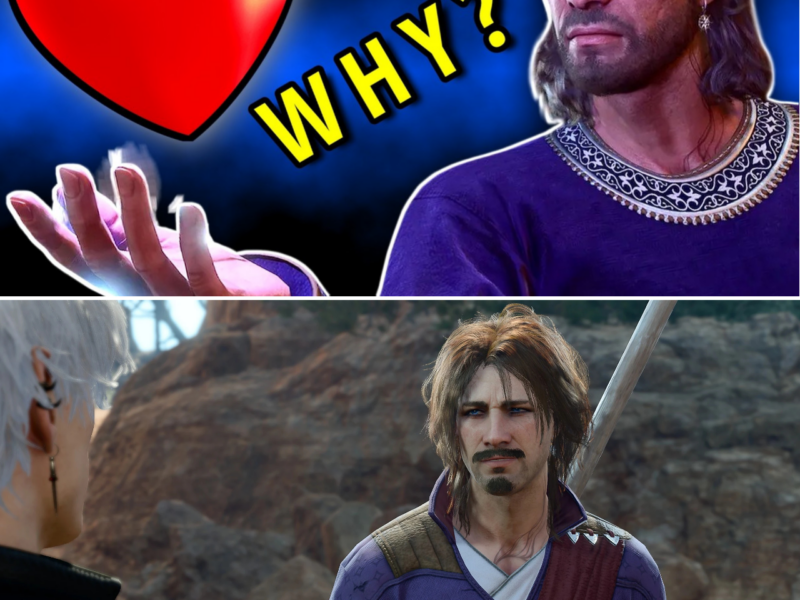
‘THE POLARIZING HATE MAGNET’: WHY BALDUR’S GATE 3 PLAYERS DESPISE GALE—AND WHY THEY’RE COMPLETELY WRONG
WHY DOES EVERYONE HATE GALE? 🧙♂️💔
He’s the Wizard of Waterdeep, a magical prodigy, and potentially a literal god… so why is Gale consistently voted the most annoying, punchable companion in Baldur’s Gate 3?
A brilliant new breakdown just exposed the actual psychological reasons behind the “Gale Hate.” Is he just a narcissistic, item-hoarding “man-baby,” or is Larian Studios hiding a tragically brilliant narrative about the crippling burden of gifted children behind that smarmy smile? 🤯
Wait until you hear the shocking truth about his Act 2 romance scene. Are you team #ProfessorGale or did you blow him up at the brain? Let the debate begin! 👇🔥
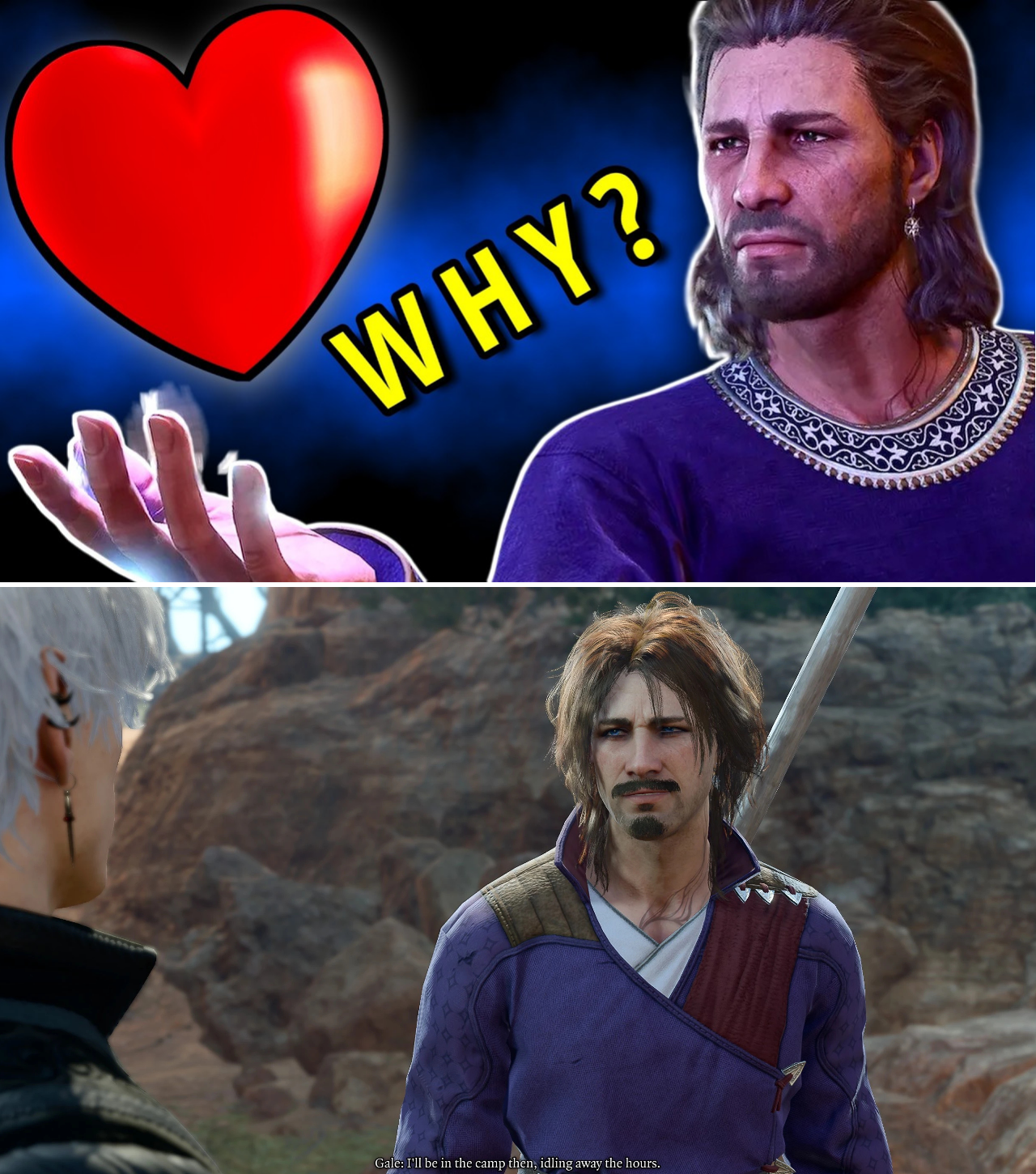
In the vast, critically acclaimed world of Larian Studios’ Baldur’s Gate 3, players are given a rich tapestry of companions to recruit, romance, and battle alongside. There’s a fiercely loyal Githyanki warrior, a brooding vampire spawn, and a fiery tiefling barbarian.
And then there is Gale of Waterdeep.
For a character who presents himself as a charming, eloquent, and helpful wizard, Gale has cultivated an astonishingly toxic reputation within the gaming community. Walk into any Reddit thread, Discord server, or X (formerly Twitter) debate regarding Baldur’s Gate 3 companions, and you will inevitably find players complaining about Gale. They call him arrogant. They call him an item-hoarding nuisance. Many outright admit they leave him trapped inside his introductory portal or intentionally blow him up just to be rid of him.
But is the “Gale Hate” actually justified?
A new, in-depth psychological and screenwriting analysis by the YouTube channel DoubleXGaming, titled “Gale: The Polarizing Hate Magnet – Baldur’s Gate 3 Analysis,” aims to clear the air. By deconstructing Gale’s cinematic cutscenes, romance arcs, and underlying character motivations, the video reveals that Gale is not just a narcissistic “man-baby”—he is arguably one of the most tragic, complex, and brilliantly written characters in modern RPG history.
THE ‘GIFTED CHILD’ SYNDROME
To understand why players hate Gale, you have to understand how Larian Studios introduces him.
When players first rescue Gale from a swirling portal in Act 1, he introduces himself with an overwhelming aura of confidence. He is eloquent, heavily titles himself (“an esteemed scholar of exceptional accomplishment”), and casually name-drops his magical prowess. When players ask him to share details about himself, he speaks strictly in terms of his resume and achievements.
For many gamers, this immediate grandstanding is a massive red flag.
“At best, you might view Gale as someone who is charming, charismatic, and very confident in himself,” DoubleXGaming notes in the analysis. “But at worst, these same traits can come off like someone who is really annoying, egotistical, full of themselves, and shallow—kind of like Jaime Lannister [from Game of Thrones].”
However, this arrogance is entirely rooted in Gale’s backstory. Gale is not suffering from blind arrogance; he is suffering from the intense psychological burden of being a “gifted child.”
As the story reveals, Gale was a magical prodigy of unparalleled talent. He grasped the weave so masterfully that Mystra—the literal Goddess of Magic—took notice. She became his teacher and, eventually, his lover. For a mortal to bed a deity out of sheer magical talent is a narrative flex that justifies his ego.
But as the analysis points out, the “prodigy” label is a heavy burden. Gale’s entire self-worth is tethered to his magical achievements. He believes he must constantly overachieve to be worthy of love, attention, and existence. When he attempted to prove his love to Mystra by returning a lost fragment of raw Netherese magic, he failed catastrophically—embedding a volatile, ticking Netherese bomb into his own chest and losing Mystra’s favor in an instant.
THE HOARDER’S DILEMMA
While Gale’s psychological baggage is compelling, a significant portion of the community’s hatred stems from purely mechanical gameplay frustrations.
Early in Act 1, Gale reveals he has a “condition” that requires him to consume powerful magical artifacts. If the player refuses, he warns of dire consequences, but he refuses to actually explain why he needs the items.
“RPG gamers specifically are hoarders. I don’t care if this ring lets me cast Light, I’m going to hold on to it,” the analysis explains. “Asking a player to part with their loot for a character they hardly know—and have no idea why—is a really hard sell… Gale feels like that one overpowered friend you play a multiplayer game with who ruins any fun.”
Larian Studios essentially forces the player to surrender hard-earned loot to a smug wizard who hasn’t properly earned their trust. If players let him die in retaliation, his necrotic aura can wipe the party, and if left dead for two days, his internal bomb detonates and permanently deletes the player’s save file. This mechanical blackmail alienated a massive portion of the player base before they ever gave his story a fair chance.
THE ROMANCE OVERLAP: ‘REDDIT MODERATOR’ ENERGY
Another major grievance leveled against Gale is his romance arc. While other companions require specific choices to trigger romantic encounters, Gale’s romance triggers are notoriously sensitive.
“His character plotline and his romance are very tightly interwoven early on. Just talking to Gale progresses his story, and by picking friendlier options, it gives Gale this magic idea that the pair of you share a romance,” the video states.
This resulted in thousands of players accidentally triggering intimate scenes with Gale when they simply thought they were being polite to a friend. When Gale earnestly monologues about how happy the player’s basic kindness makes him, it can come off as desperate or overly attached. As DoubleXGaming hilariously described it: “It kind of comes off like ‘Reddit moderator-ish.’ Is Gale a Reddit mod?”
However, for players who intentionally pursue the romance, Gale offers some of the most visually stunning and emotionally profound scenes in the game. During Act 2, facing a decree from Mystra to blow himself up to destroy the Absolute, Gale uses magic to project the player into the astral stars. He drops his pompous facade, admitting his deep-seated fears of inadequacy and his terror of dying. The scene—which can culminate in an LSD-fueled, multi-clone astral intimacy sequence—is a masterpiece of vulnerable screenwriting.
AMBITION VS. CONTENTMENT: THE FINAL VERDICT
By Act 3, Gale’s story evolves into a profound commentary on the dangers of unchecked ambition. Upon discovering the Crown of Karsus, Gale’s inner prodigy violently re-emerges. He begins fantasizing about reforging the crown to challenge the gods, attempting to prove his worth through divine power.
The player is given the agency to either feed this toxic ambition or teach Gale the ultimate lesson: that he is worthy of love simply for being Gale, the man, rather than Gale, the God of Magic.
If the player steers him toward humility, Gale receives what is arguably the most wholesome, human ending in Baldur’s Gate 3. Abandoning his thirst for godhood, he returns to Waterdeep to become “Professor Gale,” teaching young wizards at the Blackstaff Academy. In stark contrast to his Act 1 ego, he finds genuine peace and joy in a quiet, domestic life.
Conversely, players can encourage his darker instincts, allowing him to ascend as the God of Ambition—an ending that amplifies all his worst, most egotistical traits.
So, does Gale deserve the hate?
According to DoubleXGaming, the answer is a resounding no. While his mechanics can be frustrating and his early-game ego is purposely abrasive, Gale’s narrative arc is a masterclass in slow-burn redemption. He is a deeply flawed, highly ambitious man desperate to be loved for his achievements, who must learn that true power lies in contentment.
If you left Gale in that portal during your first playthrough, it might be time to start a new campaign. The Wizard of Waterdeep has a lot to teach you—if you have the patience to listen.