‘THE WALKING DEATH TRAP’: GAMER DESTROYS BALDUR’S GATE 3 BOSSES BY LITERALLY STANDING STILL IN BIZARRE ‘RETALIATION ONLY’ RUN
A mad genius just broke Baldur’s Gate 3 by beating the entire game SOLO without ever actively attacking the hardest bosses. He built an unkillable “Radioactive Porcupine” that forces gods and demons to nuke themselves just by touching him—and his final boss strategy is pure insanity…
Is this the most brilliant “Pacifist” run in RPG history, or did he completely manipulate the game’s code to survive? The BG3 community is entirely divided! 💥
Uncover the forbidden Retaliation build that’s breaking the internet right now: 👇🔥
In the ruthless, hyper-strategic world of Baldur’s Gate 3, the best defense has always been a good offense. For years, the community meta has revolved around striking first, dealing massive critical damage, and wiping out enemy forces before they can even take their turn.
But one gaming content creator has just turned that philosophy completely upside down, completing a solo run of Larian Studios’ massive RPG without ever going on the offensive.
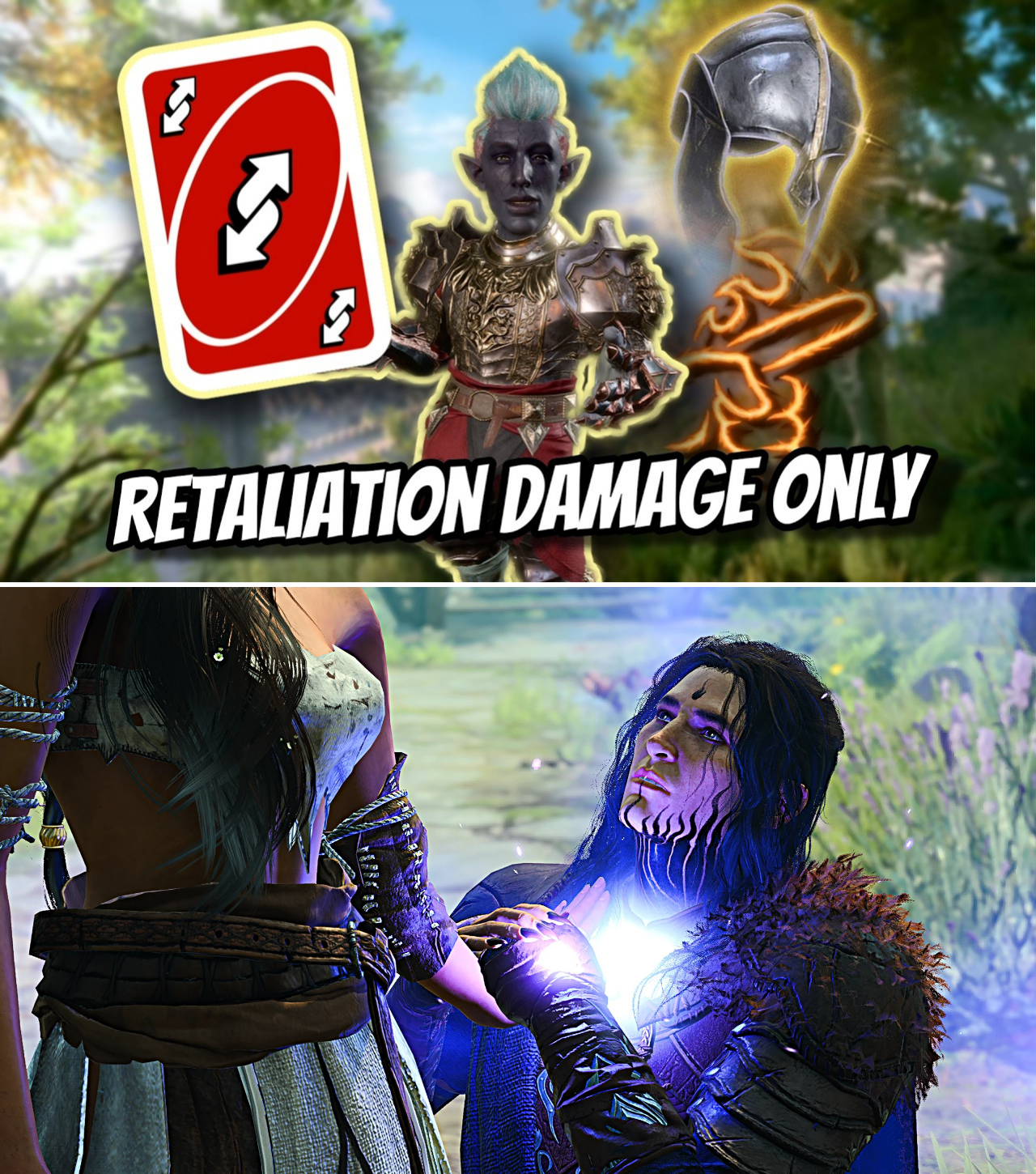
In a viral spectacle appropriately titled “Destroying Baldur’s Gate 3 Solo With Retaliation Damage!”, popular YouTuber TheTruant transformed his lone Gnome character into an untouchable, radioactive meat-grinder. By utilizing an obscure combination of reactive spells, punishing armor sets, and elemental conditions, he forced the game’s most terrifying villains—from the Apostle of Myrkul to the Archdevil Raphael—to literally beat themselves to death against his shield.
The run has sent shockwaves through the gaming community, sparking fierce debate across social media about the limits of Larian’s game engine and whether weaponizing your own explosive blood technically counts as “pacifism.”
THE ‘POISON DART FROG’ BLUEPRINT
The rules of TheTruant’s self-imposed torture test were simple but incredibly restrictive: his character, a Gnome named Rise Aliate, was strictly forbidden from initiating direct offensive attacks against enemies. He could heal, he could cast defensive buffs, and he could walk around. If an enemy wanted to die, they had to be the one to throw the first punch.
“I’ve always had a soft spot for defensive strategies in this game,” TheTruant explained to his viewers. “So I’ve set out to see if we can’t flip that strategy on its head by beating the whole game with retaliatory defense alone.”
To achieve this, he engineered a multiclass monstrosity—a Warlock/Cleric/Druid hybrid affectionately dubbed the “Poison Dart Frog.”
The build relied on stacking multiple layers of passive consequences for any enemy foolish enough to target him:
The Warlock Core: Utilizing the Fiend subclass to access Armor of Agathys (which grants temporary hit points and deals flat Cold damage to anyone who lands a melee strike) and Hellish Rebuke (a fiery reaction spell that punishes attackers).
The Cleric Battery: Taking levels in the Tempest Domain to unlock Wrath of the Storm, allowing the Gnome to strike back with Thunder or Lightning damage whenever hit, empowered by Destructive Wrath for maximized damage output.
The Druid Utility: Utilizing the Shillelagh cantrip solely to activate the passive effects of specific shields.
However, the true terror of the build came from the itemization. As the run progressed, the Gnome became a walking hazard of status effects.
If an enemy missed their attack, the Holy Lance Helm blasted them with Radiant damage. If they landed a hit, the Flesh Melter Cloak melted them with Acid damage, while the Ironvine Shield (empowered by Shillelagh) stabbed them with Piercing damage. Meanwhile, the Boots of Stormy Clamour and Gloves of Belligerent Skies constantly applied stacks of Reverberation. Once an enemy accumulated enough stacks, they would violently explode with Thunder damage and fall prone to the ground.
“We just quintupled the damage back at him,” the creator laughed in absolute disbelief during an early Act 1 encounter. “We’re literally overpowered.”
TRIVIALIZING THE SWORD COAST
The early game, usually a brutal gauntlet for solo players, devolved into a dark comedy.
When invading the Goblin Camp, TheTruant simply strolled into the center of the horde. Goblins who attempted to strike the Gnome were instantly vaporized by a combination of Armor of Agathys and Hellish Rebuke. “This is the most self-defense fight I’ve ever seen in my life,” he joked as the goblin forces decimated themselves against his impenetrable defenses. “What crimes have I committed?”
Even legendary bosses were completely ill-equipped to handle a target that refused to fight back. During the Act 1 confrontation with the hag Auntie Ethel, the boss practically deleted her own health bar. Because she continually inflicted ambient fire damage, every tick of environmental damage registered as an “attack,” triggering the Ironvine Shield to passively stab her from across the room.
But the ultimate endurance test arrived in Act 2, deep within the Mind Flayer Colony, against the Apostle of Myrkul—the avatar of the God of Death.
Because the massive skeletal boss is stationary and relies on widespread necrotic damage, the fight turned into a grueling, hour-long battle of attrition. TheTruant simply stood on the boss’s platform, soaking up hits, utilizing Protection from Evil and Good, and allowing the Apostle to slowly chip away its own health bar via retaliation damage.
“This is getting slowly cooked,” the creator noted as he meticulously managed his healing potions and spell slots for over 50 consecutive rounds of combat. “World’s slowest pork roast.” After an exhausting standoff, the God of Death finally swung one last time, taking lethal lightning damage in return and crumbling to dust.
ACT 3: ILLITHID POWERS AND THE ‘BLOOD BOMB’ LOOPHOLE
By the time the Gnome reached the city of Baldur’s Gate in Act 3, the build had reached apocalyptic levels of passive destruction.
Equipped with the Circlet of Psionic Revenge and utilizing the Illithid power Psionic Backlash, the Gnome no longer even needed to be hit with a sword. If an enemy spellcaster attempted to cast magic anywhere near him, his brain would automatically fry their nervous system with Psychic damage.
This led to a hilariously anticlimactic showdown with the Archdevil Raphael in the House of Hope. By casting Arcane Lock on the doors to isolate the boss and heavily utilizing Psionic Backlash, TheTruant watched as the legendary devil continuously damaged himself every time he attempted to use his infernal magic, eventually dying on the floor without the Gnome ever swinging a weapon.
However, the final encounter against the Netherbrain presented a seemingly impossible mechanical hurdle: The brain itself does not perform direct melee or spell attacks that trigger standard retaliation gear. How do you kill a boss that doesn’t attack you, when you aren’t allowed to attack it?
TheTruant’s solution was a stroke of absolute, chaotic genius.
Throughout the game, players can stockpile explosive smokepowder barrels and bombs. He dragged a massive arsenal of explosives to the crown of the Netherbrain and dropped them in a pile. But how could he detonate them without taking an offensive action?
Earlier in Act 2, the creator had acquired a permanent passive buff from the blood-merchant Araj Oblodra called Unstable Blood, which renders the player’s blood highly flammable. Standing directly on top of the bomb pile, TheTruant waited for the ambient damage of the boss arena to strike him. The moment he took damage, his Gnome bled. The highly flammable blood hit the floor, instantly igniting the massive pile of smokepowder bombs in a catastrophic, frame-dropping explosion that instantly wiped out the final boss.
“Yes, definitely 100% this counts as retaliation,” he declared triumphantly as the fiery shockwave cleared the screen. “We light our blood on fire… It works! That’s legit!”
COMMUNITY EXPLODES: GENIUS OR RULE-BENDING?
The video’s release caused an immediate sensation across the Baldur’s Gate 3 community, drawing thousands of comments across YouTube, Reddit, and Discord.
On the r/BaldursGate3 subreddit, players marveled at the sheer mathematical absurdity of the build, praising the creator for exposing just how complex Larian Studios’ elemental interaction system truly is.
“The fact that the Ironvine Shield triggers off environmental fire ticks because the game registers the fire as the boss’s ‘attack’ is the most ridiculous coding oversight I’ve ever seen, and I love it,” one top Reddit commenter noted.
Over on X (formerly Twitter), gaming analysts highlighted the hilarious philosophical implications of the run.
“Can we really call this a pacifist run? The guy is walking around Faerûn acting like a radioactive porcupine coated in acid and lightning,” one user tweeted. “He didn’t swing a sword, but he definitely committed war crimes.”
Others debated the legitimacy of the final boss execution. Purists argued that dropping a pile of bombs and purposefully bleeding on them to trigger an explosion borders on offensive action, while defenders argued that relying entirely on a passive biological reaction (Unstable Blood) perfectly aligns with the “retaliation” rule set.
Regardless of where fans stand on the semantics, one thing is undisputed: TheTruant has successfully proven that in Baldur’s Gate 3, you don’t need to lift a finger to save the world—you just need to make sure that anyone who touches you immediately regrets it.
As the creator joked while claiming control of the Netherbrain in the game’s final moments: “Maybe you can’t beat Baldur’s Gate 3 with Retaliation only… Oh wait, yes you can.”