
THINKING OUTSIDE THE BOX: How ‘Palworld’ 1.0 Players Are Bending Physics to Build Perfect Circular Bases
Palworld 1.0 Builders Finally Cracked The Code To Building PERFECT Circle Bases! 😱🔥
While everyone else is stuck living in ugly, jagged square boxes, elite architects just exposed a zero-mod building glitch that perfectly tracks the Palbox boundary line to create flawless, massive circular fortresses…
Are you still fighting the game’s rigid 90-degree collision physics, or have you learned the genius “Tree Fence” hack to crown your base with a floating circular forest? Tap the link below for the exact coordinates and step-by-step guide before Pocketpair patches this exploit! 👇
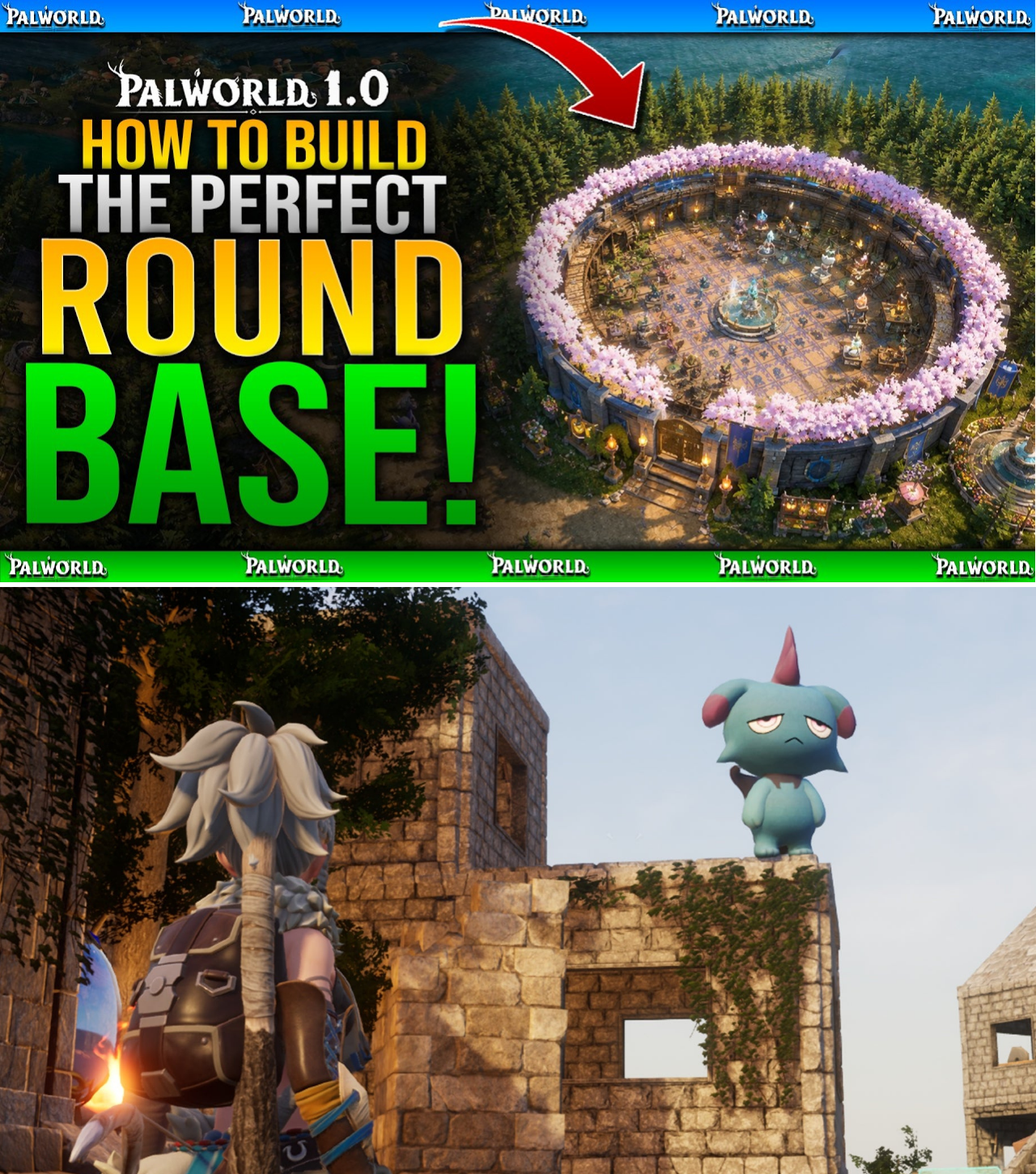
For as long as Palworld has existed, base building has been strictly governed by the tyranny of the grid. Because the game’s structural assets—foundations, walls, and ceilings—are rigidly locked to 90-degree square and triangular angles, player bases have historically looked like massive, blocky warehouses.
However, the launch of version 1.0 has ushered in a new era of architectural defiance.
Refusing to accept the limitations of the building engine, the community has discovered a zero-mod, completely vanilla method to construct mathematically perfect, multi-story circular fortresses. Highlighted in a viral building masterclass by prominent creator DPJ, this “Perfect Circle” exploit relies on manipulating the game’s defensive wall snapping mechanics to flawlessly trace the invisible boundary line of a base.
Here is a step-by-step breakdown of how Palworld architects are bending the game’s physics, and how you can construct your own circular empire.
Step 1: The Pristine Canvas
Attempting to build a massive, perfectly round structure on uneven terrain is a recipe for disaster. Structural collision will inevitably fail if the ground elevation changes. Therefore, finding a perfectly flat plain is the absolute requirement for this build.
The community has universally agreed on the prime real estate for circular builds: coordinates (-307, 68).
“I have completely flattened this land, and if you do want a flat piece of land, guys, this is a great spot right here,” confirmed DPJ in his guide. After clearing out the native trees and boulders, the player locates the absolute dead-center of the plain. By laying down a central stone (or glass) foundation and placing the Palbox directly on top, the game projects a massive, glowing blue ring indicating the absolute boundary of the base.
This blue ring is the blueprint.
Step 2: Bending the Walls (The Blue Line Exploit)
Because standard wooden or stone walls must snap to square foundations, they can never form a true circle. To bypass this, players must utilize the Stone Defensive Wall (unlocked via the Technology Tree).
Unlike standard walls, defensive walls are designed to be placed freely on terrain. However, the game possesses a hidden “soft-snap” mechanic when placing defensive walls near the Palbox boundary line.
Players run to the very edge of their base until they encounter the glowing blue boundary. By aiming their cursor directly at the blue curve, the Stone Defensive Wall will subtly snap to follow the invisible ring.
“What we’re doing here is we’re basically following the line, and you can actually turn this and rotate it by using your bumpers,” the guide demonstrates. By carefully placing a wall segment, rotating the camera a fraction of a degree, and placing the next segment so it slightly overlaps the previous one, the player manually traces the exact circumference of the blue line.
If done carefully, the player will eventually complete a massive, seamless 360-degree stone wall that perfectly outlines the base radius.
Step 3: Fixing the Foundation Gap (The “OCD” Hack)
While the exterior wall is now a perfect circle, the interior floor remains a problem. The player must fill the inside of the base with square and triangular foundations to support crafting stations and Pal beds.
Because you are trying to fit square pegs into a round hole, there will inevitably be ugly, jagged patches of exposed grass where the square foundations fail to meet the curved outer wall. For players who demand aesthetic perfection, this geometric gap is unacceptable.
To solve this, decorators utilize the game’s Furniture tab.
Players select large, decorative Bushes. Because furniture items do not abide by the rigid grid snapping rules of foundations, they can be placed entirely freehand. The player walks along the interior perimeter of the base, placing overlapping bushes to completely cover the gaps between the floor and the wall.
“A quick tip as well, rotate these slightly,” advised DPJ. “It makes them look more genuine… just rotate them every time you put them down, it just makes them look like proper bushes instead of just placements.”
The result is a flawless, organic interior border that completely masks the game’s geometric limitations.
Step 4: The Floating Forest (The Fence Glitch)
To crown the architectural masterpiece, builders often want to place decorative items on top of the massive circular wall. The ultimate flex is lining the rim of the base with massive, towering trees.
However, Palworld’s collision engine explicitly forbids placing large furniture items like trees on the narrow lip of a Defensive Wall. If a player attempts it, the game simply will not register a valid surface to build on.
To shatter this limitation, builders have discovered the Wooden Fence Hack.
While the game will not allow a massive tree to be placed on a Defensive Wall, it will allow a small Wooden Fence to be snapped to the top of the wall. The player must painstakingly walk the entire circumference of the roof, placing overlapping Wooden Fences to create a continuous track.
Once the fence track is complete, the game’s collision logic breaks.
“You see, it stands on top of them just like so, you can just build on them,” the creator showcased. Because the game registers the Wooden Fence as a valid structural floor, the player can select massive decorative trees and snap them directly into the fences.
By having a high-tier Handiwork Pal (like Seline) auto-build the queued assets from the ground floor, the player can rapidly spawn an entire forest hovering in the sky. The final product is a towering, perfectly circular stone coliseum crowned by a lush, continuous canopy of trees.
The Verdict: Architecture Over Survival
The discovery and widespread adoption of the “Perfect Circle” base build is a testament to the evolving nature of the Palworld player base. In the early days of the game, players were simply struggling to survive, slapping down crude wooden shacks to protect their Chikipis from Syndicate raids.
In version 1.0, the community has mastered the survival mechanics. Armed with endgame mounts like Xenogard and limitless resources, players have pivoted from survivalists into avant-garde architects.
While many players are demanding that Pocketpair officially add curved walls and circular foundations to the game’s technology tree, the current lack of official support has only fueled the community’s ingenuity. By painstakingly tracing blue boundary lines and tricking collision engines with wooden fences, Palworld builders have proven that they don’t need the developers’ permission to build a masterpiece.