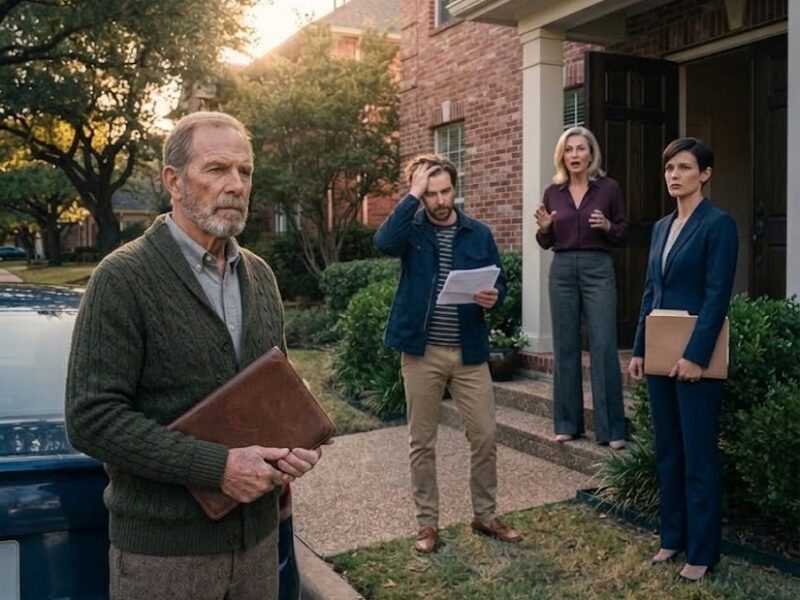
The Reckoning
My daughter-in-law threw me out of the Dallas house I had quietly helped finance and said, “He needs to leave tonight.”
My son stared into his drink and let her do it.
They thought I was a penniless retiree with nowhere to go.
They did not know about the $800,000 I had saved—or the three envelopes my attorney was preparing.
For years, Arthur and Chloe had seen only Julian Vance, sixty-eight, widowed, and living on what they assumed was a small pension. I cooked their meals, repaired their faucets, trimmed their lawn, and stayed out of sight whenever Chloe wanted to impress someone.
I lived simply because I chose to.
Not because I had nothing.
After thirty-five years as a senior accountant, I understood the difference between looking wealthy and being secure. I had invested quietly, avoided debt, and built accounts worth more than $800,000.
I intended to leave most of it to Arthur one day.
I also intended to protect him until then.
That was why my signature appeared behind more of their life than they realized: the refinance that lowered their mortgage payment, the personal loan used for renovations, and the guarantee that helped Arthur secure financing when his credit was strained.
They remembered the approvals.
They forgot the man who made them possible.
At first, living with them had felt like rescue. My wife had died six years earlier, and the silence in my apartment had become unbearable. Arthur offered me their spare room near Thunderbird Road.
Chloe smiled when I arrived.
Then she slowly erased me from the house.
“Could you eat in the kitchen tonight? We’re having guests.”
“Would you stay upstairs? It’s more of a couples’ evening.”
One Thanksgiving, she placed me at a folding table near the hallway while everyone else sat beneath the chandelier.
Another evening, she opened the back door and said, “Company is coming. It’ll be less awkward if you use this entrance.”
Arthur always looked uncomfortable.
He never told her to stop.
I kept the peace because he was my son. I folded towels, fixed cabinet hinges, and made the stuffed mushrooms he had loved since childhood.
Meanwhile, bills covered their counters: designer furniture, restaurant charges, an expensive SUV, and renovation invoices they could not afford.
I noticed every number.
Accountants always do.
Then came Chloe’s Monday-night dinner party.
Arthur’s coworkers filled the living room. Glasses clinked. Chloe moved among them in a silver dress, presenting the house like proof of her success.
I carried in the tray of mushrooms.
She blocked me before I reached the guests.
“Julian, stop hovering,” she whispered. “You’re making people uncomfortable.”
I stepped away.
Minutes later, she followed me into the hallway and raised her voice.
“Why don’t you stay in your room?”
Several guests turned toward us.
Then she looked directly at Arthur.
“Are you going to handle this?”
The entire room went quiet.
My son gripped his glass and stared at the floor.
“Dad,” he said, “maybe you could just give us some space.”
Chloe folded her arms.
“No,” she said. “He needs to leave this house.”
No one spoke.
Not the coworkers eating food I had prepared. Not the neighbors whose broken fence I had repaired. Not my son.
I looked at Arthur one last time.
He did not defend me.
So I smiled.
“I won’t be in the way again.”
That night, while their laughter continued downstairs, I packed two suitcases. I took my documents, my laptop, a few photographs, and my late wife’s cardigan.
Before sunrise, I placed my house key on the kitchen counter.
Beside it, I almost left a note.
Instead, I left silence.
In the garage were storage boxes containing every co-signing agreement, loan record, receipt, notarized promise, and bank document connected to their lifestyle.
I took those too.
Not as weapons.
As evidence.
The next morning, I met contract attorney Fiona Cartwright. She read every page without interrupting. When she finished, she tapped three documents with her pen.
“Your son and his wife believe these obligations belong to them alone,” she said.
“They never read the paperwork.”
Fiona’s expression hardened.
“Then they are about to.”
I told her I wanted my finances separated legally and completely. No revenge. No threats. No shouting.
Just clean numbers.
She prepared three notices.
One concerned the mortgage support arrangement.
One concerned the renovation loan.
The third concerned something Chloe had no idea I controlled.
For three weeks, I redirected my mail, rented a quiet apartment, moved my investments into a protected trust, and removed Arthur as the beneficiary of accounts he had never known existed.
Then, at exactly 8:30 on a hot Texas morning, a delivery truck stopped outside their house.
I watched from my car down the street.
The driver placed three plain envelopes on the porch, rang the bell, and walked away.
Chloe appeared in a robe, holding her coffee.
She opened the first envelope casually.
Her smile vanished.
She tore open the second.
The coffee cup began trembling in her hand.
Then Arthur stepped outside as she opened the third envelope.
He read the first line over her shoulder.
His face drained of color.
And across the street, Fiona’s phone rang with the confirmation we had been waiting for.
I know you’re curious to see what happens next, so please continue reading in the comments below. Thank you for your patience. Leave a “YES” below and give this post a Like if you want the full story. 👇
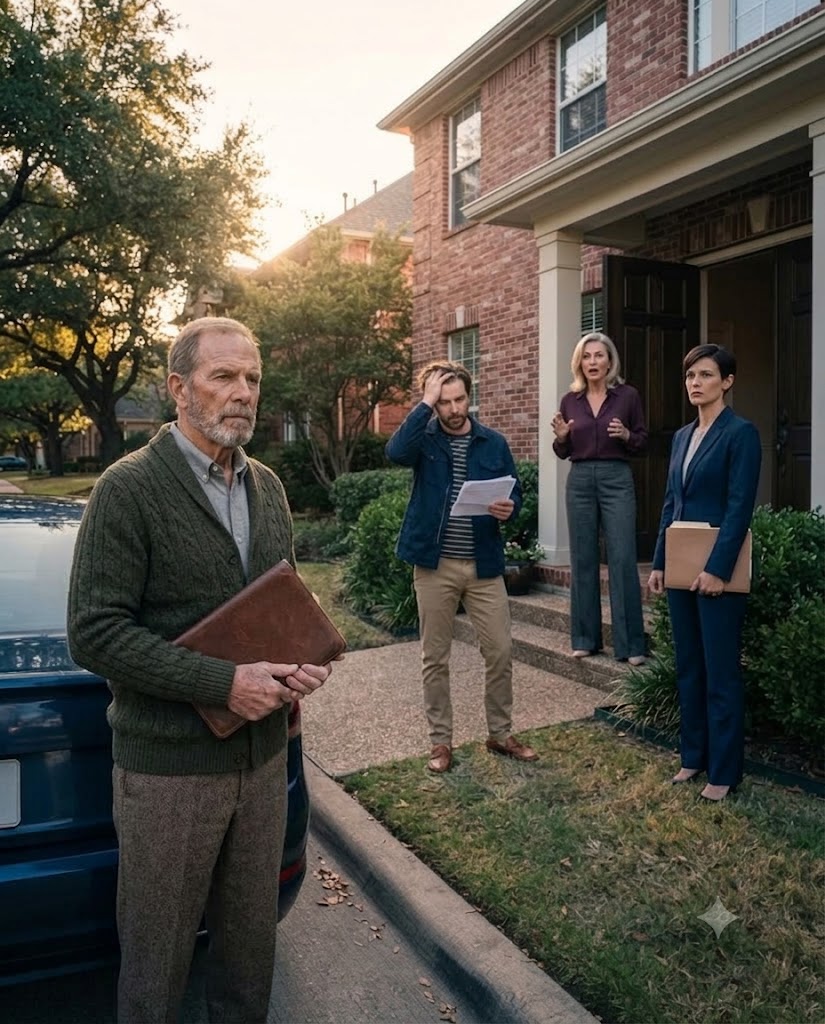
The phone call from Fiona was brief, clinical, and absolute.
“The notices have been legally served and acknowledged electronically,” she told me, her voice cutting through the hum of the air conditioner in my new downtown apartment. “The mortgage guarantee has been revoked under clause fourteen of the primary agreement, transferring full financial liability back to Arthur. The second-lien home renovation loan has been accelerated in full due to material breach of contract. And as for the third envelope…”
Fiona paused, a rare note of satisfaction softening her professional cadence. “Well, Julian. That property title is now officially locked under your independent trust. They have seventy-two hours to cure the defaults, or foreclosure proceedings begin immediately.”
I thanked her, ended the call, and walked over to the floor-to-ceiling window. Down below, the Dallas traffic hummed along the sun-bleached asphalt. I looked at my reflection in the glass—an old man with tired eyes, rumpled slacks, and a quiet posture. For decades, the world had looked right through me. But numbers do not care about appearances. Numbers do not lie, and they do not forgive.
Across town, on Thunderbird Road, the illusion was shattering.
I didn’t need to be there to imagine the panic. Arthur and Chloe had spent years living inside a financial house of cards, convinced that the wind would never blow. They had treated stability like an infinite resource, funded by an invisible ghost they could order around, dismiss from dinner parties, and shove out into the cold night without a second thought.
What they did not understand was basic arithmetic. A guarantee is only as strong as the guarantor’s willingness to stand behind it. And when the guarantor steps away, the structure collapses under its own weight.
By Wednesday afternoon, my phone started buzzing.
It wasn’t Arthur. It was an unknown mobile number that I recognized immediately from utility records. I let it ring out to voicemail. Seconds later, a text message arrived from Chloe. Julian, please pick up. There’s been a terrible mistake with the bank. We need to talk.
I placed the phone face down on the kitchen counter and went back to organizing my books.
An hour later, another message came, this time from Arthur. His tone was frantic, stripped of the quiet compliance he had worn like a second skin during my final weeks in his house. Dad, where are you? The mortgage company called. They’re demanding the full arrears immediately, and they said the guarantor backing our loan has withdrawn. That’s impossible, right? Please call me.
I felt a faint, cold ache behind my ribs. Not from pity—pity had burned out of me the night I stood in their hallway while my son looked at the floor. It was simply the residual weight of a lifetime spent loving someone who lacked the spine to love me back. He wasn’t calling because he missed his father. He was calling because his lifestyle was evaporating.
By Thursday morning, the situation escalated from a financial crisis to an outright collapse.
I had driven back out to North Dallas to handle some paperwork at a local bank branch, and on a whim, I took a slow detour down Thunderbird Road. I parked two blocks away, cutting the engine and rolling the windows down just enough to feel the stifling July heat.
The scene outside their house was chaotic.
A flatbed tow truck sat idling in the driveway, its hydraulic winch humming as it hoisted Chloe’s expensive white SUV off the pavement. Chloe stood near the front porch, her hair unbrushed, screaming tearfully at the repo driver while clutching a clipboard to her chest.
Arthur was sitting on the low brick wall by the flowerbeds—the very same flowerbeds I had edged and weeded every Saturday morning. His head was buried in his hands, his shoulders slumped inward. He looked smaller than sixty-eight, smaller even than he had when he was a boy skinning his knees on the sidewalk.
As I watched, the front door swung open and a pair of professional movers marched out carrying a large, ornamental floor mirror—one of the many luxury items Chloe had purchased on credit while pretending my presence was an embarrassment.
They weren’t just losing the house. They were losing everything.
The third envelope Fiona had mailed wasn’t just a legal notice about a loan; it was the deed notification. Unknown to Arthur and Chloe, the original purchase agreement for the Dallas house five years ago had been structured through a silent equity partnership. To secure the mortgage when Arthur’s credit had bottomed out after his divorce, I hadn’t just co-signed—I had purchased fifty-one percent of the equity outright under a private trust, listing myself as the primary stakeholder while allowing them to pay down a subsidized monthly rate.
When they threw me out, they legally violated the residency covenants of that private trust, which explicitly required the primary occupant to maintain a respectful, habitable familial environment for all resident co-owners. By evicting me unceremoniously, they triggered an immediate forfeiture of their occupancy rights.
The house had never truly belonged to them. It belonged to the old man they kept in the hallway.
My phone rang again. This time, I picked it up.
“Dad?” Arthur’s voice was broken, trembling with a raw, desperate panic. “Where are you? Please. The police won’t help, the bank is saying we have to vacate by Monday, and… and Chloe is inside packing bags. Everything is gone. The car, the furniture accounts—they’re freezing our cards. What is happening?”
“You’re experiencing reality, Arthur,” I said quietly. My voice was steady, devoid of anger, which seemed to terrify him more than a shout would have.
“Was that you?” A sudden, sharp realization cut through his tears. “The lawyer… the letters… Dad, you did this?”
“I didn’t do anything,” I replied evenly. “I simply stopped doing for you. There is a vast difference.”
“You can’t do this to us! We’re family!” He let out a choked, hysterical laugh that sounded dangerously close to a sob. “You ruined our lives! We have nowhere to go!”
“I spent six years living in your spare room, Arthur,” I said, the memory of the folding Thanksgiving table flashing behind my eyes. “I cooked your meals, I fixed your leaks, and when your wife told me to leave into the middle of the night, you stood there and watched. You had a choice. You chose silence. Now, you can live with the consequences of it.”
“Dad, please! Just come over here! We can talk about the mortgage, we can fix the paperwork—”
“The paperwork is already filed, son,” I interrupted softly. “And unlike yours, my numbers always add up.”
I ended the call, switched the phone off completely, and slid it into the glove compartment.
For a long moment, I sat there in the quiet interior of my car, watching the tow truck pull away with the SUV, its taillights flashing red against the harsh Texas sun. Across the street, Chloe slammed the front door so hard the glass pane rattled in its frame.
I started the engine, shifted into drive, and pulled away from the curb.
I didn’t look back. The past was a ledger already closed, audited, and balanced down to the final cent. Ahead of me lay a clean slate, an empty apartment overlooking the city, and a future where my worth would never again be measured by how well I could hide in the hallway.