The Ghost Army Exploit: How Genessa’s ‘Faithful Doubles’ Build is Breaking Mortal Shell 2
Why fight bosses in Mortal Shell 2 when you can sit back and let an army of ghosts do it for you? 👻⚔️
A completely broken 44-point Genessa build has just surfaced, abandoning the popular “Stray” mechanics to abuse her “Faithful Doubles” instead. By equipping the Axatana and the Torpor Stone, players are summoning infinite clones that infinitely freeze enemies, spam shockwave abilities, and literally refund their own casting cost…
Want the exact Skill Tree and Tarstone setup to let your ghosts play the game for you before it gets patched? 👇
In the punishing, blood-soaked world of Mortal Shell 2, survival usually demands pixel-perfect parries, flawless stamina management, and an aggressive, hands-on approach to combat. But what if the optimal way to play the game was to simply stop fighting altogether?
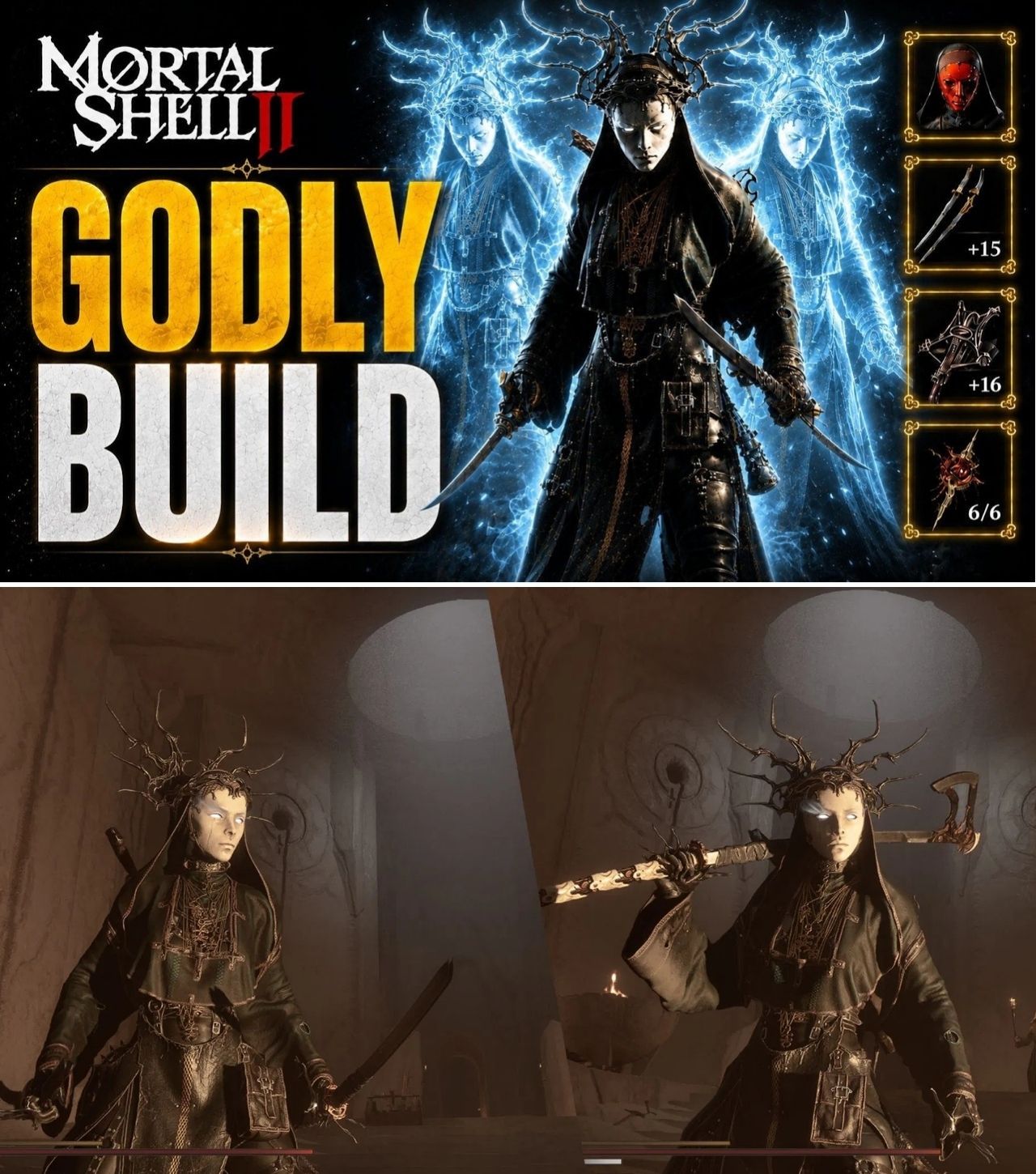
A new, wildly overpowered meta has emerged that completely trivializes the game’s difficulty curve. Dubbed the “Godly Genessa” build, this 44-point setup revolves around the Shell known as Genessa the Wayward. But instead of utilizing her standard attacks or the chaotic “Stray Form” that speedrunners have been exploiting, this specific build leans entirely into her Faithful Doubles—ethereal ghost clones that do all the killing while the player stands safely in the background.
Showcased in a viral breakdown by gaming creator LaserBolt, the build transforms Mortal Shell 2 from a grueling action RPG into a passive, automated slaughterhouse. The community is already calling it unfair, and it is highly likely that developer Cold Symmetry is watching closely.
The Engine: Augmentation and Distraction
To understand why this build is fundamentally broken, one must look at how the Faithful Doubles operate. When summoned, these ghosts rush the enemy, execute a set number of attacks, and vanish. The entire build is an exercise in resource management: the player’s only job is to generate Resolve to summon more ghosts.
However, the Augmentation skill node completely shatters this economic loop.
When fully maxed out, Augmentation not only reduces the summoning cost of the Faithful Doubles by 25%, but its Tier 3 perk dictates that the doubles regenerate one Resolve every single time they damage an enemy.
“The doubles are paying for themselves,” LaserBolt emphasized in his breakdown. “Summon them, let them hit things, and the meter fills back up on its own.”
If generating infinite Resolve wasn’t enough, the Distraction node ensures the player is never in danger. The first two tiers give the ghost clones an 80% chance to be targeted by enemies instead of the player, acting as perfect decoys. But the max tier turns them into walking bombs: when a Faithful Double is struck by an enemy attack, it bursts into a shockwave that inflicts 15 Stasis stacks, instantly freezing the attacker in place.
Multiplying the Damage: Affinity and Impetus
With the economy and defense completely automated, the build shifts focus to raw, unadulterated damage.
The Affinity node is a pure damage multiplier. When maxed out, it boosts the clones’ damage to 160% and allows them to attack three separate times before vanishing. This triples the physical output of every single summon. Furthermore, the Instigation node buffs the summons upon arrival, granting them 10 Warp stacks (drastically increasing their attack speed) and allowing them to inflict 4 Phantom stacks on everything they hit.
But the true game-breaker—the mechanic that pushes this build from “strong” into “God-tier” territory—is the Impetus node.
Impetus grants the Faithful Doubles a 22% chance to perform the player’s equipped weapon ability instead of their standard light attack. Because players can spam the summon button continuously, the screen is flooded with ghosts, all of which are constantly triggering devastating weapon abilities without costing the player a single drop of extra Resolve.
As a final safety net, the Intangible node guarantees that if the player’s health is ever depleted, the Shell summons a final, desperate wave of four Faithful Doubles to protect the body and finish off the threat.
The Axatana and the Torpor Stone Synergy
A build that relies on weapon abilities requires the perfect weapon. For Genessa the Wayward, the undisputed king is the Axatana.
Referred to in-game as an exquisite weapon that once bore the name Dream Thresher, the Axatana is incredibly fast, allowing the player to remain agile while the ghosts do the heavy lifting. But the weapon’s true power comes from how it interacts with Tarstones.
The single most important Tarstone for this setup is the Torpor Stone. This stone consumes 25 Resolve to infuse the player’s weapon with Stasis. At max level, this infusion becomes permanent. Because the Faithful Doubles perfectly copy the player’s weapon and its current imbuments, every single ghost is now applying massive Stasis buildup with every swing.
“You’re not really fighting,” LaserBolt noted. “You’re standing behind a wall of ghosts while the room freezes solid.”
To layer the devastation, players equip the Strike Stone. This ability consumes Resolve to launch the player high into the air, plunging the weapon into the ground for 150 splash damage and 25 Break damage. Thanks to the Impetus node, the ghost clones are constantly executing this plunging Strike Stone attack, turning the battlefield into a staggered, frozen nightmare. The Duality Stone is the cherry on top, forcing light attacks to strike twice—a buff that the clones also happily inherit.
The Crossbow and the Critical Economy
While the ghosts handle the frontline, the player operates as a sniper using the Forgotten Crossbow.
The sidearm is modified with the Ember Seed Stone, granting a permanent Burn infusion for 20 Resolve. This ensures that while the weapon applies Stasis, the sidearm applies Burn, preventing the status effects from cannibalizing each other. The Barrage Stone allows the crossbow to fire a heavy round that detonates three times above a target, dealing splash damage.
But the ranged loop is truly tied together by the Rupturing Stone, which dictates that any projectile that scores a critical hit now deals massive Break damage (up to 12). This shatters enemy guards from across the room, leaving them wide open for the ghosts to execute ripostes.
To guarantee these critical hits, the player’s passive character Tarstones are heavily optimized:
Auspicious Stone: Grants a flat 18% critical hit chance for melee attacks.
Headsman Stone: Boosts critical hit damage by a staggering 100%.
Marksman Stone: Grants a 15% critical hit chance for the crossbow, ensuring the Rupturing Stone constantly procs.
Shattering Stone: After killing an enemy, the next melee attack deals up to 50% extra stagger damage.
Between the passive critical boosts, the automated Resolve regeneration, and the army of exploding, freezing ghosts, Genessa the Wayward operates less like a traditional action RPG character and more like a real-time strategy commander.
A Patch on the Horizon?
What makes this build so fascinating is that it completely ignores the “Stray Doubles” mechanics that dominate other popular Genessa builds. It proves that Cold Symmetry designed Mortal Shell 2 with incredibly deep, branching skill trees that can be radically altered based on a player’s preferred playstyle.
However, the sheer automation of the “Faithful Doubles” build raises questions about game balance. A setup that allows the player to sit back while infinite summons freeze and execute endgame bosses fundamentally bypasses the punishing difficulty that defines the Soulslike genre.
Whether Cold Symmetry decides to nerf the Resolve regeneration of the Augmentation node, or lower the Impetus trigger chance for weapon abilities, remains to be seen. But for now, if you are tired of dying in the Undermether and want to take a well-deserved break, pick up the Axatana, max out the Torpor Stone, and let your faithful ghosts do the bloody work for you.