The Foundation of Glass
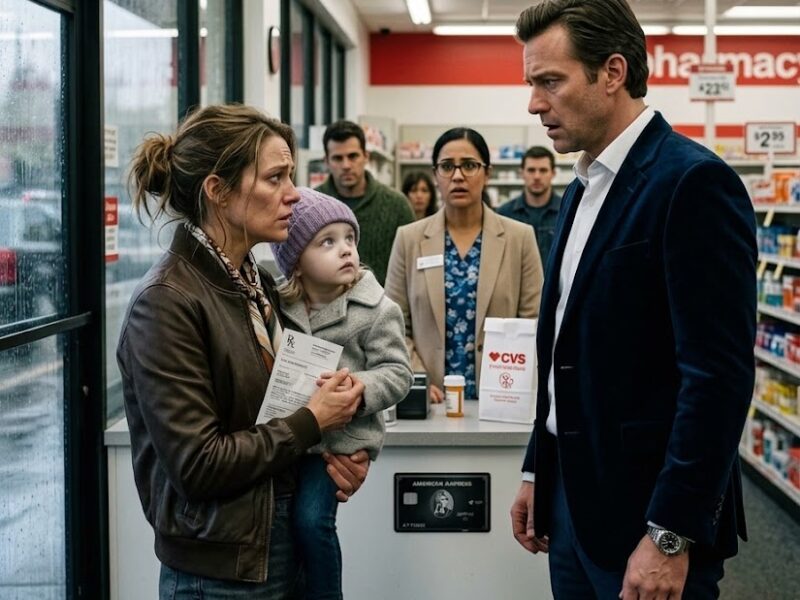
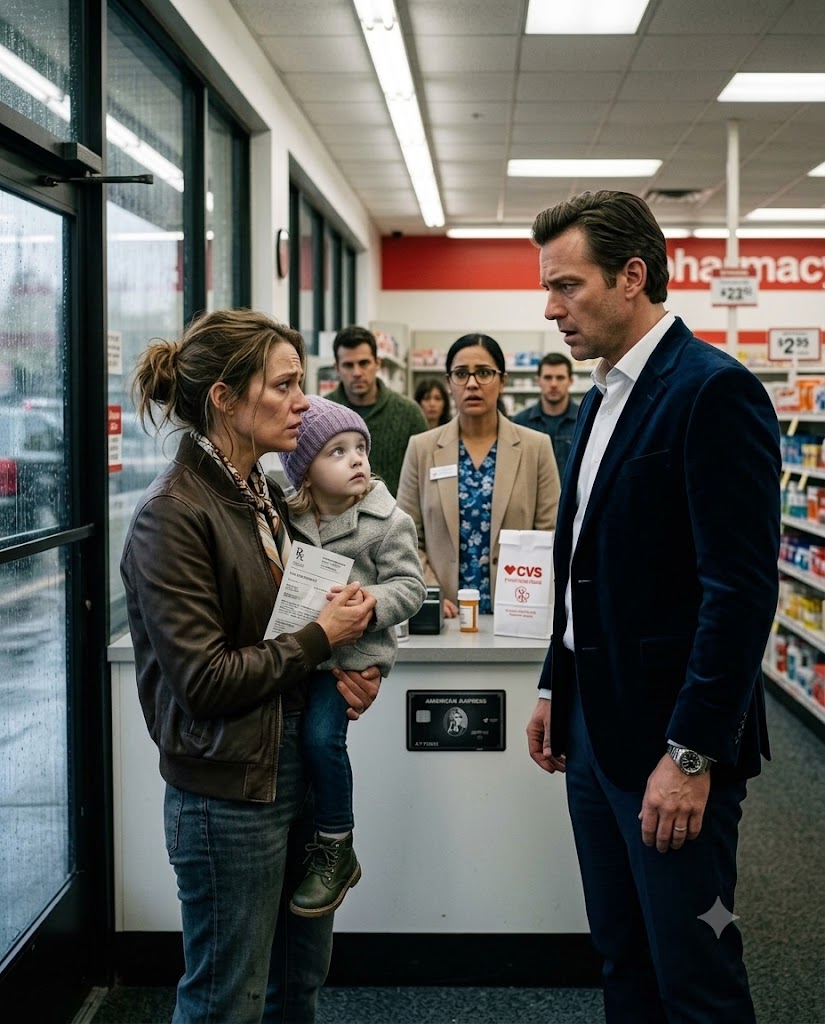
My ex-wife was crying at a CVS pharmacy because she could not afford our sick daughter’s $486 prescription.
I did not know the little girl was mine until she looked up at me and asked five words that stopped my heart.
“Are you my daddy, Harrison?”
The pharmacy went silent.
Adeline tightened her arms around the child as if I were the danger.
Three years earlier, she had left our Back Bay mansion, placed her key on the kitchen counter, and disappeared behind a wall of attorneys.
Now she stood beneath fluorescent lights in a worn navy coat, holding a rejected insurance card and a crumpled prescription.
Beside her was a pale little girl in pink rain boots.
Dark hair.
Gray eyes.
My eyes.
The pharmacist lowered his voice. “Without insurance approval, the total is four hundred and eighty-six dollars.”
Adeline stared at the counter.
“I can pay half today,” she whispered. “Please. She needs it tonight.”
The pharmacist looked genuinely sorry. “I can’t release part of a prescription.”
The child tugged Adeline’s sleeve.
“Mommy, don’t cry. I can stop being sick. I promise.”
Something inside me broke.
I had negotiated billion-dollar acquisitions without blinking. I had watched executives threaten lawsuits, senators demand favors, and competitors try to destroy my company.
But I could not watch that little girl apologize for being sick.
I stepped forward and placed my card on the counter.
“Fill it. Add anything else the doctor ordered.”
Adeline turned slowly.
Her face lost all color.
“Harrison.”
One word carried three years of anger, grief, and unfinished questions.
“It is not for you,” I said quietly.
Her jaw tightened because she understood exactly who I meant.
The little girl studied me with unsettling seriousness. Then her gaze moved from my face to Adeline’s.
“Are you my daddy, Harrison?”
A woman waiting near the vitamins stopped moving. The pharmacist looked down. Even the rain seemed to disappear behind the windows.
Adeline lifted the child into her arms.
“Maya, we’re leaving.”
“Adeline, wait.”
“No.”
I had heard powerful people refuse me before.
No one had ever made the word sound that final.
She walked out with Maya pressed against her shoulder. I signed the receipt, took the medicine, and followed them into the rain.
Not because I wanted control.
Because I had just seen my own eyes looking back at me from the face of a child I had never held.
Adeline stopped outside a narrow apartment above a laundromat. Water ran from her hair as she searched for her keys.
“Please,” I said.
She froze.
It was a word I should have used three years ago.
I held up the pharmacy bag. “Let me give you the medicine. Then I will leave if that is what you want.”
Maya coughed against her shoulder.
Adeline finally unlocked the door.
The apartment was clean but painfully small. A folding table stood beside the kitchenette. Children’s drawings were taped above a radiator. On the couch lay a blanket, a thermometer, and an unopened hospital bill.
I placed the medicine on the table.
Then I looked at Maya.
“How old is she?”
Adeline closed her eyes.
“Don’t do this.”
“How old?”
“Two years and eight months.”
The timeline struck with brutal precision.
Adeline had been pregnant when she left me.
“She’s mine.”
It was not a question.
Her eyes filled, but her voice stayed steady.
“Yes.”
For three years, my daughter had been learning to walk, learning to speak, getting fevers, blowing out birthday candles, and asking where her father was.
And I had known nothing.
“Why didn’t you tell me?”
Adeline laughed once, but there was no humor in it.
“I tried.”
“No message ever reached me.”
“I sent twelve emails. Three certified letters. I went to your office when I was five months pregnant. Security escorted me outside.”
“That is impossible.”
“Your mother was standing in the lobby when it happened.”
The room seemed to tilt.
Eleanor Callahan had spent my entire life protecting our family name as if it were a crown.
She had never believed Adeline belonged beside me.
Adeline crossed to a cabinet and removed a thick gray folder wrapped in plastic.
“Two days after I went to your office, this arrived.”
She placed a letter on the table.
It was printed on Callahan Global stationery.
My name was at the bottom.
The message was cold and precise.
If Adeline publicly identified me as the father, my attorneys would seek sole custody. Her finances, medical history, and supposed emotional instability would be used against her. A cashier’s check was enclosed in exchange for her silence.
I stared at the signature.
It looked like mine.
Almost.
But whoever copied it had missed the small break I always left between the H and the C.
“I did not write this.”
“I know that now,” Adeline said. “Back then, your lawyer delivered it personally and told me you never wanted to see me again.”
My hands became very still.
“Which lawyer?”
“Julian Vance.”
The attorney who had handled our divorce.
The man my mother had recommended.
Adeline opened the folder wider. Inside were postal receipts, printed emails, a photograph of her standing outside my headquarters while visibly pregnant, and a sealed envelope marked with the name of a private investigator.
“Your mother didn’t just keep my messages from you,” she said. “She had people watching me.”
My phone vibrated.
Eleanor’s name appeared on the screen.
Adeline saw it.
Before I answered, her own phone began ringing.
Same caller.
Eleanor had called us both within seconds.
Adeline placed her phone on the table and turned on the speaker.
My mother’s voice filled the apartment.
“You should have stayed invisible.”
Maya stirred on the couch.
Adeline reached for her, but I raised one hand and pressed record on my phone.
“Mother,” I said.
Silence.
Then Eleanor spoke in the controlled tone she used in board meetings.
“Harrison, you do not understand what that woman is doing.”
“I understand she sent me twelve emails I never received.”
“She is manipulating you.”
“I am looking at a letter with my forged signature.”
For the first time in my life, Eleanor had no immediate answer.
I photographed the first page and sent it to Adrian Cho, Callahan Global’s general counsel.
Ten seconds later, Adrian called.
His voice was tight.
“Harrison, do not let anyone destroy that folder. The document number belongs to a sealed company investigation, and your mother was the only person authorized to access it.”
Then he said the sentence that made Adeline grip the table.
“There is enough here to put someone in prison.”
Read Part 2 with all the major twists and the ending in the comments below! 👇 If it’s hidden, just switch to “All comments.” Thank you for your support! ❤️📖
The digital silence stretching across the speakerphone felt heavier than any board room confrontation I had ever weathered. Adrian’s warning echoed off the peeling wallpaper of the cramped kitchenette, mixing with the distant hum of the laundromat dryers spinning below.
“Harrison,” my mother’s voice cut through the receiver, regaining its razor-sharp composure. “You are reacting based on emotion. Bring that girl and the child back to the estate immediately. We will handle this privately, through proper channels.”
“Proper channels?” I repeated, my own voice dropping into an icy register that made Adeline flinch slightly. “Is that what you call forging my signature, intercepting my mail, and hiring investigators to terrorize a pregnant woman?”
“I was protecting the firm,” Eleanor snapped, her aristocratic veneer cracking to reveal the ruthless pragmatist underneath. “Callahan Global was in the middle of the Vanguard merger three years ago. A messy divorce or a paternity scandal would have wiped out fifty million dollars in shareholder value overnight. That woman was a transient risk. I simply neutralized it.”
“She was my wife,” I said. “And that child is my blood.”
“Blood is a biological detail, Harrison. Assets are reality,” Eleanor replied coldly. “Julian Vance is still on retainer. He can draft a quiet settlement by morning. Give her two hundred thousand, put the child in a trust, and let her disappear back to wherever she crawled from. It is over.”
“It isn’t over, Mother,” I whispered. “It hasn’t even started.”
I ended the call, cutting her off mid-sentence.
Adeline was staring at me, her chest rising and falling in shallow, rapid breaths. She pulled Maya closer, as if expecting me to suddenly morph into the corporate monster my mother believed me to be.
“She’ll destroy you,” Adeline said, her voice shaking. “You don’t know what she’s capable of. When I tried to fight back three years ago, Julian Vance didn’t just threaten custody—he had my bank accounts frozen, my apartment lease terminated overnight, and my car towed. I spent a week sleeping on a park bench before I realized I couldn’t beat a family that owned the courts.”
I knelt beside the folding table, looking directly into her eyes.
“Three years ago, I didn’t know you were drowning,” I said. “I won’t make that mistake twice. Adrian Cho isn’t just our general counsel—he’s a former federal prosecutor who has been looking for an excuse to dismantle my mother’s shadow operations inside the board for a decade. She thought she was running the company. She was just running a prison.”
Before Adeline could answer, a sharp rap echoed at the apartment door.
We both froze.
I stood up, moving cautiously toward the warped wooden door. Through the peephole, I saw a familiar silhouette standing in the dim, flickering hallway light.
It wasn’t a process server. It was Julian Vance, holding a leather briefcase, looking impeccably groomed despite the midnight rain.
I pulled the door open before he could knock again.
Julian’s polite corporate smile evaporated instantly when he saw my face.
“Harrison,” he stammered, taking a nervous half-step back. “I… I was told you were at the estate. Eleanor called me. She said there was an administrative discrepancy that needed immediate remediation.”
“An administrative discrepancy,” I repeated.
I reached out, grabbed the lapels of his expensive Italian wool suit, and hauled him across the threshold with enough force to send his briefcase clattering against the linoleum floor.
“Harrison, please—!” Julian gasped, his hands flying up to push against my chest as I shoved him against the opposing wall, pinning him beneath the framed crayon drawings of a four-year-old girl.
“You forged my signature,” I whispered, so quietly he had to strain to hear it over the rattle of the radiator. “You delivered a fraudulent custody threat to my wife under my letterhead. You helped my mother steal three years of my daughter’s life.”
“I was acting under executive directive!” Julian choked out, panic leaking through his legalistic facade. “Eleanor holds the controlling voting block on the corporate governance committee! If I didn’t execute the directive, she would have disbarred me, stripped my partnership, and ruined my career!”
“Then I suppose it’s a good thing,” I said, pulling out my phone and tapping the speaker icon, “that Adrian Cho is recording this entire conversation from his office.”
The phone crackled to life. Adrian’s voice boomed through the tiny apartment. “Got every syllable, Harrison. That’s wire fraud, forgery, and subornation of perjury. I’m dispatching a state trooper friend of mine to Julian’s office right now to secure the physical hard drives before he can wipe the server.”
Julian’s knees buckled. He slid down the wall until he was sitting on the floor, his professional life collapsing around him in less thirty seconds.
I looked down at him once, feeling nothing at all, before turning back to Adeline.
She was standing by the couch, holding Maya, who had woken up and was rubbing her heavy eyes. My daughter looked up at me, blinked through the dim light, and sleepily reached out a tiny hand.
“Daddy?” she murmured.
The word didn’t hit like a shockwave this time. It settled into my chest like an anchor finding the ocean floor.
“I’m here, Maya,” I said, crossing the room to kneel beside them. I gently took her small, warm hand in mine. “I’m not going anywhere.”
Adeline looked down at me, a single tear cutting a clean path through the dust on her cheek. The armor of three years of survival finally, completely shattered, leaving only the truth behind.
“What happens now?” she asked softly.
“Now,” I said, standing up and wrapping an arm around both of them, pulling my family into a circle that no corporate board, no forged letter, and no mother’s ambition could ever break again, “we go home.”