The Deed of the Ground
At the family reunion, my father said, “I’m proud of my sons… but you? You’re a disgrace.” No one stood up for me. I rose from my seat, slid a legal document across the table and whispered, “Happy Father’s Day.” He forgot one important thing.
The backyard fell silent before the grill even stopped sizzling.
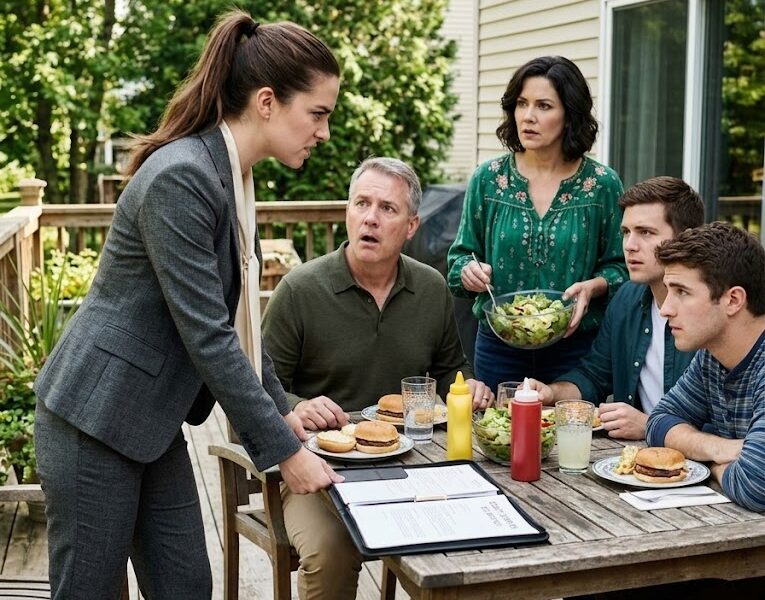
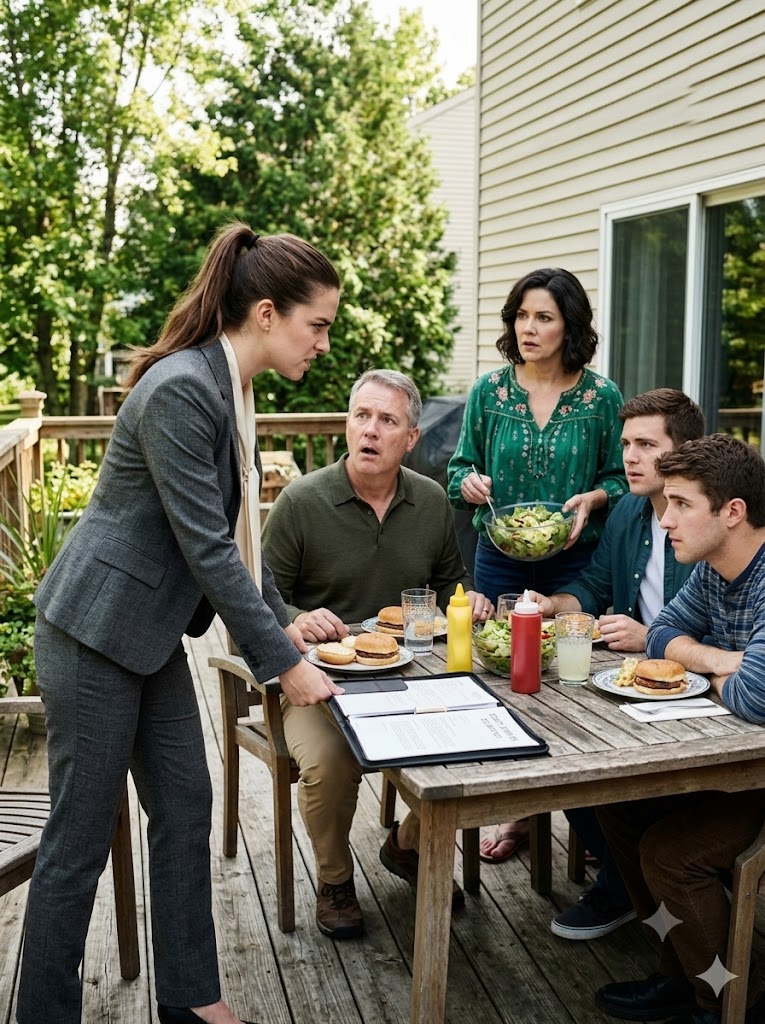
Arthur Vance sat at the head of the long wooden table like the entire lawn belonged to him, one hand wrapped around a beer bottle, the other close to a plate of ribs. His sons, Lucas and Miles, sat on either side of him, laughing too loudly, leaning too far back, soaking up attention like they had been trained to expect it.
Then Clara stepped onto the grass.
She was not wearing jeans. Not the faded cardigan they remembered. She wore a tailored navy suit, steel-lined cuffs catching the Idaho sun. In one hand, she carried a black envelope. In the other, a single car key.
Her father looked her up and down, and the smile came before the cruelty.
“Well,” he said, loud enough for the cousins, uncles, and neighbors near the cooler to hear. “Look who finally remembered she has a family.”
A few people chuckled because that was what people did around Arthur. They laughed first and thought later.
Clara stopped at the end of the table.
“Happy Father’s Day, Dad.”
Lucas lifted her beer, smirking. “Didn’t think you still existed.”
Miles whistled under his breath. “Nice entrance. Who died?”
No one told them to stop.
That was the part Clara noticed most. Not the insult. Not the smirk. Not even her father’s eyes, flat and cold, moving over her like she was still the same quiet girl who used to disappear into corners with a notebook.
It was the silence from everyone else.
Her mother stood near the porch steps with a dish towel twisted in both hands. Her mouth opened, then closed. The younger kids had stopped running. Somewhere behind them, a porch fan clicked in a tired circle.
Arthur leaned back, enjoying himself now.
“You know,” he said, raising his bottle toward Lucas and Miles, “I’m proud of my sons. Built men. Real men. They know how to show up.”
The words landed exactly where he aimed them.
Then his gaze returned to Clara.
“But you?” His mouth curved. “You’re a disgrace.”
No one moved.
Clara felt the old wound open, but it did not bleed the way it once had.
At ten years old, she had handed this same man a handmade Father’s Day card covered in glitter stars. He had muttered thanks without looking away from the game. Five minutes later, Miles gave him a store-bought mug, and Arthur laughed like he had been handed a trophy.
When she said she had earned a partial scholarship to Boise State, he told her to study something useful.
So she did.
Accounting. Then software. Then late nights, side clients, empty bank accounts, instant coffee, secondhand furniture, and a laptop that hummed like it was begging for mercy. She built in silence because silence was the only inheritance Arthur had ever given her.
And now she was back in his backyard, with every person who had watched her shrink now watching her stand completely still.
Arthur pointed at the black Jaguar parked beyond the iron gate. Its dark paint reflected the striped tablecloths and the American flag hanging from the porch rail.
“That yours?” he asked, trying to sound amused.
Clara did not answer.
She walked forward.
The table felt longer than it had when she was a child. Back then, every chair had seemed assigned before she even entered the room. Her brothers near her father. The men near the grill. Her mother in motion. Clara somewhere at the edge, useful only when plates needed clearing.
This time, she did not look for a seat.
She placed the car key beside Arthur’s plate.
Then she laid the black envelope in front of him.
The sound was soft, almost nothing.
Still, everyone heard it.
Arthur glanced down, then back up at her.
“What’s this supposed to be?”
“A gift,” Clara said.
Her voice was quiet, but it carried.
Miles leaned forward. “You brought Dad paperwork for Father’s Day?”
Lucas laughed once. “That’s weird, even for you.”
Clara turned her eyes toward him, and the laugh died in his throat.
Arthur tapped the envelope with two fingers. “If this is some emotional letter, save it. We’re eating.”
“It is not a letter.”
Her father’s expression tightened.
The people around the table shifted. A fork scraped against a plate. Someone cleared their throat. The air smelled like smoke, cut grass, and barbecue sauce, but underneath it, something else had arrived. Pressure.
Clara looked at Arthur’s hands.
Those hands had signed checks for her brothers. Tuition deposits. Gym equipment loans. Emergency money that never had to be repaid. Those same hands had waved her away when she asked for art supplies, when she needed help with rent, when she wanted one honest question about her life.
He had taught her not to ask.
Facebook has a character limit, so I couldn’t fit the entire story into one post. The rest of the story—including the biggest twists and the ending—is already waiting for you in the comments below.
Arthur slowly slid a thumb beneath the flap of the black envelope, his expression hardening from amused condescension into something sharp and cautious. He pulled out a single, heavy sheet of legal cardstock embossed with the seal of the Ada County Recorder’s Office.
He didn’t read the whole page. He didn’t need to. His eyes locked onto the bold-faced parcel ID and the ownership transfer stamp at the bottom.
The color drained from his weathered face so fast it looked like someone had snuffed out a candle behind his eyes.
“What… what is this?” Arthur whispered, his voice cracking slightly against the hum of the backyard refrigerator.
“It’s a quitclaim deed, Dad,” Clara said, her voice entirely flat, devoid of anger or triumph. “Specifically, a foreclosure execution notice regarding the parcel this house, this lawn, and that grill are currently sitting on.”
Lucas stopped chewing. He dropped his rib back onto his paper plate with a wet smack. “What are you talking about? Dad owns this place. He’s owned it for twenty years.”
“He did own it,” Clara corrected, stepping back two paces so she could see every face at the table—her uncles, her mother frozen by the porch, her brothers sitting in chairs they believed were permanently secured by a lineage of male privilege. “For the last five years, when the lumber market crashed and Dad’s loans went into default, he didn’t go to the bank. He went to private hard-money lenders. And when they threatened to seize the title, he needed someone with corporate backing to buy out the debt quietly before the county auctioned the property.”
She pointed a finger down at the wooden table.
“You all remember three years ago? When Dad told everyone he secured a ‘restructuring partnership’ that saved the family farm? He didn’t. I did. I bought the primary mortgage note through my holding company, using every penny of my startup equity.”
Miles leaped to his feet, knocking his plastic chair backward into the grass. “You lying little witch! You can’t just take our house!”
“It’s not your house, Miles,” Clara replied sharply. “It hasn’t been yours for thirty-six months. You’ve been living under my roof, eating food bought with grocery allowances I approved, driving a truck insured by my corporate policy, and mocking the exact person who has been paying the property taxes so your precious father doesn’t end up living in his Ford F-150.”
A collective gasp rippled down the table. Uncle Pete dropped his beer bottle, the amber glass shattering against the concrete patio, sending foam splashing across his work boots.
Arthur clutched the legal document, his fingers trembling violently as the reality of the black envelope settled into his bones. He looked up, his eyes pleading for the first time in his life—not with the authority of a patriarch, but with the terror of a tenant facing an absolute eviction.
“Clara,” Arthur choked out, his voice shaking. “We’re family. You can’t… you can’t throw us out on the street over a harsh word.”
“A harsh word?” Clara let out a cold, humorless laugh that echoed off the metal siding of the garage. “You called me a disgrace in front of forty people while my brothers laughed like hyenas. You treated me like a ghost in my own history. But worse than that, you mistook my silence for weakness.”
She reached down, picked up the single car key from beside his plate, and tossed it into the air, catching it neatly in her palm.
“The car key belongs to the Jaguar outside,” Clara said, turning toward the iron gate. “Which I also own. The insurance lapses at midnight. If you want to move your furniture out before the sheriff arrives with the writ of possession on Monday morning, I suggest you start packing now.”
She turned her back on the long wooden table, walking down the sunlit grass toward the gate without looking back once.
Behind her, the backyard erupted into frantic shouting—Lucas cursing, her mother crying out in despair, and Arthur slamming his fists onto the wood, screaming commands to people who no longer had the power to obey.
Clara opened the door of the black Jaguar, slid into the cool leather driver’s seat, and started the engine. As she pulled away from the curb, she looked in the rearview mirror at the house where she had spent a lifetime being invisible.
The lawn was still green. The barbecue smoke was still rising. But for the first time in her life, the ground beneath her feet belonged entirely to her.