
Lindsay Clancy Trial Hits Breaking Point as Jury Remains Deadlocked After Six Days
45 MINUTES. ONE HOUSE. AND A DIGITAL TRAIL THAT MAY CHANGE THE ENTIRE STORY.
What happened inside the Clancy home during those missing 45 minutes has become one of the most haunting questions surrounding the case.
Patrick had stepped out.
When he returned, everything had changed.
His desperate 911 call.
His wife found critically injured.
Three children gone.
But now, the courtroom has been digging into something even more difficult to understand:
Lindsay’s digital history.
Searches. Phone activity. Location data. Online behavior.
Prosecutors say the pattern points toward preparation.
The defense says the same digital trail tells a completely different story — one involving a devastating psychiatric crisis and a mother whose state of mind had deteriorated dramatically.
And then comes the detail that has kept people arguing:
What was really happening during those 45 minutes?
Was the digital trail evidence of a carefully thought-out plan?
Or was it something far more complicated?
After weeks of testimony, the jury has now been deliberating for days — and they still haven’t reached an answer.
One juror dispute has even erupted inside the deliberation room.
So what exactly did investigators find?
Why are prosecutors and the defense interpreting the same digital evidence so differently?
And could those 45 minutes ultimately determine Lindsay Clancy’s fate?
The details buried inside the courtroom evidence are much more complicated than the viral version of this case. 👇
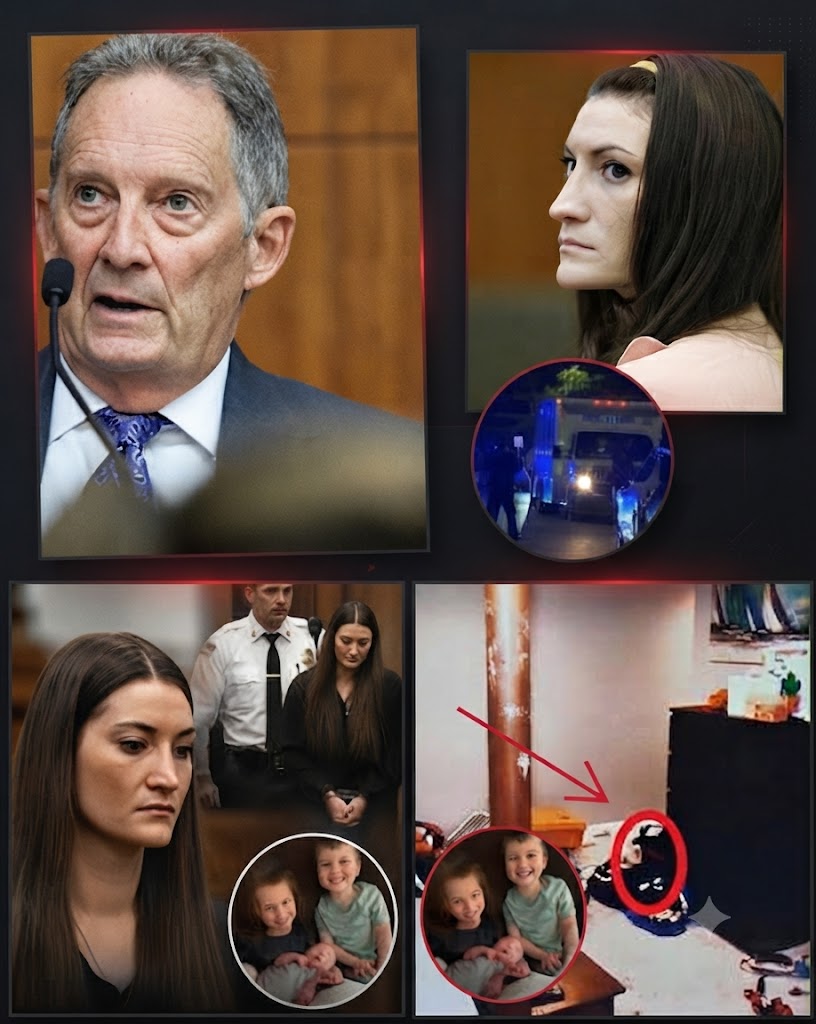
Lindsay Clancy Trial Hits Breaking Point as Jury Remains Deadlocked After Six Days
The Lindsay Clancy murder trial has reached a dramatic breaking point.
After weeks of emotional testimony, more than 80 witnesses and roughly 300 exhibits, the 12-member jury has now spent six days behind closed doors — and still cannot agree on whether Clancy should be held criminally responsible for the deaths of her three young children.
On Thursday, Sept. 3, the courtroom was thrown into further turmoil when defense attorney Kevin Reddington accused one juror of refusing to follow the judge’s instructions concerning reasonable doubt.
Judge William Sullivan declined to remove the juror.
The jury was sent home without a verdict and is scheduled to continue deliberating.
The development has raised the possibility of a mistrial if the panel ultimately cannot reach a unanimous decision.
But beneath the courtroom drama is the central question that has divided the prosecution and defense from the beginning:
Was Lindsay Clancy a mother who deliberately planned the deaths of her three children — or was she experiencing a catastrophic postpartum psychotic episode that left her unable to understand or control what she was doing?
That question now rests entirely with the jury.
The 45 Minutes at the Center of the Case
One of the most closely examined periods in the trial has been the roughly 45 minutes when Patrick Clancy left the family’s Duxbury home on Jan. 24, 2023.
According to prosecutors, Patrick’s trip to CVS and a restaurant was part of a plan that gave Lindsay enough time alone with the children.
Prosecutors have presented cellphone and digital evidence in an effort to reconstruct what happened during that period.
Among the evidence discussed in court was data showing Lindsay’s phone being used to obtain directions to a Plymouth restaurant.
The prosecution argues that this evidence supports its theory that Lindsay deliberately created an opportunity to carry out the killings.
The defense, however, has challenged that interpretation and has focused heavily on Lindsay’s mental state, medications and symptoms of psychosis.
The difference is crucial.
The prosecution does not dispute that Lindsay was suffering from mental-health problems. Its argument is that those problems did not prevent her from understanding what she was doing.
The defense argues the opposite.
The jury must ultimately decide whether Lindsay was criminally responsible under Massachusetts law.
Patrick Clancy’s 911 Call Became One of the Trial’s Most Emotional Moments
Patrick’s return home produced one of the most haunting pieces of evidence heard by jurors.
He discovered his children and called 911.
His frantic reaction became a central part of the prosecution’s presentation of the case.
The call captured Patrick’s immediate belief that Lindsay had killed the children and that she had attempted to take her own life.
Prosecutors have used the circumstances surrounding the call and Lindsay’s statements as evidence that she understood the consequences of her actions.
The defense has offered a dramatically different interpretation, arguing that Lindsay’s physical and psychological condition after the incident must be considered when evaluating what she said and did.
The emotional nature of Patrick’s testimony has also underscored the unusual position he occupies in the case.
He lost three children.
At the same time, he has not portrayed Lindsay simply as a monster.
His testimony has reflected the complicated reality of being the surviving parent in a case involving the woman who was once his wife.
The Digital Evidence Became a Major Battlefield
The trial has spent considerable time examining Lindsay’s phone activity and other electronic evidence.
Prosecutors presented digital records they say help establish a timeline leading up to the killings.
The evidence included cellphone data, internet activity and information recovered from Lindsay’s devices.
One important dispute involved whether certain digital activity reflected ordinary behavior, preparation for the killings, or symptoms of a severe psychiatric crisis.
A Cellebrite witness testified about phone data during the trial, while prosecutors used the information to argue that Lindsay’s movements and searches were consistent with planning.
The defense has challenged aspects of that interpretation.
That distinction matters because the same digital footprint can potentially be interpreted in very different ways depending on what question the jury is asking.
A search does not automatically prove intent.
But prosecutors argue that the cumulative pattern of searches, movements and communications tells a coherent story.
The defense says the broader context — including Lindsay’s mental deterioration — cannot be separated from those searches.
The jury has now spent days trying to reconcile those competing narratives.
The Insurance Allegation Has Not Been Established
A particularly sensational claim circulating online has suggested that investigators uncovered searches related to activating a million-dollar life-insurance policy or transferring assets after a spouse’s institutionalization.
That allegation fits neatly into a dramatic internet narrative about a supposed financial motive.
But it should not be presented as established fact.
The major reputable reports covering the trial and its digital evidence have instead focused on cellphone data, directions, internet activity, medications, exercise bands and the prosecution’s theory of premeditation.
There is no reliable confirmation in the sources reviewed for this article that Lindsay carried out a “million-dollar insurance plot” or that Wi-Fi-router logs exposed such a scheme.
That distinction is particularly important as the jury considers the evidence.
A viral claim can spread much faster than a courtroom exhibit, but the jury can only base its decision on evidence admitted during the trial.
The Defense Has Put Mental Illness at the Center of Its Case
Lindsay Clancy does not deny killing her three children.
Her defense is fundamentally about responsibility.
Attorney Kevin Reddington has argued that Lindsay was suffering from postpartum psychosis and was severely affected by psychiatric illness and medication.
The defense has presented evidence about the dramatic deterioration in Lindsay’s mental health after giving birth to her youngest child.
Her mother, Paula Musgrove, testified that Lindsay had told the family she experienced thoughts about harming her children.
The defense has sought to demonstrate that these symptoms were not simply ordinary depression or anxiety but part of a much more serious psychiatric crisis.
That argument is designed to support a verdict that would find Lindsay not criminally responsible because of mental illness.
The prosecution has offered a fundamentally different interpretation.
Prosecutors argue that Lindsay knew what she was doing and that her actions showed planning rather than uncontrollable psychosis.
The prosecution’s case has included evidence about the timing of her husband’s departure, her phone activity and what investigators say happened before the children’s deaths.
The result is an unusually difficult legal question:
How much control did Lindsay actually have over her actions at the moment the children were killed?
The Exercise Bands Became Physical Evidence of the Alleged Killings
Among the most disturbing pieces of evidence were the exercise bands prosecutors say were used to strangle the children.
The bands were presented in court as physical evidence.
Patrick described finding the children and removing the bands in an attempt to save them.
The evidence provided jurors with a physical connection between the crime scene and the prosecution’s account of what happened.
But even here, the disagreement between the two sides remains focused on intent and responsibility rather than whether Lindsay caused the children’s deaths.
Both sides essentially accept that she did.
What they cannot agree on is why and, more importantly, whether she was legally capable of being held responsible.
The Jury Has Now Become the Story
The legal drama took another extraordinary turn this week.
After several days of deliberation, jurors repeatedly informed Judge Sullivan that they could not reach a unanimous decision.
The judge issued a “Tuey-Rodriguez” or so-called “dynamite” instruction encouraging jurors to continue discussing the case and attempt to reach a verdict.
But the disagreement persisted.
On Thursday, the foreperson reportedly indicated that one juror was not following the court’s instructions concerning reasonable doubt.
Reddington asked the judge to remove that juror.
Sullivan declined to do so after privately questioning jurors and reminding them of their legal obligations.
The jury was then sent home without a verdict.
It is expected to return Friday.
The development is highly unusual because jurors are generally given wide latitude during deliberations.
Courts are extremely cautious about intervening in the internal decision-making process of a jury.
Removing a juror simply because that person holds a different view of the evidence could threaten the integrity of the deliberations.
That appears to be part of why the judge rejected the defense request.
What Happens If the Jury Cannot Agree?
The immediate possibility hanging over the case is a mistrial.
A criminal jury in Massachusetts must reach a unanimous verdict.
If the jurors remain permanently deadlocked, Judge Sullivan could eventually declare a mistrial.
That would not mean Lindsay had been acquitted.
It would mean the jury could not reach a legally sufficient verdict.
The prosecution would then have to decide whether to try the case again.
Legal analysts have suggested that, given the seriousness of the charges and the deaths of three children, a retrial would be a realistic possibility if the current proceeding ends without a verdict.
For the Clancy family, however, another trial would mean reopening one of the most painful chapters of their lives.
For prosecutors, it would mean presenting an enormous amount of evidence all over again.
And for Lindsay, it would mean remaining in legal limbo.
The Five Possible Outcomes
The jury has several possible paths.
It could find Lindsay not guilty.
It could find her not guilty by reason of lack of criminal responsibility.
It could convict her of first-degree murder.
It could convict her of second-degree murder.
Or it could convict her of manslaughter.
The consequences differ dramatically.
A murder conviction could result in life imprisonment without parole.
A finding that Lindsay was not criminally responsible because of mental illness could instead lead to psychiatric hospitalization.
That is why the distinction between mental illness and legal responsibility has become the defining issue of the trial.
A Case That Has Divided the Public
Outside the courtroom, the Lindsay Clancy case has generated intense and sometimes deeply polarized reactions.
Some observers believe the evidence demonstrates deliberate planning and argue that the deaths demand criminal punishment.
Others have focused on postpartum psychosis and the failures that can occur when a severely mentally ill mother does not receive appropriate treatment.
Supporters of Clancy have sent letters from around the world, according to her attorney.
At the same time, the prosecution’s case has attracted strong support from people who believe the deaths were the result of conscious decisions rather than psychosis.
That division reflects a broader national debate.
The case is no longer simply about one Massachusetts family.
It has become a test of how the justice system should treat severe postpartum mental illness when that illness is alleged to have contributed to the deaths of children.
Six Days, No Verdict
As Friday approaches, the entire case has narrowed to a single room.
Twelve jurors.
One verdict.
And an enormous amount of evidence.
The jury has already deliberated for more than 28 hours and has twice indicated that it cannot reach agreement.
Now, after the extraordinary dispute involving one juror, the possibility of a mistrial has become increasingly real.
But the case is not over yet.
The jurors will return and continue deliberating.
They may still reach a unanimous decision.
And whatever that decision is, it will answer the question that has defined the trial from the beginning:
Was Lindsay Clancy criminally responsible for the deaths of her three children — or was she so severely affected by postpartum psychosis that the law should not hold her responsible?
For now, there is no answer.
Only twelve jurors sitting behind closed doors, trying to find one.