PLAYBOOK OF THE 1%: How Advanced Math and ‘Risk Portfolios’ Are Transforming Path of Exile 2 Crafting in Patch 0.5
Stop mindlessly copying the exact same YouTube build guides and wondering why you’re permanently broke in Patch 0.5! 🛑 The top 1% of players are exploiting a major structural flaw in the Runes of Aldur trade market, and it has nothing to do with lucky mirror drops.
While casuals are burning their last Divine Orbs buying overpriced gear, a hidden “Playbook” has just leaked showing how to calculate the exact geometric distribution of currency before you spend a single exalt. Crafters are quietly printing hundreds of divines by stopping at hidden break points—like converting normal items to magic bases or hitting an isolated tier-one fracture—and selling them directly to wealthy players who are too lazy to do the tedious work. If your math is right, you can literally out-earn top boss farmers without ever stepping foot into a high-tier map.
If you don’t understand how cost variance and trial math work in POE 2 right now, you are actively donating your wealth to the people who do. The entire formula to identify these off-meta markets is officially exposed 👇
The virtual trade markets of the Runes of Aldur league are undergoing a quiet, data-driven revolution. For years, the standard path to wealth in Action RPGs was simple: grind maps, kill bosses, and pray to the gods of random number generation (RNG) for a mirror-tier drop. However, following the deployment of Path of Exile 2’s Patch 0.5, an elite tier of player-economists has abandoned raw gameplay entirely, replacing it with rigorous financial modeling, probability distributions, and market variance analysis.
As high-end crafting becomes increasingly gatekept by steep currency barriers, the community is facing a massive wake-up call. A newly leaked economic “playbook” has exposed the exact mechanics of how mega-wealthy crafters exploit off-meta builds and player impatience to systematically drain liquid wealth from the broader market.
Moving Beyond “Caveman” Crafting
The transition from traditional gameplay to pure market manipulation was recently detailed by veteran Path of Exile 2 market analyst and content creator LilBotQ. In a comprehensive manifesto, the analyst slammed the community’s reliance on copycat behavior, labeling it a “caveman analogy” where players blindly replicate YouTube guides without understanding the underlying math.
“People heavily underestimate how wealthy some of these players are, and they act broke because they aren’t willing to risk five divines to make thousands,” LilBotQ argued. “They just want to copy exactly what they see, which instantly destroys the profit margins of that specific rare item. The secret isn’t a specific item—it’s the mathematical playbook.”
According to market data from Patch 0.5, the traditional method of crafting rare items has homogenized significantly. Apart from localized exceptions like Jewels, nearly every top-tier rare item in the Runes of Aldur league follows an identical manufacturing pipeline: fracturing an item to lock in a single mandatory modifier, chaos spamming for a secondary mod, using specific Essences or Alloys to force a crafted mod, and finalizing the item via Well of Souls desecration.
Because this loop is standardized, pure profit is no longer found in the items themselves, but in calculating the exact geometric distribution of the currency required to build them before a single orb is spent.
The Geometry of Crafting: A Case Study in Variance
To prove how predictable the market truly is, analysts point to the manufacturing of high-end, Item Level 75+ martial artist and melee gloves featuring +2 to Melee Skills and Tier 1 Attack Speed.
For the average player, spending dozens of divines on a project that fails to hit its desired mod feels like an economy-ruining disaster. To the elite, it is simply a predictable failure threshold within a broader risk portfolio.
Using data extracted from Craft of Exile and the live PoE2 database, advanced crafters utilize geometric distributions—calculating the exact number of failures expected before achieving a single success. For instance, when spamming Chaos Orbs on an Evasion-based glove base to hit Tier 1 Attack Speed (which carries a strict weighting of 500 out of a filtered pool of roughly 136,450), the mathematical probability sits at a razor-thin 0.36% per click.
+-------------------------------------------------------------+
|             THE GEOMETRIC EXTRACTION FORMULA                |
+-------------------------------------------------------------+
| BASE ITEM:                                                  |
|  - Item Level 75-81 Glove Base (Required for T1 Mods)       |
| STATISTICAL WEIGHTINGS:                                     |
|  - T1 Attack Speed Weighting: 500                           |
|  - Total Available Modifier Pool Weighting: ~136,450        |
| PROBABILITY PER TRIAL:                                      |
|  - 500 / 136,450 = ~0.36% Success Chance                    |
| EXPECTED CURRENCY INVESTMENT:                               |
|  - 1 / 0.0036 = ~273 Chaos Orbs to Guarantee Success        |
+-------------------------------------------------------------+
By calculating this expected value beforehand, a crafter can map out the entire financial blueprint of an item. For example, a triple-fracture attempt on +2 Melee Skills carries a strict 1-in-3 (33%) success rate when applying a Fracturing Orb (valued at roughly 6.5 Divine Orbs). To account for variance, a player must purchase at least three to four Magic bases at 19 Divines each, bringing the baseline structural cost to roughly 78 to 80 Divine Orbs before the item is even turned rare.
Exploiting Market Break Points
The real revelation dividing the community is the concept of “Market Break Points”—hidden intervals during a multi-stage craft where an item can be sold for massive profit without ever finishing it.
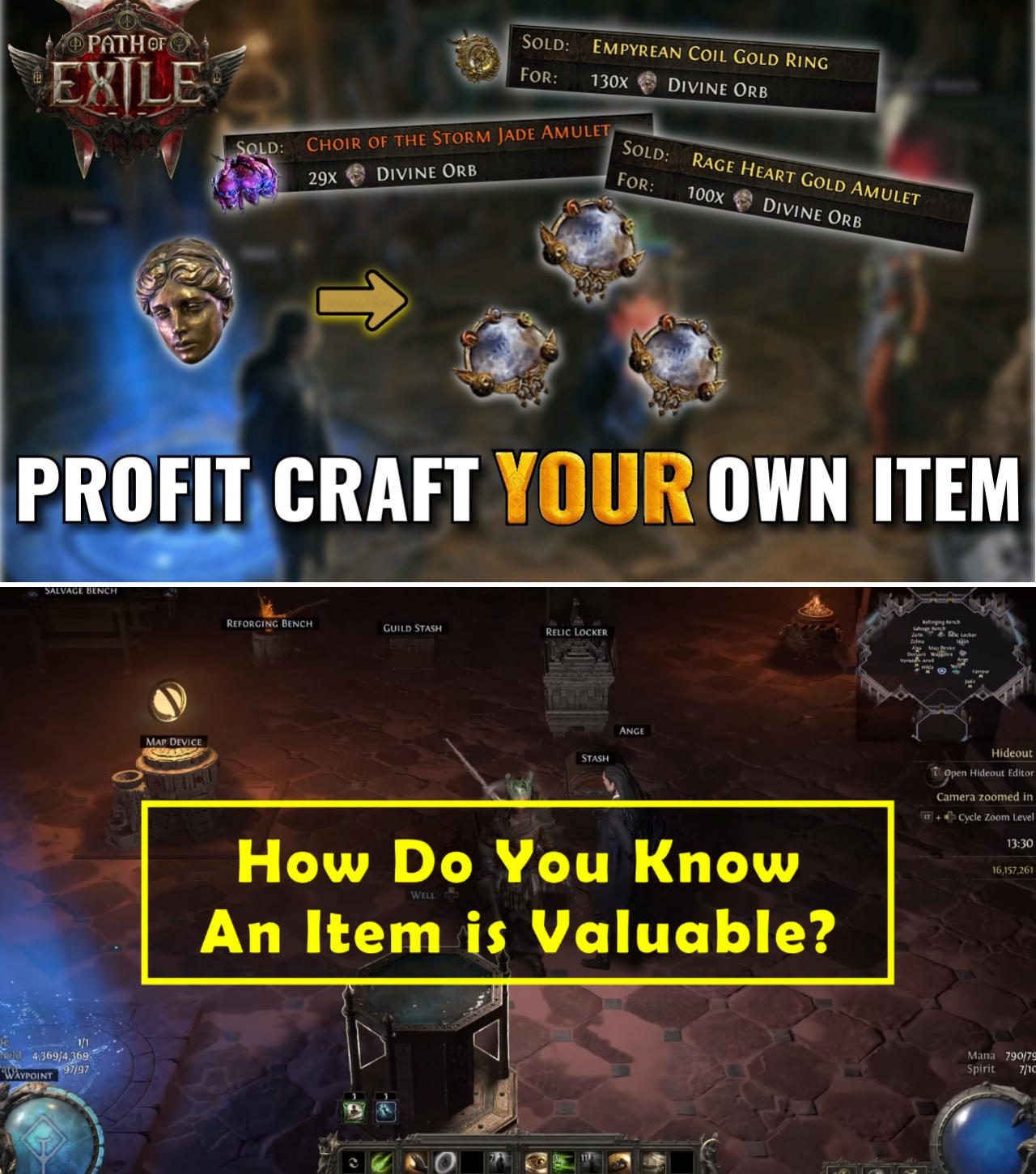
Because a vast portion of the Path of Exile 2 player base despises the tedious nature of trading and base preparation, they are willing to pay massive premiums for pre-isolated bases. Elite crafters capitalize on this by buying raw white Gold Amulet bases for mere exalts, slamming them to Magic or Rare levels using Regal Orbs, and selling them to lazy players for a 400% markup.
Similarly, if a crafter beats the 33% variance curve and successfully fractures +2 Melee Skills onto an item level 81 glove base, the raw, unfinished base can instantly be flipped on the trade site for upwards of 120 to 145 Divine Orbs. Since the expected cost to manufacture that fracture sits at roughly 60 divines, the player secures a massive, hassle-free profit margin without ever engaging in the stressful process of Chaos spamming or dealing with risky 10-divine Omen of Light blocks at the Well of Souls.
Community Polarized Over the “Rich Get Richer” Meta
The exposure of these calculated portfolios has sparked intense debate across community hubs. Many casual players feel that Patch 0.5 has turned Path of Exile 2 into a virtual investment banking simulator rather than an ARPG.
“If you don’t have 100 Divine Orbs to absorb the initial statistical variance, you literally cannot participate in the economy,” wrote one user on the r/PathOfExile2 subreddit. “The rich players run 200 trials, absorb the losses, hit one massive item with plus-three projectiles or flat physical damage at the Well of Souls, sell it for a mirror, and price everyone else out of the game.”
However, market defenders argue that this math-heavy ecosystem keeps the trade league alive. “The playbook is open to anyone who bothers to open a spreadsheet,” argued a prominent trade Discord moderator. “Slamming white bases to magic level costs almost nothing and yields guaranteed returns because people are fundamentally lazy. If you don’t want to do the math, you can go kill a boss like Koulamok or farm maps. The market rewards knowledge and risk management, period.”
With Patch 0.5’s economy hitting its peak stabilization period, the window for raw mechanical ignorance is closing. As elite crafters continue to treat Wraeclast as a high-stakes trading floor, the casual player base must adapt to the numbers—or find themselves permanently funding the mirrors of the 1%.