NVIDIA’s “Yassified” Games: Why DLSS 5 Has PC Gamers Fighting Over the Future of Graphics
🚨 NVIDIA JUST TURNED VIDEO GAMES INTO AI SLOP — AND GAMERS ARE NOT HAPPY.
DLSS 5 was supposed to make games look more realistic… so why are players joking that NVIDIA is “yassifying” their favorite characters instead? 💀
From GTA V’s Michael to Cyberpunk and Skyrim, modders have already shown what happens when NVIDIA’s new AI tech gets unleashed — but is this really the future of gaming graphics?
And now that DLSS 5 is officially here, one uncomfortable question is getting louder:
Are we making games look better… or just making them look more AI-generated?
The answer is causing a serious divide among PC gamers. 👀
🔥 Click the link to see why NVIDIA’s biggest graphics upgrade yet has become one of gaming’s strangest controversies.
NVIDIA wanted DLSS 5 to represent the next major leap in real-time graphics.
Instead, the technology has become the latest battleground in the increasingly heated debate over artificial intelligence in video games.
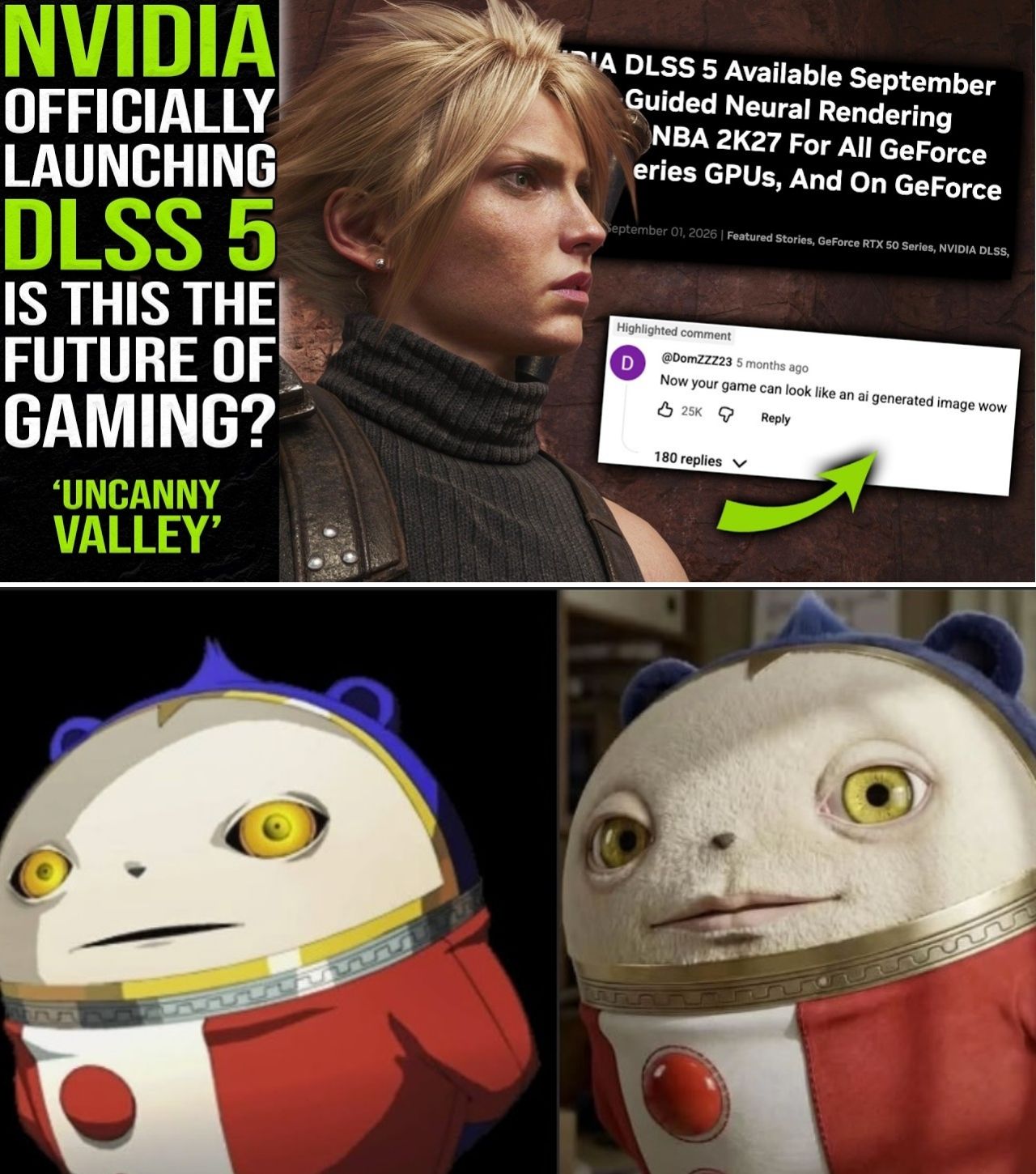
The controversy is easy to understand when looking at some of the images circulating online.
Faces appear smoother. Skin looks more detailed. Lighting becomes dramatically more realistic. Shadows gain additional depth. Characters can suddenly look less like traditionally rendered game models and more like digitally enhanced photographs.
To some players, that is exactly what next-generation graphics should look like.
To others, it is something much stranger.
They have started calling it “AI slop,” “AI filtering” and, perhaps most memorably, “yassifying” games.
The jokes became particularly widespread after unofficial experiments applied NVIDIA’s technology to older games, producing bizarrely enhanced versions of familiar characters.
And now the debate has become much more serious because DLSS 5 is no longer simply a controversial technology demo.
NVIDIA is officially launching it on September 3, 2026.
From DLSS to generative graphics
DLSS has been part of NVIDIA’s gaming strategy for years.
The original technology focused heavily on reconstructing higher-resolution images from lower-resolution inputs, allowing gamers to achieve better performance without simply rendering every frame at native resolution.
Over time, NVIDIA expanded DLSS into a broader collection of neural-rendering technologies, including Super Resolution, Frame Generation and Ray Reconstruction.
DLSS 5 takes the concept considerably further.
NVIDIA describes it as a form of generative control at the geometry level, rather than simply putting a conventional image filter over a finished frame.
The company argues that the system uses information from the game’s rendered scene to generate more realistic visual details while remaining controllable by developers.
That distinction matters.
The popular description of DLSS 5 as an “AI filter” is convenient, but it doesn’t fully describe what NVIDIA says the technology is doing.
The company has emphasized that developers can control how strongly the neural rendering affects different aspects of an image.
But that technical explanation hasn’t stopped the internet from having fun with the results.
Then came “Yassified Michael”
The controversy exploded even further after an unofficial version of the technology was discovered through an early-access build of NBA 2K27.
Modders extracted NVIDIA’s neural-rendering component and began experimenting with it across games that were never officially announced as DLSS 5 titles.
Among them were GTA V, Cyberpunk 2077, Skyrim and Control.
The results were unpredictable.
Some scenes looked noticeably more detailed.
Others looked heavily processed.
And some character faces became so altered that the internet quickly turned the experiments into memes.
One particularly memorable example involved Michael from Grand Theft Auto V.
Instead of simply becoming sharper, the character’s face could take on a noticeably different appearance.
The phrase “I yassified Michael” subsequently became one of the more recognizable jokes surrounding the technology.
It sounds ridiculous.
But underneath the meme is a legitimate concern about how much artificial intelligence should be allowed to alter the visual identity of a game.
The uncanny valley problem
Game developers have spent decades trying to make digital characters look more realistic.
But realism has always come with a catch.
Once a character becomes almost human-looking, tiny imperfections become much more obvious.
A slightly unnatural eye.
A strange facial expression.
Skin that looks too smooth.
Hair that behaves incorrectly.
A face that changes subtly between frames.
These problems can push a character into the infamous uncanny valley — the uncomfortable territory between clearly artificial and convincingly human.
NVIDIA’s own ACE and RTX technologies have explicitly targeted this challenge.
The company’s RTX Neural Faces technology, for example, uses generative AI to enhance rendered faces in real time, while its broader RTX Character Rendering technology targets realistic skin and hair.
DLSS 5 is part of a much larger direction.
NVIDIA increasingly wants GPUs to do more than traditional rasterization and ray tracing.
It wants neural networks to participate directly in how game worlds are rendered.
That could eventually change the appearance of games in ways that go far beyond higher resolution.
NVIDIA says it isn’t replacing artists
This is where NVIDIA strongly disagrees with the “AI slop” criticism.
CEO Jensen Huang has argued that DLSS 5 is fundamentally different from simply applying generative AI to a finished screenshot.
According to NVIDIA’s explanation, the system combines the controllability of game geometry, textures and other scene information with generative AI.
The company therefore argues that developers retain control over the final appearance rather than simply allowing an AI model to independently invent whatever it wants.
That distinction is important because one of the biggest fears surrounding AI-generated game content is loss of artistic control.
A traditional game asset is deliberately created.
Artists decide how a character looks.
Lighting artists determine how a scene is illuminated.
Technical artists establish materials and shaders.
Animators determine movement.
If an AI system starts making major visual decisions automatically, developers could theoretically lose some of that control.
NVIDIA’s answer is that DLSS 5 is designed to work with those decisions rather than replace them.
But the performance question is brutal
There is another problem that has received considerably less attention than the memes:
DLSS 5 is expensive.
The Verge reports that NVIDIA estimates a roughly 50–60% performance hit from DLSS 5 in certain configurations.
That creates an obvious contradiction.
One of the original selling points of DLSS was improving image quality while allowing gamers to run games at higher frame rates.
Now NVIDIA is introducing a technology capable of dramatically improving visuals — but the additional AI processing can itself consume substantial GPU resources.
The company has worked to make DLSS 5 more efficient than the early demonstrations suggested.
Recent demonstrations reportedly showed the technology running on hardware as modest as an RTX 5060 laptop under specific conditions, although results depend heavily on the game and configuration.
Still, the performance cost will remain an important question once developers begin implementing the technology at scale.
The RTX 50-series problem
There’s also a hardware divide.
DLSS 5 is currently tied to RTX 50-series GPUs, alongside GeForce Now support.
That means millions of PC gamers using older RTX cards won’t simply be able to download a driver and receive the complete experience.
For NVIDIA, this creates another reason for enthusiasts to upgrade.
For consumers, it creates a familiar frustration:
A new graphics technology arrives.
The visual demonstrations look spectacular.
Then gamers discover that experiencing the full effect requires the latest generation of hardware.
That dynamic has become increasingly common as NVIDIA pushes dedicated AI processing deeper into its gaming ecosystem.
And NVIDIA is putting AI everywhere
DLSS 5 doesn’t exist in isolation.
NVIDIA is simultaneously developing technologies such as ACE, which uses AI to create conversational and actionable game characters.
Its ACE platform includes AI models for speech, intelligence and animation, with both cloud and on-device implementations designed specifically for gaming.
Then there is Project G-Assist, NVIDIA’s AI assistant for GeForce PCs.
G-Assist can already optimize graphics settings, adjust RTX features, monitor performance, update drivers and perform other PC-management functions.
NVIDIA’s broader RTX Kit strategy also explicitly describes AI as part of the future of game rendering and character creation.
So the “AI-ification” of gaming isn’t really about one controversial graphics feature.
It is a much larger strategy.
NVIDIA sees artificial intelligence becoming another fundamental layer of the gaming stack.
Gamers aren’t necessarily rejecting AI
Interestingly, the community reaction isn’t universally negative.
Hands-on testing of the final DLSS 5 implementation has produced much more positive impressions than the initial leaked demonstrations.
PC Gamer reported that its experience with DLSS 5 was surprisingly impressive, with no obvious facial morphing during gameplay and a convincing improvement in overall visual quality.
TechRadar similarly found the technology impressive in NBA 2K27, particularly when developers carefully tuned its settings rather than simply pushing the effect to maximum intensity.
That suggests an important distinction.
The problem may not be AI itself.
It may be what developers choose to do with it.
A subtle improvement to lighting or facial detail can be difficult to object to.
A dramatic transformation that makes every character look like an AI-generated influencer is another matter entirely.
The real fear: every game looking the same
This may ultimately be the biggest artistic concern.
If developers increasingly rely on the same neural-rendering technologies, AI models and visual presets, games could theoretically begin converging toward a similar definition of “realistic.”
That’s especially concerning for games with highly stylized art directions.
Not every game is supposed to look photorealistic.
Borderlands doesn’t need to resemble a Hollywood film.
The Legend of Zelda doesn’t need photorealistic skin.
A fantasy RPG may deliberately use exaggerated proportions.
An indie game may embrace visible pixels and artificial lighting.
If AI-enhanced rendering becomes synonymous with “better graphics,” developers could face pressure to make their games increasingly realistic even when realism isn’t appropriate for the artistic vision.
That concern has already appeared in community discussions surrounding Bethesda titles, where players have questioned whether AI-powered visual enhancement could undermine the distinctive look of games such as The Elder Scrolls and Fallout.
The future of gaming may look increasingly synthetic
The irony is that NVIDIA may actually be succeeding.
DLSS 5 has generated enormous discussion precisely because it challenges players’ assumptions about what a rendered game should look like.
For decades, the goal was straightforward:
Render more polygons.
Improve textures.
Increase resolution.
Add better lighting.
Increase frame rates.
Now the formula is changing.
The question is no longer simply how much can the GPU render?
It is increasingly:
How much of what the player sees should the GPU generate?
That is a much bigger philosophical shift.
And gamers are clearly divided.
Some see DLSS 5 as the beginning of a new era where AI finally helps developers create visuals that would otherwise require enormous amounts of computational power.
Others see the same technology as another step toward a gaming industry where machines increasingly decide what the player sees.
The reality will probably land somewhere between those extremes.
DLSS 5 is officially arriving today, but its long-term reputation will depend heavily on how developers use it.
Used carefully, it could become another invisible graphics technology that players eventually take for granted.
Used aggressively, it could become exactly what the internet is already joking about:
the great “yassification” of gaming.
And that may be the real test for NVIDIA — not whether AI can make games look more realistic, but whether it can do so without making every game look like it came through the same AI filter.