He Warned Cleveland Police Was Under Pressure — Then the A66 Crash Killed Seven and Raised New Questions
🚨 HE WARNED THEM. THEN SEVEN PEOPLE WERE KILLED.
For years, Cleveland’s police commissioner had reportedly warned that funding pressures were leaving officers stretched dangerously thin — even warning they might not be there “when they were needed most.”
Now, after the A66 horror crash killed two officers and five young men, a grieving family is questioning whether the police pursuit should have happened at all.
Was the tragedy preventable? Why was the pursuit ended just seconds before the fatal collision? And how much did Cleveland Police’s long-running resource crisis actually matter?
The answers are far more complicated than the first headlines suggested.
👇 Read the full story and see what investigators are now examining.
He Warned Cleveland Police Was Under Pressure — Then the A66 Crash Killed Seven and Raised New Questions
The fatal A66 crash in northeast England has become more than a devastating road tragedy. It has opened a wider debate about police resources, pursuit decisions and whether years of warnings about Cleveland Police funding pressures were being heard.
Seven people were killed in the early hours of August 22 when a Volkswagen Passat travelling the wrong way along the A66 collided head-on with a marked Cleveland Police vehicle near South Bank, Middlesbrough.
The two police officers inside the vehicle — PC Matthew Blades, 37, and PC Tom Clough, 38 — died alongside the five occupants of the Passat: Michael Robert Cahill, 23, Jakub Matusiak, 23, Makai Saddington, 18, Theo Rae, 17, and Cole Robert Worthy, 17.
Cleveland Police confirmed that the Passat was travelling against the direction of traffic and that the police vehicle was travelling correctly. The force immediately referred the circumstances to the Independent Office for Police Conduct, or IOPC, as required after a death connected with police contact.
But in the days since, the central question has shifted from simply what happened to what happened in the minutes — and even years — before the crash.
The pursuit that ended shortly before the collision
One of the most important details is that the Passat had been pursued by Cleveland Police before the crash.
According to Sky News, the pursuit lasted just under seven minutes and was called off after the Passat began travelling the wrong way along the A66. The decision to terminate the pursuit reportedly came about 10 seconds before the collision.
That distinction matters.
The police vehicle carrying Blades and Clough was not itself part of the pursuit. It happened to be travelling on the same stretch of road when the wrong-way Passat collided with it.
The IOPC is therefore examining the circumstances surrounding the pursuit and the events leading to the crash. Until that investigation is completed, it would be premature to say that the pursuit caused the collision — or that it could have prevented it from happening.
Cleveland Police has also urged the public not to speculate while the investigation continues.
A grieving family challenges the narrative
Against that backdrop, the family of one of the young men killed in the Passat has questioned whether the police response played a role in the chain of events.
Reports circulating since the weekend say relatives have questioned whether the pursuit should have taken place or whether it could have been terminated earlier.
The argument has understandably generated a fierce response because the crash killed two serving police officers who were simply travelling on the A66 in the correct direction.
A recently published account describing the family’s position says relatives want investigators to examine whether the police response contributed to the final sequence of events. However, that account is not itself evidence that police wrongdoing occurred.
That distinction is particularly important in a case where emotions are running extremely high.
The IOPC investigation exists precisely to establish the facts independently.
The questions investigators ultimately need to answer include why the Passat was being pursued, what information officers had at the time, how the pursuit was managed, why it was terminated and what happened during the crucial seconds between the pursuit ending and the fatal impact.
The story behind the Passat has also changed
The crash initially generated reports describing the five young men as being involved in a dangerous joyride.
The picture has since become considerably more complicated.
Cleveland Police said officers had received several reports of vehicles being driven dangerously in the area that morning. One vehicle, believed to be a Volvo XC60, had reportedly been involved in ramming properties, while the Passat was believed to have been associated with those activities.
Both vehicles were operating with cloned registration plates, according to police.
The Passat was detected by automated number-plate recognition technology, and the subsequent pursuit became part of the chain of events now being investigated. Cleveland Police later launched a much broader criminal investigation into what happened before the collision.
Twelve people were arrested in connection with alleged criminality surrounding the events. Cleveland Police said those arrested included nine men and three women between the ages of 19 and 61, with suspected offences ranging from firearms possession to participation in the activities of a crime group. One man was charged with drug-related offences and possession of criminal property.
The force has described the investigation as involving significant links to serious and organised criminal activity.
That does not mean every person connected to the crash or the surrounding incidents has been proven to be part of organised crime. Those allegations remain matters for investigators and, where appropriate, the courts.
Social media has added another layer
The A66 tragedy has also reignited concerns about dangerous driving content circulating on social media.
Reports have highlighted videos allegedly connected with some of those who died, including footage showing dangerous driving and police pursuits.
A video reportedly associated with Makai Saddington was published on TikTok in March 2025 and showed a vehicle being followed by police. BBC Verify reportedly geolocated the route shown in the footage. The account and video have since been removed.
At the same time, authorities have cautioned against assuming that the fatal A66 crash itself was being filmed for TikTok.
Sky News reported that Cleveland Police had confirmed there was no evidence indicating that the incident was being filmed for TikTok.
That distinction has become important online, where speculation can move much faster than an official investigation.
Community discussions have reflected the divide. Some commenters have expressed overwhelming sympathy for the families of the two officers, while others have argued that the families of the five young men are also experiencing an extraordinary loss. Discussions on forums such as Mumsnet have shown how sharply opinions differ over responsibility, parenting, dangerous driving and the role of social media.
Then there is the funding question
Perhaps the most politically explosive part of the story involves Cleveland Police’s finances.
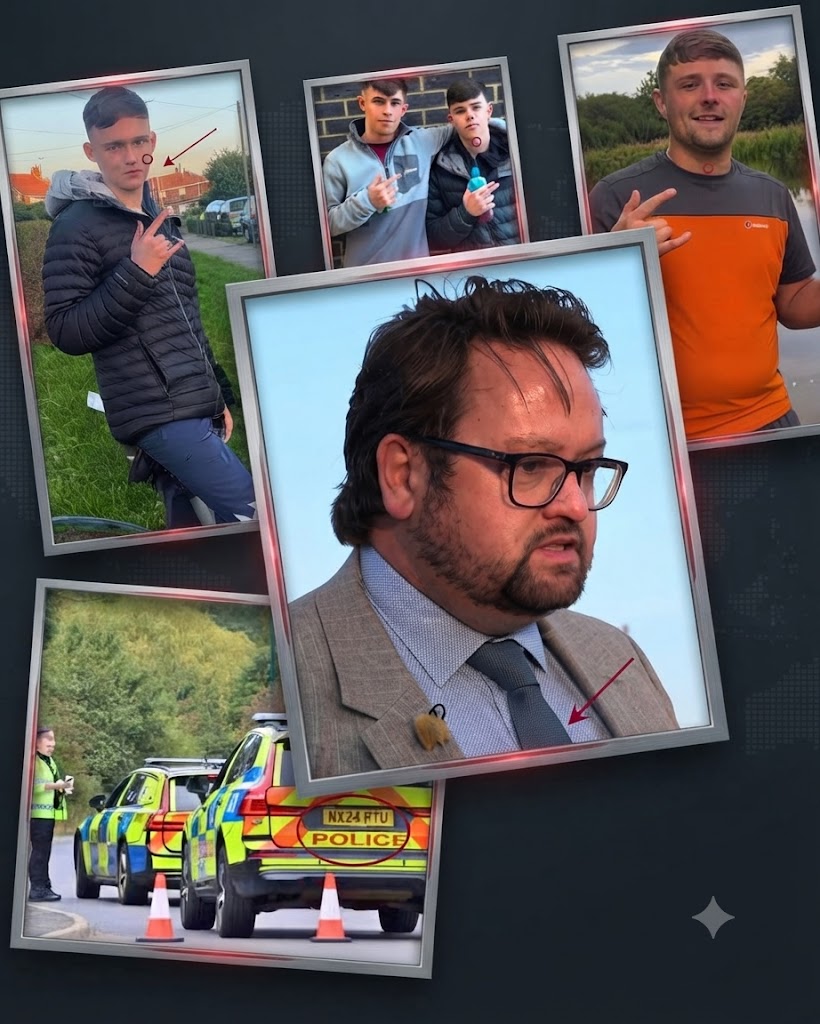
Police and Crime Commissioner Matt Storey has repeatedly argued that the force has been operating under severe financial pressure.
In a statement earlier this year, Storey said Cleveland faced a £2.4 million funding shortfall for the 2026-27 financial year — an amount he equated to approximately 40 full-time police officers.
He also argued that Cleveland received an effective increase of only 2.9% after accounting for the previous year’s pay award, describing the settlement as a real-terms reduction.
The issue was also raised in Parliament.
During a February 2026 Commons debate, MPs highlighted that Cleveland had around 12% fewer officers than in 2010 and argued that the force was serving an area with particularly high deprivation and crime while receiving what was described as the smallest increase in the national funding settlement.
The debate also recorded Storey’s argument that Cleveland Police was having to operate “with one hand behind their back” because funding had failed to keep pace with inflation and other resources had been redistributed.
More recently, reports have said Storey had sent at least seven letters to government ministers since July 2024 warning about the force’s financial pressures, with only two receiving responses.
That claim is particularly significant because it has emerged in the aftermath of the A66 crash and the wider wave of serious incidents in Middlesbrough.
However, there is an important difference between saying Cleveland Police was under-resourced and saying underfunding caused the A66 crash.
There is currently no established evidence proving the latter.
A force under pressure in a community under pressure
The wider context has made the funding debate even more intense.
The Financial Times recently reported that Cleveland Police has roughly 1,500 officers — around 250 fewer than in 2009 — while the force covers an area experiencing disproportionately high crime and deprivation.
Following the A66 tragedy, the force has also had to call on officers and resources from other areas as authorities responded to a series of serious incidents across the region.
At the same time, Cleveland Police has stressed that its officers have continued responding to major incidents despite those pressures.
The force’s official account says officers from Cleveland, Durham, Northumbria and North Yorkshire worked together after the crash to establish what happened.
That reality makes the political argument more complicated.
A police force can be under significant financial pressure without every operational decision being the result of that pressure. Equally, concerns about staffing levels and resources can be legitimate even if they ultimately have no connection to one particular tragedy.
Those two questions need to be investigated separately.
Seven deaths, two very different narratives
The emotional divide surrounding the A66 crash is now impossible to ignore.
For the families of Matthew Blades and Tom Clough, the tragedy is the loss of two officers who went to work and never returned home.
Their colleagues have described both men as dedicated public servants, while tributes have poured in from across the region. Blades’ connection with Manchester United has also led to a highly personal tribute, with his young sons recently appearing as mascots at Old Trafford.
For the families of the five men in the Passat, there is also grief, regardless of the circumstances that preceded the crash.
But grief does not settle questions of responsibility.
Those questions belong to investigators.
And that is why the IOPC investigation will be so important.
What happens next?
The central issue now is not simply who was driving the wrong way.
That fact is already established.
The harder questions concern the chain of decisions leading up to those final seconds.
What prompted the pursuit?
What information did officers have?
Was the pursuit conducted according to policy?
Why was it terminated when it was?
What happened immediately afterwards?
And, most importantly, was there any realistic opportunity for the collision to have been prevented?
Those answers cannot be supplied by social-media posts, grieving relatives, angry commenters or political arguments about police funding.
They will have to come from evidence.
The A66 tragedy unfolded in seconds, but determining exactly why seven people died may take considerably longer.
For now, the most responsible conclusion is also the simplest: the families deserve answers, the two fallen officers deserve to be remembered, and the independent investigation must be allowed to establish what happened before anyone declares who — or what — was ultimately responsible.