Birmingham’s Flag War Explodes Into a Court Battle as Council Moves Against St George’s Cross and Union Jack Displays
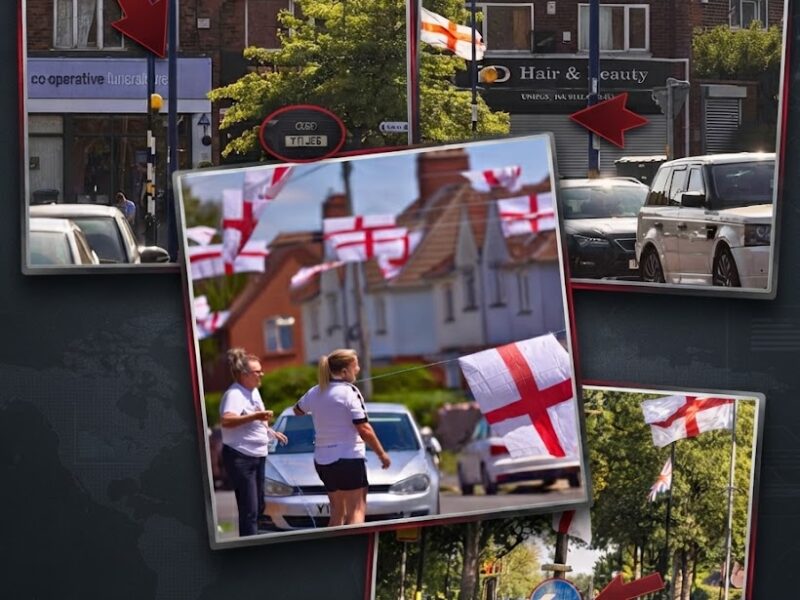
🇬🇧🚨 BIRMINGHAM JUST TURNED A FLAG DISPUTE INTO A COURT BATTLE.
The St George’s Cross and Union Jack are at the centre of a furious new row after Birmingham City Council went to the High Court seeking to stop flags being attached to lamp posts and other public infrastructure.
The council says it’s about safety, obstruction and community cohesion.
But critics are asking a very different question: is this really about public safety — or has Britain’s flag become the latest front line in a much bigger culture war?
And with campaigners refusing to back down, this fight may be nowhere near over…
👇 Click the link to see what’s really happening in Birmingham.
Birmingham’s Flag War Explodes Into a Court Battle as Council Moves Against St George’s Cross and Union Jack Displays
A battle over England’s flag has escalated into a legal confrontation in Birmingham, with the city council seeking a High Court injunction to stop people attaching flags to lampposts and other public infrastructure.
The move has thrust a dispute that might once have been dismissed as a local argument over street decorations into the centre of a much broader British debate about patriotism, immigration, public space and community relations.
At the heart of the controversy is Raise the Colours, a campaign group that has encouraged people to display St George’s Cross and Union Jack flags across Birmingham and elsewhere in Britain.
The group describes its campaign as an effort to promote “unity and patriotism.” Critics, however, have accused it of promoting anti-immigration rhetoric and creating tension in communities — allegations the group disputes.
Now Birmingham City Council wants the courts to intervene.
But the council insists the legal action is not a ban on national flags themselves.
Instead, it is targeting unauthorised attachments to public infrastructure, regardless of the political or national symbolism involved.
What Birmingham City Council is actually seeking
On August 26, the council submitted an application to the High Court seeking an injunction that would prevent people from attaching flags and other unauthorised objects to highways infrastructure.
The application names Raise the Colours organiser Ryan Bridge and six others, as well as “persons unknown,” meaning the proposed order could potentially apply more broadly than the named individuals.
The council says its decision followed an “evidence-led process” focused on three issues: public safety, lawful management of highways and community cohesion.
It also says there have been incidents involving harassment, intimidation and obstruction during attempts to remove unauthorised flags.
Councillor Jane Baston, the cabinet member responsible for the issue, has described the approach as lawful, proportionate and evidence-led.
That language is significant because it directly addresses one of the most contentious accusations surrounding the dispute: that the council is trying to suppress patriotic expression.
The council’s position is that people remain free to display flags on property where they have the right to do so. The issue is the attachment of objects to infrastructure controlled by the authority or used for public highways.
This fight did not start this week
The current legal action is the latest chapter in a dispute that has been developing for more than a year.
Flags began appearing in large numbers across parts of Birmingham during the summer of 2025.
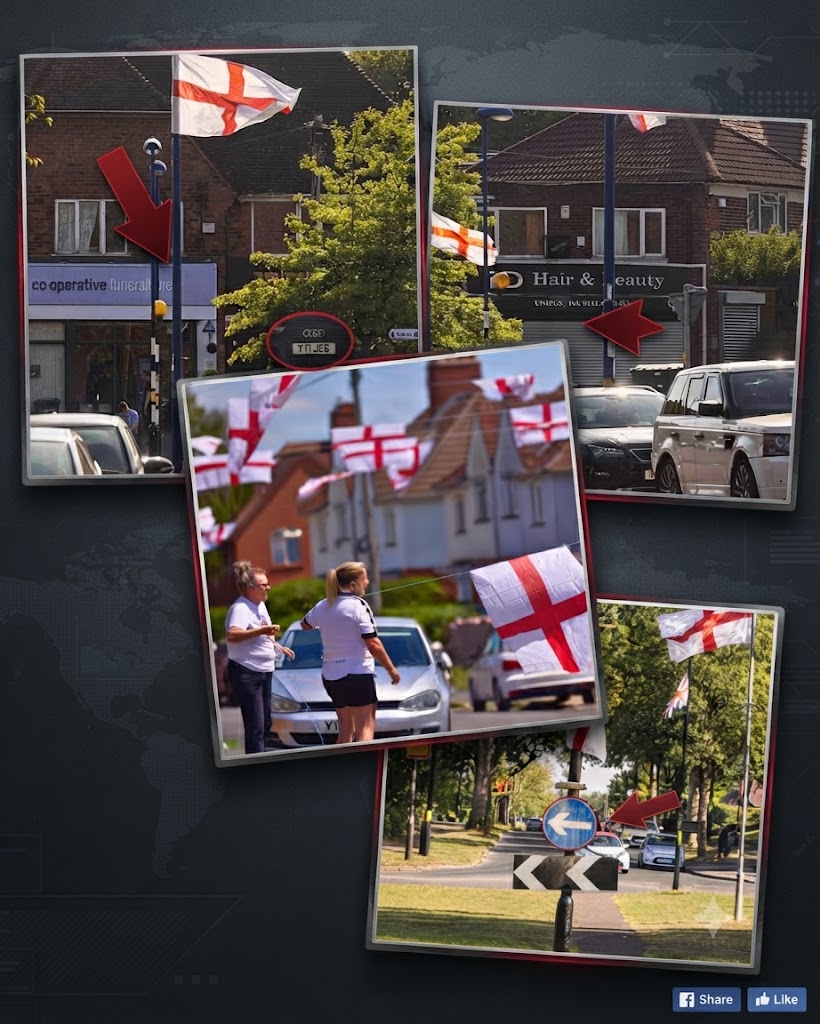
St George’s Cross flags and Union Jacks were attached to lamp posts, roundabouts and other structures, particularly in parts of southern Birmingham.
The campaign quickly attracted supporters who described the displays as a patriotic expression of national identity.
A Reddit discussion from August 2025, for example, attracted thousands of votes after a Birmingham resident posted that flags were appearing throughout areas including West Heath and Bartley Green.
Some commenters welcomed the displays, describing the flags as a positive reminder of British identity. Others objected to their political associations or the condition of some of the flags.
The debate has continued into 2026.
In May, Birmingham City Council formally warned residents not to attach flags or other unauthorised items to street furniture.
The council said such attachments were not permitted without permission and could be removed. It also warned that enforcement action could be taken where attachments caused obstruction, created a safety hazard or were repeatedly installed in the same locations.
That is an important piece of context.
The latest High Court application did not suddenly create a new rule banning the English flag. The council had already been removing unauthorised flags and warning about enforcement.
What has changed is the escalation from ordinary enforcement to court proceedings.
Why does the council say the flags are a safety issue?
This is one of the most disputed aspects of the controversy.
The council’s argument is not that the St George’s Cross or Union Jack is inherently dangerous.
Rather, officials are concerned about attaching objects to infrastructure designed for specific public purposes.
Potential issues include visibility, obstruction and the possibility of objects becoming detached.
There is also the question of workers having to remove the flags.
Birmingham says its evidence-gathering process identified incidents in which removal activity became associated with harassment, intimidation or obstruction.
Similar arguments have appeared elsewhere in England.
Oxfordshire County Council recently secured a High Court injunction preventing people from attaching flags to neighbourhood lampposts. That case has become an important precedent in the wider dispute over so-called “flagging” campaigns.
The Oxfordshire case also involved concerns over intimidation directed at council staff and contractors.
Birmingham is now seeking comparable legal protection.
But critics see something much bigger
For supporters of Raise the Colours, the issue is not simply about lamp posts.
The St George’s Cross has become an increasingly visible symbol in Britain’s political debate.
The sudden spread of English flags across roads and public spaces has been embraced by some people as an expression of national pride.
At the same time, the symbol has become politically complicated because some flag displays have appeared alongside anti-immigration demonstrations and activism.
That has created a difficult question for local authorities: when does a patriotic display remain a legitimate expression of identity, and when does the surrounding context make it a source of intimidation or community tension?
The Guardian reported in July that Birmingham residents had complained to the council and West Midlands police about the activities of Raise the Colours, including alleged confrontations and behaviour they considered intimidating. The group has denied accusations of racism and says its campaign is about unity and patriotism.
That disagreement is at the heart of the controversy.
One side sees the flags as ordinary national symbols.
The other sees their coordinated placement across public infrastructure as part of a political campaign with consequences for how minority communities experience public spaces.
Online reaction is sharply divided
The debate has also become a major social-media argument.
On Reddit, reactions range from outright support for the council’s decision to frustration that national flags are being treated as politically controversial.
One recent UK politics discussion about potential legal consequences for people attaching flags to lampposts included commenters arguing that permission should be required for any objects placed on public property. Others mocked the campaign and criticised the quality or appearance of some of the flags.
Another discussion captured the opposite side of the argument, with commenters questioning why people should be prevented from displaying the English flag in England.
The split demonstrates why the Birmingham dispute has become so emotionally charged.
People are not necessarily arguing about the same thing.
For some, it is a straightforward question of whether anyone should be allowed to attach objects to public infrastructure without permission.
For others, the council’s intervention represents something much more symbolic: whether displaying the national flag in a British city is increasingly being treated as politically suspect.
The council insists it is not targeting a viewpoint
That distinction is central to Birmingham’s legal case.
Officials have said the proposed injunction is not aimed at a particular community, belief or political viewpoint.
Instead, the proposed restrictions concern unauthorised attachments to highways infrastructure.
In practical terms, that means the same principle could apply regardless of whether someone attaches a St George’s Cross, Union Jack, another national flag, a political banner or another object.
The council has also stressed that its enforcement concerns arise from the way the items are installed and the consequences for safety and council staff.
That argument could prove important if the case reaches a substantive hearing.
The legal question is not simply whether people have a right to display a flag.
It is whether that right extends to attaching the flag to infrastructure they do not own or control.
The political backdrop makes everything more explosive
The dispute comes at a particularly sensitive time in Britain.
Immigration, national identity and public displays of patriotism have become increasingly prominent political issues.
Raise the Colours has capitalised on that environment, turning the simple act of putting an English flag on a lamp post into something with a much larger political meaning.
The campaign says it is spreading symbols of unity.
Critics argue that the symbols have become associated with anti-immigration politics and can make some residents feel targeted.
Neither interpretation automatically settles the legal question.
A person can display a national flag for entirely benign reasons.
Likewise, a coordinated campaign can have political implications without every individual participating in it sharing the same views.
That is precisely why Birmingham’s decision has attracted so much attention.
Birmingham is now testing where the line is
The High Court application could ultimately become more significant than the immediate dispute over a handful of lamp posts.
If the injunction is granted, it would give Birmingham a stronger legal mechanism to prevent repeated unauthorised attachments to public infrastructure.
If it is rejected or substantially narrowed, the council could face further challenges in controlling the campaign.
Either way, the case may provide another indication of how British councils and courts are approaching the growing practice of attaching political or national symbols to public infrastructure.
For residents, meanwhile, the disagreement is already about much more than street furniture.
One group sees a simple symbol of England.
Another sees a campaign that has become increasingly political.
And the council sees a public-management and safety problem that has escalated to the point where ordinary enforcement is no longer enough.
What happens next?
The immediate question is whether Birmingham City Council will obtain the High Court injunction it is seeking.
The court will have to consider the evidence behind the council’s claims and the scope of any restrictions.
The case will also be watched closely because Oxfordshire has already obtained a similar order.
For Raise the Colours and its supporters, the legal battle represents another test of whether national symbols can continue to be displayed in public spaces without interference.
For Birmingham officials, the argument is much narrower: public infrastructure cannot simply become a canvas for whoever wants to attach something to it.
The most important point, however, is that Birmingham has not banned the English flag.
The controversy is about where and how flags can be displayed.
That may sound like a technical distinction, but in Britain’s increasingly heated debate over identity and belonging, it has become a very consequential one.
The High Court proceedings could therefore determine far more than what hangs from Birmingham’s lamp posts.
They may help define the boundary between patriotic expression, political campaigning and the lawful use of public space — at a moment when Britain’s national symbols have rarely generated so much debate.