The Phantom in the Glass
The ocean breeze didn’t smell like salt tonight; it smelled like ozone and impending violence.
Standing on the private stretch of sand behind the Fontaine Belle, with the Atlantic hissing against the dark shore like a held breath, I stared down at my shoes. The separation near the right toe had worsened. A little strip of leather flapped silently every time the wind caught it—a quiet, mocking reminder that my bank account was sitting at a terrifying twelve dollars and forty cents.
Inside the glass walls of the ballroom, three hundred people in bespoke tuxedos and designer silk were laughing over pan-seared sea bass and vintage champagne, entirely unaware that the floorboards beneath their polished Oxfords were made of balsa wood.
A heavy hand landed softly on my bare shoulder.
“Emma. Stop looking at your feet.”
I turned around to find Marisol, my supervisor, eyeing my posture with the weary precision of a woman who had managed high-society disasters for twenty years. “Vincent Caruso’s private detail is sweeping the terrace again. Do not drop a single glass, do not make eye contact unless spoken to, and for God’s sake, keep that tray level. If you survive tonight, your rent is covered for two months. If you mess up, I never met you.”
“I’m invisible, Marisol. You know me,” I forced a tight smile, adjusting the heavy silver tray in my palm.
“That’s what I’m counting on.”
She melted back into the crowd of glittering chandeliers and cascading white orchids. I took a deep breath, smoothing down the standard-issue black-and-white catering uniform that felt less like a garment and more like a second skin I couldn’t wait to shed. I stepped back through the heavy glass doors, slipping back into the hum of elite Miami wealth.
Vincent Caruso. Even the name tasted like copper and old blood.
In the Wynwood coffee shop where I spent my mornings, customers whispered about him over cold brews. They called him the architect of the bay—the man who owned every container ship, marina, and construction crane from Biscayne Bay to Key West. To the public, he was a ruthless billionaire philanthropist. To the underworld, he was a ghost who settled scores before law enforcement even realized a crime had been committed.
I scanned the perimeter, looking for empty champagne flutes to clear, keeping my head tilted downward just enough to remain part of the background architecture.
That was when the air went dead.
It wasn’t a physical sound, but a sudden, violent shift in atmospheric pressure. Near the northern wall, surrounded by local politicians and real estate magnates who leaned toward him like sunflowers chasing a dying sun, stood Caruso. He was thirty-five, sharp-jawed, with ink-dark hair and eyes the color of a winter ocean. He held a glass of scotch, completely silent while everyone else fought for the privilege of filling the quiet.
I started toward them, spotting two empty crystal flutes on their table.
“Champagne, gentlemen?” I murmured, keeping my eyes respectfully cast downward.
The councilman to his left took a glass without glancing at me. Another man murmured a dismissive word. But Caruso didn’t take a glass.
He looked straight at me.
Before our eyes could fully lock, something tiny, crimson, and terrifying flickered across his dark lapel.
I froze. The silver tray wobbled in my grip, a half-inch from sliding to the marble floor.
It wasn’t a reflection. The tiny red point slid upward, tracing the sharp line of his collarbone, lingering for a fraction of a second against his jugular, and then settling with absolute, mathematical precision right between his dark eyebrows.
A sniper. Somewhere out there in the dark, framed against the vast, starless expanse of the Atlantic, a crosshair was resting on the most dangerous man in Florida.
My mother had spent her life in the Jackson Memorial emergency room. “Assess the bleeding first, ask questions later,” she used to tell me when patching up my scraped knees. Instinct over intellect. Survival over hesitation.
If I screamed, three hundred elites would scatter like roaches, creating absolute chaos—and giving a professional assassin a clear, unobstructed target in the panic.
Before my brain could logically process the suicide mission I was embarking on, my hand moved. I set the heavy tray down on a passing service table, reached out, and grabbed the sleeve of Vincent Caruso’s custom-tailored Tom Ford tuxedo.
His entire body locked. The men around him stiffened instantly, their hands dropping toward their waistbands with terrifying speed.
“Dance with me,” I whispered, keeping a bright, trembling smile plastered to my face while my heart hammered violently against my ribs.
Caruso’s eyes darkened into abyssal trenches. His gaze dropped to my cheap, peeling black flats, then slashed back up to my face. The red dot shifted from his forehead down to his temple, pulsing like a heartbeat.
“Excuse me?” he murmured, his voice a low, gravelly vibration that barely carried over the string quartet.
“Like you’re my husband,” I whispered frantically, my nails digging into the expensive wool of his sleeve. “Do not turn toward the windows. There is a red dot right between your eyes.”
He didn’t flinch. He didn’t gasp. His dark eyes simply evaluated me, stripping away every layer of my fake identity, weighing the truth of my words against the sudden tension in the room.
“Who sent you?” he asked, his tone chillingly smooth.
“Nobody! Look at the glass behind you—look at the reflection in the French doors!”
“Why should I trust a girl smelling of cheap espresso and panic?”
“Because that red point just moved from your temple back to your brow, and if I let go, your brains are going to decorate that ice sculpture!”
The string quartet transitioned into a sweeping, aggressive waltz.
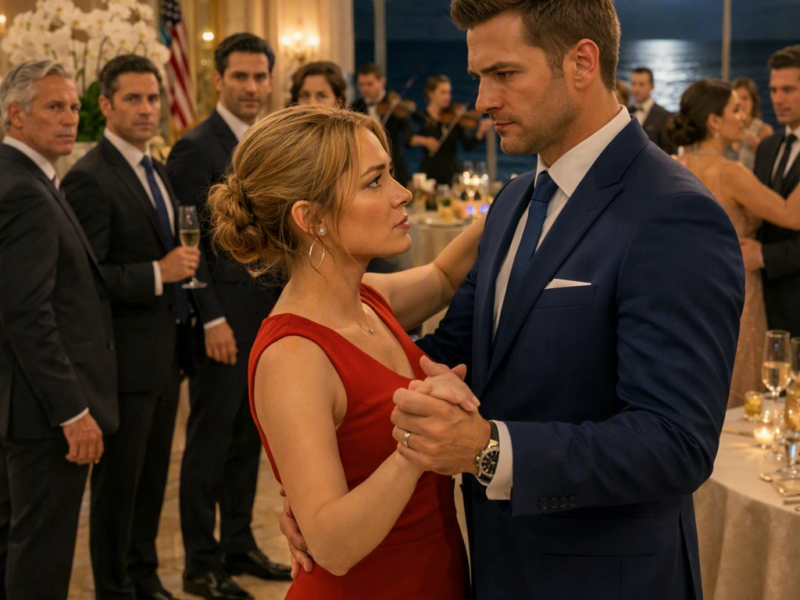
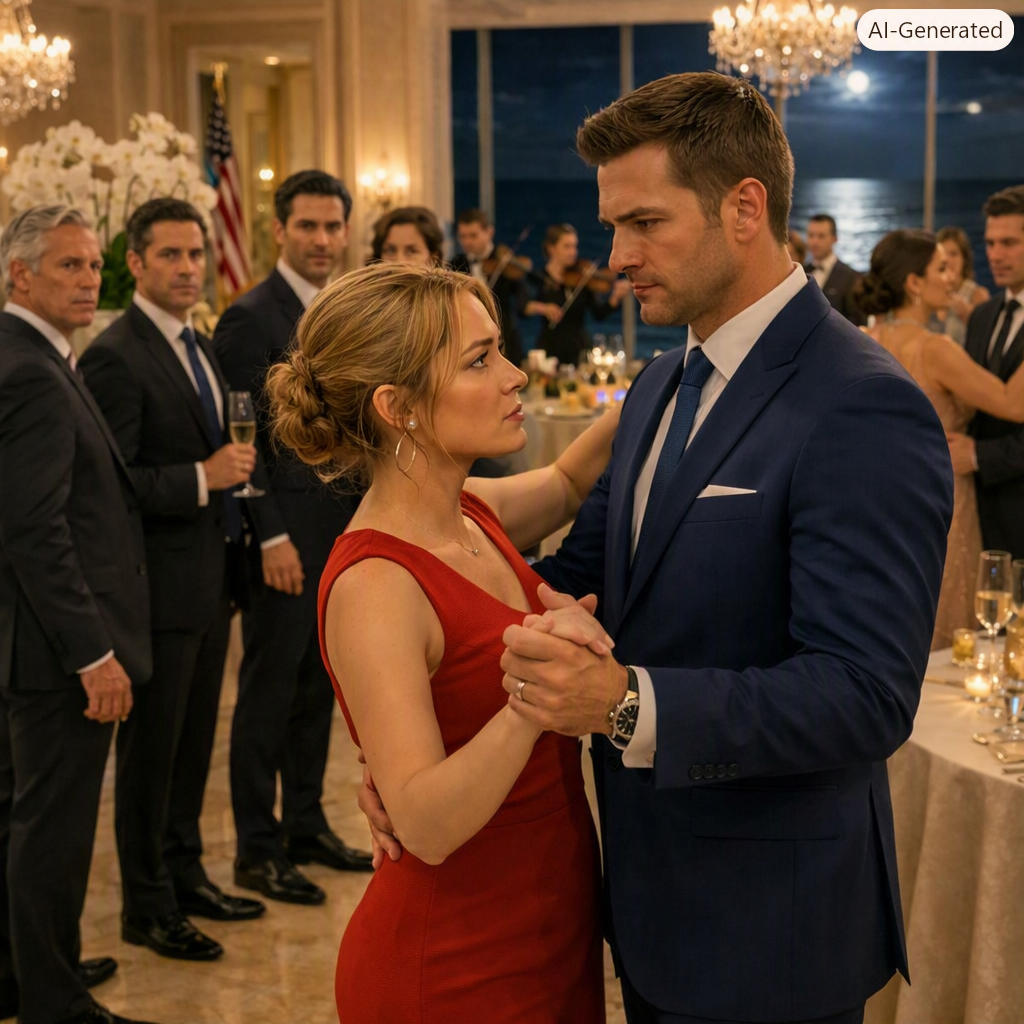
Without another word, Caruso’s hand shot out. His fingers—hard, warm, and calloused—closed firmly around my waist. He didn’t ask for permission; he hauled me violently against his chest and spun us straight into the center of the crowded dance floor.
The sudden movement broke the line of sight. The red dot vanished across the dark mahogany paneling of the ceiling.
“Still there?” he murmured into my hair, his breath hot against my ear as he guided us backward with terrifying, calculated grace, using the spinning bodies of other couples as human shields.
“It’s tracking the movement,” I whispered, my palms flat against his chest, feeling the steady, unnerving rhythm of his heart beneath the silk. “Upper balcony. Must be the service catwalk.”
“Your name.”
“Emma Thompson.”
“Where do you work, Emma?”
“Are you seriously conducting a background check while we’re dodging a bullet?”
A ghost of a smirk touched the corner of his sculpted mouth, though his eyes remained entirely dead-eyed and tactical. “You’d be surprised what people try to slip past my security, Emma Thompson. How did you spot it?”
“I notice things people try to hide. Like rent increases, leaking pipes, and laser sights.”
Over his shoulder, I watched his men move. The silver-haired man who had been standing near the bar—evidently his chief of security—had stopped talking. Two fingers touched a cuff link. A second later, three men in identical black suits dissolved seamlessly through the side doors leading to the exterior stairwells.
“You didn’t even have to speak to them,” I noted, my voice shaking despite my best efforts.
“They know the language of my silence,” Caruso replied softly, spinning us smoothly past a pillar of white orchids. “Apparently, so do you.”
The music swelled to a dramatic close. As the final notes echoed through the crystal chandeliers, the red dot flickered one last time against a floral arrangement, then blinked out entirely.
Applause erupted around us. Couples pulled apart, laughing.
Vincent Caruso did not let go of my waist.
Instead, with a gentle yet inescapable pressure, he guided me backward into a secluded, palm-shaded alcove near the rear service corridor. The silver-haired security chief materialized beside us like a shadow detaching from a wall.
“West balcony is clear, boss,” the older man reported in a low hiss. “The roof team found an unlocked service door. Security lock was picked cleanly.”
Caruso looked down at me, his gaze heavy and analytical. “She saw the beam before anyone else.”
The chief’s eyes narrowed, shifting onto me with an expression that suggested I was either a very talented federal asset or a dead liability. “The catering server?”
“I need to go back,” I said, panic finally breaking through my adrenaline rush. “Marisol is looking right at me. If I lose this shift, I don’t make rent.”
“Your rent is irrelevant tonight,” Caruso said smoothly.
“To you, maybe! To me, it’s the difference between sleeping in a bed or out on Biscayne Boulevard!”
Before Caruso could answer, another operative jogged up, holding a clear evidence bag. Inside lay a black plastic roof-access card with the photograph violently ripped off. In the bottom right corner was a faint, embossed blue crescent symbol. Beneath it, stamped in faded white ink, was the number 417.
My breath caught.
Caruso caught the hitch in my breathing instantly. “You recognize it.”
I swallowed hard, looking between the cold plastic bag and the billionaire’s piercing eyes. “I saw that symbol earlier today during setup.”
The silver-haired chief stepped closer. “Where?”
“On an equipment case near the audiovisual booth in the lower sub-basement. It wasn’t on the official delivery manifest. Marisol—my supervisor—spent twenty minutes arguing with an independent AV subcontractor who tried to sneak past the loading dock without signing the liability clipboard.”
“Could you identify him?” Caruso asked, his voice dropping an octave, carrying the terrifying weight of absolute authority.
“Maybe. He had a slight limp. And his left sleeve sat higher than his right—like he was hiding a forearm holster or a medical brace. There was a pale chemical burn scar right across his wrist.”
Caruso stared at me for a long, agonizing moment. The silence between us stretched until it felt thick enough to suffocate. Then, he turned to his chief.
“Lock down the property. Nobody leaves through the docks, the parking garage, or the service elevators. I want every security camera feed from Miami to Fort Lauderdale scrubbed for a man with a left-wrist scar and an unauthorized AV case.”
“Right away, Mr. Caruso,” the chief muttered, disappearing into the shadows.
I let out a shaky breath, smoothing down my black uniform skirt. “Well. It sounds like you have everything under control. I’m just going to go back inside, grab my coat, and take the midnight bus back to Wynwood.”
I took half a step backward.
A large, warm hand clamped gently onto my bare shoulder. It wasn’t a violent grip, but it was anchored in concrete.
“You aren’t going anywhere alone, Emma,” Caruso said, his voice entirely unyielding.
“Excuse me?”
“The man on that roof didn’t just try to kill me. He knows someone saw him fail. If that sniper has a spotter, or if the contractor you described is still on the premises, they know you made them. Going home to a studio apartment in Wynwood tonight is a very efficient way to get yourself killed.”
A cold shudder raced down my spine, entirely unrelated to the ocean breeze. “You’re joking.”
“I don’t joke about logistics,” he replied, his dark eyes locking onto mine with an intensity that made it difficult to draw breath. “You saved my life tonight, Miss Thompson. That creates a debt. But it also paints a very large, very permanent target on your back.”
“I don’t want your protection, Mr. Caruso. I don’t want to be part of your world. I just wanted to pay my landlord!”
“Life rarely gives us the luxury of choosing our wars,” he said quietly, stepping closer until the clean, expensive scent of sandalwood and danger enveloped me completely. “You can walk out those front doors right now and take your chances with whatever is waiting in the dark… or you can get into my car, let me secure your life, and let us figure out who wants me dead before they decide to tie up loose ends.”
Through the massive glass windows behind him, the ballroom music swelled again, bright and oblivious. But out here in the dark, surrounded by armed men and whispered threats, the glittering lights of Miami looked less like a city and more like a trap.
I looked down at my peeling shoes, then back up at the most dangerous man on the coast.
“If I get into your car,” I whispered, my voice trembling with a mix of fear and furious defiance, “I’m billing you for my time.”
A slow, dangerous smile finally broke across Vincent Caruso’s face—a look that promised protection, retribution, and a storm I was entirely unprepared for.
“Send me your hourly rate, Emma,” he murmured, taking my hand. “It’s the least I can do.”