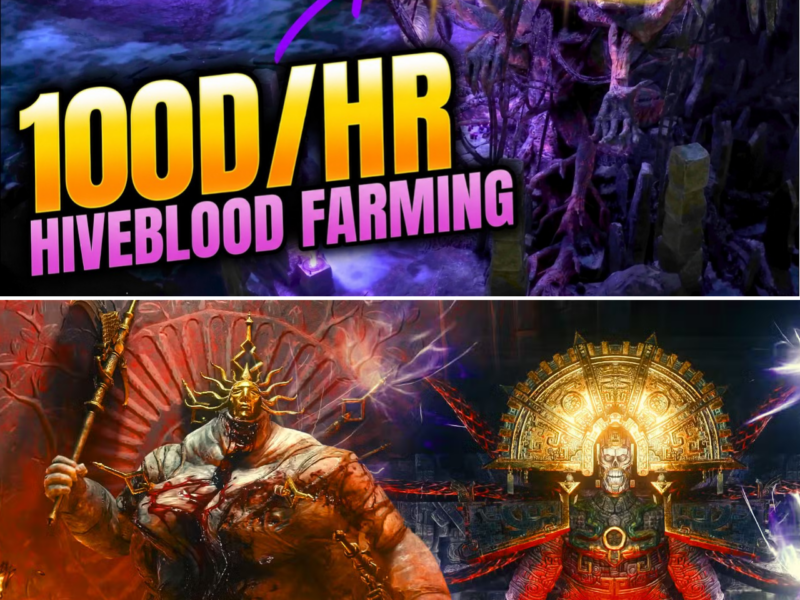
PRINTING DIVINES: HOW A BROKEN ENDGAME ‘HIVEBLOOD’ LOOP IS SHATTERING THE PATH OF EXILE 2 MARKET
The 100D+/HR economy exploit GGG didn’t see coming, and why top-tier duos are keeping it completely quiet until now… 🔥
The endgame market is shattering right now, and it’s all thanks to a broken interaction between multi-account party mechanics and Hiveblood generation. While average players are grinding standard maps for pennies, a fringe group of elite farmers is literally printing Refined Sibling and Reaver Catalysts by the inventory-load—yielding up to 180 Divines per hour with zero high-budget gear requirements.
But here’s the twist that has the community in an absolute uproar: why are smart solo players suddenly parking completely AFK secondary accounts at the map entrance, and how does this single trick multiply the entire loot pool without increasing the map’s difficulty? If you haven’t transitioned your endgame Atlas to this specific Breach tablet loop yet, you are actively flushing mirror-tier wealth down the drain before the league wraps up.
Discover the exact setup, the Genesis tree pathing, and how to replicate this broken farm before the economy crashes entirely 👇
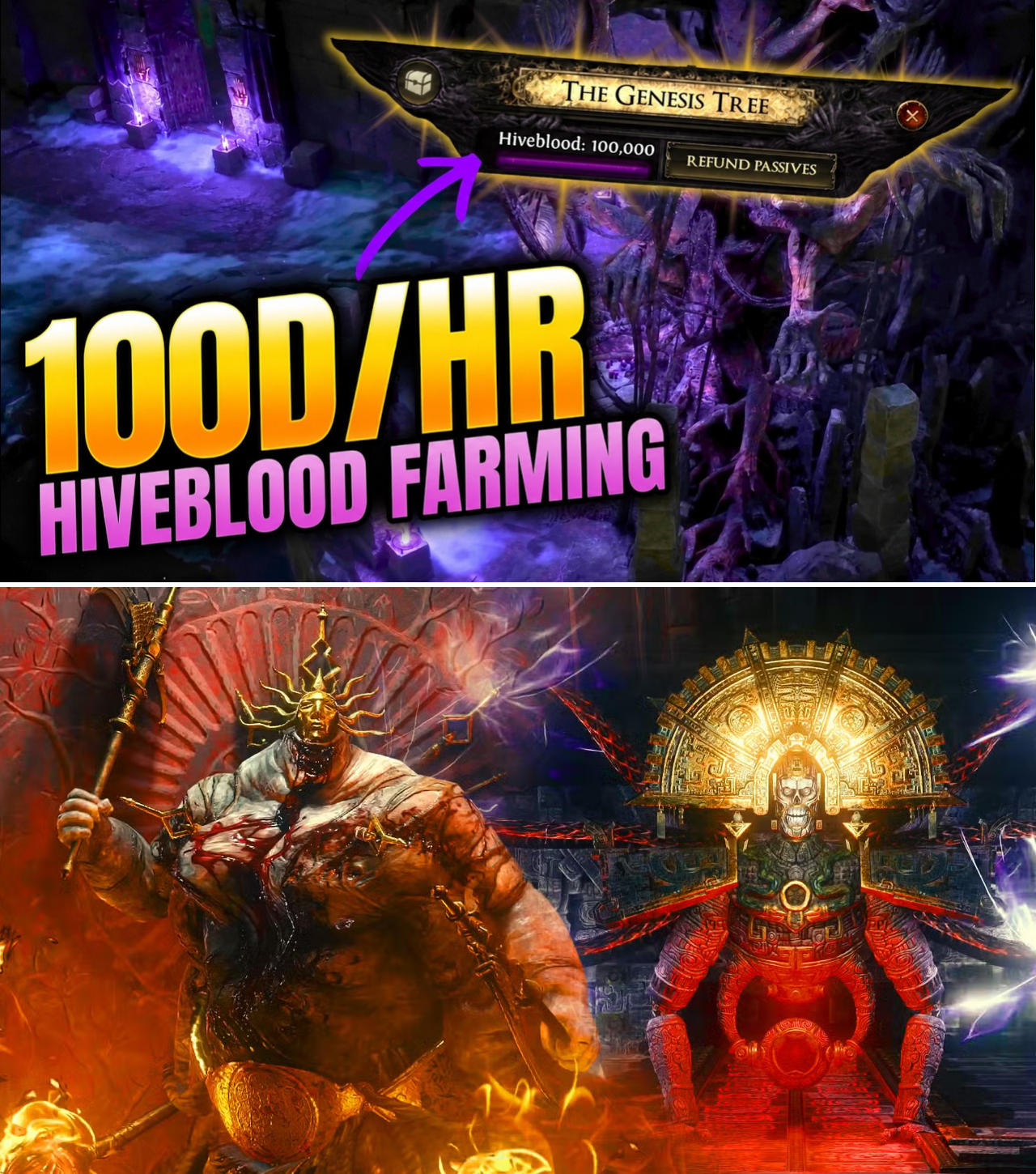
An economic gold rush has erupted in the closing weeks of the Path of Exile 2 league, leaving the player-driven economy in absolute chaos. A newly popularized endgame strategy utilizing high-effectiveness Breach maps combined with specific Hiveblood reward trees has proven so lucrative that top-tier players are reporting astronomical returns of over 130 to 180 Divine Orbs per hour.
Dubbed the “100D+/HR Breach Hiveblood Farm” by prominent community theorycrafter and content creator XTheFarmerX—who credited Twitch streamer Sammy for the initial data testing—the strategy exposes a massive loophole in how Grinding Gear Games (GGG) handles party-play loot allocation. As word of the strategy spreads across Reddit, Discord, and Twitch, the market for specific endgame items has begun to warp, sparking a fierce debate within the community regarding whether the mechanic constitutes an unintended exploit or peak endgame optimization.
The Mechanics of the ‘Catalyst Printer’
At the epicenter of this economic upheaval is the interaction between high-tier Waystones, specialized Tablets, and the automated “printing” of endgame Catalysts via the Genesis tree. Unlike standard farming methods that rely on raw currency drops, this strategy targets “Lavish Womb Gifts” specifically tuned to output high-value Refined Sibling Catalysts and Refined Reaver Catalysts [00:23].
The technical setup requires explicit precision:
The Tablet Architecture: Players purchase cheap endgame Tablets featuring two distinct modifiers: Additional Rare Monsters and Increased Quantity of Hiveblood when Stabilized [02:01]. By applying Divine Orbs to these tablets manually, players juice the quality to 45%–50%, instantly turning a low-cost item into a map worth seven Divine Orbs [02:16].
Waystone Optimization: The strategy utilizes Tier 15 or Tier 16 Waystones rolled to 70% monster effectiveness [02:48]. These maps are then corrupted using Vault Orbs, aiming for 8-mod variations that drastically increase monster pack sizes [03:04].
The Genesis Tree Mapping: The true catalyst for the wealth generation lies in the specialized passive tree nodes. Farmers must spec into Wild Growth for maximum efficiency, Complete Refinement to restrict the reward pool strictly to Catalysts, and Enhanced Creation to unlock high-tier jewel catalysts [08:53].
Once inside the map, the gameplay loop bypasses traditional clear-speed metrics. Players open up to four Breaches per map, utilizing an aggressive circular pathing mechanic [05:47]. By circling the outer rim to clear minor monsters before returning to the center to instantly vaporize up to 40 clumped rare monsters at the end of the stabilization phase, a single map can yield between 2,500 and 3,000 Hiveblood points per Breach [05:12, 06:39].
The AFK Party Trick Enraged the Community
While the sheer volume of item drops is staggering, the aspect of the strategy causing the deepest rifts within the Path of Exile 2 community is its extreme scalability via party mechanics.
In Path of Exile 2, Hiveblood generated from Breach encounters is not split among party members; instead, it is duplicated. XTheFarmerX detailed how elite duos managed to pull in a staggering 260 Divine Orbs per hour collectively [11:31]. More controversially, solo players have begun exploiting this system by bringing secondary, completely un-geared accounts—colloquially referred to as “little bros”—into the map [01:19].
“You can run a second account and just park his ass at the front of the map, and then gain Hiveblood in the same way, which could double or even triple, quadruple your loot,” XTheFarmerX revealed during his breakdown [01:28]. Because the party members do not need to be within the combat radius to accumulate the currency, solo players are effectively doubling their passive income with zero added mechanical difficulty.
On the game’s official subreddits and community Discord servers, reactions have been highly polarized. Traditional solo players claim the mechanic heavily penalizes those who do not multi-box or play in organized groups, branding it an unfair market advantage. Conversely, defenders argue that leveraging inherent group mechanics has always been a core tenet of ARPG endgame scaling, praising the strategy for its ingenious subversion of traditional administrative overhead.
Market Impact and the Admin-Free Loop
The financial data backed by a massive 100-map test run shows undeniable proof of concept [11:46]. Across 2,163 individual Lavish Womb Gifts, the strategy yielded an average of 87 Divine Orbs in pure Catalysts per set of 10 maps, taking just over 25 minutes to complete [10:10, 10:28].
A major selling point driving the current mass migration to this strategy is the total absence of inventory management or tedious trading setups. Utilizing the Genesis tree interface, players can simply hold Control + Click to instantly dump thousands of accumulated Hiveblood points, printing an entire inventory of Catalysts directly onto the hideout floor in seconds [09:11, 09:16]. At current market rates—where Refined Sibling Catalysts command massive prices—a single 3-minute map run can clear an easy 14 Divine Orbs off just a couple of lucky clicks [09:23, 09:50].
As thousands of players attempt to replicate the loop, the market for underlying crafting materials has shown signs of a structural squeeze. Prices for raw Divine Orbs and high-effectiveness Tier 15 Waystones are fluctuating wildly, while the value of standard Catalysts faces heavy inflationary pressure due to sudden market oversaturation.
Looking Ahead: Will GGG Step In?
As the current league reaches its twilight phase, this explosive Breach loop will likely serve as the final economic meta-strategy before the community migrates to upcoming seasonal content. For creator XTheFarmerX, the discovery marks a triumphant conclusion to what he hailed as his “best league in POE2 in terms of the amount of fun” [13:17].
The lingering question hanging over the community is whether Grinding Gear Games will allow these duplicated party-wide reward structures to survive into the next league cycle. Historically, the developer has been hesitant to execute mid-league nerfs unless a mechanic threatens total server stability. However, with the data now completely public and multi-account farming becoming the standard for elite wealth accumulation, structural changes to how Hiveblood is distributed in parties seem almost guaranteed before the next major expansion launches.
Until those balance patches arrive, the message from the community’s top tier remains entirely clear: fire up your secondary accounts, roll your Tablets for rare monsters, and print your wealth while the system allows it.