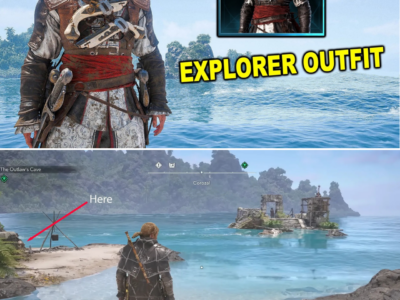
CURRENCY COLLAPSE? ‘ASSASSIN’S CREED BLACK FLAG RESYNCED’ PLAYERS DISCOVER LETHAL INFINITE MONEY EXPLOIT ON PINOS ISLE
Ubisoft literally forgot to code despawn parameters on this specific map coordinate… 💀
A massive uproar is sweeping through the Assassin’s Creed Black Flag Resynced community after a viral 2-minute video exposed an absolute, unbroken infinite money glitch that completely shatters the game’s currency economy. If you are still risking your crew fighting elite ships in the south just to afford simple upgrades, you are working way too hard.
The exploit requires zero naval combat, zero high-tier weapons, and can be repeated indefinitely right from the start of your playthrough—but there is an incredibly precise fast-travel sequence you must execute, or the game engine will lock out the loot tables entirely. It turns out that a single campsite on Pinos Isle contains high-value ground assets that refuse to check for duplicate collection flags, allowing you to vacuum up thousands of Reals in a literal 45-second loop.
The developers are already scrambling to patch this algorithmic oversight. The exact fast-travel rotation and the chest visual cues are fully exposed in the guide below. 👇

The structural integrity of Assassin’s Creed Black Flag Resynced’s in-game marketplace has suffered a catastrophic exploit this week. Just days after casual players celebrated the developer’s sweeping patches that successfully wiped out legacy 2013 money bugs, an entirely new, system-breaking technical loophole has been unsealed within the remake’s modern engine.
Discovered and distributed by prominent tactical outlet All-Around Player Gaming, a newly leaked loop has exposed a profound flaw in how the engine handles fast-travel memory storage and container states. The exploit, localized entirely within the secluded borders of Pinos Isle, grants players the ability to amass infinite gold reserves at a blistering pace without firing a single cannon shot or engaging in physical combat. As documentation of the loop goes viral across Reddit, TikTok, and community Discord servers, the game’s structural progression curve has been completely destabilized.
The Anatomy of the Pinos Isle Exploit
The mechanism behind the infinite cash loop relies on a glaring omission in the remake’s cell-reloading code. In typical open-world development, once an asset or loose item pouch is harvested by the player character, the game engine flags that specific asset coordinate as “spent,” permanently preventing it from duplicating during the current play session.
However, on Pinos Isle—specifically at the coordinates (303, 453)—the system completely breaks down.
                  [PINOS ISLE INFINITE ECONOMY LOOP]
                                  |
            [Fast Travel: Pinos Isle Viewpoint (303, 453)]
                                  |
                [Perform Synchronize / Leap of Faith]
                                  |
              [Run Down to Defeated Smuggler / Skeletons]
                                  |
           [Loot Ground Assets: +22 Reals, +15 Reals, +78 Reals]
                                  |
            [Sprint to Smuggler Camp Table: +15 Reals / Supplies]
                                  |
            ==================================================
            [CRITICAL STEP: Fast Travel to Distant Viewpoint]
                     (e.g., Havana or Dry Tortuga)
            ==================================================
                                  |
         [Instantly Fast Travel BACK to Pinos Isle Viewpoint]
                                  |
                  (Asset Tables Fully Reset: REPEAT)
To initiate the loop, players utilize the primary Pinos Isle Synchronized Viewpoint. Upon executing a standard Leap of Faith into a localized straw stack, the player runs down the stone steps of a Mayan ruins structure, moving toward a small inlet clearing.
Lying exposed on the ground are several loose item nodes and human remains. Approaching the first skeletal asset immediately drops an interaction prompt, awarding a flat baseline of Reals. Continuing a few meters further along the dirt path reveals a secondary collection of items directly on the soil, yielding substantial payouts of 15 and 78 Reals back-to-back.
The path culminates at an abandoned smuggler campsite featuring a large canvas tent and a crude wooden table. Looting the bowl sitting on the table injects another wave of currency and loose tactical items directly into Edward Kenway’s inventory. In total, a single 30-second run down the path netting several hundreds of Reals.
The Memory Flush: Why Distant Fast-Travel is Mandatory
While finding loose cash on the ground is a standard feature of exploration, the game-breaking nature of Pinos Isle occurs during the extraction phase. Under normal exploration conditions, simply walking away from the camp or fast-traveling to the opposite side of the same island will not reset the containers.
To bypass this memory check, players are executing a precise Distant Fast-Travel Sequence.
Once the smuggler camp is entirely stripped of its wealth, the player immediately opens the world map and fast-travels to a completely separate, highly rendered geographical sector—such as the central hub of Havana or the remote fort at Dry Tortuga.
[Loot Pinos Isle Assets] ---> [Open Map] ---> [Fast Travel to Havana / Dry Tortuga]
                                                             |
                                               (Forces Engine to Purge Pinos Isle Cell Data)
                                                             |
[Loot Re-Spawns Instantly] <--- [Open Map] <--- [Fast Travel BACK to Pinos Isle Viewpoint]
According to engineering analysis circulating within technical Discord channels, forcing the game engine to load a massive, distinct territory like Havana effectively purges the temporary cache data for Pinos Isle from the console’s memory hardware. Because the engine must allocate resources to render the bustling streets of Havana, it completely flushes the previous status flags of the Pinos Isle containers.
The moment Edward Kenway materializes on the roof of Havana, the player instantly re-opens the map interface and fast-travels straight back to the Pinos Isle Viewpoint. Upon dropping down from the ruin wall, the engine is forced to reload Pinos Isle as a completely fresh instance.
As a result, the skeleton, the ground nodes, and the smuggler table are completely replenished with pristine, identical loot tables. The entire sequence—from the initial drop to the dual fast-travel loading screens—takes a seasoned player roughly 45 to 55 seconds to complete.
Faction Panic: The Community Reacts to the Patch Countdown
The emergence of the Pinos Isle loop has completely divided the Assassin’s Creed community into two distinct ideological camps on platforms like X.
On one side, optimization purists and speedrunners are aggressively exploiting the loophole to bypass the game’s intended pacing. By spending a mere 30 minutes executing the fast-travel loop, early-game players are generating tens of thousands of Reals. This unchecked wealth allows them to buy out every piece of advanced weaponry at the general store and purchase massive structural upgrades for the Jackdaw before even progressing to the mid-game naval campaigns. “It completely removes the friction from the economy,” one Reddit user commented. “Why spend an hour fighting dangerous Man-of-War fleets in the south when a skeleton on Pinos Isle is an infinite ATM?”
On the other hand, immersive players and completionists are expressing heavy concern that the presence of such an accessible exploit heavily cheapens the reward structure of the remake. The ease of execution has sparked widespread fears that Ubisoft will deploy an emergency hotfix within days to close the memory reload loophole, leading to a massive rush of players attempting to stockpile millions of Reals before the exploit is permanently erased from the codebase.
Future Outlook: Ubisoft’s Next Move
Historical development patterns suggest that Ubisoft’s live-operations team will likely prioritize a fix for Pinos Isle in the next title update. Because the exploit directly devalues the newly introduced Animus Project Tracks and the fundamental survival pacing of the remake’s naval combat, developers cannot afford to let an infinite gold engine remain active in the wild.
For the time being, the Pinos Isle cellular reload glitch remains fully operational for all players on current patches. Whether this technical oversight will be corrected via a silent server-side adjustments or a formal title patch remains to be seen, but the high seas of Black Flag Resynced are currently experiencing an economic golden age that the original creators never intended.