PIRATE ECONOMY BROKEN? ‘ASSASSIN’S CREED BLACK FLAG RESYNCED’ PLAYERS DISCOVER REVOLUTIONARY METAL FARMS THAT EXPLOIT UBISOFT’S NEW REMAKE ENGINE
Ubisoft DID NOT intend for players to break the Jackdaw’s economy this fast… 🏴☠️
Rumors are exploding across Discord and Reddit after a prominent creator exposed the absolute best-kept secrets to farming Metal in the newly released Assassin’s Creed Black Flag Resynced. If you are still grinding low-level regions, you are completely wasting your time—but there is a massive catch that everyone is arguing about.
It turns out that sinking the highest-rated 5-Star ships is actually a massive trap that yields less metal than certain 4-Star vessels, and players are furious about the hidden resource penalty that cuts your hard-earned loot exactly in half. Even crazier? A newly discovered “Hideout Trick” lets you farm metal instantly without ever firing a single cannon or losing a single crew member.
Don’t spend another hour struggling to upgrade your hull. The full mathematical breakdown of the three ultimate routes—including the exact coordinates of the Serranilla exploit and the Pirate Hunter loop—has just been leaked.
Find out how to max out your Jackdaw before the devs patch it 👇
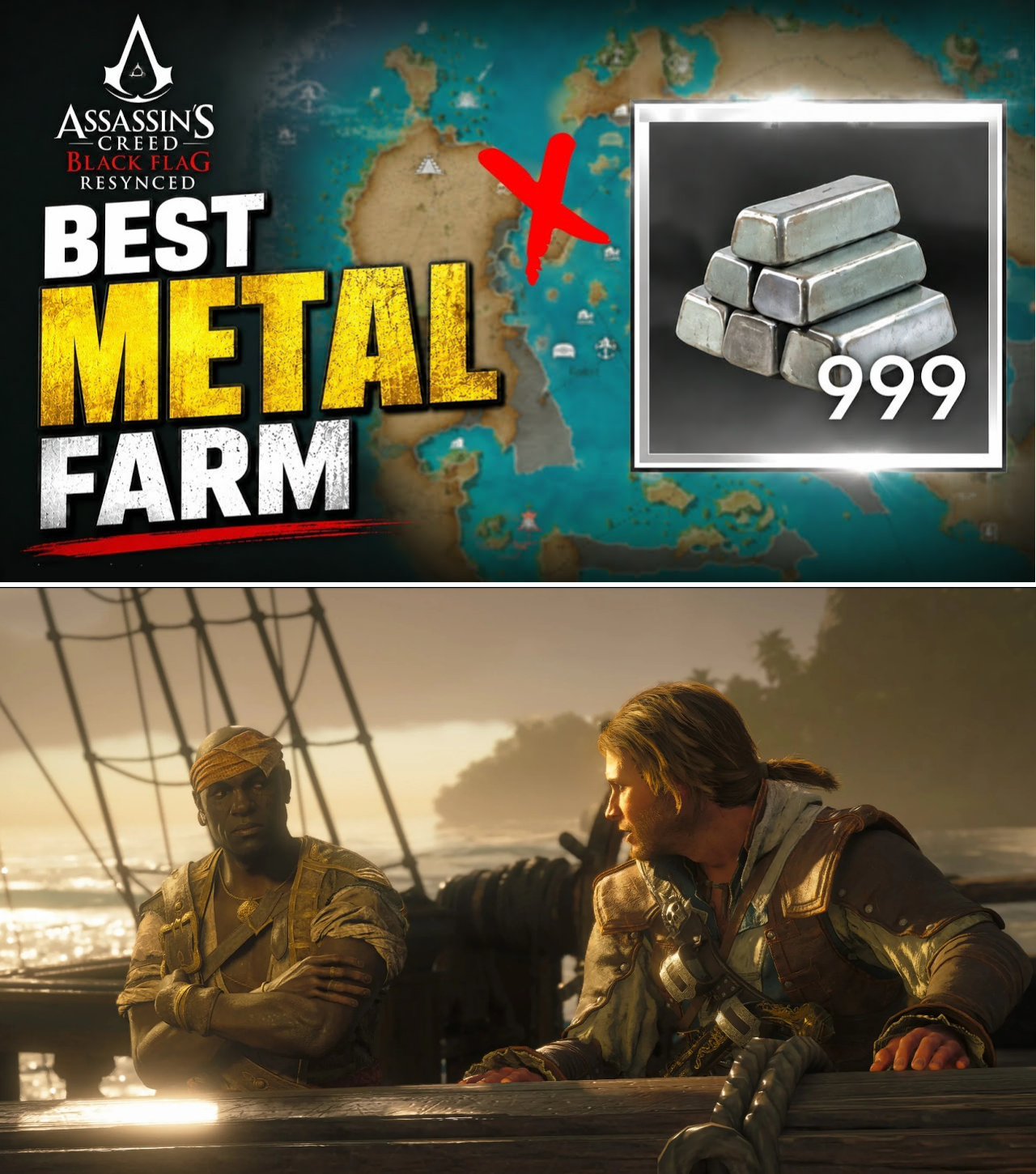
The high seas of gaming are in absolute turmoil this week following the discovery of several game-breaking resource loops in Ubisoft’s freshly minted remake, Assassin’s Creed Black Flag Resynced. As players rush to upgrade the Jackdaw to survive the title’s revamped, brutal naval combat, a definitive consensus has emerged within the community: the traditional grind is officially dead.
A comprehensive investigative breakdown published by prominent gaming analyst channel Gaming with Griff Griffin has set the community ablaze, pulling back the curtain on the game’s internal coding to reveal how players can manipulate spawn rates, exploit high-tier zones, and avoid a devastating “50% loot tax” that has left thousands of uneducated players broke. From the treacherous waters of the southern map to the safety of the Captain’s planning table, the race to build the ultimate seafaring fortress has completely destabilized how the remake is being played.
The Serranilla Paradox: Why 5-Star Ships Are a Trap
For years, the standard logic of open-world action-RPGs dictated a simple rule: bigger targets equal bigger rewards. However, in Assassin’s Creed Black Flag Resynced, running on the upgraded Ubisoft Anvil engine, that logic has been entirely inverted, sparking heavy debate across Reddit’s r/AssassinsCreed and various tactical Discord servers.
According to real-time gameplay data, the absolute sweet spot for farming Metal—the game’s rarest and most vital upgrade resource alongside gold—lies within the high-difficulty Serranilla region. Tucked away in the lower portion of the world map where enemy scaling drastically spikes, Serranilla has become a goldmine due to a bizarre statistical anomaly involving Brigs and Frigates.
While a standard Brig in the region reliably carries roughly 60 units of metal, local Frigates frequently roll high-tier loot tables yielding between 90 and 110 metal per encounter. The community has quickly labeled these mid-tier warships as the “perfect mathematical balance” in the current meta. They possess enough vulnerability to be quickly systematically dismantled by upgraded Mortars and Heavy Shot without inflicting severe structural damage back onto the Jackdaw.
The real drama, however, surrounds the ocean’s ultimate behemoths: the Man-of-War class. While a standard 4-Star Imperial vessel like the HMS Invincible or HMS Dragon offers a massive bounty ranging from 150 to 200 metal, players who seek out the maximum 5-Star variants are reportedly being shortchanged.
Data confirms that certain 5-Star Man-of-War ships heavily guard fewer materials, dropping as little as 170 metal despite offering a significantly more punishing, lethal engagement. “It’s an absolute trap,” one prominent Discord theory-crafter noted. “Ubisoft scaled the difficulty up for the 5-Star encounters, but the actual resource reward regression makes them an algorithmic waste of ammunition.”
The “50% Loot Tax” Outrages Casual Seafarers
Beyond the ship classifications, an even harsher mechanical reality has divided the player base between aggressive boarding purists and casual players. In the Resynced edition, naval physics allow players to entirely bypass the lengthy, chaotic boarding sequences by simply hammering a disabled vessel with continuous cannon fire until it disintegrates into the ocean.
However, the community was rocked by the revelation that sinking a ship without boarding it triggers a hidden 50% resource penalty across the board.
If a player boards a crippled Man-of-War, they secure the full 180 metal allocation. If they opt to sink it dynamically from afar, the game immediately slashes the yield to a meager 90 metal. The same draconian penalty applies to gold reserves. While standard text guides have largely ignored this underlying mechanic, the math proves that relying on pure long-range destruction effectively doubles the time required to max out the Jackdaw’s defenses.
To maximize profits, top-tier players are utilizing a strict sequence:
Soften the target from maximum range using precise Mortar Strength upgrades.
Close the distance to disable the vessel’s propulsion.
Use Swivel Guns to detonate on-board explosive barrels, instantly crushing enemy morale.
Scale the rigging to cut down the enemy faction’s flag.
Cutting down the flag has been verified as a hard prerequisite; failing to perform this high-risk action locks out the highly lucrative Captain’s Lockbox prompt during the final surrender sequence. Successfully plundering the lockbox injects an additional 2,000 to 5,500 gold directly into Edward Kenway’s pockets on top of the base metal rewards, fundamentally breaking the game’s mid-game economy wide open.
The Aggressive “Wanted Level” Ramming Loop
For players who find the meticulous nature of southern Man-of-War hunting too tedious, a secondary, highly chaotic strategy has taken TikTok and YouTube by storm: the low-level Wanted Level Loop.
Instead of braving the high-level southern seas, this method directs players to lower-difficulty starting zones. By equipping the Jackdaw with an upgraded Bow Ram via any local Harbor Master, players can sail through low-tier waters at maximum travel speed, obliterating small enemy Schooners and scout ships instantly upon physical collision. The impact physics of the new Anvil engine frequently cause these smaller ships to break apart or immediately enter a boardable state from a single ramming strike.
While the base metal from these small ships is trivial, the true objective is rapidly filling the player’s four-stage Wanted Status meter located in the upper right corner of the user interface.
Once a player triggers a maximum pirate rampage, elite Pirate Hunters are automatically dispatched to track them down. Recognizable by their menacing, tattered crimson sails and custom faction uniforms, these hunters are treated by casual players as terrifying boss encounters. For farmers, however, they are essentially loot boxes on water.
Pirate Hunter vessels consistently carry massive, concentrated packages of 55 to 80 metal. Furthermore, because these hunters frequently hunt in pairs, players can exploit a glaring AI limitation: the moment Edward Kenway initiates a boarding sequence on one hunter ship, the secondary hunter ship completely ceases firing, granting the player a totally safe, uninterrupted window to clear the deck, restock their crew, and harvest the massive resource cache. The speed and frequency of these hunter spawns make it arguably the fastest active farming method in the entire game.
The “Zero-Risk” Cabin Strategy: Fleet Salvaging
The final, and perhaps most shocking, discovery circulating within the Assassin’s Creed community requires absolutely no naval combat, zero ammunition consumption, and zero risk to the Jackdaw’s crew. It takes place entirely within the absolute safety of the player’s naval hideout.
By stepping into the captain’s quarters and accessing the Fleet Planning Table (or Captain’s Table), players can open the active management interface. By navigating directly to their acquired fleet overview via the bumper controls, players have the option to permanently dismantle and salvage ships currently sitting in their secondary roster.
Dismantling a captured ship like the Aurora, for instance, immediately extracts a flat rate of metal directly into the player’s main inventory without requiring a single second of real-time sailing. While the yields are objectively lower per ship (often averaging around six metal for basic vessels) compared to a massive 180-metal high-seas raid, the method provides a completely passive, instantaneous option for players who are just a few units shy of purchasing an elite hull upgrade.
Future Outlook: Will Ubisoft Patch the Meta?
As the community widely adopts these highly optimized routes, the conversation on platforms like X (formerly Twitter) has inevitably turned toward the prospect of a developer intervention. The sheer efficiency of the Pirate Hunter loop and the math defying 4-Star vs 5-Star reward structures suggest that the game’s economy is running in a state the developers may not have fully anticipated.
For now, the economy remains completely open for exploitation. Whether players choose to brave the harsh, terrifying broadsides of the Serranilla Man-of-Wars, turn the northern seas into a demolition derby to bait out crimson-sailed Pirate Hunters, or casually click buttons at their fleet management table, one thing is undeniably clear: the Jackdaw has never been more lethal, and the ocean has never been more profitable.
Players looking to completely optimize their progression before any potential balance patches drop are highly encouraged to review the full visual loops, geographical spawn patterns, and exact upgrade requirements currently dominating the community discourse.