Willa stopped at the double doorway.
The backseat of the black Lincoln was dead quiet, save for the low hum of the climate control and the steady tick of the digital clock.
Willa sat on the edge of the plush leather seat, her fingers clenched tightly around the frayed hem of her jacket. She stared straight ahead at the back of the driver’s head, refusing to look at Miles Drummond, who sat right beside her in the dark cavern of the car. Yet, she could feel his presence—heavy, calculated, and entirely immovable.
“You’re not asking where we’re going,” Miles broke the silence, his voice a low, gravelly baritone that seemed to vibrate against the glass.
Willa didn’t turn her head. “Does it matter? If you wanted me dead, you wouldn’t have handed over a hundred grand to get me into the car. You would have just dragged me.”
A low, humorless chuckle escaped Miles. “Pragmatic. I like that. Most people start screaming or crying by this point in the trip.”
“Most people haven’t lived in Brendan’s basement,” she muttered under her breath.
Miles went still. The air in the car shifted, growing dense. He didn’t ask who Brendan was, but Willa could feel his sharp, analytical gaze sliding over her profile—noting the rigid set of her shoulders, the way she guarded her left side. He didn’t need details to connect dots; men like Miles Drummond collected information the way others collected dust.
Forty minutes later, the Lincoln passed through an iron gate that slid open silently into the courtyard of a heavily guarded glass-and-steel monolith overlooking the East River. No signs. No lights. Just private security in unmarked suits tracking every inch of their approach.
The elevator ride to the penthouse felt like dropping into a vacuum. The digital numbers climbed past fifty without stopping.
When the doors slid open, Willa stepped out into a space that took her breath away—not because of its luxury, but because of its emptiness. Floor-to-ceiling glass walls exposed the glittering grid of Manhattan below, but the room itself was cast in dim, somber shadows.
And then she smelled it.
The sharp, metallic scent of antiseptic mixed with the deep, stale musk of a large animal that had given up.
“He’s in the master study,” Miles said, leading the way past minimalist art pieces and towering bookshelves. “The vets wanted to put him down three days ago. They said his organs were shutting down from grief. His name is Caesar.”
Willa stopped at the double doorway.
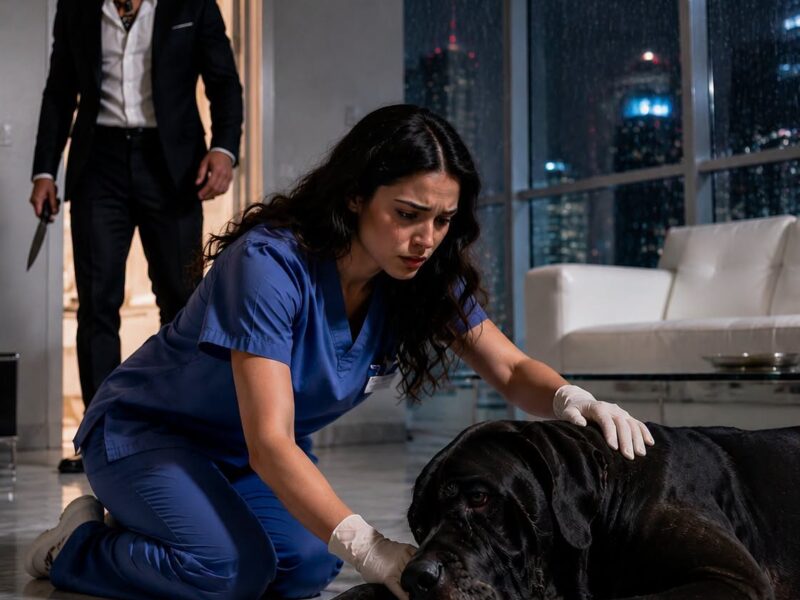
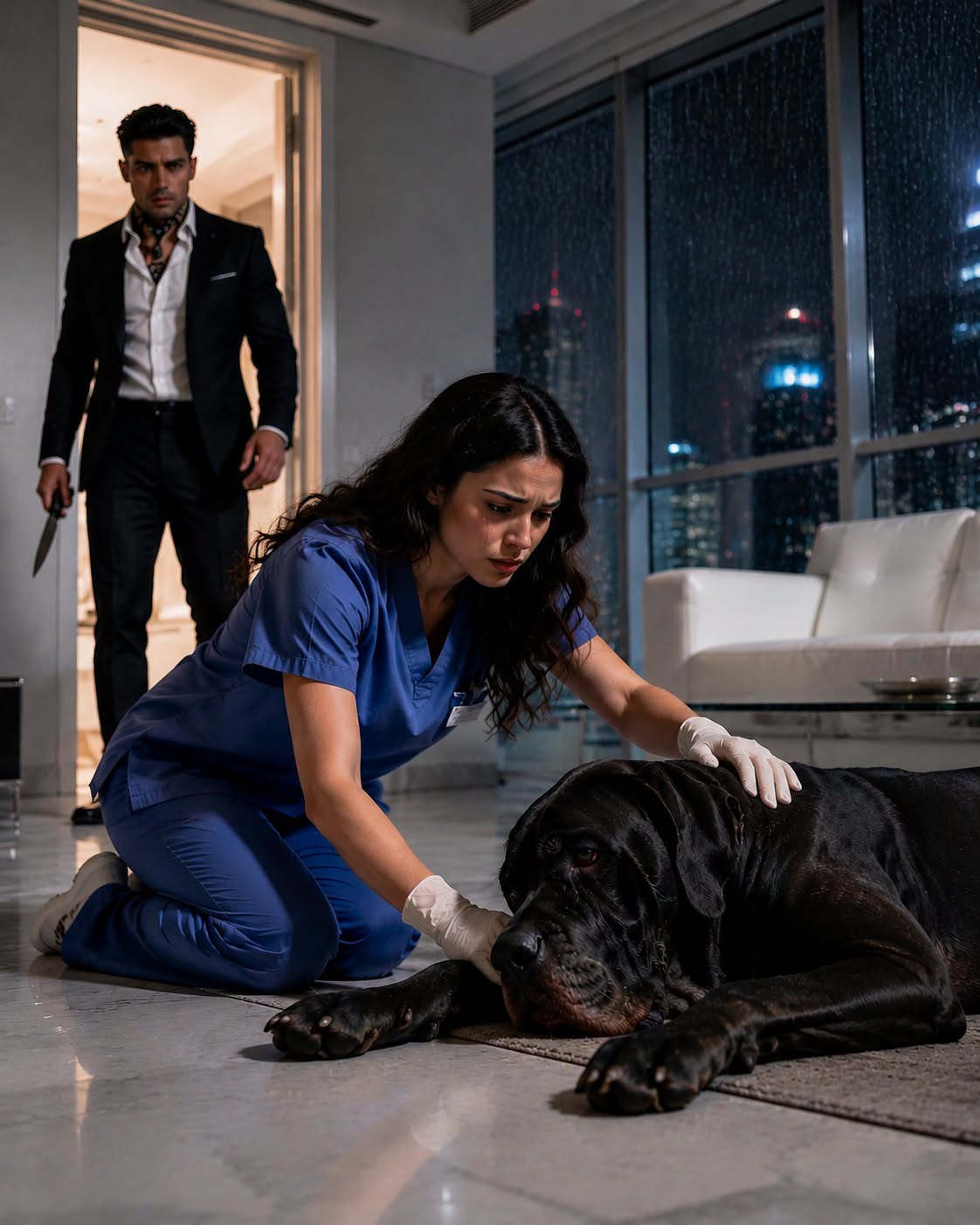
In the center of a massive, custom-built orthopedic dog bed lay the 150-pound Neapolitan Mastiff. Up close, Caesar was a monument of tragic architecture. His loose, silver-gray skin hung off skeletal ribs, and his massive, blocky head rested flat against the hardwood floor.
Two private veterinarians in crisp white coats stood nervously in the corner, whispering among themselves. One of them stepped forward as Miles and Willa approached.
“Mr. Drummond, we advise against letting an unauthorized person—”
“Shut up,” Miles said without raising his voice, but the word carried the weight of a falling safe. The vet swallowed hard and stepped back into the shadows.
Willa didn’t look at the vets. She didn’t look at Miles.
Her entire world narrowed down to the massive, breathing statue of grief in front of her.
She remembered what her father had taught her back in North Carolina, long before the world went sideways: ‘Animals don’t care about your pedigree, your bank account, or your degrees. They care about your heartbeat. If you’re lying, they smell it. If you’re broken, they recognize it.’
Willa slowly unzipped her jacket and let it drop to the floor.
She didn’t walk toward the dog. She sank to her knees, right on the cold hardwood, about six feet away.
The vets watched with skeptical, irritated expressions. Caesar didn’t twitch a muscle. Not an ear flick. Not a heavy sigh. He looked like he had already crossed the border into a place where pain couldn’t reach him anymore.
Willa didn’t reach out her hand. She didn’t call his name.
Instead, she did something that made Miles Drummond narrow his eyes.
She crossed her legs, lowered her shoulders, and closed her eyes. She let out a long, shuddering breath—the kind of breath she usually kept locked deep inside her chest, the kind that carried the lingering, quiet terror of every night she had spent wondering if she would survive her past.
She mirrored his isolation. She mirrored his surrender.
One minute passed. Then two. The room was so quiet she could hear the faint hum of the city miles below.
“He’s unresponsive,” one of the vets muttered under his breath. “It’s a waste of—”
“Enough,” Miles cut him off, his eyes fixed entirely on Willa.
Willa opened her eyes. She shifted her weight, sliding another inch closer across the floor—not aggressively, but with the slow, deliberate hesitation of someone who knew what it felt like to be cornered.
She stopped. She looked directly into those sunken, milky-brown eyes staring blankly at the floorboards.
And then, in a voice barely louder than the rustle of dry leaves, she whispered the one word she had said to herself every single morning she woke up in that Brooklyn hellhole.
“Stay.”
It wasn’t a command. It was a plea. A recognition between two living things that had been battered by a world that didn’t care if they woke up tomorrow.
For three seconds, nothing happened.
Then, a microscopic shudder rippled through the massive folds of Caesar’s neck.
The heavy, dead silence in the room broke.
Slowly—with an agonizing, bone-creaking effort that looked like it cost him every ounce of energy he had left—the 150-pound mastiff lifted his massive head a quarter of an inch off the floor.
His dark, hollow eyes drifted upward.
They locked onto Willa.
In the corner, one of the veterinarians gasped aloud, dropping a clipboard onto the floor with a sharp crash.
Willa didn’t flinch. She kept her eyes steady, her breathing even, and held out a single, bare hand, palm up, resting inches from the floor.
Caesar let out a deep, shuddering exhale that sounded like a sigh of relief trapped inside a mountain. With a slow, trembling slide of his massive paws across the wood, the giant dog dragged himself forward, inch by agonizing inch, until his wet, cold nose pressed directly into the center of Willa’s palm.
Behind her, standing in the shadows of the penthouse, Miles Drummond watched the scene unfold with an expression that defied reading. But as he looked from the broken, bruised girl kneeling on his floor to the dog that had just chosen to come back to life for her, a cold, absolute certainty settled into his mind.
Willa had just saved his dog.
And Miles had just decided that she was never, ever walking out of his world.