The Lockbox Chronicles
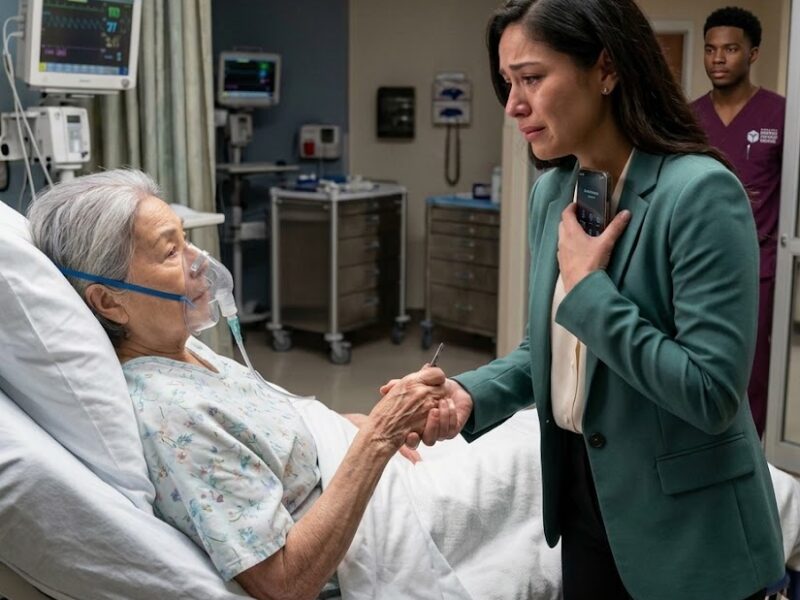
The woman’s laugh came through my phone while I stood beside Clara’s hospital bed.
“Seriously, stop calling him. He’s in the shower, old wife. We’re enjoying Maui.”
Behind her voice, I heard waves crashing and a champagne cork pop.
I didn’t scream. I didn’t fight with a stranger over the phone.
I just looked at Clara and realized the man she raised had chosen a beach vacation over being there for her final moments.
Marcus told me he was leaving for a business trip. He packed his dress shirts, kissed my forehead, and acted like work was the reason he couldn’t stay.
It wasn’t work.
He was in Hawaii with another woman while his mother struggled to breathe under the ER lights.
For twenty years, I was the one who stayed with Clara.
I cooked the meals she could eat. I helped her after her strokes. I organized her medicine. I sat beside her on nights when she was afraid to close her eyes.
Marcus always had an excuse.
He was too busy. Too tired. Too important.
But that night, there was no excuse left.
I called him again.
Ring.
Voicemail.
Again.
Ring.
Voicemail.
By the 31st call, another woman answered.
She thought she was humiliating me.
She thought she had won.
What she didn’t know was that my phone was on speaker.
Clara heard every word.
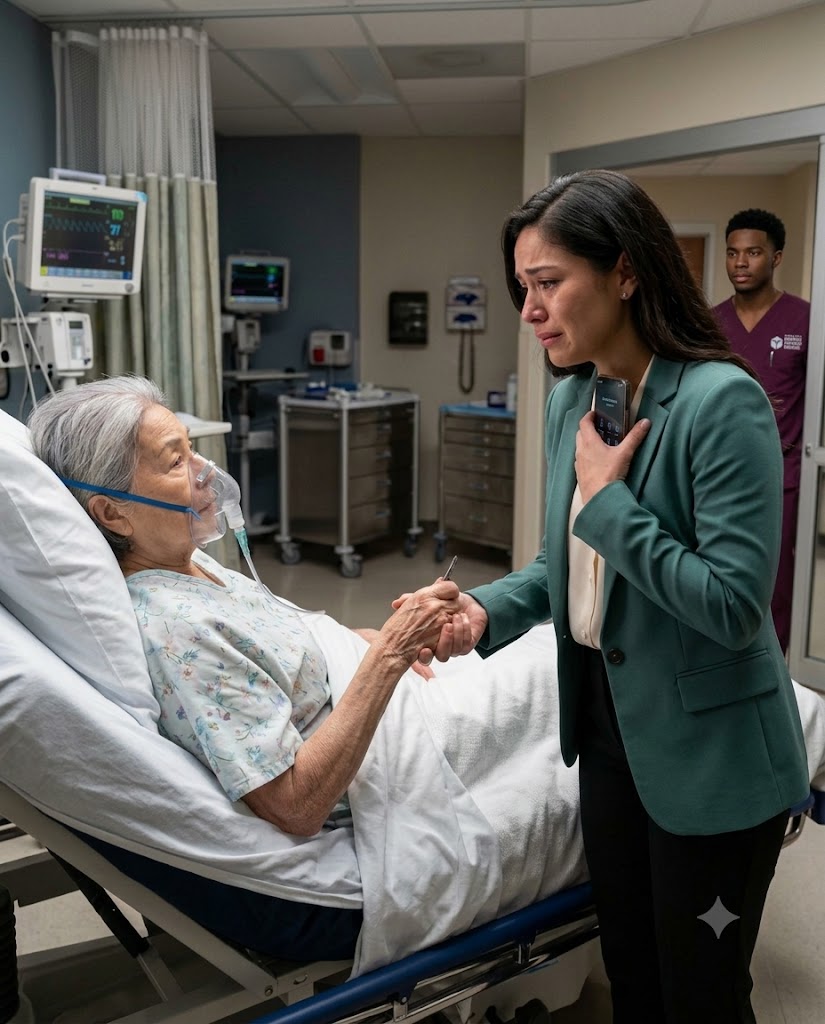
“I’m sorry,” I whispered after the call ended. “He isn’t coming.”
For hours, Clara’s hand had barely moved.
Then her fingers tightened around mine.
Her eyes opened.
And for one moment, the weakness disappeared.
She wasn’t just a dying woman anymore.
She was a mother who finally understood what her son had done.
Her lips moved behind the oxygen mask.
No sound came out.
But after twenty years beside her, I knew exactly what she said.
“Destroy him.”
Then she reached beneath her hospital gown and pulled out the small silver key she always kept hidden on a chain.
I had seen it before.
Whenever Marcus entered the room, Clara hid it.
Once, when he joked about taking a look, she pushed his hand away and made me promise he would never touch it.
I always thought it opened a jewelry box.
I was wrong.
She placed the key in my hand and closed my fingers around it.
The monitor beside her bed changed into one long, steady tone.
Clara was gone.
I stood there holding the key while Marcus’s missed calls filled my screen.
He chose Maui.
He chose champagne.
He chose another woman.
But Clara chose me.
She trusted the person who stayed, not the son who left.
Now I was holding the one thing she protected from him until her final breath.
And somewhere, there was a lockbox waiting for that silver key.
Whatever Clara hid inside it was important enough to keep close for years.
Important enough that she gave it to me instead of him.
The question was no longer why Marcus abandoned his mother.
The question was what Clara wanted me to uncover.
Read Part 2 with all the major twists and the ending in the comments below! 👇 If it’s hidden, just switch to “All comments.” Thank you for your support! ❤️📖
The sterile hum of the intensive care unit faded into a muffled drone as the nurses moved in to handle the final protocols. I stood frozen in the corner of room 304, the small silver key biting sharply into my palm. The weight of it felt disproportionate to its size—cold, heavy, and absolute.
My phone vibrated in my pocket. A text message notification from Marcus flashed across the screen. “Babe, stop blowing up my phone. The conference dinners are long. Talk tomorrow.”
A bitter, humorless laugh escaped my lips. Conference dinners in Maui, accompanied by crashing waves and pop-culture laughter. He still thought he was playing me, still cocooned in the careless arrogance of a man who believed consequences only applied to ordinary people. He had no idea that his mother had just crossed the threshold into eternity, or that the foundation of his entire gilded life was about to collapse beneath his feet.
I didn’t reply. I walked out of the hospital into the biting midnight air, sliding into my car with the key clutched safely in my coat pocket.
Instead of going home to the quiet, empty house Marcus and I shared, I drove straight to Clara’s old Victorian estate on the edge of town. For two decades, I had dusted her heavy mahogany furniture, watered her sprawling indoor ferns, and navigated the creaking floorboards of the guest room. But there was one place Clara had always kept strictly forbidden: the basement archive room. A heavy iron-reinforced door with a biometric padlock that Marcus claimed was broken and rusted shut.
Except it wasn’t broken.
Using my own set of house keys, I let myself into the dark, silent house. The air smelled of old paper, lavender polish, and the faint, lingering essence of Clara’s favorite peppermint tea. I walked past the family portraits—pictures where Marcus smiled with calculated perfection, his arm draped casually over my shoulder while his mother watched with eyes that always seemed to look straight through his facade.
I descended the creaking wooden steps into the basement. The darkness swallowed the beam of my phone flashlight until I reached the back corner, where the iron-reinforced door stood sentinel against the stone wall.
There was no biometric scanner here anymore. Just a heavy, old-fashioned keyhole hidden beneath a sliding brass plate.
My hand trembled slightly as I pulled the silver key from my pocket. I slid it into the mechanism. It fit with a satisfying, buttery click that echoed loudly in the subterranean silence. I turned it twice, felt a heavy internal bolt slide back, and pushed the door open.
Inside, the room wasn’t filled with dusty antiques or forgotten heirlooms. It was a forensic command center.
Rows of industrial metal shelving lined the walls, covered not in boxes, but in neatly organized binders, bank statements, corporate audits, and legal transcripts. At the center of the room sat a massive oak desk lit by a single goose-neck lamp left permanently plugged into a surge protector. On top of the desk was a laptop and an open ledger labeled in Clara’s precise, elegant handwriting: The Marcus Project.
I stepped inside, my breath hitching in my throat. I flipped open the nearest binder.
It detailed corporate embezzlement dating back five years. Marcus hadn’t just been attending routine business trips; he was the primary architect behind an offshore financial fraud scheme that had systematically drained millions from the real estate development firm where he worked as chief operating officer. But that wasn’t the most shocking part.
Deeper in the files, medical and financial records revealed a darker truth. Marcus hadn’t just neglected his mother; he had been slowly liquidating Clara’s properties behind her back using forged power-of-attorney documents. The luxury cars, the designer watches, the extravagant lifestyle he flaunted—it was all built on stolen money, stolen from the woman who gave him life, while I spent my days nursing her back to health with homemade soups and heating pads.
And worse—there was a folder stamped with federal investigation markers. The FBI’s white-collar crime division had already opened a secret dossier on Marcus three months ago. Clara hadn’t just stumbled upon his crimes; she had been working with federal investigators as a confidential informant to build an airtight RICO case against her own son, using her failing health as a shield to gather evidence right under his nose.
My phone buzzed again on the desk. This time it wasn’t a text. It was a video call from Marcus.
Startled, I stared at the glowing screen. His face popped up, illuminated by the dim neon glow of a tiki bar backdrop, a tropical drink resting near his elbow. He looked flushed, relaxed, and entirely unbothered.
I swiped to answer, propping the phone against Clara’s ledger.
“Hey, honey,” Marcus’s voice slurred slightly through the speaker, carrying the unmistakable edge of too much tequila. “Look, I told you, I’m tied up with regional partners tonight. Stop calling me obsessively, okay? It’s a bad look.”
I didn’t speak for a long moment. I just let the silence stretch across the thousands of miles between Maui and the dark basement archive.
“Marcus,” I finally said, my voice dangerously calm, devoid of the exhaustion or desperation he expected.
He blinked, leaning closer to his phone camera as if trying to figure out where I was calling from. “Why do you sound like that? Where are you? Is that… is that the basement?”
“I’m in your mother’s archive, Marcus,” I replied evenly.
A flicker of genuine panic crossed his flushed face, instantly masked by a defensive sneer. “What are you talking about? Mom’s room is off-limits. Get out of there before you break something. You’re losing your mind.”
“I found the silver key, Marcus,” I interrupted softly, leaning into the light of the desk lamp so he could see the cold determination in my eyes. “The one she kept hidden on her chain for twenty years. The one she gave me with her final breath before the monitor flatlined an hour ago.”
Marcus froze. The ambient sounds of the Maui resort seemed to vanish behind a wall of absolute, suffocating silence. The color drained from his face so fast it looked like digital corruption on the screen.
“What… what did you say?” he whispered, his bravado instantly shattering into raw, jagged terror.
“She heard you, Marcus,” I said, my voice steady as steel. “She heard every single word that woman said on the phone while you were sipping champagne in paradise. And before she died, she looked me dead in the eye and gave me the exact key needed to unlock everything you’ve spent years hiding.”
“Sarah… wait,” Marcus stammered, standing up so fast his barstool crashed backward onto the wooden deck in Hawaii. “Listen to me, baby, let’s talk about this, I can explain—”
“You can explain it to the federal agents waiting for your flight to land,” I said.
I reached over and tapped the screen, ending the call.
Upstairs, the grandfather clock in the hallway struck midnight, its deep, resonant chimes echoing through the empty house. I closed Clara’s ledger, picked up the silver key, and walked out of the basement, locking the iron door behind me for the very last time. Marcus had chosen his beach, his champagne, and his freedom. But he had forgotten one fundamental rule of human nature: you can run across an ocean, but you can never outrun a dying mother’s wrath.