The Internet Investigated Pamela Cisneros — But How Much of It Was Actually True?
THE INTERNET THINKS IT FOUND THE CLUES TO PAMELA CISNEROS’ STORY.
Within hours, strangers online were digging through old posts, videos and footage from Times Square.
Some noticed disturbing messages Pamela had written months earlier.
Others zoomed in on the footage and claimed they spotted things that “didn’t make sense.”
One viral theory even claimed something visible in the video was a bullet moving in and out of her body.
But there was a problem…
It wasn’t a bullet.
Fact-checkers identified the object as a Taser probe.
And suddenly, the entire online investigation looked very different.
So how much of what people “discovered” about Pamela is actually true?
And how much was simply the internet connecting dots that were never connected?
👇 See the viral theories, the real evidence, and the details the internet got completely wrong.

The Internet Investigated Pamela Cisneros — But How Much of It Was Actually True?
Within hours of the Times Square attack, the internet began conducting its own investigation.
Old social-media posts were rediscovered.
Videos from the scene were slowed down and analyzed frame by frame.
People searched for clues in Pamela Cisneros’ past, her family history and her final encounter with police.
On Reddit, commenters debated everything from the police response to whether Cisneros had intentionally provoked officers. On X, users circulated theories about objects visible in bystander footage and questioned whether parts of the official account made sense.
Some of the online questions were legitimate.
Others were built on assumptions.
And at least one widely circulated claim was demonstrably false.
The episode has become a striking example of how quickly a major breaking-news story can turn into an internet detective story — and how difficult it can be to separate genuine evidence from speculation.
The first clues came from Pamela’s own posts
One reason Cisneros quickly became the subject of online scrutiny was the discovery of older Facebook posts attributed to her.
Among them was a November 2025 post discussing war, disease, earthquakes, homelessness, drug use and the perceived persecution of Christians.
The post also referred to people hearing voices telling them to harm themselves or others and included a disturbing reference to people attacking strangers “for no reason.”
After the Times Square incident, screenshots of the post circulated widely.
The timing immediately attracted attention.
Some users interpreted the writing as evidence that Cisneros had somehow anticipated what would happen.
But there is no evidence establishing that.
A disturbing post written months before an event is not, by itself, proof that the writer was predicting that event or announcing an intention to carry it out.
The distinction is important because hindsight can make unrelated statements appear connected.
The same problem applies to other older posts in which Cisneros discussed hopelessness, human behavior and religion.
They may provide context about her state of mind or interests.
They do not automatically provide a motive.
Then the video theories began
As more footage from Times Square circulated online, attention shifted from old posts to the confrontation between Cisneros and police.
Bystander video showed Cisneros holding knives as officers confronted her.
Police said officers spent approximately four minutes ordering her to drop the weapons.
Three officers deployed Tasers, according to the New York Attorney General’s Office, but the devices appeared to have no effect.
Cisneros allegedly continued moving toward officers while holding the knives.
Two officers then discharged their service weapons.
The entire sequence quickly became a subject of intense online debate.
On Reddit, some commenters argued that officers had attempted several less-lethal options before using firearms.
Others questioned whether additional distance, different positioning or other tactics could have changed the outcome.
One Reddit discussion about the incident attracted hundreds of votes and sharply divided comments, illustrating how differently the same footage was being interpreted by different viewers.
The debate itself was not unusual.
What came next was.
The “bullet” that wasn’t a bullet
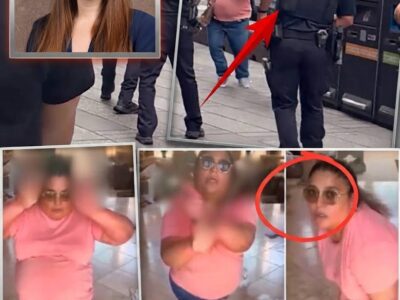
A viral post on X claimed that footage showed a bullet apparently “jumping” in and out of Cisneros’ body after the shooting.
The claim was accompanied by slowed-down footage in which a shiny object appeared to move near her clothing.
The theory quickly became part of the wider online discussion.
But fact-checkers examined the footage and reached a much less dramatic conclusion.
Lead Stories consulted weapons-training expert Artur Sadowski, who identified the object as a probe from a Taser 7 cartridge rather than a bullet.
The longer footage also showed other Taser equipment and wires around Cisneros, including a probe associated with the earlier attempts to incapacitate her.
In other words, an image that appeared mysterious when isolated from its context had a relatively straightforward explanation.
It was not evidence of a bizarre projectile behaving in an impossible way.
It was part of the Taser deployment that police had already described.
Why context matters
The incident demonstrates one of the biggest problems with viral footage.
Short clips can be powerful.
They can also be misleading.
A few seconds of video may capture something unusual without showing what happened immediately before or afterward.
That was particularly relevant in the Cisneros case.
The viral clip involving the supposed “bullet” did not contain the complete sequence of the police encounter. According to Lead Stories, the circulated slow-motion version focused on roughly 2.44 seconds of footage after Cisneros had fallen and omitted earlier moments involving the Tasers.
That missing context changed the interpretation.
Once viewers knew that officers had deployed Tasers, the shiny object was no longer mysterious.
It was part of the equipment used during the confrontation.
The “fake cab” theory
The same social-media ecosystem produced another theory involving vehicles visible near the scene.
Some users claimed that apparently unusual taxis or cars in the footage were evidence of something suspicious.
Those claims spread alongside the discussion of the shooting.
But unlike the Taser-probe claim, there was no credible evidence establishing the “fake cab” theory as fact.
This is where online investigation can become particularly dangerous.
A user notices something unusual.
Another person offers a possible explanation.
A third person repeats that explanation as though it has already been confirmed.
Within hours, speculation can acquire the appearance of established fact.
The original uncertainty disappears.
Reddit became a second courtroom
The online response was not entirely conspiracy-driven.
A large portion of the discussion was focused on a legitimate question:
Could police have handled the encounter differently?
Some Reddit users defended the officers, pointing to the reported four-minute effort to persuade Cisneros to surrender and the unsuccessful Taser deployments.
Others argued that officers could have maintained greater distance or used different tactics.
The disagreement illustrates an important point.
People can watch the same footage and reach different conclusions without either side necessarily possessing the complete picture.
The final determination depends on evidence that ordinary viewers do not have access to — including full body-camera footage, witness interviews, physical evidence and investigative findings.
The official account is still preliminary
That last point is particularly important.
On Sept. 2, the New York Attorney General’s Office announced that its Office of Special Investigation had opened an investigation into Cisneros’ death following the encounter with NYPD officers.
The agency’s preliminary account says officers encountered Cisneros at approximately 4:26 p.m. on Seventh Avenue between West 42nd and West 43rd streets.
She was holding a knife in each hand.
Officers ordered her to drop the knives.
Three officers discharged Tasers with no apparent effect.
Cisneros then allegedly moved toward the officers while still holding the knives.
Two officers discharged their service weapons.
She was transported to a hospital and pronounced dead.
The Attorney General’s Office explicitly cautioned that these are preliminary facts and may change as the investigation continues.
That warning is easy to overlook in the rush of social-media discussion.
But it matters.
An investigation is not simply a formality.
It is the process through which authorities establish what happened based on evidence rather than online interpretation.
The internet did uncover something important
Despite the misinformation, online investigators did uncover material that helped reporters understand Cisneros’ background.
Old social-media posts provided additional context.
Family members spoke publicly about her history.
Archived court records helped reconstruct her divorce and custody dispute.
Video footage offered another perspective on the confrontation.
Some of those discoveries became legitimate reporting leads.
This is one of the internet’s strengths.
Millions of people can collectively locate material that might otherwise take journalists much longer to find.
But finding something is not the same as proving what it means.
That second step requires verification.
The danger of connecting every dot
The Pamela Cisneros case is particularly vulnerable to retrospective storytelling.
There are old posts.
There is a history of mental-health struggles.
There was a difficult marriage and custody dispute.
There were reports that her family believed she had been doing better.
There was an abrupt and unexplained change before the Times Square incident.
And there is disturbing footage of the final confrontation.
Put all of those elements next to each other and it becomes tempting to construct a single narrative.
But a narrative is not necessarily evidence.
The fact that two events happened before another event does not automatically establish causation.
The fact that someone wrote something disturbing months earlier does not prove they were planning a later act.
And the fact that a video contains an unexplained object does not mean the explanation must be extraordinary.
What remains genuinely unanswered
The most important questions in the case remain unresolved.
Why did Cisneros attack two strangers?
What happened during the period when her family believed she was stable?
Did anything change in her treatment or personal circumstances?
What exactly happened during the approximately four-minute confrontation with police?
Why did the Tasers appear ineffective?
And was there anything officers could realistically have done differently before the final escalation?
Those are questions for investigators, not internet detectives.
The New York Attorney General’s investigation will examine the police encounter, while other investigators continue working to establish the circumstances surrounding the attacks themselves.
When the internet gets it right — and wrong
There is an important lesson in what happened after the Times Square incident.
The internet can uncover real information incredibly quickly.
It can also transform uncertainty into certainty just as quickly.
In Cisneros’ case, users correctly identified old posts and found footage worth examining.
But the same online environment also produced a false claim about a “bullet” moving in her body — a claim that collapsed once the object was properly identified as a Taser probe.
The difference between those two outcomes comes down to one thing:
verification.
For now, the most responsible approach is to separate three categories.
What authorities have confirmed.
What credible reporting has independently established.
And what people online merely believe might be true.
The third category can generate the most clicks.
It is also the one that deserves the most caution.
The Pamela Cisneros story is still developing, and the official investigation remains underway.
The internet may continue finding new clues.
But until those clues are independently verified, they remain just that — clues, not conclusions.