The Horizon Legacy
The morning they brought Mia over, my mother did not knock.
She used the key I had begged her to return years earlier, walked straight into my kitchen with her sunglasses still on, and told nine-year-old Mia to stand beside the refrigerator like a piece of luggage.
Mia wrapped both hands around her backpack straps and stared at the floor while the ceiling fan clicked above us. Her shoulders were pulled tight beneath her hoodie, and she looked like a child who had learned that making eye contact could make things worse.
My father came in behind her, rolling two suitcases across the tile. He was already wearing his vacation shirt, even though their ship would not leave until sometime that afternoon.
He called Mia “too much effort” and said I was the only person dramatic enough to turn their cruise into a problem.
Then Mom placed a custody statement on my counter and tapped the signature line with one pink fingernail.
The paper claimed Mia had been born silent, could not remember dates, and became “agitated” whenever investigators asked her questions.
I read that sentence twice.
“Why would investigators need answers from a child who has never spoken?”
Dad adjusted the handle of his suitcase and glanced toward the driveway.
“Your brother left a mess when he died,” he said. “Do not start digging.”
Caleb had died two years earlier in a warehouse fire.
My parents sometimes called his death a blessing in disguise, then corrected themselves before spending the insurance payout on a condo, a new car, and the balcony cabin they had described to everyone since spring.
Mia had lived with them since the funeral. Every time I asked to visit, they gave me the same answer.
She needed quiet.
For her first two days with me, quiet was all Mia gave me.
She tore her toast into tiny squares, slept with her shoes on, and carried that backpack from room to room—even when she went to wash her hands.
When the ice maker suddenly dropped cubes into the tray, she crawled beneath my dining table and covered both ears.
The kitchen smelled faintly of burned bread because I had forgotten the second batch in the toaster. I sat on the floor about ten feet away and told her nobody was angry.
Then I arranged three fresh pieces of toast into triangles, which accomplished nothing because Mia never touched them.
So I waited.
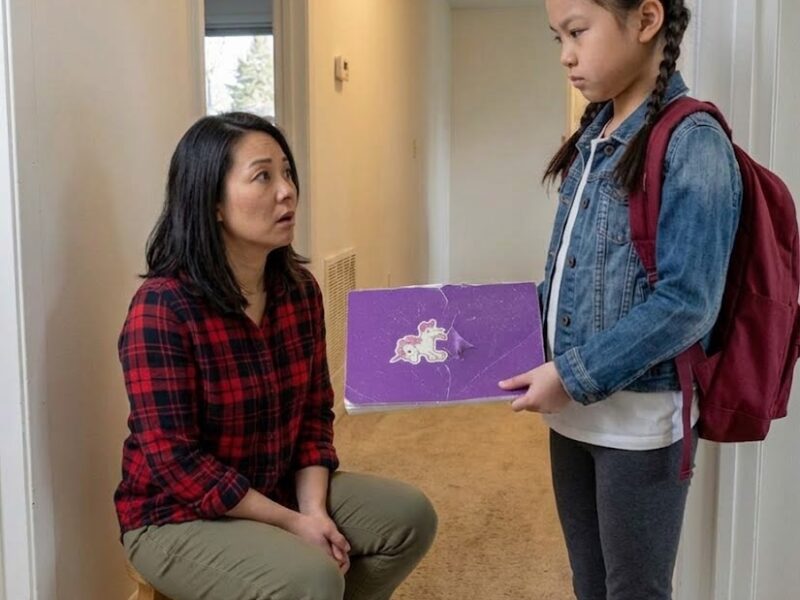
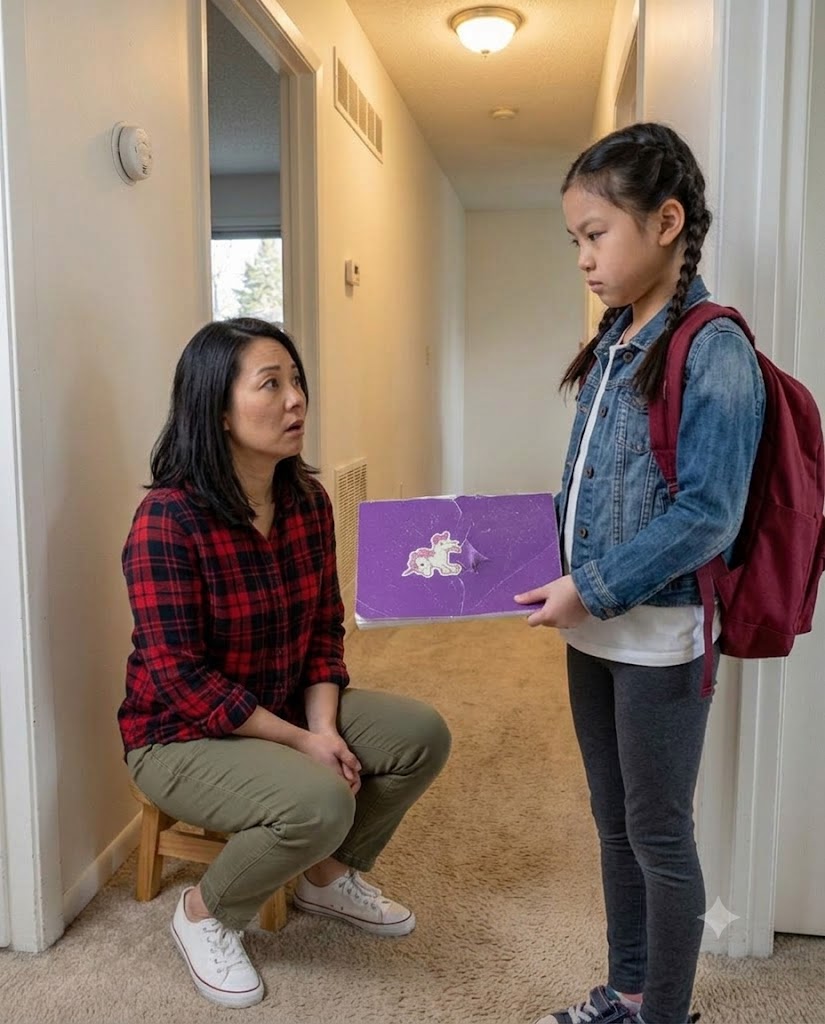
On the third morning, I found her outside my office holding a purple notebook with a cracked unicorn sticker on the cover.
Her hand trembled, but she did not pull it away when I reached for it.
Inside were drawings instead of sentences: a blue storage unit, a ferry terminal clock, and my mother’s bracelet resting beside a stack of papers.
The blue unit appeared four times.
Dates filled the margins in careful block letters, along with three figures Mia had labeled GRANDMA, GRANDPA, and DAD.
In the final drawing, Caleb was lying on the floor of a warehouse office while my father stood beside the door.
The next page contained five words.
Grandma said quiet girls stay alive.
My knees stopped holding me. I slid down against the hallway wall with the notebook open across my lap.
Mia watched my face while rubbing one sneaker against the other.
I did not ask her to speak. I did not make her explain herself. Most importantly, I did not hand the fear back to her.
After photographing every page, I called the number on a business card Caleb’s former neighbor had given me after the funeral.
The woman who answered introduced herself as Agent Morris. The moment I said Caleb’s name, she went silent.
“Is the child safe with you right now?”
I looked at Mia. She was still wearing the backpack.
“Yes. My parents return Sunday.”
Agent Morris told me not to confront them, not to sign the custody statement, and not to let the notebook leave my sight.
Mia reached into her backpack and placed a folded cruise itinerary beside me.
Their Sunday arrival pier had been circled in purple crayon.
Then she opened the notebook to the inside back cover and pressed one finger beneath the paper lining.
Something hard shifted underneath it.
I know you’re curious to see what happens next, so please continue reading in the comments below. Thank you for your patience. Leave a “YES” below and give this post a Like if you want the full story. 👇
My fingertips brushed the inner lining of the purple notebook. With a careful, steady tug, I peeled away the cardboard backing. A flat, heavy metal object slid into my palm.
It was a micro-cassette, the kind old voice recorders used. Taped beside it was a tiny micro-SD card.
Mia looked up at me, her wide, dark eyes searching my face for panic. She didn’t find any. Instead, a cold, absolute clarity settled over me. My brother Caleb hadn’t died in a tragic, accidental warehouse fire. He had been murdered, and my own parents—the people who had spent decades playing the pillars of our community—had engineered it to protect their status, their stolen insurance money, and a secret far darker than I could have ever imagined.
“You’ve been carrying this the whole time, haven’t you, sweetheart?” I whispered.
Mia gave a tiny, almost imperceptible nod.
I didn’t have a cassette player, but my old desktop computer in the office still had a multi-card reader, and the digital card slid right into the adapter. Within seconds, a directory of audio files popped up on my monitor. The most recent file was dated two years ago—the exact night of the warehouse fire.
I plugged in my headphones, handed one bud to Mia, and put the other in my ear. Then I hit play.
The audio crackled with static, followed by the heavy, echoing sound of industrial metal doors sliding shut.
“You can’t do this, Dad!” Caleb’s voice rang out, breathless and terrified. “The insurance fraud, the offshore accounts—if the federal auditors trace it back, we’re all going down! I’m turning myself in tomorrow morning.”
“No, you aren’t, son,” my father’s voice replied, cold and devoid of any paternal warmth. “You’re going to take the fall for the discrepancy, and the warehouse fire will solve our liquidity problem. It’s clean.”
“And what about Mia?” Caleb sobbed. “She was with me in the office. She saw you take the ledger files!”
“She’s nine years old, and she hasn’t spoken a word since she watched you defy us,” my mother’s voice cut in, sharp as a razor. “We’ll take her in. We’ll make sure she stays mute, permanently terrified into silence. Dead men don’t talk, and neither do traumatized children.”
A scuffle followed. A heavy thud, the sharp crack of breaking glass, and then the suffocating roar of rising flames crackled through the speakers.
I ripped the headphones off, my chest heaving as hot tears spilled over my cheeks. The nightmare was real. My parents hadn’t just abandoned a child on my doorstep to go on a luxury cruise; they had dumped a witness they thought they had successfully silenced, fully expecting to return on Sunday to finish what they started.
My phone rang loudly on the desk, startling us both.
It was Agent Morris.
“Ms. Hayes,” the agent’s voice came through crisp and urgent. “I ran the storage unit numbers and dates from the photos you sent. We pulled the federal registry. That blue storage unit isn’t rented under your brother’s name. It’s leased directly to your father’s shell corporation. It contains every missing financial record from the past ten years—and physical evidence from the warehouse fire.”
“Agent Morris,” I said, my voice shaking with a cold, terrifying resolve. “My parents’ cruise ship docks this Sunday at Pier 4. But they aren’t going to find me waiting at home with a signed custody paper.”
“What are you planning to do?”
“I’m giving them a welcome home party they’ll never forget.”
Sunday afternoon arrived with a heavy, overcast sky that matched the storm brewing inside me.
Mia sat quietly in the passenger seat of my sedan, wearing a bright yellow raincoat, her backpack safely zipped. We parked fifty yards away from the designated arrival gate at Pier 4, watching the massive luxury liner glide majestically into the harbor, its decks crowded with vacationers returning from their tropical getaway.
I spotted them immediately.
My father was wearing his crisp vacation polo, rolling the same two suitcases, while my mother strode beside him in her oversized sunglasses, looking entirely refreshed and utterly untouchable. They marched toward the exit terminal, expecting a quiet handoff, a signed piece of paper, and a granddaughter back under their absolute control.
Instead, as they stepped out onto the curbside terminal, two unmarked federal vehicles pulled up with sirens silently flashing, blocking their path.
Agent Morris and three federal agents stepped out, badges gleaming in the gray light.
My parents froze, their vacation smiles instantly evaporating into expressions of absolute, bone-chilling horror as they realized who was waiting for them.
My father tried to turn and wheel his luggage back toward the terminal, but an agent stepped directly into his path, locking a pair of steel handcuffs around his wrists with a sharp click.
“Arthur and Evelyn Hayes,” Agent Morris announced loudly, her voice echoing across the concrete pier. “You are under federal arrest for wire fraud, corporate embezzlement, arson, and the premeditated homicide of Caleb Hayes.”
A crowd of tourists gasped, stepping back. My mother’s face turned the color of wet chalk. She turned her head wildly, her eyes scanning the parking lane until they locked onto my car.
Through the windshield, she saw me sitting in the driver’s seat. And sitting right beside me, staring straight back at her without a single trace of fear, was Mia.
I rolled my window down an inch, letting the cold harbor wind carry my final words across the concrete.
“The quiet girls,” I said softly, loud enough for her to hear every syllable, “finally learned how to speak.”
As the police cruisers led my parents away in handcuffs, Mia reached into her backpack, pulled out the purple unicorn notebook, and for the first time in two years, she opened it to a brand-new page, picking up a purple crayon to draw something entirely new: freedom.