The ‘Furniture Exploit’: How Palworld 1.0 Players Are Breaking the Farming Economy With a Massive Base-Building Glitch
Your massive Palworld farming base is a complete waste of space, and players are furious that a hidden “furniture exploit” is completely breaking the game’s economy. 🛑
Dataminers and top-tier builders just exposed two heavily guarded glitches that allow you to bypass the strict physical limits of your Palbox radius by manipulating early-game wooden stools and Japanese floor cushions. Are you going to keep starving your Pals with terrible, space-consuming crop layouts, or are you ready to use this massive Stacking Exploit before the developers wipe it from the servers forever?
Find out the exact steps to build your vertical glitch farm right now 👇🔥
When Pocketpair officially released the monumental Palworld 1.0 update, the studio promised a refined, expansive survival experience, complete with new islands, complex raid bosses, and an overhauled progression system. However, the game’s notoriously creative and relentless player base has once again found a way to bend the virtual physics of the Palpagos Islands to their absolute breaking point.
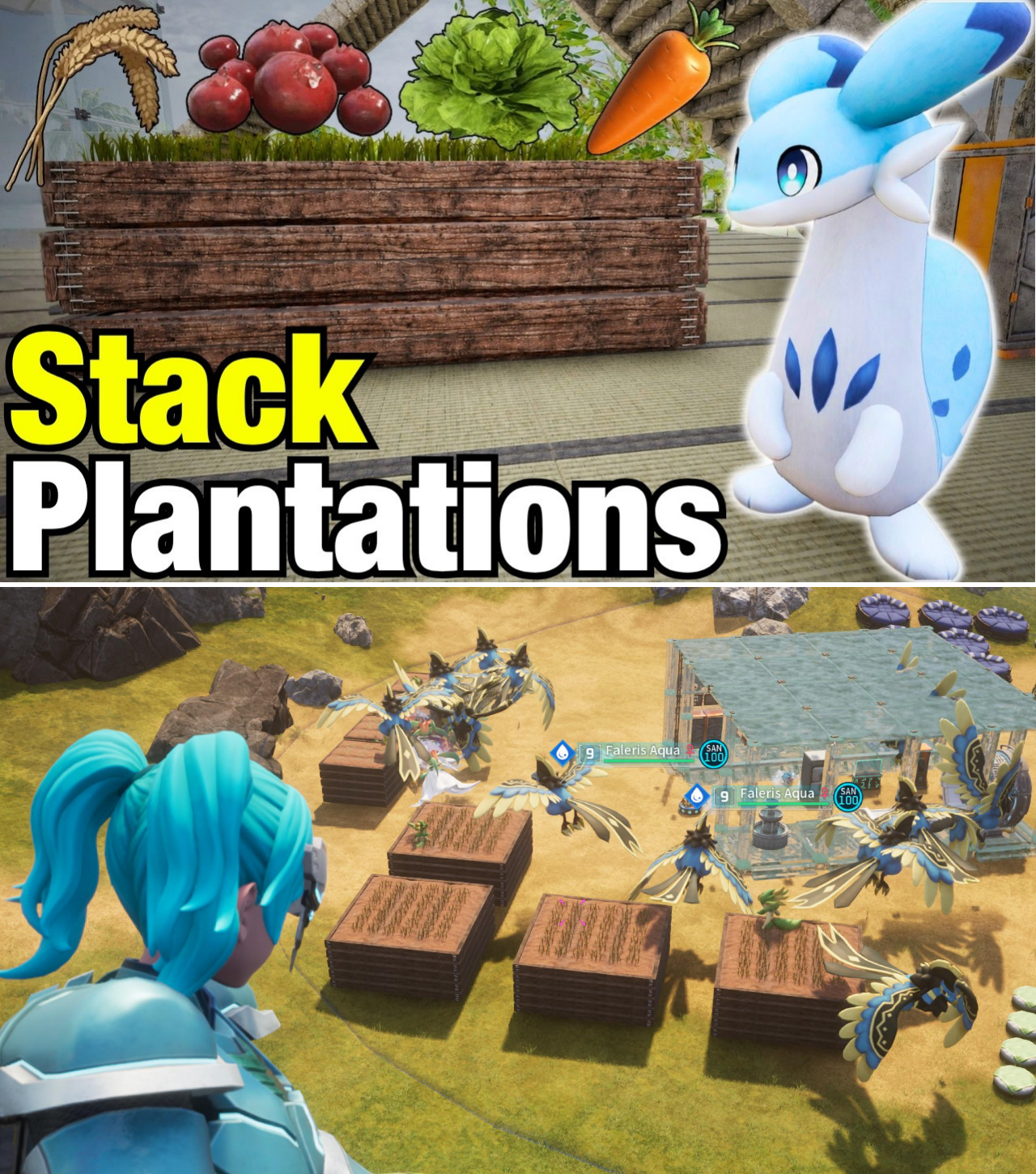
Right now, a massive, game-changing architectural glitch is spreading like wildfire across YouTube, Discord, and Reddit. Dubbed the “Stacking Farm Glitch,” players have discovered that by manipulating specific decorative furniture items, they can entirely bypass the physical space limitations of the game’s farming system. By stacking Plantations directly on top of one another, players are creating towering vertical farms that are sending the game’s food economy into overdrive.
As the exploit goes viral, the Palworld community is fiercely divided. Is this a brilliant showcase of survival game engineering, or a blatant cheat that threatens to undermine the grueling resource-management mechanics Pocketpair worked so hard to balance?
The Spatial Crisis of the Palpagos Islands
To understand why this exploit is causing such an uproar, one must understand the ruthless real estate market within Palworld.
Every player base is strictly confined within the glowing blue radius of a Palbox. Within this limited circular border, players must cram beds, assembly lines, breeding farms, defensive walls, and resource nodes. However, the most universally despised space-hogs in the game are the agricultural plots. Berry, Wheat, Tomato, and Lettuce Plantations are massive, flat squares that consume an agonizing amount of square footage.
Agriculture is not optional. Without a massive surplus of crops, players cannot cook the high-tier foods required to keep their workforce’s Sanity (SAN) levels stable, nor can they bake the endless supply of Cake required to power the Breeding Farm—the absolute core of the Palworld endgame meta.
For months, players have begged Pocketpair for smaller farming plots or vertical planters. The developers remained silent. So, the community took matters into their own hands, weaponizing the game’s own furniture catalog against its building restrictions.
Method One: The “Wooden Stool” Hustle
The glitch was recently popularized by gaming creator Jay Dunna, who released a highly circulated tutorial breaking down two distinct methods for achieving vertical agriculture. The first method is accessible from the very early stages of a playthrough, but it comes with a heavy dose of trial-and-error jank that is characteristic of the survival genre.
Players begin by unlocking basic wooden furniture via the Technology Tree. The glitch specifically requires the Wooden Stool (though Wooden Benches can also be utilized). By placing a Wooden Stool on the ground, players can engage “axis alignment mode”—toggled via the left control key on PC setups. This allows builders to snap multiple stools directly on top of one another, creating a makeshift wooden tower.
From there, the true exploitation begins. Players select a Plantation blueprint and carefully maneuver their camera until they locate a specific “red arrow” prompt indicating that the farming plot has recognized the top stool as a valid foundational floor. Once the plot is built mid-air, the player simply opens their disassembly menu and deletes the supporting wooden stools underneath.
The result? A fully functional farm floating completely unsupported in mid-air. The player can then repeat the process, building another stool tower right beneath the floating plot, and stacking another plantation below it.
“It does take a little bit of trial and error… it is a little bit tricky,” Dunna admits in the viral breakdown, noting that jumping and building temporary staircases is often required to find the exact pixel-perfect placement. Regardless of how sloppy the construction process looks, the end result is undeniably powerful.
Method Two: The “Japanese Floor Cushion” Breakthrough
While the Wooden Stool method revolutionized early-game base building, it was the discovery of the second method that truly shattered the endgame meta.
Later in the progression tree, players unlock the Japanese Style Furniture Set. This decorative bundle contains a seemingly innocuous item: the Japanese floor cushion. Hardcore base builders quickly realized that this tiny, flat cushion possesses incredibly broken hitbox properties when interacting with agricultural plots.
Instead of building precarious towers of wooden stools, endgame players can simply build a base-level Plantation, drop a Japanese floor cushion dead-center in the middle of the dirt, and then snap an entirely new Plantation blueprint directly on top of the cushion. The game’s engine fails to register the collision conflict, allowing the new plot to materialize perfectly inside the old one. The player can repeat this action infinitely, dropping a cushion and placing a farm over and over until they have five, ten, or twenty plantations merged into a single vertical column.
“The beautiful part about this is it is the easiest method to do,” Dunna stated, highlighting that this bypasses the frustrating jumping and deleting required by the first method. It is clean, visually compressed, and mathematically devastating to the game’s intended resource scarcity.
The AI Anomaly: Why the Glitch is Unstoppable
Historically in Palworld, whenever players force objects to clip through one another or build complex vertical structures, the game’s artificial intelligence catastrophically breaks down. Pals assigned to bases routinely get stuck on staircases, freeze on top of logging sites, or starve to death because they cannot pathfind their way to a Feed Box.
The most shocking revelation of the Stacking Farm Glitch is that it does not break Pal AI.
According to extensive community testing on Reddit and Discord, Pals equipped with the Planting, Watering, and Gathering work suitabilities have absolutely no issue interacting with these glitched towers. Because the plantations share the same X and Y coordinates on the map, a single Water-type Pal can spray a single spot and simultaneously water five stacked plots at once. A Grass-type Pal can throw seeds into a single square and plant a massive vertical yield.
Players are currently posting TikTok clips of a single Jormuntide and a single Lyleen outputting enough crops in ten minutes to sustain an entire 20-Pal base for a week. The efficiency is staggering, completely negating the need to dedicate massive portions of a base to farming or allocating half a dozen Pals just to manage food production.
A Community Divided: Innovation or Exploitation?
As the glitch dominates the 1.0 base-building meta, a fierce ideological war has erupted within the game’s massive community.
On one side are the min-maxers and hardcore raiders, who view the glitch as a necessary evolution. “Pocketpair gives us a tiny circle to build in and expects us to fit industrial assembly lines alongside massive crop fields. This isn’t cheating; it’s surviving the bad building mechanics,” argued a prominent user on the r/Palworld subreddit. For these players, the glitch is a massive quality-of-life improvement that allows them to focus on the game’s true endgame: breeding perfect combat Pals for the Bellanoir Libero raids.
On the other side are the purists. Dedicated roleplay and aesthetic building servers on Discord have already begun strictly banning the use of the Japanese floor cushion glitch. Purists argue that the Stacking Farm ruins the immersion and visual integrity of the game. They claim that bypassing the spatial management puzzle destroys the core identity of the survival-crafting genre.
Furthermore, some critics are raising concerns about server stability. While individual bases seem to handle the glitched plots well, server administrators are warning that overlapping hundreds of animated crop hitboxes could lead to massive memory leaks and server crashes in densely populated multiplayer worlds.
The Clock is Ticking
As of this writing, Pocketpair has remained tight-lipped regarding the Stacking Farm Glitch. The studio has a mixed track record when it comes to patching unintended mechanics. In the past, they swiftly removed popular exploits—such as the infamous glitch that allowed players to capture human Syndicate bosses—while leaving other benign physics quirks intact.
Given how deeply this exploit affects the core resource economy of Palworld 1.0, industry insiders heavily suspect that a hotfix is imminent. Modifying the collision parameters of the Japanese floor cushion and the Wooden Stool would be a relatively simple patch for the development team.
But until the patch notes drop, the Palpagos Islands are currently experiencing an unprecedented agricultural boom. Thousands of players are rushing to log on, frantically tossing down cushions, and stacking their farms to the sky. The furniture exploit may be a temporary anomaly, but in the ruthless, hyper-optimized world of Palworld, players will always exploit every single advantage they can get their hands on.