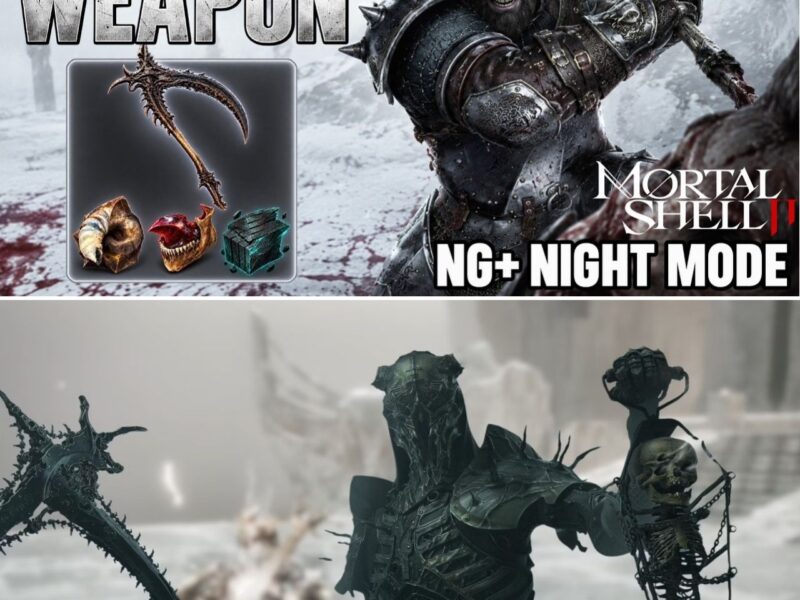
Is Clockwork Scythe Actually the Best Weapon in Mortal Shell II? The Endgame Build Making Players Rethink the Meta
🔥 EVERYONE MAY HAVE BEEN SLEEPING ON MORTAL SHELL II’S MOST INSANE WEAPON.
Clockwork Scythe looked like a slow crowd-control gimmick… until players discovered what happens when its multi-hit mechanics, Scholar’s Wormstone and status effects start feeding into each other — and suddenly even the “S-tier” weapons have a problem. 👀
🔥 See why Clockwork Scythe might actually be the BEST weapon in Mortal Shell II right now 👇
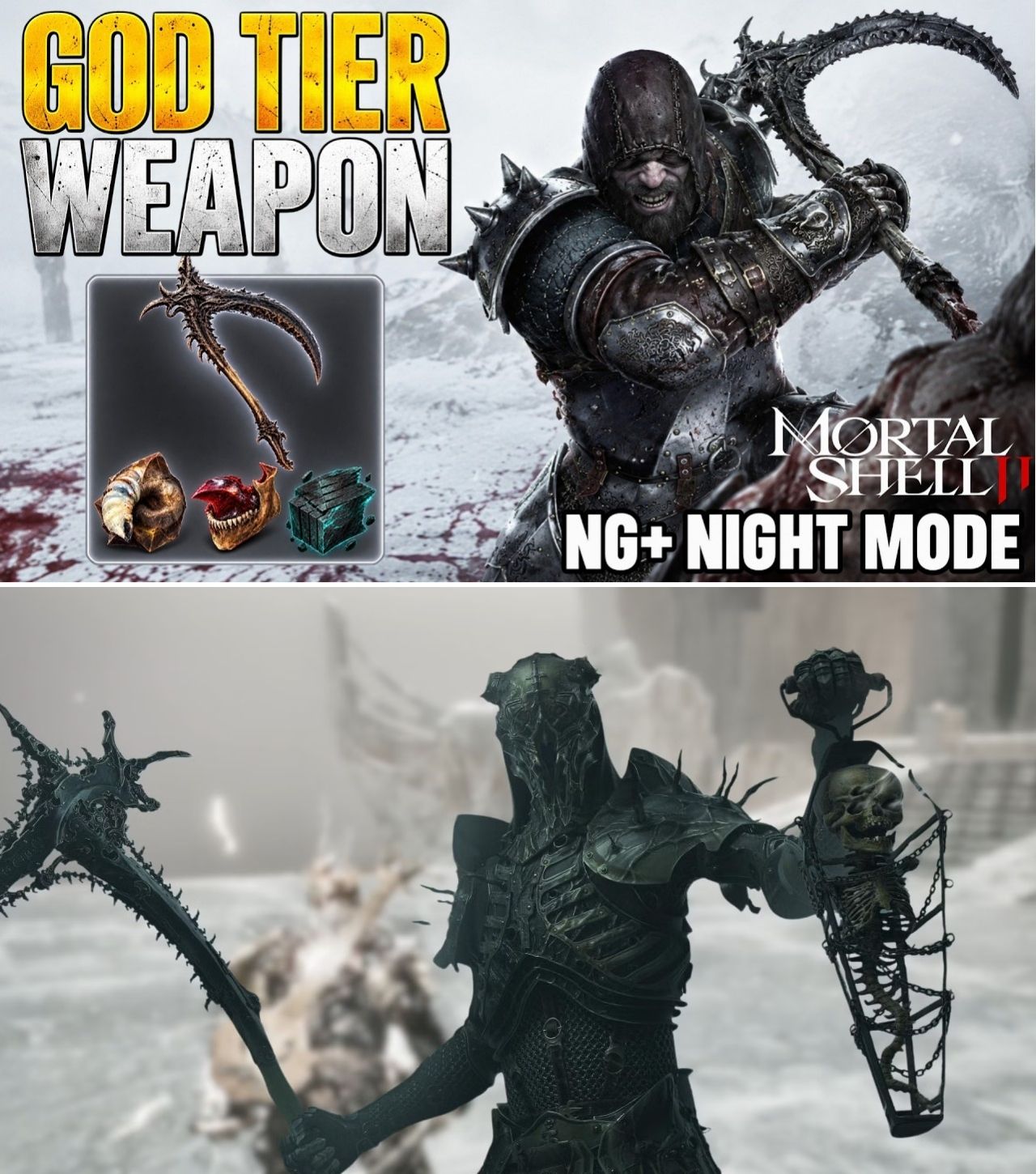
Is Clockwork Scythe Actually the Best Weapon in Mortal Shell II? The Endgame Build Making Players Rethink the Meta
For much of Mortal Shell II’s early meta, the conversation around the best melee weapon appeared relatively straightforward.
Axe & Dagger had speed and multi-hit pressure.
Axatana offered an unusually versatile two-form moveset.
Heavy weapons such as Great Martyr’s Blade provided enormous individual hits.
And then there was Clockwork Scythe.
At first glance, the mechanical reaper can look like a specialized crowd-control weapon rather than the obvious centerpiece of an endgame build. Its wide swings are excellent for clearing groups, but several launch-era rankings placed it below the game’s most popular fast weapons, particularly for boss encounters.
That perception is now being challenged.
A current tier list from KeenGamer places Clockwork Scythe in S tier, specifically highlighting its crowd control and wide-area attacks. Another newly updated ranking also places it in S tier, arguing that its multi-hit mechanics and status interactions give it an unusually high endgame ceiling.
At the same time, other current guides remain more cautious.
Games.gg ranks Clockwork Scythe in B tier, praising its overworld AoE while arguing that it struggles against bosses because it lacks the reach and attack speed of the higher-ranked weapons.
So which side is right?
The answer appears to depend heavily on whether the player is using the Scythe as a basic weapon — or actually building around what makes it special.
The Clockwork Scythe is not just a big AoE weapon
The Clockwork Scythe is one of the eight primary melee weapons in Mortal Shell II.
It is obtained through the Chamber of Becoming route associated with Sariel, the Endless, making it a later-game weapon rather than something players can immediately build around during the opening hours. Current guides place its acquisition in the Mammon region, with the route beginning near Silent Steps Beacon.
That late availability matters.
By the time players acquire the Scythe, they already understand Mortal Shell II’s combat system, have access to more Tarstones and have begun experimenting with specialized Shell builds.
The weapon’s normal moveset is built around broad sweeping attacks.
That makes it naturally effective against multiple enemies.
But its real potential comes from the weapon-specific mechanics layered on top of those attacks.
And that is where the current debate begins.
Clockwork Shardstone changes the weapon’s identity
One of the key pieces of the current Clockwork Scythe setup is Clockwork Shardstone.
Current build guides describe the Tarstone as enabling the weapon’s distinctive powered chainsaw-style attack, consuming Resolve over time while the mechanical blade continues spinning.
That changes the Scythe from a conventional sweeping weapon into something much more aggressive.
Instead of relying solely on one large swing connecting with an enemy, the player can create a sequence of repeated hits.
And repeated hits are extremely important in Mortal Shell II.
They can increase status application.
They can generate additional opportunities for stagger.
They can interact with Tarstones that reward attack frequency.
And, depending on the build, they can produce considerably more value from a single opening.
This is why the Clockwork Scythe’s ceiling may be much higher than its basic moveset suggests.
Scholar’s Wormstone is the real game changer
If Clockwork Shardstone provides the mechanical identity, Scholar’s Wormstone is arguably the interaction that makes the endgame build so interesting.
A current build analysis describes Scholar’s Wormstone as turning the Scythe’s attacks into multi-hit sequences, dramatically increasing the frequency with which status effects can be applied.
That creates an important distinction.
A conventional weapon asks:
How much damage does this attack deal?
The optimized Clockwork Scythe asks:
How many times can this attack actually hit?
That second question can produce very different results.
If a single attack becomes multiple hits, any mechanic tied to hit frequency becomes more valuable.
This is precisely why the Scythe is attracting attention from players experimenting with status-focused builds.
Bloodcurse is one of the biggest reasons
One of the most obvious pairings is Bloodcurse.
Bloodcurse has already emerged as one of the most discussed status effects in the current Mortal Shell II meta, particularly for weapons capable of applying repeated hits.
The Clockwork Scythe’s multi-hit mechanics fit naturally into that philosophy.
Rather than waiting for a slow weapon to land another enormous attack, the Scythe can repeatedly apply pressure and build status.
A newly updated NerdsChalk tier list specifically identifies Clockwork Scythe as an S-tier option for multi-hit AoE and rapid Bloodcurse stacking, placing it directly behind Axatana and Axe & Dagger in its overall ranking.
That is a significant shift from the idea that the Scythe is merely a crowd-clearing weapon.
If Bloodcurse is part of the build, every additional hit becomes potentially more valuable.
The weapon is no longer being judged by one swing.
It is being judged by the entire sequence.
Lightning creates another route
Bloodcurse is not the only status interaction attracting attention.
Current build information also identifies Lightning/Voltaic as another viable direction for the Clockwork Scythe. One current guide specifically lists both Blood Curse and Voltaic among the weapon’s available offensive options.
That creates two fundamentally different approaches.
A Bloodcurse setup emphasizes sustained damage against individual targets.
A Lightning setup can be particularly attractive when the player is surrounded by multiple enemies and wants status effects to contribute to crowd clearing.
This plays directly into the Scythe’s natural strength.
It is already good at hitting several enemies.
Adding an effect that benefits from repeated or widespread attacks can therefore reinforce what the weapon is already trying to do.
The Sariel connection is more than coincidence
The Clockwork Scythe’s relationship with Sariel is also relevant to its build potential.
Community testing has highlighted Sariel + Clockwork Scythe as a particularly powerful combination.
One recent NG++ player reported that the combination produced extremely high damage and was effective against both mobs and bosses. The same community discussion was part of a broader debate about whether heavy weapons in Mortal Shell II are underperforming relative to faster alternatives.
Why does Sariel fit?
The answer is sustain.
A build that allows the player to remain aggressive while recovering some of the health lost through combat can benefit significantly from a weapon that produces a large number of repeated hits.
Instead of relying on perfect hit-and-run timing, the player can potentially sustain pressure through an encounter.
That is especially relevant to the Clockwork Scythe because its strongest mechanics encourage players to stay committed to an attack sequence.
But there is an important qualification.
This is a build synergy, not proof that Sariel + Clockwork Scythe is universally the strongest combination in the game.
Different bosses and player skill levels can produce very different results.
The Scythe’s biggest advantage may be crowd control
Even critics of the weapon generally agree on one point:
Clockwork Scythe is excellent against groups.
Games.gg’s current weapon ranking specifically describes it as having the best overworld AoE clear while simultaneously criticizing its performance against bosses.
That is a useful distinction.
Imagine a player entering an area filled with several aggressive enemies.
A narrow sword forces the player to select one target.
A spear can poke from a safer distance.
A slow hammer can stagger one opponent.
The Clockwork Scythe can potentially hit several enemies with the same broad attack sequence.
That makes it particularly efficient during exploration.
And when the weapon’s multi-hit mechanics are activated, the number of interactions happening simultaneously can become even larger.
This is why players who primarily judge weapons by boss DPS may underestimate it.
The Scythe is solving a different problem.
But the boss argument cannot be ignored
The strongest criticism against calling Clockwork Scythe “the best weapon” is its performance against bosses.
Games.gg currently ranks the weapon only B tier, specifically because it believes the Scythe’s strengths against crowds do not translate as effectively into single-target encounters.
That is not a trivial criticism.
Bosses punish long animations.
They punish poor spacing.
They punish attacks that require the player to remain committed for too long.
A sweeping AoE weapon can be incredible when surrounded by enemies and awkward when facing one highly mobile target.
This is where Axatana and Axe & Dagger continue to have strong arguments.
Their faster attacks allow players to enter and exit combat more quickly.
Their rapid-hit mechanics are also highly compatible with status effects and Resolve generation.
So if “best weapon” means the safest universal boss weapon, Clockwork Scythe has not conclusively won that argument.
Then why are some tier lists suddenly putting it in S?
Because endgame builds change the equation.
The most recent S-tier evaluations are not simply judging the base moveset.
They are evaluating what happens when the weapon is paired with its specialized Tarstones and status effects.
NerdsChalk’s August 29 ranking, for example, puts Clockwork Scythe in S tier and describes it as an exceptional multi-hit AoE weapon capable of rapidly stacking Bloodcurse.
KeenGamer also places it in S tier, describing its wide-area attacks and crowd-control potential as sufficient to justify the ranking.
That suggests the current disagreement is not necessarily about whether the Scythe is powerful.
It is about what criteria should determine a tier list.
Should the best weapon be the one with the highest boss DPS?
The safest weapon?
The most versatile?
The strongest fully optimized build?
The best exploration weapon?
Depending on the answer, Clockwork Scythe can move dramatically up or down the ranking.
The 12-slot advantage matters
Another factor that can easily be overlooked is the weapon’s 12 Tarstone slots.
Games.gg notes that Clockwork Scythe has 12 slots, putting it among the weapons with the largest Tarstone pool.
That gives experienced players more room to experiment.
A player can create a crowd-control configuration.
Another can focus on Bloodcurse.
Another can build around Lightning.
And another can construct a defensive or sustain-oriented setup.
This flexibility becomes increasingly important in longer playthroughs.
A weapon that supports several configurations can remain useful even when the player changes Shells or encounters enemies with different resistances.
In that respect, the Clockwork Scythe may have a higher buildcrafting ceiling than its basic moveset initially suggests.
Balance Patch 1 also helped
The weapon has not been completely untouched since launch.
Current patch-aware weapon information reports that Balance Patch 1 improved the tracking of Clockwork Scythe light attacks.
That may sound like a small technical adjustment.
For a melee weapon, it is not.
Attack tracking determines whether an enemy that moves slightly during an animation remains inside the weapon’s effective arc.
Improved tracking therefore makes the Scythe more reliable in actual combat.
It does not necessarily turn the weapon into an unstoppable boss killer.
But it reduces one of the frustrations associated with wide-swing weapons: watching an attack that should connect simply miss because the target moved a few steps away.
In a weapon built around repeated hits, that reliability can compound.
More connections mean more status buildup.
More status buildup means more damage.
More successful attacks mean more opportunities to sustain the build’s resource loop.
The current community is split
The disagreement over Clockwork Scythe is visible across current guides.
One recent editorial ranking places Axatana alone in S tier, while putting Clockwork Scythe in B.
Another current ranking puts Axatana, Axe & Dagger and Clockwork Scythe all in S tier.
KeenGamer also puts the Scythe in S tier, while Games.gg ranks it B.
That is a remarkably large disagreement for a game that launched only recently.
And it tells us something useful.
There is no established universal Clockwork Scythe meta yet.
Players are still discovering how much of its apparent power comes from the weapon itself and how much comes from the supporting build.
So is Clockwork Scythe actually the best?
The evidence does not support an absolute answer.
Calling it the undisputed best weapon in Mortal Shell II would go beyond what current testing establishes.
But there is a strong case for a more nuanced claim:
Clockwork Scythe may have one of the highest endgame build ceilings in the game.
Its wide attacks are excellent for groups.
Its 12 Tarstone slots provide considerable flexibility.
Its specialized mechanics can turn attacks into multi-hit sequences.
Bloodcurse can exploit that hit frequency.
Lightning provides another status-oriented route.
And Sariel offers an especially interesting sustain synergy.
Most importantly, Balance Patch 1 has already improved its attack tracking, making the weapon more reliable than its launch version.
That is a compelling package.
But players looking for the most universally reliable weapon still have strong alternatives.
Axe & Dagger remains a dominant fast multi-hit choice.
Axatana remains arguably the most flexible all-round weapon.
Those two continue to appear near the top of multiple current rankings.
Clockwork Scythe’s argument is different.
It is not necessarily the weapon that does everything best.
It may be the weapon that becomes absurd when the entire build is designed around what it does best.
And that distinction is exactly why the current debate is getting so heated.
The real Clockwork Scythe test
For players wondering whether they should invest in it, the answer may come down to one question:
Do you want a weapon that is already excellent — or a weapon whose full potential you can build toward?
If the answer is the first, Axe & Dagger or Axatana remains the safer recommendation.
If the answer is the second, Clockwork Scythe deserves serious attention.
The basic weapon is good.
The specialized weapon can be something else entirely.
Activate its mechanical attack.
Increase its hit frequency.
Apply Bloodcurse or Voltaic.
Take advantage of its huge attack coverage.
Pair it with a Shell capable of exploiting sustained combat.
And suddenly the weapon that looked like an AoE gimmick starts generating the kind of damage and status pressure usually associated with the game’s top-tier fast weapons.
That is why the “Clockwork Scythe is the BEST weapon” argument is gaining traction.
Not because the community has mathematically proven that it beats every other weapon.
It hasn’t.
But because players are discovering that its ceiling may be much higher than the launch meta initially assumed.
For now, the most accurate verdict is probably this:
Clockwork Scythe is absolutely an endgame S-tier contender — but whether it is THE best weapon depends on whether you value crowd destruction, status stacking and build potential over raw single-target consistency.
And if future balance patches continue improving its reliability, that debate could become even harder to settle.