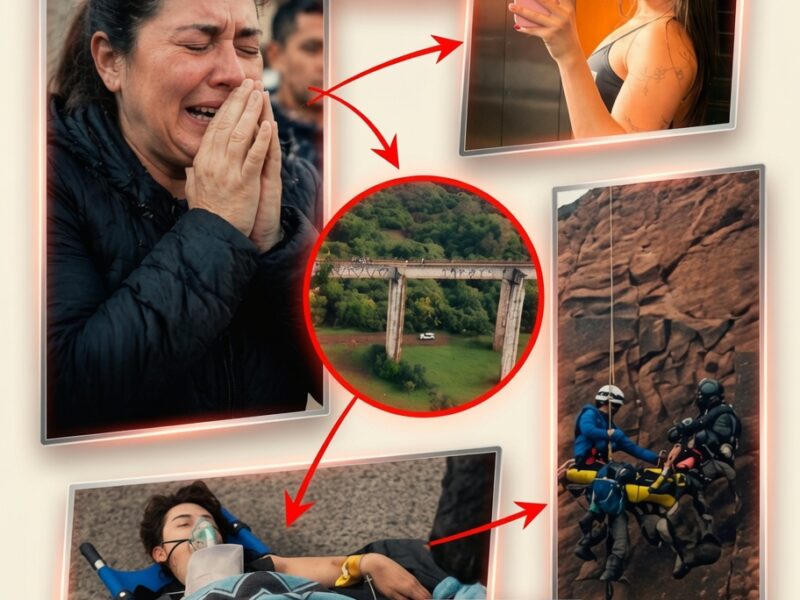
BEYOND NEGLIGENCE: Why Brazilian Prosecutors Are Pushing for Murder Charges in the “Skeleton Bridge” Tragedy
“THIS IS NOT AN ACCIDENT.” 🚨 Brazil is on the verge of a historic legal shift as prosecutors demand MURDER charges for the 130-foot bridge plunge…
When 21-year-old Maria Eduarda Rodrigues de Freitas was thrown into a rocky canyon with zero safety ropes at the infamous “Skeleton Bridge,” the defense immediately leaned on “accidental negligence.” They wanted the world to think it was just a tragic oversight. But the Civil Police and top legal minds in São Paulo are fighting back with a powerful, burning fury.
How does throwing a human being off a 40-meter ledge without checking their waist cross the line from a “mistake” into a calculated gamble with human life? Law experts are exploding over a rare legal doctrine called Dolus Eventualis—the concept of “implied malice.” If you operate an illegal death trap, skip every basic check, and ignore the crowd’s warnings, you aren’t negligent. You are accepting murder. This case is about to set a massive precedent for the entire global adventure tourism industry, and the defense’s “collective amnesia” story is completely unraveling under the pressure.
The shocking legal maneuvers, the new suspects added to the dragnet, and why this manslaughter case is turning into a full-scale homicide trial 👇
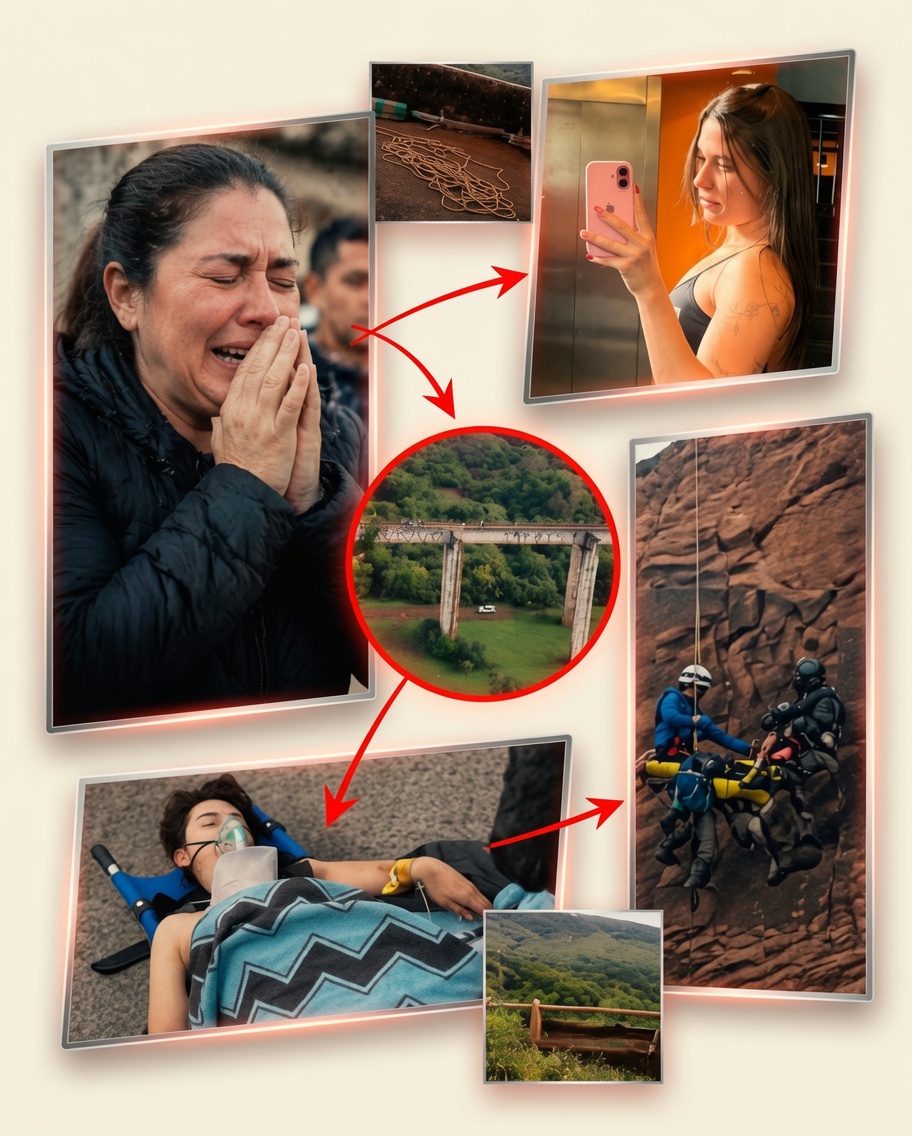
In the immediate wake of a fatal sports catastrophe, the legal system typically defaults to charges of involuntary manslaughter. It is the standard box to check for severe carelessness. However, the horrific death of 21-year-old physical education graduate Maria Eduarda Rodrigues de Freitas at the abandoned Ponte do Esqueleto (Skeleton Bridge) in Limeira, Brazil, is shattering traditional legal paradigms.
As the three lead instructors—Luis Felipe Feliciano Egoroff, Vitor de Freitas Goncalves, and Maicon Fernandes Cintra—sit in pre-trial detention, a fierce, high-stakes battle is brewing inside the São Paulo judicial system. Moving past the initial shock of the viral footage, which showed Maria Eduarda being launched into a 40-meter (130-foot) abyss with her safety harness completely unattached, prosecutors and local legal analysts are aggressively demanding that the charges be upgraded from standard criminal negligence to full-scale homicide.
The pivot rests on a powerful, sophisticated legal doctrine that could change the face of unregulated adventure tourism forever: Dolus Eventualis.
The Anatomy of Dolus Eventualis
To the average observer, the defense’s claim of a “collective blackout”—where all three instructors simultaneously forgot to anchor the main bungee line—sounds like an absurd excuse. Legally, however, the defense is attempting to keep the case firmly within the realm of culpa grave (gross negligence). Under Brazilian law, manslaughter carries significantly lighter sentencing and offers pathways to bail or reduced prison time, framing the event as an unthinkable, tragic mistake by qualified professionals.
But the Civil Police, spearheaded by Chief of Police Andrea Levy, are building a starkly different narrative. Prosecutors are aiming to invoke dolus eventualis, often translated as “eventual intent” or “implied malice.”
Under this framework, the state does not need to prove that the instructors woke up on the morning of June 13, 2026, with the explicit intent to kill Maria Eduarda. Instead, they must prove that the defendants consciously engaged in an activity so riddled with risks, operating an entirely illegal, uncertified business on an abandoned federal bridge, and executed it with such absolute, flagrant disregard for human safety that they effectively accepted the probability of a fatal outcome.
“When you lift a human being onto your shoulders and throw them off a structure higher than a ten-story building without looking at their waist to see if a massive, brightly colored safety rope is clipped in, you are no longer being careless,” argued a prominent São Paulo criminal attorney during a recent analytical panel on X (formerly Twitter). “You are looking at a lethal drop and saying, ‘I don’t care what happens.’ That is the absolute definition of dolus eventualis.”
The Evidentiary Web Tightening Around the Crew
The push to upgrade the charges to murder is being fueled by an expanding web of evidence that directly contradicts the defense’s portrayal of an “innocent oversight.”
First is the venue itself. The Skeleton Bridge is not a sanctioned zone for eco-tourism; it is a hazardous, half-built concrete relic. By choosing to run a commercial business via clandestine WhatsApp and Instagram channels at this location, the operators of “Entre Cordas” and “Ih Voei” had already established a baseline of defiance against federal and municipal laws.
Second, the emerging audio analysis of the viral video clip has introduced a devastating hurdle for the defense. True-crime forums and legal commentators on Reddit are closely tracking reports that a clear, vocal warning was shouted on the platform a second before Maria left the guides’ shoulders. If court-appointed audio forensics validate that a warning was broadcasted and ignored, the defense’s “blackout” narrative collapses entirely. It transforms the final push from a moment of absent-mindedness into an act of reckless arrogance, directly fulfilling the criteria for implied malice.
Finally, the post-incident behavior of the crew—where two coordinators fled on foot into the dense jungle, necessitating a military police Águia helicopter manhunt, while others allegedly pressured the crowd to delete their phone recordings—is being weaponized by prosecutors. In the eyes of the law, a flight from justice and an attempt to suppress evidence demonstrate a sudden, acute awareness of guilt, completely incompatible with the actions of individuals who simply suffered a tragic memory lapse.
Global Implications for the Influencer Economy
As the dragnet expands to include up to six individuals connected to the illegal operation, the international community is watching the legal proceedings with intense scrutiny. The case has transcended the borders of Limeira, becoming a watershed moment for the global “influencer tourism” black market. For years, pop-up adventure outfits worldwide have relied on flashy social media packaging to bypass expensive safety certifications, using the cover of “freelance clubs” to evade criminal liability when things go wrong.
If the Brazilian courts successfully convict the instructors under the banner of dolus eventualis, it will send a seismic shockwave through the extreme sports community. It will establish a strict legal precedent: cutting corners on human safety to turn a quick profit on social media will no longer be protected by the shield of “accident.” It will be treated as a violent crime.
For Maria Eduarda’s family, a murder conviction will not bring back the promising 21-year-old student whose life was cut short. But for a public demanding absolute accountability, the upcoming trial is an essential battlefield to prove that a human life cannot be treated as a disposable prop for an adrenaline rush.