The mud was still settling when the last man stopped moving, and for a heartbeat the whole forest went silent—like the trees themselves were holding their breath. Fog clung low to the ground, curling around boots, bodies, and one trembling old man who thought he was about to die on land his family had tended for three generations.
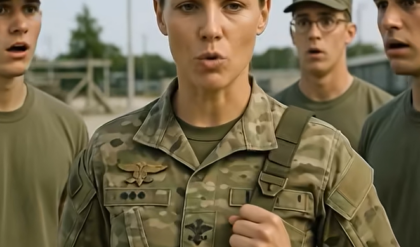
They’d come for him laughing, loud and filthy, six bodies moving with the swagger of men who thought the law answered to their boss. They expected him to be helpless. They expected me—alone, uniform dusty, hair tucked under my cap—to be the warm-up act before the real violence began.
They didn’t expect I’d stopped pretending to be lost the second they put their hands on me.
They definitely didn’t expect the shoulder-cam quietly recording every threat they slurred.
When it was over—when the groans started and the bravado bled out of them—I knelt beside Henry Alcott. Seventy-two. Ribs likely bruised. Hands shaking like cracked porcelain. “Sir,” I said softly, “you’re safe now.” But he kept staring at the men zip-tied to the log as if he still couldn’t believe it.
“You… who are you?” he whispered. Just a woman. Just a uniform. Just someone they thought wouldn’t fight back.
What I didn’t tell him was the truth: I was a Sergeant Major investigating Pine-Ridge Logging, a “respectable” company that used armed intimidation to steal land. Everyone in this county whispered about them. No one had evidence. Not until they grabbed me—and gave me exactly what I needed.
Sheriff Miller nearly choked when I radioed in: “Package secured. All six. And Sheriff… you’re gonna want to see this footage.”
But the real storm wasn’t in the forest. It was waiting at town hall.
A week later, the mayor stood under bright lights, smiling that polished, politician’s smile, promising “economic rebirth.” His cousin—the CEO who ordered hits while wearing $900 boots—unfurled a map showing which parcels would be “redeveloped for community benefit.”
Zone C. Henry’s land. The same land he’d nearly died for.
Every seat was full. Half the town showed up in work boots and winter jackets; the other half wore suits and forced optimism. No one knew what really happened in those woods. No one knew how close their county had come to becoming someone’s private empire.
I stood in the back, baseball cap low, civilian clothes hiding the bruises on my arms. The flash drive in my pocket felt heavier than a sidearm. Inside were six voices bragging about “finishing the old man,” about “orders from Thorne,” about “the mayor backing it.”
The kind of evidence people spend years wishing for. The kind that never survives daylight.
When the mayor spread his arms wide and asked, “Any questions before we proceed?”, the room went quiet. Expectant. Trusting.
Henry shifted on his cane in the front row. His eyes met mine for one fragile second—fear, hope, disbelief all tangled together.
He’d survived the forest.
But the real wolves were standing on stage.
I stepped forward, heart steady, thumb brushing the cold metal of the flash drive.
And for the first time since that night, the entire room turned toward me—one woman in a borrowed flannel, about to decide whether a whole county keeps living under a lie… or learns exactly what the woods heard when the fog closed in.
I raised my hand. And the mayor’s smile began to crack.
The mayor’s eyes flicked to me—polite, dismissive, the way men like him look at anyone who doesn’t come with a campaign donation or a last name that matters.
“Yes, ma’am?” he said, voice honeyed for the cameras. “Question about the community center, maybe?”
I walked down the center aisle slow enough for every head to turn. Work boots scraped on the floor. Suits whispered. Henry’s knuckles went white around his cane.
“No, Mr. Mayor,” I said, loud enough for the back row. “Question about attempted murder.”
The room sucked in a breath all at once.
I pulled the flash drive from my pocket and held it up between two fingers. “Six of your cousin’s employees assaulted a seventy-two-year-old farmer on his own land last week. They put their hands on me, too—thought I was just some hiker who wandered too far. They talked. A lot. About orders. About who gave them. About how the mayor was ‘handling the paperwork side.’”
The CEO—Thorne—leaned forward on the dais, face tightening. “This is ridiculous. Security!”
Two deputies near the door shifted, uncertain. They’d seen the arrest reports. They knew whose payroll they were really on.
I kept going. “I’m Sergeant Major Elena Reyes, Army Criminal Investigation Division. I’ve been embedded here for nine weeks documenting Pine-Ridge Logging’s pattern of coercion, threats, and felony assault. That night in the woods was the break we needed.”
I nodded toward the side door. Four state troopers in crisp gray uniforms stepped in, followed by two FBI agents in windbreakers. The room erupted—gasps, shouts, chairs scraping backward.
The mayor’s polished smile was gone now, replaced by something pale and sweating. “You can’t just—this is a public meeting—”
“Actually,” one of the agents said, producing a folder thick with warrants, “we can. Mayor Harlan Brooks, you’re under arrest for conspiracy, extortion, and accessory to attempted murder. Mr. Thorne, same, plus racketeering.”
Handcuffs clicked. Cameras flashed. Someone in the back row started clapping—slow, deliberate—until half the townspeople in work boots joined in.
Henry stood up, shaky but determined. “That land’s been in my family since 1892,” he said, voice carrying in the sudden hush. “And it’s staying there.”
The mayor tried one last bluster as they led him past me. “You have no idea who you’re messing with, lady.”
I looked him dead in the eye. “I know exactly who I’m messing with. A coward who hides behind hired thugs while good people lose everything. The difference is, tonight you’re the one who’s lost.”
Outside, under the cold December sky, reporters swarmed. I gave them the short version: investigation ongoing, multiple arrests, evidence ironclad. I left out the part about the bruises still yellow on my ribs, or how Henry had cried quietly in the ambulance while medics checked his heart.
Two months later the indictments came down like an avalanche. Pine-Ridge collapsed under federal seizure. Thorne took a plea. The mayor didn’t—went to trial and lost. Henry kept his land, deeded half of it into a community trust so no one could ever try that again.
On the day the judge read the final verdict, Henry found me outside the courthouse. He pressed something into my hand—an old brass compass, worn smooth.
“My granddad carried this through France in ’44,” he said. “Said it always pointed him home. Figure you earned the right to borrow it a while.”
I turned it over in my palm. The needle trembled, then settled north.
“Home’s a direction, Sergeant Major,” he added quietly. “Not just a place. You gave a lot of us ours back.”
I closed my fingers around the compass.
Some battles are fought with rifles. Some with warrants. Some with nothing but the truth and one steady hand raised in a crowded room.
That night the fog lifted over the county for the first time in years.
And the woods—quiet, ancient, impartial—kept their secrets no more.