The Bleeding Ledger of Room 615: The Unmaking of a Perfect Daughter, the Wailing of the Righteous, and the Final Severance of a Buried Wife
Chapter 1: The Gathering of Ghosts
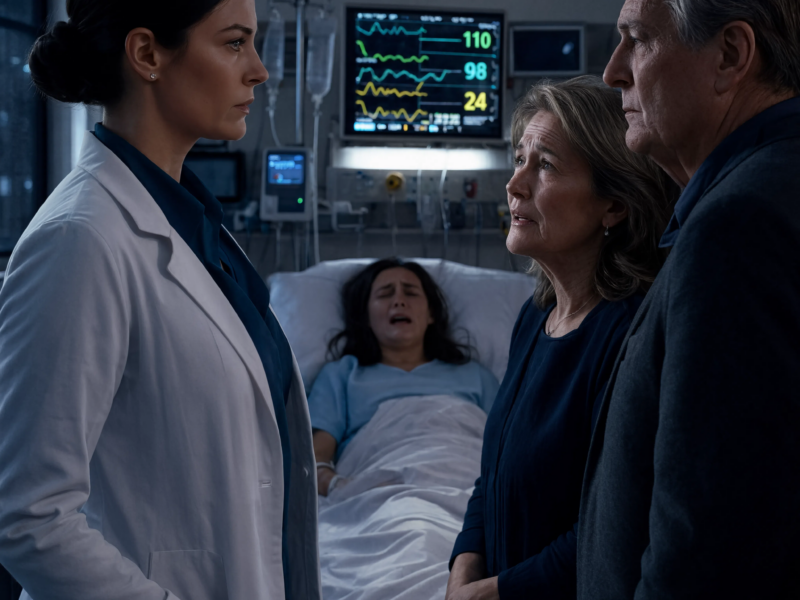
The air inside Room 615 of the Massachusetts General ICU was heavy with the sterile scent of isopropyl alcohol and the rhythmic, mocking beep of the life support monitors. Outside, a bitter Boston winter rattled the triple-paned glass, but inside, the atmosphere was frozen solid by a decade of absolute silence.
My father stood in the far corner of the room, his calloused hands folded tightly over his belt buckle, his posture mimicking a man in prayer, though his eyes carried the desperate look of someone trying to plead innocent before a judge. My mother sat pressed against the opposite wall, her fingers flying over the smooth glass beads of her rosary. The plastic clicks echoed in the quiet room, leaving deep red indentations across her pale palm.
Between them, buried beneath a thin, institutional white blanket, lay Chloe Cross. She looked nothing like the untouchable golden child who had once sat at the head of our Thanksgiving table, casually eating pumpkin pie while I was dragged by my collar out into the freezing snow. Chemotherapy had stripped her of her pristine blonde hair. Her lips were cracked and bleeding, six separate intravenous lines snaked into the bruised skin of her arms, and her oxygen mask fogged over with every shallow, agonizing breath she took.
“Maya,” my mother whispered, her voice cracking as she stepped forward, her eyes wide with a mixture of terror and hope.
“Dr. Cross,” I corrected her instantly, my voice entirely flat, dropping like a block of ice between us.
The entire room went completely still. The rhythmic beep-beep-beep of the heart monitor felt like a countdown.
Ten years ago, this very woman had written Return to Sender across every single envelope I had mailed home. Forty-seven times. I had sent birthday cards, Christmas cards, college graduation announcements, and letters detailing the absolute truth of what had happened. Her handwriting had remained impeccably perfect. Her silence had remained cleaner, sharper, and more devastating than any apology could ever be. Now, she was looking at the daughter she had buried alive, realizing the dead had returned with the power of life and death in her hands.
My father took a tentative step toward me, his arms slightly open. “Maya, please, look at your sister. She’s—”
“Don’t take another step,” I said, my voice dropping an octave.
He froze instantly. It wasn’t out of respect for my boundaries. It was because for the first time in his autocratic life, he realized he needed my explicit permission to breathe in the same space.
I ignored them both and turned my focus to the clinical chart hanging at the foot of the bed. Clinical mode was safe. Numbers did not scream at you across a dinner table. Numbers did not throw your clothes into black garbage bags and cast you out into a South Boston winter at sixteen.
Plaintext
Patient: Chloe Cross
White Blood Cell Count: 186,000 / µL
Hemoglobin: 6.2 g/dL
Platelets: 22,000 / µL
Diagnosis: Acute Myeloid Leukemia - Blast Crisis
Status: Refractory to induction chemotherapy
Prognosis: Terminal without immediate HLA-matched allogeneic bone marrow transplant.
“You understand all those medical charts?” my mother asked softly, her voice laced with a patronizing disbelief, as if the traumatized sixteen-year-old girl they threw out onto the street could never have become someone significant in the decade they chose to forget her.
“I am a clinical pharmacist, Eleanor,” I said, looking her dead in the eye. “I manage the chemotherapy regimens that failed to save your perfect daughter. This is exactly what I do.”
My father’s face crumpled, the lines of his age deepening instantly. “We… we didn’t know, Maya. We truly didn’t know.”
A cold, bitter laugh escaped my lips, echoing sharply off the concrete walls. “Didn’t know what, Arthur? Didn’t know that Plan B wasn’t the proof of mortal sin you screamed it was? Didn’t know that a sealed box from a CVS pharmacy training kit wasn’t an admission of guilt? Or did you just not know that a sixteen-year-old girl shivering in the backseat of a broken-down Honda Civic through a New England winter still counted as your flesh and blood?”
Neither of them answered. They couldn’t.
Dr. Hayes walked into the room, holding a clipboard tightly against his chest. He carried that heavy, careful voice that senior physicians use when a family is already fractured beyond repair. “We need immediate HLA typing,” Dr. Hayes said, looking directly at me. “If you are compatible, we can move to the harvesting phase within the week. But I must emphasize, Dr. Cross, the donation is entirely voluntary. Completely voluntary.”
That single word—voluntary—sparked a fire deep within my chest.
Choice. The very thing no one gave me when my sister stood at the top of our stairs, holding my purse like a prosecutor presenting evidence. The thing no one gave me when my father shoved a black plastic trash bag into my chest and locked the front door.
Now, the entire lineage of the Cross family was waiting on my choice. I silently rolled up my left sleeve. The phlebotomist drew four large vials of dark crimson blood. My parents watched every single drop fill the glass tubes like a countdown to their own execution. Chloe watched my face, her eyes begging for a flicker of recognition.
I gave her absolute nothingness. When the needle slid out, I pulled my sleeve down and walked directly toward the exit.
“Maya, please, wait,” Chloe rasped through her oxygen mask, her voice sounding like dry paper scraping together.
I stopped at the threshold, my back turned to them. “Why?”
“I’m… I’m so sorry,” she whispered.
I turned my head slightly, catching the reflection of her bald head in the glass panel. “For which part, Chloe? For the lie? Or for the fact that you need my marrow to keep breathing?”
Her mouth opened, but only the hollow hiss of the oxygen machine answered. I walked out, leaving the ghosts to their silence.
Chapter 2: The Seventy-Two Hour Crucible
Five days later, the official lab results arrived. I was sitting in my car outside the hospital clinic, holding a paper cup of black coffee that had gone entirely cold. My phone buzzed on the dashboard.
“Dr. Cross,” Dr. Hayes’ voice came through the speaker, crisp and professional. “The lab results just finalized. You are a ten out of ten HLA match. A perfect genetic compatibility. If you agree, we can schedule the peripheral blood stem cell collection for Thursday morning. But we need your final decision within seventy-two hours. Your sister is running out of time.”
“Thank you, Dr. Hayes. I will let you know,” I replied, disconnecting the call before he could say another word.
Perfect. That was the word that had always belonged to Chloe. The perfect daughter. The perfect Catholic girl sitting immaculately in the third pew of St. Jude’s Church every single Sunday. She was so perfect that when she cried, the entire world bent to comfort her. She was so perfect that my parents needed absolutely no material proof beyond the artificial trembling of her voice to ruin my life.
My phone lit up immediately after. Eight missed calls from my mother. Three voicemails from my father. I let every single one of them drop into the digital void.
That evening shift at the free clinic was quiet. Around 8:00 PM, a sixteen-year-old girl walked into my consultation room. Her hands were shaking violently, clutching a small box of emergency contraception against her chest as if the cardboard were burning her skin.
“My parents… if they find this in my bag, they will never look at me again,” she whispered, her eyes wide with a terrifyingly familiar panic. “They’ll throw me out. They told me if I ever sinned like this, I wouldn’t be their daughter anymore.”
I looked at her, and the sterile walls of the clinic faded away. Suddenly, I was sixteen again, my hands wet from washing the Thanksgiving dishes, standing in the center of a crowded living room while twelve of my relatives stared at me with pure, unadulterated disgust while a fabricated lie became my lifetime sentence.
I reached out, gently placing my hand over hers, pulling the box away from her chest. “Look at me,” I said, my voice steady, filled with an authority born from survival. “I am not here to judge you. I am here to make sure you are medically safe. Your life belongs to you, not to their conditions. You are safe here.”
The girl burst into tears, the heavy weight of her fear melting away in a matter of seconds. As I held her hand, I realized that the girl I had been ten years ago had never received that comfort. I had to become the person who saved others because no one had ever bothered to save me.
At 2:00 AM, driven by a restless, heavy impulse, I found myself driving back toward Massachusetts General Hospital. The Boston streets were entirely empty, washed out in a cold, blue hue under the halogen streetlights. I parked my car on level three, spot forty-seven, and stared at the painted numbers on the concrete wall until my chest went entirely numb.
Forty-seven letters. Forty-seven return-to-sender stamps. Forty-seven nights sleeping in the backseat of my car during that first brutal winter, wondering if my mother would ever open the door.
I took the elevator up to the sixth floor. The hallway outside the ICU was dimly lit. My parents were asleep in the waiting room chairs, their bodies folded awkwardly into themselves, looking incredibly small, aged, and broken by the reality of their golden child’s mortality. I walked right past them, their soft snores fading as the heavy glass doors of the ICU slid open.
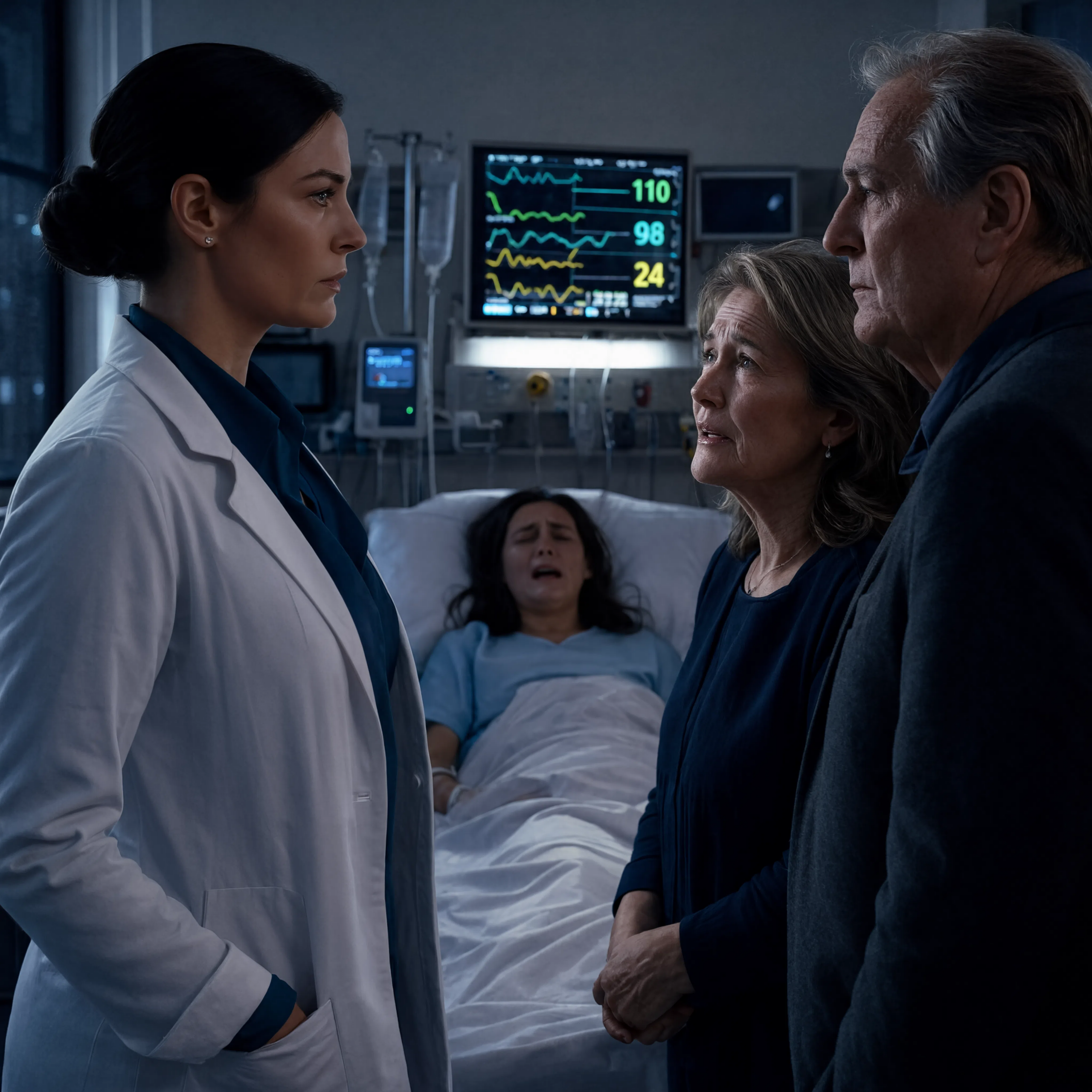
I entered Room 615 alone. The overhead lights were turned off, the only illumination coming from the blue glow of the vitals monitor. Chloe was awake, her eyes wide, staring at the ceiling.
“You came back,” she whispered, the oxygen mask damp with her breath.
“I am still deciding whether to let you live,” I said, standing at the foot of her bed, my hands tucked into the pockets of my white lab coat.
She swallowed hard, her throat clicking uncomfortably. “Maya… I can’t die like this. I need to tell you the truth. I need to tell them.”
Behind me, the door clicked open. My mother stirred first, followed quickly by my father. They rushed into the small room, their faces pale with exhaustion, instantly sensing the sudden, suffocating shift in the atmosphere.
“Maya? Are you going to do it?” my mother begged, her hands reaching out toward my coat. “Please, tell us you’re going to save her.”
Before I could answer, Chloe’s right hand shot out from beneath the white blanket with a terrifying, unnatural strength that no one in that room expected. Her thin, bruised fingers clamped down violently around my mother’s wrist, pulling her down toward the guardrail.
The heart monitor instantly began to scream, its alarm chiming rapidly as her heart rate spiked to 140 beats per minute.
“Mom, shut up and listen to me,” Chloe rasped, her voice suddenly losing all of its fragile, victimized sweetness, turning raw and desperate. She glared directly at my mother, then turned her wide, terrified eyes onto my father.
“The Plan B pill…” Chloe choked out, a thick, bloody tear spilling down her cheek. “It wasn’t Maya’s. It was never hers.”
My mother froze, her breath catching in her throat, her wrist still trapped in her dying daughter’s grip. “What… what are you saying, Chloe? You found it in her purse. You brought it to us.”
“I put it there!” Chloe shrieked, her voice echoing sharply through the entire ICU wing.
“I put it in her bag because I was the one sleeping with Marcus that winter! I was fifteen, I was terrified, and I knew that if you ever found out your perfect, holy daughter was pregnant, you would look at me the way you looked at the trash. Maya was quiet. Maya never fought back. I knew you would believe me over her. I let you throw her out into the snow to save myself, and I watched you stamp those forty-seven letters for ten years knowing she was entirely innocent!”
Chapter 3: The Wailing of the Righteous
The sentence fell into the room like a physical explosion.
My mother’s rosary slipped from her fingers, the plastic beads hitting the linoleum floor with a sharp, shattering sound before scattering into the dark corners of the room. A guttural, horrific wail tore out of her throat—a sound of pure, unadulterated devastation as the complete weight of her ten-year cruelty crashed into her soul. She dropped to her knees right there on the dirty floor, burying her face in the white sheets of the bed, her shoulders heaving as she began to sob hysterically.
“No… oh my God, no…” my mother wailed, her hands clawing at the mattress. “What did we do? What did we do to our baby girl?”
My father stood entirely paralyzed, his jaw slack, his face turning a sickening, ashen grey under the fluorescent lights. He looked at his hands—the very hands that had violently shoved a sixteen-year-old girl out into a South Boston blizzard—and began to tremble so violently he had to lean against the medical supply cabinet to keep from collapsing.
“Maya…” my father whispered, his voice cracking into a pathetic, broken sob as he turned his terrified eyes toward me. “Maya… forgive me… oh Lord, please, forgive me…”
I stood perfectly still at the foot of the bed, my arms crossed, my expression entirely unchanging. I watched their absolute collapse with a cold, clinical indifference. I didn’t cry. I didn’t scream. I didn’t offer a single word of comfort. The long-awaited apology, the sudden revelation of the truth—it didn’t heal the scars of the winters I had spent shivering in the backseat of my car. It didn’t undo the forty-seven times they had rejected my voice.
Chloe lay back against the pillows, gasping for air, her heart rate slowly stabilizing as the truth left her lips. She looked at me through the fogged plastic of her mask, her eyes completely hollow. “I told them, Maya. I gave you your name back. Please… please don’t let me die.”
I walked slowly around the bed, stepping directly over the scattered plastic beads of my mother’s rosary. I stood over my kneeling mother, looking down at the graying hair on the top of her head.
“Stand up, Eleanor,” I said, my voice cutting through her hysterical wailing like a scalpel.
My mother looked up, her face ruined by tears and smeared makeup, her eyes pleading for mercy. “Maya… my beautiful, sweet girl… we were so blind. We will make it up to you, I swear. We will be a family again—”
“We will never be a family again,” I interrupted, my voice smooth, steady, and entirely absolute. “The family you are talking about died ten winters ago. You didn’t just throw out a daughter; you executed her. The woman standing in front of you today is a stranger who carries your genetics, nothing more.”
I turned my gaze onto my father, who was weeping silently into his hands. “I am going to sign the consent forms for the bone marrow harvest, Arthur. Not because I love this family. Not because I forgive a single second of the decade of torment you inflicted on me.”
My father lifted his head, a flicker of desperate hope in his eyes. “Then… why, Maya?”
“Because I am a doctor,” I said, looking from him to the dying girl on the bed. “My oath requires me to save lives, even the lives of the people who ruined mine. I will give her my marrow. I will let her live. But it comes with a price that you will pay for the rest of your miserable lives.”
Chapter 4: The Clean Severance
I pulled a legal folder out from the pocket of my lab coat and placed it flat on the bedside table, right next to the empty plastic vials.
“These are full, legally binding adult adoption and severance documents drafted by the Sterling Estate lawyers,” I announced, my voice echoing with an absolute, sovereign authority.
“Before I step into the operating room on Thursday morning to save Chloe’s life, both of you will sign these papers. You will legally renounce any future claim to my name, my estate, my medical practice, and my life. You will agree, under penalty of immediate felony harassment charges, to never call my phone, never write a letter, and never step within five hundred feet of my residence or my clinic. To the outside world, and to yourselves, you will officially declare that Dr. Maya Cross does not exist to you.”
My mother gasped, fresh tears spilling over her cheeks. “Maya, please! Don’t do this! Don’t cast us out!”
“You taught me exactly how to cast someone out, Eleanor,” I replied, a sharp, bitter smile touching my lips. “You practiced it forty-seven times. I am simply perfecting your technique.”
My father looked at the documents, then at his dying golden daughter, whose breath was growing shorter by the minute. He knew he had absolutely no leverage left. The power had completely, permanently shifted. With a trembling hand, he reached into his pocket, pulled out his pen, and signed his name at the bottom of the legal severance document.
My mother wept hysterically, her signature nothing more than a jagged, broken line across the white paper, before she collapsed back onto the floor.
I picked up the signed documents, checked the margins to ensure the ink was dry, and slipped them neatly back into my leather portfolio. I looked down at Chloe one last time.
“The procedure is scheduled for 6:00 AM on Thursday,” I told her, my voice completely devoid of warmth, yet steady and professional. “You will live, Chloe. You will get your health back. You will get your perfect future. But every single time you look in the mirror, and every single time you take a breath of fresh air, you will remember that your existence was bought with the blood of the sister you tried to destroy. And you will live the rest of your days knowing you are entirely alone in that pristine, golden cage.”
I turned on my heel and walked out of Room 615. My footsteps were light and dứt khoát (decisive) against the clean linoleum floors of the corridor. I passed the waiting room, walked through the heavy glass sliding doors of the ICU wing, and stepped out into the crisp, early morning air of Boston.
The winter wind was cold against my face, but for the first time in ten years, it didn’t make me shiver. The letters had been answered. The forged sin had been paid in full. And my true, sovereign life had finally, beautifully begun.