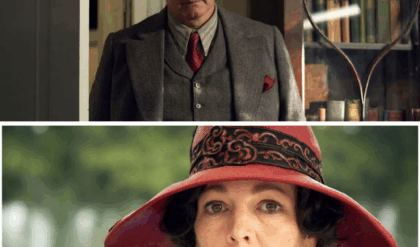
In the hushed, hedge-lined suburbs of a nameless New England town, where manicured lawns mask the rot beneath and every driveway gleams with the false promise of domestic bliss, Netflix has unleashed a serpent into its streaming garden. Premiering on November 13, 2025, The Beast in Me—an eight-episode psychological crime thriller from the twisted minds behind Homeland—slithers onto screens like a shadow you can’t quite shake, its tendrils coiling around viewers with a grip that’s equal parts seductive and suffocating. Created by Gabe Rotter and executive-produced by Howard Gordon, the limited series stars Claire Danes as Aggie Wiggs, a reclusive true-crime author whose fragile world fractures when a charismatic real estate mogul moves next door. What begins as idle curiosity—a glance over the fence, a polite wave—spirals into a vortex of suspicion, seduction, and shattering revelations, as Aggie begins to suspect her new neighbor, Nile Jarvis, may have blood on his bespoke loafers from the unsolved disappearance of his first wife. Critics are already crowning it the successor to HBO’s icy The Undoing and Hulu’s humid Sharp Objects, a mashup of marital mind games and forensic feints that outstrips both in its slow-burn savagery. Viewers, bingeing through the night with white knuckles and wide eyes, are dubbing it “the most unsettling series of the year”—a dark mirror where trust is the first casualty, and every whispered confidence feels like a loaded chamber. With Danes delivering a masterclass in unraveling restraint and Matthew Rhys embodying elusive evil, The Beast in Me doesn’t just shock; it seeps into your psyche, haunting long after the credits crawl.
The series opens in medias res, a prologue that plunges us into the deep end of domestic dread: a rain-lashed night in 2019, where Madison Jarvis (Leila George, her porcelain fragility cracking under unseen strain) vanishes from her palatial home, leaving behind a half-empty wine glass smeared with lipstick and a child’s crayon drawing clutched in frozen fingers. Cut to six years later, and Aggie Wiggs—Danes at her most achingly authentic—huddles in her dimly lit study, surrounded by stacks of yellowed case files and the ghosts of her own unsolved grief. A widowed mother whose young son drowned in a freak accident years prior, Aggie has retreated from the world, her once-prolific pen stalled by survivor’s paralysis. Her latest manuscript, a half-baked true-crime tome on “the banality of evil,” gathers dust as she pecks at freelance edits for a vanity press. Enter Nile Jarvis (Rhys, his Welsh lilt a velvet sheath for steel), the silver-haired real estate tycoon who sweeps into the cul-de-sac with the arrogance of a man who buys forgiveness as easily as foreclosures. Nile’s arrival—his Bentley crunching gravel in the driveway, his designer duffel slung over one shoulder—ignites Aggie’s dormant instincts: a casual chat over the hedge reveals his “tragic loss,” his first wife Madison presumed drowned in a boating accident off the Cape. But as Nile’s charm offensive escalates—invitations to wine tastings in his wine-cellar man-cave, “accidental” brushes of hands during neighborhood barbecues—Aggie’s antenna twitches. Whispers from the local grapevine paint Nile as a predator in pinstripes: a development deal stalled by “ethical entanglements,” a former associate vanished under suspicious circumstances. When Aggie unearths a forgotten police file hinting at foul play in Madison’s fate—bruises masked as “yacht mishaps,” a prenup riddled with escape clauses—she can’t resist the pull. What starts as furtive Googling morphs into midnight stakeouts, her laptop screen glowing like a Ouija board in the dark.

At its core, The Beast in Me is a cat-and-mouse chess match played on a board of bourgeois facades, where every move—from a lingering glance at a PTA meeting to a pilfered key fob from a coat rack—carries the weight of potential perdition. Aggie’s investigation isn’t the procedural plod of Mindhunter‘s behavioral deep dives or You‘s stalker soliloquies; it’s a psychological polka, a duet of deception where Nile’s urbane allure (“Call me Nile—formalities are for funerals”) clashes with Aggie’s analytical armor. Danes, 46, channels a coiled intensity that’s equal parts Homeland‘s Carrie Mathison and Fleabag‘s fourth-wall fragility, her wide-set eyes darting like a cornered doe as she pores over Nile’s LinkedIn labyrinth or eavesdrops on his boardroom bluster. In Episode 3’s tour de force—a tense tête-à-tête over takeout Thai in Nile’s minimalist modernist kitchen—Aggie probes his past with the precision of a surgeon’s scalpel: “Your wife loved sailing, didn’t she? Funny how the sea gives back what it takes… or doesn’t.” Rhys, 51, counters with a charisma that’s chilling in its calibration, his smile a crescent moon over a shark’s grin, his anecdotes laced with just enough ambiguity to disarm or damn. “Loss changes you, Aggie—makes you… hungrier,” he purrs, his hand grazing hers in a gesture that’s equal parts empathy and entrapment. The chemistry crackles like static before a storm, a push-pull that blurs victim and villain, hunter and hunted, until the lines dissolve into a delicious dread.
The ensemble elevates the unease, a rogues’ gallery of suspects whose smiles hide switchblades. Brittany Snow, 39, slinks in as Ronnie Abbott, Nile’s brittle best friend and Madison’s former confidante—a yoga-sculpted socialite whose pill-popping poise crumbles under cross-examination, her alibis as flimsy as her designer facades. Natalie Morales, 41, grounds the grit as Detective Lena Torres, the no-nonsense NYPD liaison whose badge burns with the fire of too many cold cases shelved for “lack of evidence.” David Lyons, 44, simmers as Brian Jarvis, Nile’s estranged brother and business rival—a hedge-fund hotshot whose Hamptons hideaway harbors horrors from their shared childhood, his polished veneer peeling to reveal a pattern of paternal poison. Tim Guinee, 63, looms large as Martin Jarvis, Nile’s tyrannical father—a real estate relic whose boardroom bullying begat a dynasty of dysfunction, his gout-gnarled grip on family fortunes fueling the feud. Deirdre O’Connell, 74, haunts as Aggie’s estranged mother, a faded folk singer whose folk tales of “monsters in the mist” mask a maternal malice that mirrors Nile’s own. Hettienne Park, 45, crackles as Olivia Benitez, the city councilwoman crusading against Nile’s waterfront development—a Latina firebrand whose mayoral ambitions make her a wildcard ally or Achilles’ heel. Will Brill, 39, brings brooding ballast as Aggie’s beleaguered editor, his bookish banter a buoy in her isolation; Kate Burton, 67, chills as the Jarvis family therapist, her sessions a symphony of suppressed screams; Bill Irwin, 76, clowns darkly as the eccentric estate lawyer whose loopholes loop like nooses; Amir Arison, 46, sleuths as a private eye with a penchant for poetic justice; and Julie Ann Emery, 42, simmers as Nile’s trophy girlfriend, her Botox-bright smiles belying a backstory buried in bad debts.
Rotter’s script, a scalpel to suburbia’s soft underbelly, dissects the dark arts of deception with a surgeon’s precision. Episodes unfurl like a fever dream: the pilot’s parlor game of introductions, where Nile’s “welcome wagon” wine tasting sours with subtle sabotage (a tampered Bordeaux leaving Aggie queasy); Episode 4’s forensic frenzy, where Aggie infiltrates the Jarvis library, her gloved fingers rifling rare editions for hidden horrors; the mid-season mindfuck, a blackout bash where alibis alibi themselves into oblivion; and the finale’s fevered face-off in a fog-bound boathouse, where truths surface like bloated secrets from the deep. Themes of gaslighting gnaw at the narrative’s edges: Nile’s “you’re imagining things, Aggie—grief plays tricks” a mantra that mirrors her son’s drowning delusions; Ronnie’s “he’d never hurt a fly—it’s the flies that hurt him” a deflection that deflects from domestic dossiers. The production, a $120 million marvel filmed in Red Bank’s riverside ravines and New Jersey’s neo-colonial cul-de-sacs, bathes the banal in baroque dread: cinematographer Kramer Morgenthau (Game of Thrones) framing manicured hedges as prison bars, low-angle lenses looming Nile like a latent leviathan. Composer Bear McCreary (The Walking Dead) scores the suspense with a cello-snarl symphony, strings sawing like suppressed screams.
Critics, catching the first four episodes at a hush-hush Hudson Yards screening, are effusive in their unease, positioning The Beast in Me as the unholy heir to You‘s stalker seduction and Mindhunter‘s behavioral burrow. “Danes and Rhys duel with a delicious depravity that devours the screen,” proclaimed The Hollywood Reporter, awarding an A- for “a thriller that twists the knife of neighborly nosiness into something profoundly paranoid.” Variety dubbed it “a binge beast with bite,” lauding the “temporal tango of timelines that toys with truth like a cat with a canary.” The New York Times‘ Margaret Lyons hailed it “dark, unsettling, and well-paced,” a procedural that “prioritizes psyche over plot, peeling back the polite veneer to reveal the venom beneath.” Metacritic’s 82/100 “universal acclaim” aggregates the adulation, while Rotten Tomatoes’ 91% fresh rating surges on viewer verdicts: “Paused episode 5 at 3 a.m., pulse pounding—it’s that visceral,” one binge-rater raved; “The Beast isn’t out there—it’s in us all, and this show drags it into the light,” another confessed. The discourse deepens divides: feminists fete Aggie’s agency amid the abuse allegory, while procedural purists praise the “forensic finesse that forgoes flash for festering fear.”
Beta viewers, a cadre of Prime subscribers via the platform’s “Early Eyes” tier, flood forums with fervor: “The pause reflex is real—froze frames to scrutinize shadows, rewound whispers for wicked subtext.” Social media simmers with solidarity: #BeastInMe trends with 2.8 million posts, TikToks dissecting Danes’s “tell-all tremor” in interrogation close-ups, X threads theorizing Nile’s “narcissist nest” as a nod to true-crime titans like Chris Watts. Purvis—no, Danes, fielding the firestorm with her trademark tremulous poise, told Vanity Fair: “Aggie’s not a victim vaulting for vengeance—she’s a vault of vulnerabilities, cracking open to confront the beast we all harbor.” Rhys, channeling Nile’s nuanced narcissism, echoes: “He’s not a monster in a mask—he’s the mask wearing the man, charming his way to the core.”
The Beast in Me isn’t mere mystery fodder; it’s a full-throated fable of fractured facades and festering faults, where neighborly nods conceal knives in the kitchen drawer. As the Jarvis empire crumbles like a house of cards in a hurricane—twists that tangle kinships, newcomers who nudge narratives, and Aggie’s crossroads choice charting a course to catharsis or catastrophe—Netflix braces for a binge bonanza. In 2025’s sultry drop, expect tears, triumphs, and a thriller that torments till the triumphant tease. Lights, camera, culpability—the beasts are loose, and they’re closer than you think.