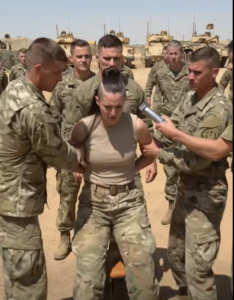
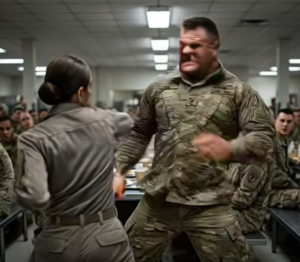
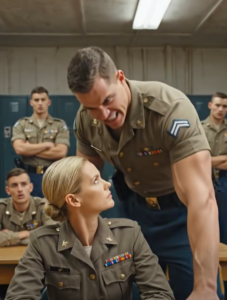
The chow hall at Forward Operating Base Griffin always smelled like powdered eggs and dust. By noon, the heat seeped through the plywood walls, turning every conversation into a tired murmur. Two hundred soldiers sat shoulder to shoulder, shoveling food in with the same rhythm they’d had for weeks. They’d learned how to eat fast, talk little, and conserve energy for the boredom that waited on the other side of the meal.
Then a voice sliced through the room like a blade.
“That’s stolen valor. You’re a disgrace.”
Forks stopped midair. Plastic trays paused halfway to mouths. Heads turned all at once.
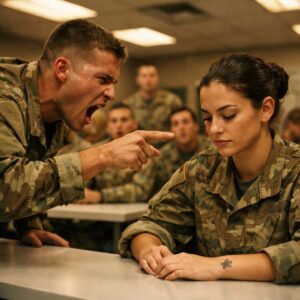
Corporal Jeffrey Webb stood near the drink station, his face crimson, his posture tense with the kind of righteous anger that needed an audience. His finger was pointed straight across the room at a woman most people barely noticed.
Susan Holly sat alone at a table near the back wall. Her uniform was clean, pressed the way admin uniforms tended to be. A clipboard rested beside her tray like it belonged there as naturally as a weapon did on everyone else. She didn’t flinch. She didn’t blink. She looked at Jeffrey the way you looked at weather: present, inconvenient, not worth arguing with.
But Jeffrey wasn’t staring at her face.
He was staring at her forearm.
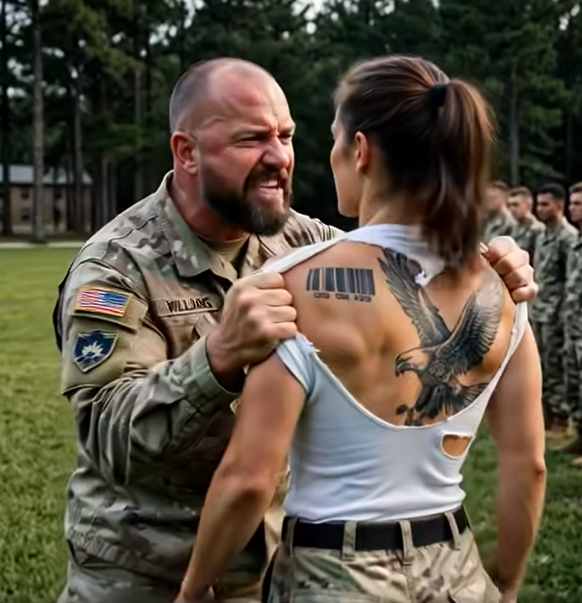
A small butterfly tattoo sat just below the sleeve line, faded and plain, like something that had been drawn years ago and forgotten. The base had been full of tattoos, of course. Names, dates, unit symbols. But a butterfly on a forward base felt wrong to Jeffrey. Soft. Decorative. Like a lie someone wore on purpose.
Jeffrey’s friends, Thomas Lucky and Anthony Stevens, hovered behind him like backup singers. They didn’t say anything, but their grins were sharp, hungry for drama.
Susan finished chewing. She set her fork down. Calmly, she picked up her tray with one hand and her clipboard with the other. She stood and walked toward the exit.
That was it. No defense. No explanation. No shaking voice, no tears.
Just a quiet woman slipping out through the door, leaving behind a room full of frozen soldiers and one man who looked like he’d expected a fight and got denied the satisfaction.
Outside, the heat hit like a wall. Susan didn’t slow down. She crossed the dusty yard between the chow hall and the admin tent, her boots crunching over gravel. She could feel eyes following her from windows and doorways.
“Clipboard Susan,” they called her sometimes. Not cruelly at first, just the way people labeled things they didn’t want to think too hard about. She’d arrived three months ago with a stack of paperwork and no obvious story. She was always the first one in the admin tent, flipping through supply forms and leave requests. She was the last one out, still checking numbers while everyone else hunted shade or cigarettes.
Her silence made her easy to ignore.
Until it didn’t.
By 1400 the rumor had spread like spilled fuel. Jeffrey had cornered her again—this time outside the admin tent. He’d demanded to see her DD-214, her service record, anything that proved she “earned” the right to wear that butterfly. He called it stolen valor again, louder this time, drawing a small crowd of bored soldiers who had nothing better to do than watch a man dig his own grave.
Susan didn’t argue. She simply reached into her breast pocket, pulled out a folded piece of paper, and handed it to him without a word.
Jeffrey unfolded it with a smirk. It was a photocopy of an old Purple Heart citation.
The date: 14 July 2011. The location: Helmand Province, Afghanistan. The citation read: For wounds received in action against an armed enemy while serving as a combat medic with 2nd Battalion, 3rd Marines.
Attached was a grainy photo clipped from a Marine Corps newsletter: a much younger Susan Holly in full battle rattle, kneeling over a wounded Marine, blood on her gloves, her face calm even then. On her left forearm, barely visible under the sleeve, the same small butterfly tattoo—fresh at the time.
Jeffrey’s smirk died.
The crowd went quiet.
Susan took the paper back, folded it neatly, and returned it to her pocket.
“I earned this ink the hard way,” she said, voice low but carrying. “The butterfly was for my little sister. She died of leukemia while I was deployed. I got it the day I came home. Thought it might remind me why I was still breathing when she wasn’t.”
She looked straight at Jeffrey.
“You want to talk about valor? Fine. But don’t talk about mine like you know it.”
Then she turned and walked back into the admin tent.
Word reached the command tent faster than dust in a windstorm.
By evening formation the next day, the entire base was ordered to muster on the hardstand. Rumors had already mutated into legend: Susan Holly wasn’t admin support. She was a former combat medic who had chosen to serve again—this time in the shadows, handling the paperwork no one else wanted, quietly keeping the machine running while younger soldiers chased glory.
At 1800 sharp, Commander Daniel Reyes—SEAL Team 7 detachment OIC—stepped onto the makeshift platform. He was a tall man with salt-and-pepper hair and eyes that had seen too many sunrises over hostile ground. He carried no notes. He didn’t need them.
Behind him stood Susan Holly in her standard ACUs, clipboard tucked under her arm like always. She looked uncomfortable in the spotlight, but she didn’t look away.
Reyes cleared his throat once.
“Attention to orders,” he said.
The formation snapped rigid.
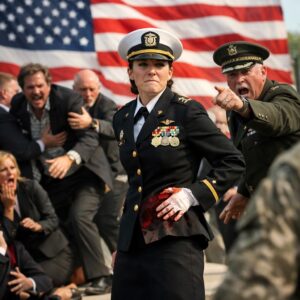
“Specialist Susan Holly,” he continued, voice carrying across the dusty square, “former Hospital Corpsman Second Class, United States Navy, attached to 2nd Battalion, 3rd Marines. Purple Heart recipient. Two Bronze Stars with ‘V’ device. Currently serving in a critical administrative role at FOB Griffin because she volunteered for it—again—when most people would have taken the pension and the quiet life.”
He paused, letting the weight settle.
“Yesterday, unfounded accusations of stolen valor were leveled against her in this very chow hall. Today, I want every soul on this base to hear the truth from me.”
Reyes turned to Susan.
Then he rendered a crisp, deliberate salute.
Not the casual two-finger kind officers sometimes gave. The full, textbook salute—palm flat, fingers together, held until she returned it.
Susan hesitated for half a heartbeat.
Then she raised her hand and returned the salute—sharp, precise, the way she’d been taught fifteen years earlier.
The entire formation held its breath.
Reyes dropped his hand first.
Susan dropped hers a second later.
Then the commander spoke again, loud enough for every ear to catch.
“Anyone who questions her service again will answer to me. Personally. Dismissed.”
No one moved for three full seconds.
Then the formation broke slowly, quietly, like men waking from a dream.
Jeffrey Webb stood at the back row, face pale, eyes fixed on the ground. His friends weren’t grinning anymore.
Susan walked off the platform without fanfare. She didn’t look triumphant. She didn’t look angry. She looked tired—the same quiet, steady tired she’d worn every day since she arrived.
Later that night, in the admin tent, she sat alone under the single bulb, still filling out forms. The door opened. Commander Reyes stepped inside.
He didn’t salute this time.
He just leaned against the doorframe.
“You didn’t have to take that quietly,” he said.
Susan didn’t look up from her clipboard.
“I’ve been shot at, blown up, and told I was going to die in a dusty wadi while I held pressure on a nineteen-year-old’s femoral artery. Corporal Webb yelling in a chow hall doesn’t even register.”
Reyes gave a short, dry laugh.
“You’re wasted on paperwork, Holly.”
She finally looked at him.
“I’m exactly where I need to be, sir. Someone has to keep the machine running so the rest of you can go out and do the loud stuff.”
He nodded once.
Then he reached into his pocket and pulled out a small, folded flag patch—the kind that went on the right shoulder.
He set it on her desk.
“For when you decide you’re done being invisible,” he said.
Susan stared at it for a long moment.
Then she picked it up, turned it over in her fingers, and slipped it into her breast pocket—right next to the folded citation.
She didn’t say thank you.
She didn’t need to.
Outside, the desert wind moved across the base, carrying away the last echoes of the day.
Some wars were fought with rifles.
Others were fought with silence, paperwork, and a butterfly tattoo that had seen more blood than most people ever would.
And sometimes, the quietest soldiers were the ones who carried the heaviest scars.
Susan Holly went back to her forms.
The base kept turning.
And somewhere in the chow hall, a corporal sat alone with his tray, staring at nothing, finally understanding what real valor looked like.
It didn’t always roar.
Sometimes it just kept showing up.
News
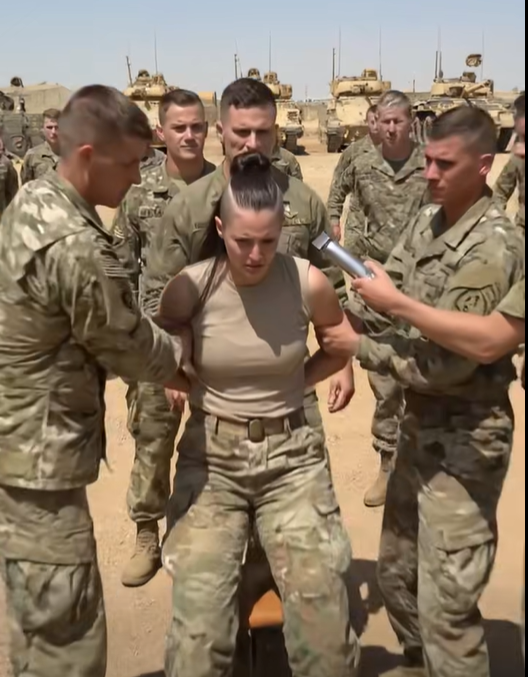
“Shave Her Head,” the Sergeant Ordered Coldly. “If Discipline Won’t Break Her, Maybe Humiliation Will.” But What They Didn’t Know Was That the Woman They Underestimated Would Bring Their Entire Base to Its Knees.
General Alexander Vance had heard the whispers for months: Fort Blackwood was rotting from within. Soldiers spoke in hushed tones of systematic humiliation disguised as “discipline,” falsified training records, missing supply funds that somehow vanished into private accounts, and a toxic command climate built on fear and intimidation. Every official inspection came back sparkling clean […]
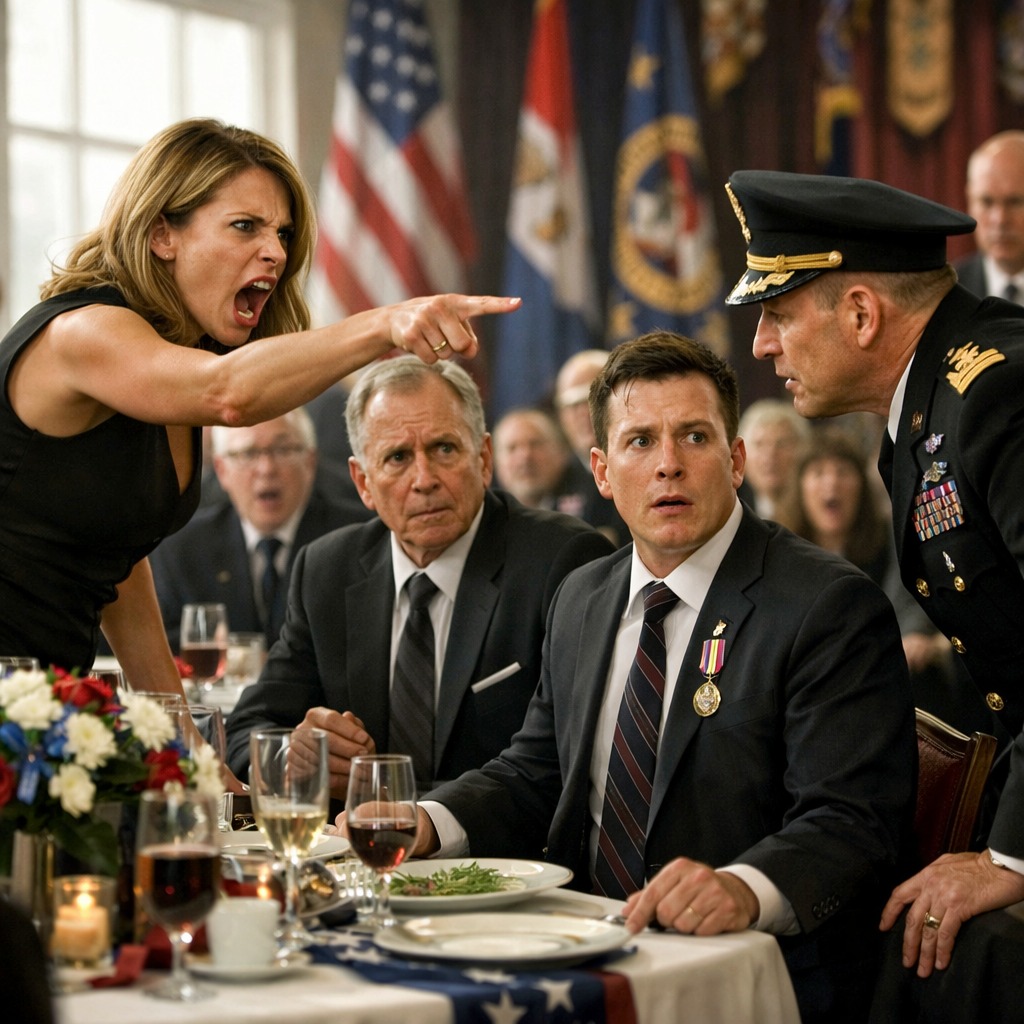
At A Veterans’ Dinner, The Colonel Leaned Toward My Brother And Asked One Simple Question: “Can You Tell Me How You Earned This Decoration, Son?” His Face Turned White. He Pointed At My Father And Said: “He Told Me It Belonged To Our Uncle.” The Uncle Never Existed.
The Ridgewood Armory smelled like every other veterans’ event I’d ever attended: floor wax, overcooked chicken, old coffee, and the faint metallic tang of too many American flags. Fluorescent lights buzzed overhead, casting a harsh glow on rows of folding tables and men in ill-fitting blazers trying to look like they still belonged in uniform. […]
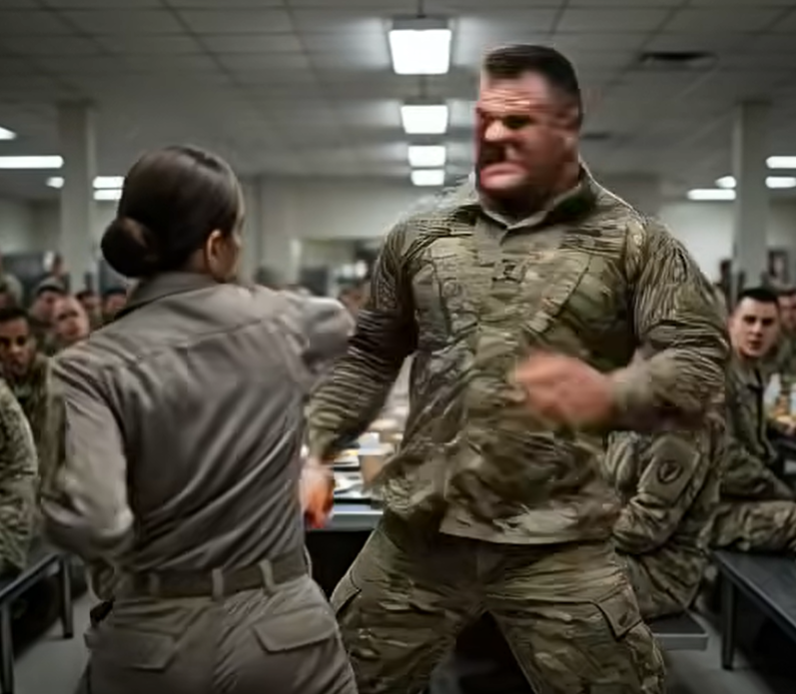
“Die, B*tch,” He Spat, Swinging a Massive Fist in the Mess Hall. He Thought I Was an Easy Target — He Had No Idea He Just Attacked a Classified SEAL Shadow Operative.
I was running on fumes. Seventy-two hours of off-the-books reconnaissance in the frozen Alaskan wilderness had left every muscle screaming. My joints ached from crawling through ice-crusted snow, my eyes burned from staring through night-vision gear, and the only thing keeping me upright was the promise of a hot meal and twelve hours of blackout […]
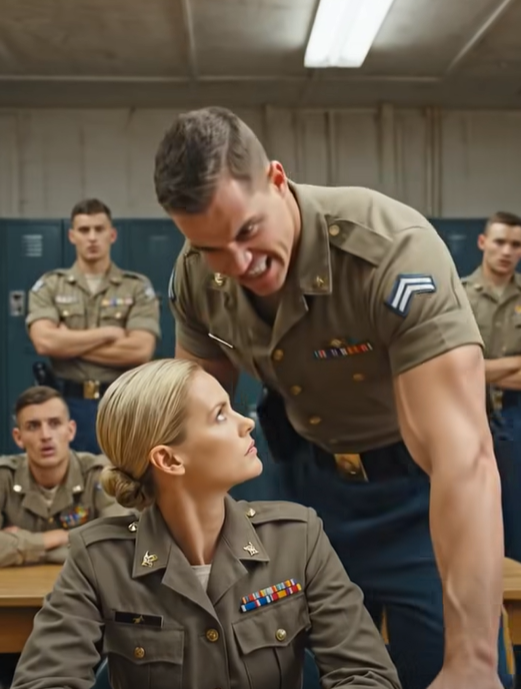
“Do You Know Who I Am?” He Pushed Her — Seconds Later, One ID Card Ended His Career
The dim lights of Rusty’s Bar flickered like dying stars just outside Camp Pendleton. It was a Friday night, the kind where Marines came to forget the sand and the screams they carried home from deployment. I had come here for the opposite reason — to disappear. My name is Commander Thalia Renwick. Highly decorated […]
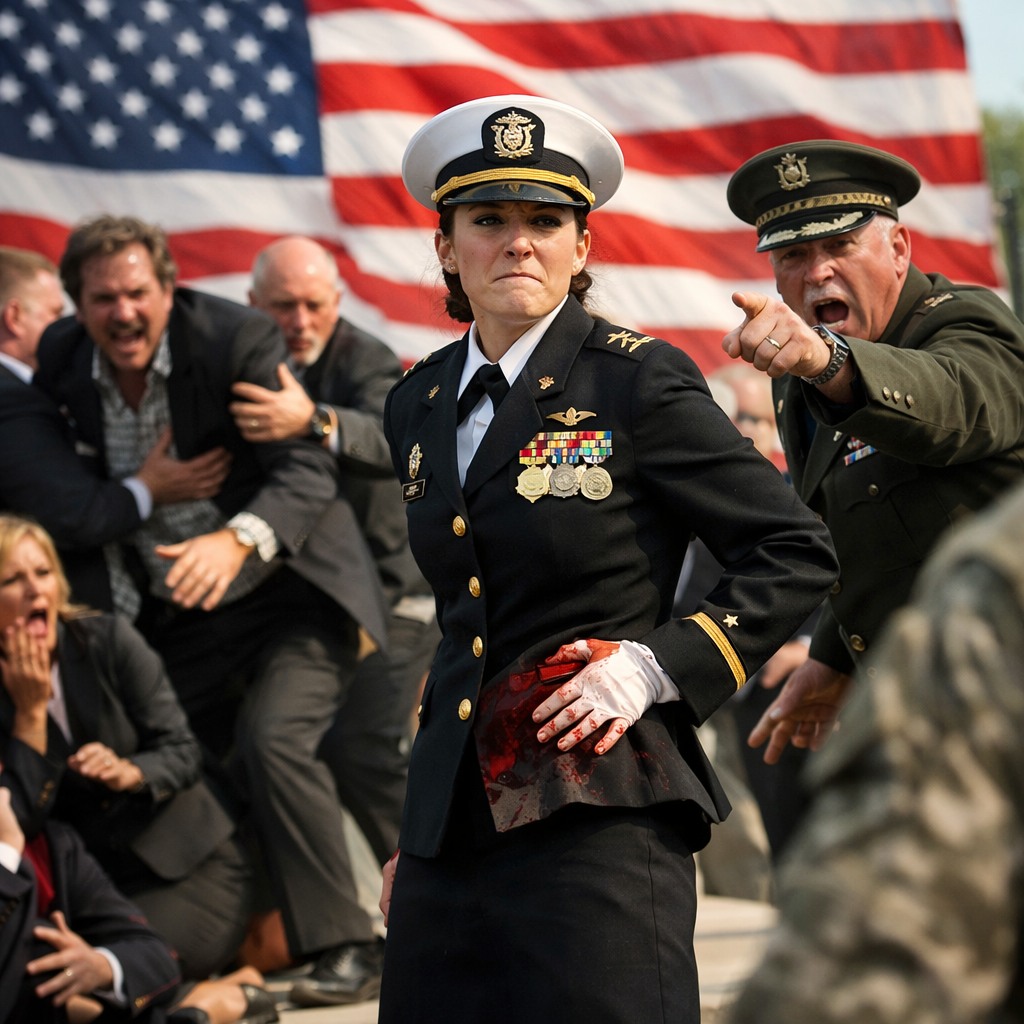
15 Years After My Dad Kicked Me Out, I Saw Him At My Sister’s Wedding. He Sneered: “If It Wasn’t For Pity, No One Would’ve Invited You.” I Just Smiled And Sipped My Wine. Then The Bride Took The Mic And Changed Everything.
The South Carolina sun was merciless that June afternoon, turning the outdoor wedding venue into a glittering oven. I stood near the back in my crisp Army dress uniform, the brass buttons and medals catching the light with every breath. At 34 years old, I had come home for my little sister’s wedding — the […]
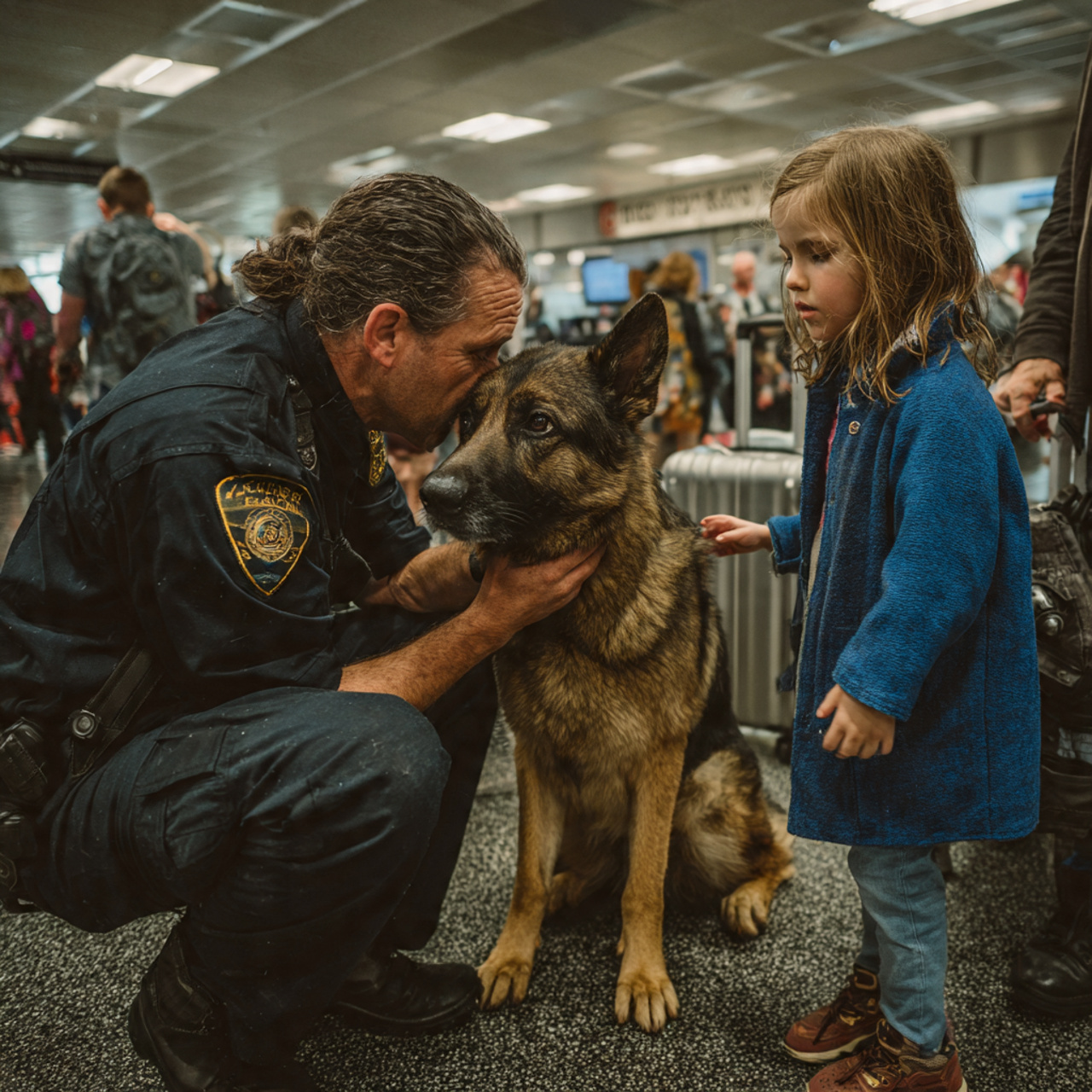
“A POLICE DOG FROZE IN THE AIRPORT. THEN A LITTLE GIRL TAPPED HIS HEAD. WHAT HAPPENED NEXT MADE EVERY TRAVELER STOP. HAVE YOU EVER WITNESSED A SILENT CRY FOR HELP?
The bustling international airport was a whirlwind of rolling suitcases, hurried announcements, and weary travelers rushing to their gates. Officer Liam Mercer patrolled the terminal with his loyal K9 partner, Rex — a highly trained German Shepherd known for his sharp instincts in detection and child safety operations. Everything seemed routine until Rex suddenly froze […]
End of content
No more pages to load