In the hallowed haze of a Nashville night, where the ghosts of country legends linger like smoke from a well-worn six-string, Miranda Lambert and Lukas Nelson stepped onto the stage at the Bridgestone Arena with a weight that transcended the spotlights. It was October 5, 2024, mere days after the world lost Kris Kristofferson at 88, and the air hummed with a reverence that felt both intimate and infinite. As part of Lambert’s inaugural Music for Mutts benefit concert—a star-packed fundraiser for her MuttNation Foundation that drew over 10,000 fans and raised six figures for animal rescues—the duo unveiled a performance that wasn’t just a song, but a bridge across generations. Their rendition of Merle Haggard’s “Silver Wings,” a melancholic masterpiece from 1969, unfolded like a heartfelt letter to the past, honoring not only Kristofferson’s recent passing but the indelible bond he shared with Haggard, the Okie from Muskogee who left us in 2016. Lambert’s voice, raw and resolute, intertwined with Nelson’s gravelly grace, creating harmonies that soared and stung, leaving the crowd in a collective hush before erupting into thunderous applause. In a genre built on storytelling, this was poetry set to pedal steel—a reminder that country’s truest power lies in its ability to heal through heartache.
The moment’s genesis was as organic as a back-porch jam session. Lambert, the fiery Texas firebrand who’s sold over 20 million albums and snagged four Grammys with anthems like “Gunpowder & Lead” and “The House That Built Me,” has long worn her influences like a well-loved Stetson. Kristofferson, the Rhodes Scholar turned boxer turned Army helicopter pilot who traded it all for Nashville’s uncertainties, was more than a hero to her; he was a mentor whose outlaw ethos shaped her unapologetic edge. Their paths crossed meaningfully in 2010 at the Kennedy Center Honors, where Haggard was feted alongside Oprah Winfrey and Paul McCartney. There, Lambert and Kristofferson shared the stage for the first time, their voices blending in a spellbinding take on “Silver Wings.” It was a highlight she still calls “one of the biggest of my career,” a memory etched in the ether of that glittering evening. Fast-forward 14 years, and with Kristofferson’s light extinguished—his death on September 28, 2024, from natural causes at his Maui ranch—Lambert sought a way to pay homage that echoed that magic without imitation.
Enter Lukas Nelson, the 36-year-old prodigy son of Willie Nelson, whose blood runs thick with the red-dirt poetry of Texas troubadours. Growing up in the shadow of icons, Lukas knew Kristofferson not as a distant deity, but as Uncle Kris—the man who swapped stories with his father over late-night whiskey, co-founding The Highwaymen supergroup in 1985 with Willie, Waylon Jennings, and Johnny Cash. That outlaw collective, which sold millions with albums like Highwayman and redefined country as a rebel yell, was Kristofferson’s defiant middle finger to Nashville’s polished suits. Haggard, though he famously turned down an invite to join (preferring his solo spotlight), was woven into the fabric of their camaraderie, a peer whose Bakersfield sound clashed and complemented the Highwaymen’s Nashville grit. Lukas, whose band Promise of the Real backed Neil Young for a decade and whose solo work like 2021’s A Few Stars Apart channels his dad’s wanderlust, was the perfect co-conspirator. “I’ve waited my whole life to sing this with her,” Nelson later reflected in a post-show interview, his voice catching on the weight of lineage. Lambert, eyes misty under the arena lights, echoed the sentiment: “And there’s no one better to share it with than Kris’ legacy.”
The performance itself was a masterstroke of restraint and release. As the house lights dimmed and a spotlight carved a silver halo around the stage, Lambert stepped forward, guitar in hand, her signature curls framing a face etched with quiet resolve. “Well, one of our dear, dear friends and heroes just passed away, Mr. Kris Kristofferson,” she began, her drawl thickening with emotion. “And I got to sing this next song with him a couple of times, and it was one of the biggest highlights of my career. So Lukas and I decided we would do a Merle song, because we know Kris loved Merle, right? We’re gonna do y’all a little Hag tonight.” The crowd, a sea of Stetsons and MuttNation tees, leaned in as Nelson joined her, his electric guitar humming like a distant freight train. The opening chords of “Silver Wings”—that lonesome waltz of longing and loss—filled the arena, Haggard’s 1969 plea for a lover’s return rendered anew in their voices.
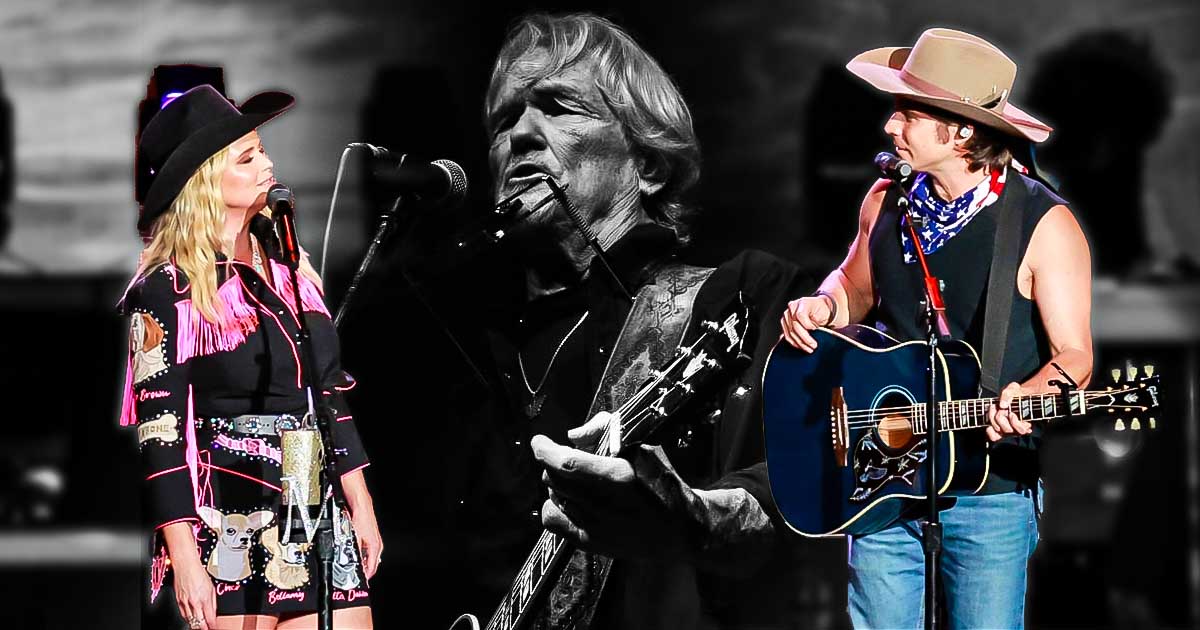
Lambert took the verses with a tenderness that belied her powerhouse range, her alto dipping into vulnerability on lines like “Silver wings shining in the sunlight, so proudly bright,” evoking the ache of goodbyes unspoken. Nelson’s tenor, husky and haunted, layered in the harmonies, his phrasing a nod to his father’s improvisational flair—subtle bends and slides that made the song breathe like a living memory. Backed by a stripped-down band (Promise of the Real’s Corey McCormick on bass, Anthony LoGerfo on drums), they let the space between notes speak volumes, the pedal steel weeping like a widow at dawn. No frills, no fireworks—just two souls channeling the essence of men who turned pain into poetry. As the final chorus swelled—”Forgive me, Lord, please, if I cry”—tears traced paths down cheeks in the front rows, and even the hardiest honky-tonk hands wiped their eyes. The last note hung, a silver thread connecting past to present, before the arena thundered back to life. It was over in four minutes, but the echo lingered like the scent of sagebrush after rain.
“Silver Wings” itself is a cornerstone of country’s emotional architecture. Penned by Haggard during a 1968 stint in Bakersfield’s dim-lit studios, the track from his album A Portrait in the Silver Age captures the Okie’s unflinching gaze at love’s fragility—a soldier’s girl waiting under those titular wings, a metaphor for fleeting freedom and enduring sorrow. Haggard, the son of Oklahoma Dust Bowl migrants who rode the rails as a teen and served time in San Quentin before finding salvation in song, infused it with the authenticity that defined his 38 No. 1 hits. Kristofferson, ever the storyteller, adored it; the two shared a mutual respect forged in the ’70s outlaw fires, when Nashville’s gatekeepers tried to tame the wild hearts of men like them. Kristofferson’s own catalog—penned in bursts of inspiration amid his pre-fame struggles, from “Me and Bobby McGee” (a Janis Joplin eternal) to “Sunday Mornin’ Comin’ Down” (a hangover hymn that shocked the CMA)—mirrored Haggard’s raw poetry. Their friendship, cemented through duets and late-night picks, exemplified country’s communal spirit: rebels lifting each other, one verse at a time.
This duet wasn’t mere nostalgia; it was a reclamation. Lambert, who’s navigated her own tempests—from a high-profile divorce to redefining her sound with 2024’s Postcards from Texas—embodies the fierce femininity Kristofferson championed. Her MuttNation gig, featuring guests like HARDY, Little Big Town, and Leon Bridges, blended levity (Lukas playfully distracted by adoptable pups pre-set) with gravity, underscoring her commitment to causes close to her heart. Nelson, fresh off touring with Lady Gaga and dropping his bluesy Sticks and Stones in 2023, brings the Nelson dynasty’s wandering soul—Willie’s “On the Road Again” ethos, tempered by Kris’s introspective depth. Together, they weren’t just singing; they were stewarding a flame. Post-performance clips exploded online, amassing millions of views: fans tweeting “Chills and tears—Kris is smiling somewhere,” or “Texas legends passing the torch, Haggard and Kris proud AF.” Country radio stations looped it relentlessly, and outlets from Whiskey Riff to American Songwriter crowned it “the tribute of the year,” a beacon in a genre sometimes accused of chasing trends over timelessness.
Yet the magic of that night ripples wider, illuminating country’s enduring allure. Kristofferson wasn’t just a singer; he was a catalyst—the ex-GI who crashed helicopters in Vietnam, boxed Golden Gloves, and penned lines that pierced the soul, all before “For the Good Times” made him a star in 1970. His Highwaymen tenure with Willie turned septuagenarians into rock gods, proving age was no barrier to rebellion. Haggard, the convict-turned-conservative icon whose “Mama Tried” masked a mama’s boy heart, balanced it with anthems of empathy. In an industry evolving with TikTok twang and pop crossovers, Lambert and Nelson’s choice to dust off “Silver Wings” reaffirms the roots: songs as vessels for vulnerability, stages as sanctuaries for shared sorrow. Lambert, now 41 and owning her narrative with unyielding grace, and Nelson, carrying the weight of legacy with effortless cool, remind us that country’s not frozen in amber—it’s alive, adapting, honoring.
As the final echoes of that Bridgestone encore fade into memory, one truth shines brighter than any silver wing: music’s greatest gifts are the connections it forges. In a world quick to forget, Miranda Lambert and Lukas Nelson didn’t just perform—they resurrected spirits, mending the invisible threads between yesterday’s outlaws and tomorrow’s trailblazers. Kris and Merle, from their celestial front porch, must’ve tipped their hats. For fans nursing the ache of loss or the thrill of live wire moments, this duet is more than a recording—it’s a rallying cry. Pour a shot of bourbon, cue up the clip, and let it carry you home. In country’s grand tapestry, some stitches are silver, some are scarred, but all bind us eternal.