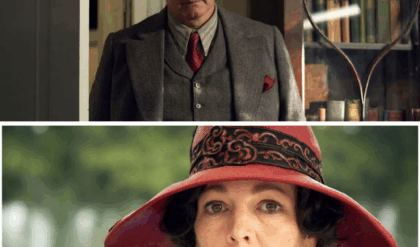
In the gray drizzle of a London autumn, where the Thames slithers like a serpent through the fog-choked streets and the spires of Westminster loom like forgotten sentinels, espionage isn’t about gadgets or gunplay—it’s about the slow poison of suspicion, the quiet corrosion of trust. Tomas Alfredson’s Tinker Tailor Soldier Spy (2011), a taut, textured adaptation of John le Carré’s 1974 novel, captures this essence with the precision of a safecracker’s drill, boring into the soul of British intelligence during the waning chill of the Cold War. Before Jackson Lamb’s rumpled cynicism in Slow Horses made “messy brilliance” a mantra for modern spies, Gary Oldman ruled the shadows as George Smiley, the unassuming everyman whose inscrutable gaze unravels empires. This isn’t flashy spy fare—no Aston Martins screeching through alleyways, no martinis shaken with cyanide. It’s one man, one mole, one betrayal that could topple the Circus (MI6’s clandestine moniker), where every glance, every pause, every exhaled cigarette plume carries more tension than a dozen Bond set pieces. With a cast that reads like a pantheon of British thespians—Benedict Cumberbatch’s earnest idealism, Colin Firth’s polished duplicity, Tom Hardy’s coiled intensity—the film transforms le Carré’s labyrinthine labyrinth into a hypnotic slow-burn, its whispered secrets and fractured loyalties hitting like punches to the gut. Quiet, devastating, and utterly unmissable, Tinker Tailor Soldier Spy stands as espionage at its purest: a symphony of silences where the unsaid screams louder than any gunshot.
The story unfurls in the bleak mid-1970s, a time when the Iron Curtain’s rust was beginning to flake and the Circus teetered on the brink of irrelevance, its agents adrift in a sea of outdated tradecraft and ideological drift. George Smiley (Oldman, 53 at the time, his lined face a map of quiet devastations) is a relic of that world: a veteran spymaster forcibly retired alongside his boss, Control (John Hurt, his craggy features etched with the weariness of a man who’s seen too many dawns break over Budapest safe houses). Smiley’s life is a study in subdued sorrow—a small flat in Islington, a marriage frayed by the job’s jealous demands (his wife Ann, glimpsed in fleeting, faithless fragments, is a ghost in his bed), and a wardrobe of ill-fitting suits that hang on his slight frame like discarded disguises. When a disgraced agent, Ricki Tarr (Tom Hardy, all brooding bulk and bottled rage), surfaces in Hong Kong with whispers of a “grill” (a Soviet mole) burrowed deep in the Circus’s upper echelons, Smiley is yanked back from oblivion by a shadowy cabinet minister (a cameo from Simon McBurney, his oily efficiency a perfect foil to the film’s fog).
The mission? Infiltrate “the Zoo”—the Circus’s dingy warren of linoleum corridors and leaky ceilings—and root out the traitor without alerting the nest. Control’s nursery rhyme code names the suspects in a game of deadly nursery rhyme: “Tinker” Percy Alleline (Toby Jones, his pinched ambition a portrait in pettiness), the new chief peddling a dubious defector named Polyakov; “Tailor” Bill Haydon (Colin Firth, all upper-crust charm and concealed cracks, a man whose easy smile hides the scars of ideological surrender); “Soldier” Roy Bland (Ciarán Hinds, his bulldog bluster belying a bitter climb from council estates); “Poor Man” Toby Esterhase (David Dencik, a Hungarian émigré whose accent thickens with desperation); and “Beggarman” Smiley himself, the unassuming underdog whose very meekness makes him the perfect patsy. The hunt unfolds not in high-octane interrogations but in the meticulous minutiae of mole-hunting: Smiley’s methodical sifting of archived files in a dusty Oxford safe house, his glasses fogging as he deciphers coded cables; surreptitious stakeouts in Oxford colleges, where tweed-clad dons double as dead drops; and clandestine chats in Islington pubs, where the clink of pint glasses punctuates the paranoia.
Alfredson, the Swedish auteur behind Let the Right One In‘s vampire chill, directs with a restraint that’s revolutionary in a genre bloated by Bourne blasts and Bond bombast. His camera—wielded by Hoyte van Hoytema, whose desaturated palettes painted Interstellar‘s cosmic voids—drenches the Circus in a pallor of perpetual twilight: nicotine-stained walls peeling like old skin, rain-lashed windows blurring the line between London and Leningrad, faces lit by the sickly glow of anglepoise lamps like interrogators in a dream. Sound design is a silent scream: the tick of a rotary phone dialing into void, the rustle of microfiche reels spinning secrets, the hush of footsteps on threadbare carpet—a symphony of suspicion where what’s unsaid screams loudest. The score, by Alberto Iglesias (The Constant Gardener), is a minimalist murmur of cellos and sparse piano, notes hanging like cigarette smoke in a stuffy safe room, underscoring the film’s core conceit: in the spy game, silence is the sharpest blade.
Oldman’s Smiley is the film’s fulcrum, a performance of such exquisite economy that it elevates the entire enterprise to art. At 53, the Darkest Hour Oscar winner—whose Churchill bellowed with bulldog bluster—here embodies the antithesis: a man so still he seems sculpted from smoke, his eyes twin wells of weary wisdom that pierce pretensions without a word. Smiley isn’t a hero hurling quips; he’s a hollow man haunted by the ghosts of operations gone awry, his unblinking stare a scalpel slicing through layers of loyalty and lies. In the film’s pivotal interrogation—a dimly lit flat where Smiley faces a suspect across a scarred oak table, the only sound the drip of a leaky faucet—Oldman conveys volumes in a single, sidelong glance: sorrow for the betrayal, resolve in the reckoning, a flicker of the daredevil youth long buried under bureaucratic ballast. “Gary doesn’t act,” Firth once marveled in a cast retrospective. “He absorbs—the room bends to him, and suddenly you’re seeing Smiley’s soul laid bare.” It’s a tour de force of restraint, earning Oldman his first Oscar nod and cementing his status as the anti-Bond: no tuxedoed tuxedo, just a tired tweed jacket and a thermos of tea, his quietude a quiet thunder that rumbles through the runtime.
The ensemble is a murderers’ row of British mastery, each performance a perfect puzzle piece in the paranoia mosaic. Firth’s Haydon is a revelation: the King’s Speech monarch here a mole of manners, his aristocratic ease a exquisite exoskeleton for ideological rot, his betrayal blooming like a bruise under Oldman’s unyielding scrutiny. Cumberbatch’s Peter Guillam, Smiley’s loyal lieutenant, brings Sherlock-esque sharpness softened by suppressed sorrow, his safe-house seduction a scene of such simmering sensuality it shimmers with the thrill of the forbidden. Hardy’s Ricki Tarr is a powder keg of pathos, his tattooed torso and tangled loyalties a whirlwind of working-class wrath, his Budapest botch a backstory that bleeds into every frame. Strong’s Jim Prideaux, the mission’s broken survivor—tortured in a Hungarian hellhole, emerging as a vengeful vicar—delivers a denouement of devastating dignity, his shotgun standoff a silent symphony of shattered trust. Jones’s Alleline simmers with small-man spite, Hinds’s Bland blusters with betrayed bitterness, Dencik’s Esterhase slinks with émigré unease—each a cog in the Circus’s corroded clock, ticking toward treachery.
Le Carré’s source, a scalpel to the soul of the Service drawn from his own Circus days as David Cornwell, lends the film a verisimilitude that’s visceral: the Circus as a crumbling Camelot, its knights in threadbare suits jousting with invisible lances, their quests quixotic quests for a queen (Karla, the Soviet spymaster glimpsed only in shadows and Smiley’s nightmares). The plot’s puzzle—Smiley’s subterranean sifting of suspects, his Oxford safe house a warren of wire recorders and whiskey tumblers—unfurls with the inexorability of a tide, each revelation a ripple that rocks the raft of reality. Betrayals bloom like black mold in damp cellars: Haydon’s honeyed heresy, Alleline’s ambitious apostasy, the Circus’s collective complicity in its own corrosion. Themes of loyalty lacerate: Smiley’s marriage a casualty of the job’s jealous god, Ann’s affairs a mirror to the mole’s moral infidelity; the Service’s “family” fracturing under foreign fealty, its “old boys” network a noose of nostalgia strangling the new world order.
Alfredson’s alchemy elevates the adaptation from faithful facsimile to cinematic sorcery: his Let the Right One In chill infuses the Circus with vampiric vacancy, characters circling like predators in a perpetual penumbra. Hoytema’s cinematography is a chiaroscuro masterpiece—London’s leaden skies bleeding into interrogation rooms lit like Rembrandt ruins, faces half-shadowed in the perpetual half-light of loyalty’s limbo. Iglesias’s score is sparse sorcery, a cello lament that laments the lost illusions of empire, its motifs mirroring the nursery rhyme’s nursery-rhyme nihilism. Production pearls: filmed in Budapest’s brutalist bunkers standing in for the Circus, with Oxford’s dreaming spires as safe-house sanctuaries; costumes by Michele Clapton (Game of Thrones) draping the suspects in dowdy drapes that disguise desperation; even the props—Smiley’s battered briefcase, a battered symbol of battered ideals—imbued with intentionality.
Critics crowned it a contemporary classic, its 83% Rotten Tomatoes fresh a testament to its timeless tension. The Guardian‘s Peter Bradshaw awarded five stars: “A weightless, slo-mo nightmare… anchored by Oldman’s tragic mandarin, a variation on Alec Guinness that transfers the emphasis to cool capacity for unconcern.” The New York Times‘ Manohla Dargis lauded its “dense puzzle of anxiety and paranoia,” Alfredson’s direction “pieces together with utmost skill.” Roger Ebert‘s three-and-a-half stars saluted the “tawdry world of spy and counterspy,” though noting its narrative knots might knot newcomers. Box office? A modest $80 million worldwide on a $20 million budget, its cult cachet swelling with home-video hauls and Blu-ray bonanzas. Legacy? A lodestar for le Carré lovers, its slow-burn sorcery spawning sequels in spirit (Our Kind of Traitor) and influencing Slow Horses‘ shadowy satire.
Tinker Tailor Soldier Spy endures as espionage’s elegy: a requiem for the Circus’s corroded code, where betrayal’s blade is blunted by bureaucratic ballast, and Smiley’s silent vigil a victory more Pyrrhic than proud. In Oldman’s unblinking eyes, we see the spy’s soul stripped bare—loyalty’s lonely labor, empire’s empty echo. Unmissable? Utterly. A masterpiece where the mole isn’t the monster; it’s the mirror, reflecting the rot in us all.