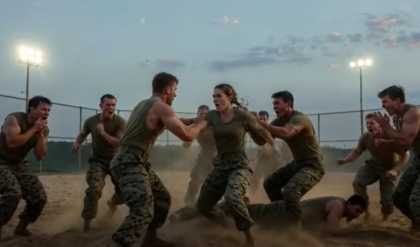
“‘5 Thugs Approached the Checkpoint — Little Did They Know, She’s an Elite Air Force Combat Controller Ready for Anything’”
2:47 A.M. Forward Operating Base Sentinel Northern Syria
The desert wind howled like a living thing, screaming across the wire, rattling the sheet metal walls, carrying sand that cut exposed skin like ground glass.
FOB Sentinel sat alone in the darkness—isolated, under-resourced, and infamous.
Among American service members, it had a reputation.
The most dangerous outpost in the Middle East.
A place where attacks didn’t announce themselves. A place where complacency got people killed.
And tonight, something was very wrong.
At the eastern checkpoint, a single figure sat inside a cramped guard station illuminated by one flickering fluorescent bulb. The space smelled of dust, gun oil, and burnt coffee. The figure adjusted her glasses and stared out into the black desert beyond the wire.
Her name was Staff Sergeant Brooklyn Hayes.
She was twenty-seven years old. Slim build. Brown hair pulled into a regulation ponytail. Wire-frame glasses slipping slightly down her nose. She looked like she belonged in a university library or behind a desk stacked with spreadsheets—not alone at the edge of a war zone at nearly three in the morning.
On paper, she wasn’t supposed to be here.
Brooklyn Hayes was logistics. Supply chain coordination. Manifests. Inventory. Paperwork.
She made sure toilet paper arrived on time. She made sure ammunition didn’t disappear. She made sure other people fought wars efficiently.
But tonight, the regular checkpoint guards were gone.
Food poisoning.
All six of them.
The chow hall investigation would come later. Right now, command needed a warm body with a rifle to cover the gap until morning.
So they sent her.
Brooklyn sat alone, fingers wrapped tightly around a Styrofoam cup that had gone cold an hour earlier. She stared into the desert, trying to ignore the knot tightening in her stomach—the instinctive unease she couldn’t explain, the feeling that the night was watching her back.
Then she saw them.
Five figures, emerging from the darkness like phantoms.
No headlights. No vehicles. No conversation.
They moved with purpose. With spacing. With discipline.
Military formation.
Brooklyn’s heart rate spiked instantly.
Her hand moved to the radio.
“Command, this is Checkpoint Echo. I have five unidentified individuals approaching from the east.”
Static.
She frowned and adjusted the handset.
“Command, do you copy? Five unknowns approaching Checkpoint Echo.”
Nothing.
No hiss. No crackle.
The radio was dead.
Jammed.
Cold spread through her chest.
She looked back up.
They were closer now.
Close enough to see weapons.
AK-47s slung across chests. A tube unmistakably shaped like an RPG launcher. Tactical vests heavy with explosives.
These weren’t refugees. These weren’t smugglers. These weren’t lost travelers.
They were ISIS militants.
And they were walking straight toward the base.
Brooklyn swallowed hard.
She was alone.
No backup. No comms. One sidearm. One rifle she was technically qualified on—but hadn’t fired in months.
And five killers who would tear through this checkpoint like wet paper.
She glanced at the digital clock on the wall.
90 seconds.
Ninety seconds before they reached the wire.
Ninety seconds to decide.
Run— And let them breach the base, where 200 American soldiers slept, weapons stacked, armor off, completely vulnerable.
Or stand.
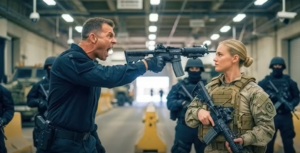
And show them exactly who they were dealing with….
The five militants paused just outside the wire, their silhouettes sharp against the faint glow of the base’s perimeter lights. The leader—a stocky man with a scarred cheek and a radio handset clipped to his vest—raised a hand, signaling halt. He scanned the checkpoint, eyes narrowing at the single lit window. A woman. Alone. Glasses. No threat.
He smirked, muttering something in Arabic to his men. They chuckled softly, spreading out in a loose semicircle, weapons ready but not raised. Why waste bullets on one soft target when the real prize was the sleeping barracks beyond?
Brooklyn’s mind raced through her training—not the logistics briefings, but the classified CCT pipeline she’d survived two years ago. Air Force Combat Controller School: the grueling crucible where she learned to direct airstrikes in hellish conditions, infiltrate behind enemy lines, and turn chaos into precision. She’d graduated top of her class, but requested reassignment to logistics after a classified op went sideways, costing her team a man. The paperwork world was supposed to be her sanctuary. Until tonight.
Ninety seconds had ticked down to thirty.
She set the cold coffee aside and stood slowly, deliberately, hands visible through the window. No sudden moves. Yet.
The leader stepped forward, AK raised casually, barking in broken English: “Open gate! We take supplies. No fight, you live.”
Brooklyn’s voice came back steady, amplified slightly by the station’s external speaker: “Checkpoint Echo is secure. Turn around now. This is your only warning.”
Laughter rippled through the group. The RPG guy shouldered his launcher, aiming lazily at the gate.
Inside, Brooklyn’s hand hovered over the console. The radio was jammed, but the base’s automated defenses weren’t. She typed a quick override code into the hidden terminal—her CCT credentials still active in the system. Alarms stayed silent; no need to wake the base prematurely. Not yet.
The leader approached the gate, rattling the chain-link. “Last chance, girl. Open or—”
Brooklyn flipped the switch.
Floodlights blazed to life, blinding the militants. Simultaneously, the automated turret— a remote-operated M2 Browning she’d helped install during a supply audit—whirred to life from its concealed position atop the checkpoint tower. It wasn’t lethal yet; warning bursts stitched the sand at their feet.
The group scattered, cursing, as Brooklyn burst from the door, M4 carbine shouldered, suppressor screwed on. She moved like shadow—low, fluid, the product of countless night drops and HALO jumps.
The first militant spun toward her, AK barking wildly. Brooklyn dropped to a knee, squeezed twice: center mass, head. He crumpled.
Chaos erupted. The RPG guy swung his tube her way. She rolled left, the rocket screaming overhead to explode harmlessly against the outer berm. Return fire from the others pinged off the station walls.
“Contact east gate!” she shouted into her personal encrypted earpiece—her backup comms, always on her. “Five hostiles, armed heavy. Request immediate QRF and CAS on my mark.”
Base command finally crackled back: “Echo, confirm identity!”
“Hayes, CCT-qualified! Auth code Zulu-7-Niner. Engaging!”
No time for doubt. The leader charged, spraying rounds. Brooklyn flanked behind a sandbag barrier, popping up to drop him with a three-round burst. Two down.
The remaining three fanned out, one tossing a grenade that bounced short. She kicked it back mid-roll—boom—taking out the thrower in the blast’s periphery.
Sirens wailed now; the base was waking. But she wasn’t waiting for cavalry.
The last two militants—smarter now—laid suppressive fire while retreating. Brooklyn called it: “Mark. CAS approved. Hellfire on grid Echo-3, danger close.”
High above, an orbiting Reaper drone—scrambled from a routine patrol—locked on. Missiles streaked down, guided by her laser designator she’d activated on her vest. Twin explosions lit the desert, engulfing the fleeing figures.
Silence fell, broken only by the wind and distant shouts of responding Marines.
Brooklyn advanced cautiously, securing weapons, checking for survivors. None. Five bodies, neutralized threat.
By the time the Quick Reaction Force arrived—boots pounding, rifles up—she stood at the gate, M4 slung, glasses slightly askew but unbroken.
Major Harlan, the detachment commander, skidded to a halt. “Hayes? What the hell—”
“Five ISIS militants neutralized, sir. Jammed primary comms, but drone strike confirmed kills. No base casualties.”
He stared at the scene—the precision shots, the cratered sand—then at her. “You’re… logistics.”
She adjusted her glasses. “Logistics with a CCT tab, sir. Hidden in plain sight.”
Word spread like wildfire through FOB Sentinel. By dawn, Brooklyn was pulled into a classified debrief. Turns out, her reassignment request had been a cover; JSOC had embedded her as a sleeper asset for high-threat supply routes. The food poisoning? A targeted bio-agent from a local informant. She’d been the perfect bait—and trap.
Promoted on the spot to Technical Sergeant, Brooklyn was reassigned to lead a forward CCT team, directing airstrikes that dismantled ISIS cells across the region. Her first op post-promotion: a precision raid that rescued a downed pilot, earning her the Air Force Cross.
Back home, years later, she taught at the CCT school, mentoring wide-eyed recruits. “They saw a clerk,” she’d say with a wry smile. “But threats don’t check your MOS. Be ready for anything.”
And in the quiet nights, she remembered that howling wind—and how one woman turned it into a symphony of survival.
The desert remembered too. FOB Sentinel stood stronger, its legend now including the night the “paper pusher” became the guardian who saved them all.
A happy ending, etched in sand and stars: competence unrecognized, until the moment it shines brightest.