 The 59th Annual CMA Awards, broadcast live from the pulsating heart of Bridgestone Arena on November 19, 2025, was primed for glory—a glittering tapestry of rhinestones, twangy anthems, and hard-won accolades under the watchful eyes of 20,000 fervent fans and millions tuning in via ABC. Hosted solo for the first time by the indomitable Lainey Wilson, the evening unfurled like a well-worn vinyl record: smooth grooves of high-energy performances, surprise collaborations that crackled with electricity, and a winners’ list that crowned new royalty while saluting enduring legacies. Lainey Wilson herself swept the stage with three trophies, including the crown jewel of Entertainer of the Year, etching her name deeper into country lore as only the third woman to claim it twice. Ella Langley and Riley Green dominated with three wins apiece for their chart-topping duet “You Look Like You Love Me,” a track that swept Song, Single, and Music Video of the Year—the first in CMA history to claim every eligible honor. Brooks & Dunn shattered records with their 20th overall win, securing Vocal Duo for the 16th time, eclipsing even Chris Stapleton’s tally. Yet, amid the confetti and cheers, one moment transcended the script, plunging the arena into a vortex of raw emotion that left jaws slack, eyes flooded, and hearts irrevocably cracked open: George Strait’s shadowy, unheralded entrance to honor Vince Gill with the Willie Nelson Lifetime Achievement Award.
No leaks, no whispers, no orchestrated hype. As the clock ticked toward the night’s sacred interlude, the arena’s lights—those brilliant beacons of Music City’s nocturnal splendor—flickered and died. A hush descended, thicker than the November fog rolling off the Cumberland River, as darkness swallowed the stage whole. Whispers rippled through the crowd: a technical glitch? A dramatic prelude? Then, from the void, a silhouette materialized—a lone figure in a wide-brimmed Stetson, boots echoing like distant thunder on the polished oak floor. Step by deliberate step, he advanced, the spotlight catching the glint of a silver belt buckle, the subtle sway of a man who commands arenas without uttering a syllable. For an eternal heartbeat—two, perhaps three seconds—the world held its breath. And then, recognition crashed like a tidal wave: It was him. The King of Country. George Strait.
The eruption was cataclysmic. A roar swelled from the depths of Bridgestone, 20,000 voices merging into a primal symphony of disbelief and adoration, cellphones thrusting skyward to capture the miracle. Strait, at 73, hadn’t graced a CMA stage unannounced in over a decade, his appearances as rare as a flawless diamond in a coal mine. No microphone in hand, no guitar slung low—just the weight of his presence, a living monument to four decades of sold-out stadiums and timeless hits like “Amarillo by Morning” and “The Chair.” He moved with the quiet authority of a gunslinger entering a saloon, eyes locked on his target: Vince Gill, seated front-row, oblivious to the storm about to break over him.
Gill, the 68-year-old virtuoso with a voice like aged bourbon—smooth, warm, laced with the ache of a thousand untold stories—had just weathered a prelude of pure poetry. Brandi Carlile, the gravel-voiced folk-rock titan, had ignited the tribute with a soaring rendition of Gill’s 1990 heartbreak anthem “When I Call Your Name,” her fingers dancing over guitar strings as if summoning ghosts from the ether. Joined onstage by Patty Loveless, the bluegrass queen whose harmonies cut like a switchblade through silk, the duo transformed the song into a lament for lost loves and unbroken spirits, pedal steel wizard Paul Franklin weaving golden threads of melancholy beneath their voices. Gill, ever the stoic showman, sat transfixed, his trademark grin faltering into something deeper, more vulnerable—a man’s quiet reckoning with his own legend. Twenty-two Grammys, eighteen CMAs, over 30 million albums sold, and a songbook that birthed classics like “Go Rest High on That Mountain”—all of it culminating in this: the Willie Nelson Lifetime Achievement Award, bestowed upon only ten immortals before him, including Dolly Parton, Johnny Cash, and, fittingly, Strait himself in 2022.
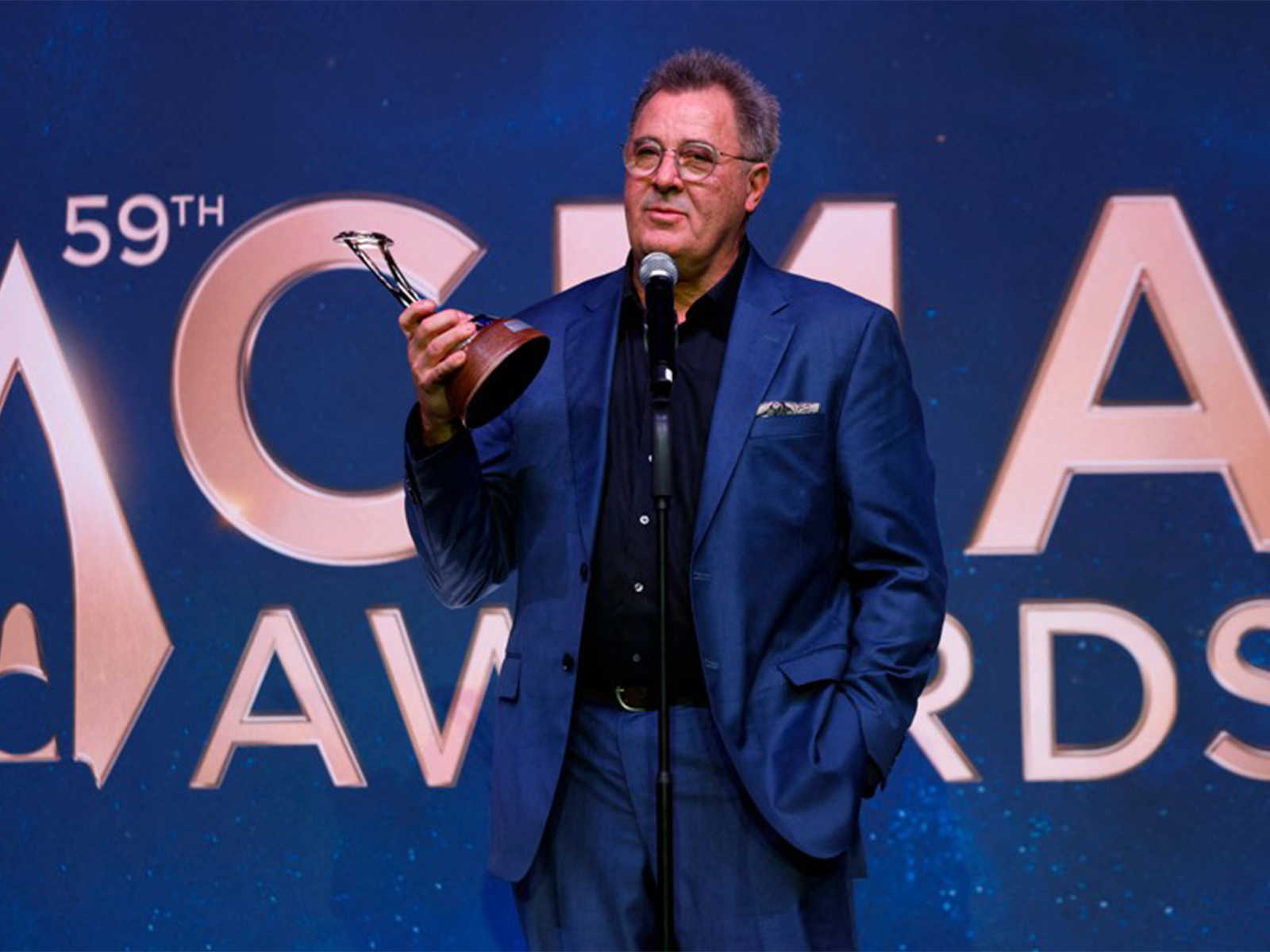
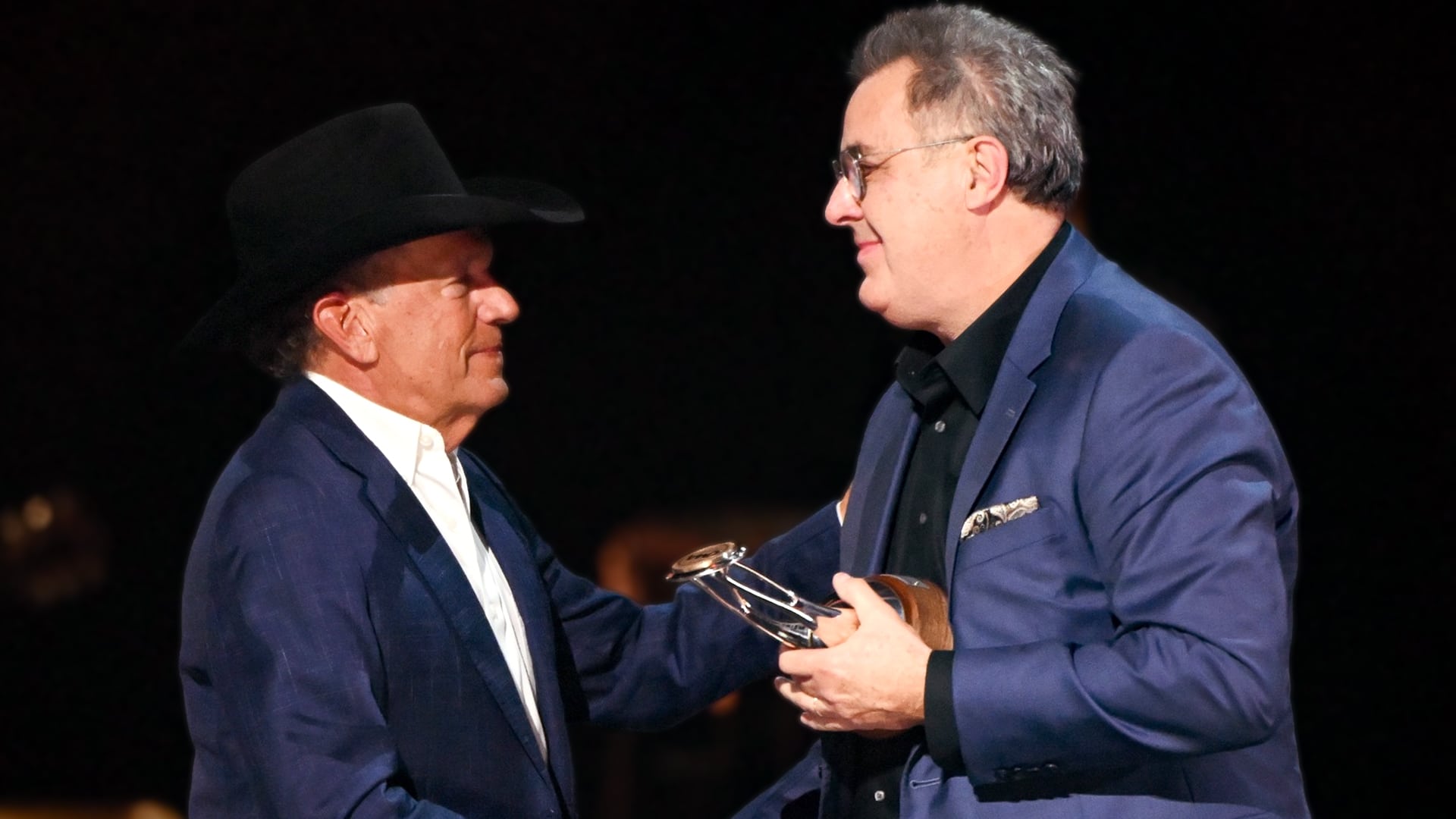
But nothing—no accolade, no ovation—could prepare him for what came next. Strait reached the podium, his hand extending not for a script, but for Gill’s shoulder. The touch was paternal, profound—a brother’s clasp across the chasm of years. Leaning into the mic, Strait’s baritone rumbled low, each word freighted with the gravel of Gulf Coast winds: “No one deserves Willie more than you, Vince. Your voice, your heart, the way you’ve carried this music for all of us… To say that, I had to come here myself.” The arena, still buzzing from the reveal, fell into a stunned reverie. Gill’s eyes, those windows to a soul forged in Oklahoma fires, brimmed instantly. He rose, enveloping Strait in a bear hug that spoke volumes unspoken, his voice a fractured whisper barely audible over the swelling applause: “George… I’m speechless. Thank you, brother. From one troubadour to another.”
The floodgates shattered. Tears cascaded unchecked—down Gill’s cheeks, tracing the lines etched by half a century of spotlights and shadows; across the faces of icons like Reba McEntire and Alan Jackson in the audience, their own legacies intertwined with these two titans. Lainey Wilson, mid-host duties, dabbed at her eyes from the wings, her bell-bottoms forgotten in the face of such unadorned grace. Cameras panned the crowd: young fans, barely out of high school, clutching CMA-branded cups, sobbing as if mourning a personal loss; grizzled veterans, faces weathered by decades of honky-tonks, nodding in solemn agreement, their applause thunderous yet tender. Social media ignited like dry tinder—X (formerly Twitter) ablaze with clips timestamped 9:47 p.m. CST, hashtags #StraitForGill and #CMAMagic trending worldwide within minutes. “I ugly-cried through my mascara—George Strait walking out of the dark like a ghost? Iconic,” tweeted @CountrySoulSis, her post amassing 15,000 likes in an hour. Another, @NashvilleNighthawk, captured the zeitgeist: “That wasn’t a presentation; that was a coronation. Vince Gill, the poet laureate of pain, humbled by the King. #CMA2025.”
This wasn’t mere theater; it was a seismic rupture in the fabric of country music, a moment where the genre’s storied code—loyalty forged in late-night jam sessions, respect earned in the unforgiving forge of the road—burst into the open like a long-suppressed sob. Strait and Gill’s brotherhood dates back to the neon haze of 1980s Nashville, when two hungry troubadours traded licks in smoke-filled dives, dreaming of stages bigger than their britches. Strait, the stoic Texan with a voice like sun-baked leather, had inducted Gill into the Country Music Hall of Fame in 2007, but this? This was personal, unscripted, a gauntlet thrown down against the industry’s churn of fleeting fame. “George doesn’t do surprises,” Gill later confided to reporters backstage, his voice still husky from the weight of it all. “He shows up when it matters. And tonight? It mattered more than air.”
To fully grasp the quake of this encounter, one must rewind the reel of these men’s intertwined odysseys—tales as rich and rugged as the Appalachian trails they both sing of. George Strait, born in 1952 amid the oil fields of Poteet, Texas, was a reluctant revolutionary. A mortar artilleryman in Vietnam, he returned stateside to rodeo arenas and ranch life, his baritone a secret weapon unleashed only in local lounges. By 1981, MCA Records signed him, and “Unwound” cracked the charts like a whip. What followed was a dynasty: 60 No. 1s, the most of any artist in any genre; tours grossing billions; a net worth eclipsing $300 million, funneled into cattle empires and philanthropy for first responders. Yet Strait’s allure lies in his elusiveness—the anti-star who shuns Vegas residencies for quiet ranches, his 13 CMA Entertainer wins a testament to purity over polish. “I sing for the folks who work hard and love deep,” he once drawled in a rare interview. “That’s country. That’s me.”
Vince Gill, meanwhile, emerged from Oklahoma’s red dirt in 1957, a prodigy whose fingers flew across mandolin strings by age five. Influenced by the bluegrass blaze of his father’s band, Gill cut his teeth with Pure Prairie League and the Time Jumpers, his tenor a crystalline arrow piercing the heart. His 1989 solo breakthrough “When I Say No” vaulted him to stardom, but it was the ’90s that crowned him: “I Still Believe in You,” a duet with Roseanne Cash; the Eagles’ invocation post-Glenn Frey in 2016, where his harmonies on “Take It Easy” evoked spectral resurrection. Gill’s ledger brims with firsts—most CMA Male Vocalist wins (five), a record unbroken—and a discography blending gospel-tinged ballads with honky-tonk fire. Offstage, he’s the everyman’s sage: a Nashville philanthropist raising millions for hunger relief, a stepfather to Amy Grant’s brood, his humility as vast as his range. “Music’s not about me,” Gill often muses. “It’s about the stories we share—the ones that make us feel less alone.”
Their paths crossed in the crucible of the 1985 CMA Awards, where Strait, already a titan, mentored the wide-eyed Gill through a duet that sparked a lifelong pact. Over barbecue-fueled bondings at Strait’s Texas spreads and Gill’s Belcourt Theatre haunts, they swapped tales of lost loves (Strait’s Norma, his high-school sweetheart of 52 years; Gill’s post-divorce renewal with Amy Grant) and industry betrayals. Strait, ever the sentinel, shielded Gill from Nashville’s viper pit; Gill, the wordsmith, penned tributes that Strait cherished privately. This award—named for the outlaw poet Willie Nelson, whose braids and bravado Gill emulates—was the perfect canvas. “Vince is Willie reborn,” Strait affirmed in his impromptu eulogy, “a man who braids family into fame, who sings truth when the world’s screaming lies.”
The ripple of this revelation coursed through the evening like a rogue current, elevating the CMAs from gala to gospel. Earlier, the show had hummed with kinetic highs: Kelsea Ballerini’s rain-soaked swing through “Penthouse Philosophy,” umbrella aloft as water cascaded like tears of joy; Steve Martin’s banjo-fueled romp with Jordan Davis on “Buy Dirt,” a nod to bluegrass bedrock that had the crowd two-stepping in their seats. Zach Top, the lanky Washington phenom, claimed New Artist of the Year with a Coors in hand, his acceptance a cheeky toast to underdogs: “To the dreamers still haulin’ hay— this one’s for y’all.” The Red Clay Strays upset Old Dominion’s seven-year Vocal Group reign with their soul-stirred “Wondering Why,” a victory lap for roots revivalists. And Cody Johnson, the Texas torchbearer, snagged Male Vocalist, his gravelly gratitude a balm: “This game’s tough, but y’all make it holy.”
Yet, post-Strait, the air thickened with reverence. Lainey Wilson, reclaiming Entertainer with a medley opener blending Lady A’s “Need You Now” and Miranda Lambert’s “Gunpowder & Lead,” paused her patter to honor the duo: “That’s what this family’s for—lifts when you’re low, cheers when you’re high.” Her Album of the Year win for Whirlwind—a cyclone of confessional country—felt like destiny’s wink, especially as she skewered online trolls pitting women against each other: “To the basement-dwellers with your Cheetos: Find better hobbies, darlin’.” Ella Langley’s Song triumph for “You Look Like You Love Me” sparked a duet encore with Riley Green, their chemistry a live-wire spark that had couples swaying in the stands.
Backstage, the aftershocks lingered. Gill, clutching the crystal Willie like a talisman, pulled Strait aside for a private reprise—whispers of future collaborations, perhaps a joint tour to bridge generations. “He didn’t have to,” Gill told Billboard, eyes misty anew. “But George? He shows up for soul, not spotlight.” Strait, ever laconic, shrugged it off: “Vince is family. Awards are paper; brothers are forever.” Fans echoed the sentiment online, with @TrueCountryHeart posting a clip that garnered 2 million views: “Strait from the shadows? Chills. Eternal chills. #CMALegacy.” Even skeptics melted; one X user lamented the missed duet—”You had King George and no mic? Criminal!”—but conceded the spoken tribute’s supremacy.
In the broader canvas of country’s evolution, this interlude was a lifeline—a rebuke to the genre’s growing pains, from AI-assisted songwriting debates to the TikTok-fueled rise of Post Malone’s genre-blending nods (he snagged International Song for “I Had Some Help”). Kenny Chesney’s medley of “American Kids” and “When the Sun Goes Down” celebrated his Hall of Fame induction alongside Tony Brown and June Carter Cash, a bridge from ’90s nostalgia to tomorrow’s anthems. Stephen Wilson Jr.’s stripped-down “Stand By Me” cover earned the night’s first standing O, his acoustic purity a counterpoint to the spectacle.
As the final notes faded and the arena emptied into Nashville’s neon night, the Strait-Gill moment lingered like smoke from a bonfire—warm, wistful, indelible. It reminded us that country’s core isn’t in the glitz of Bridgestone’s beams but in the quiet bonds that bind us: a hand on a shoulder in the dark, words that heal what charts can’t touch. In an era of algorithms and avatars, this was authenticity unchained—a tear-jerking explosion that didn’t just honor a lifetime but reignited the soul of the music itself. For Vince Gill, the Willie is a milestone; for George Strait, a mission accomplished; for country music, a covenant renewed. And for the fans left breathless and sobbing? A story to retell around campfires for generations: the night the King stepped from shadows to crown his brother, and the world wept in wonder.
As dawn broke over Music City on November 20, replays dominated Hulu streams, X feeds, and barroom TVs. The CMAs’ 6.037 million viewers—down a tick from ’24 but topping prime-time—spoke to a night that transcended metrics. In the words of one arena-goer, etched on a post-show sign: “From darkness, light. From kings, kinship. Thank you, George. Thank you, Vince.” Indeed. In the grand honky-tonk of life, some moments aren’t just magic—they’re eternal.