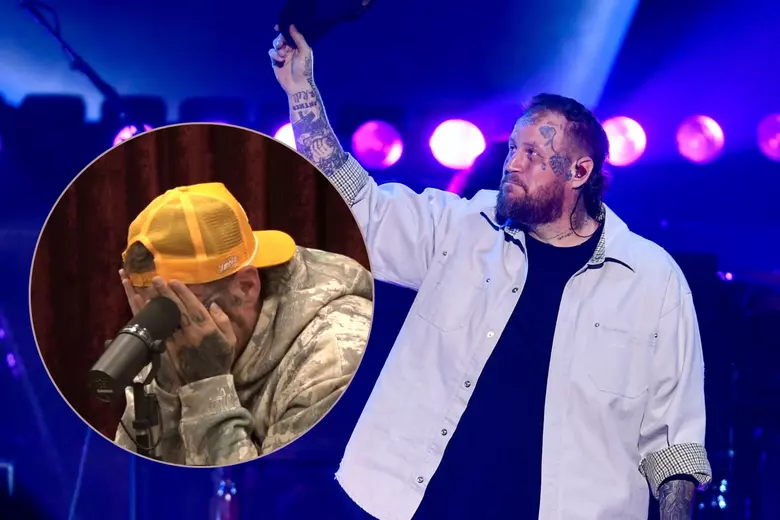
In the dim glow of a podcast studio, far from the neon haze of Nashville’s back alleys where his story began, Jason DeFord—better known to the world as Jelly Roll—found himself unraveling. The words slipped from his lips like a confession long held in the shadows: “I never thought a moment like this could belong to someone like me.” His voice cracked, thick with the weight of a lifetime’s battles, as tears carved fresh paths down his tattooed cheeks. Across from him sat Joe Rogan, the unflinching host whose platform has borne witness to countless raw truths, but even Rogan paused, offering a steady hand and a rare, tender hug. This wasn’t just another celebrity milestone. It was redemption incarnate—a former inmate, a man who’d stared into the abyss of addiction and crime, being welcomed into the hallowed circle of the Grand Ole Opry, country music’s most sacred institution.
The moment unfolded on December 10, 2025, during episode #2424 of The Joe Rogan Experience. Jelly Roll, at 41, had already shared laughs and hard-won wisdom with Rogan about his dramatic 300-pound weight loss, his chart-topping anthems of vulnerability, and the relentless grind of touring with Post Malone. But when Rogan cued up a pre-recorded video message, the air shifted. Out came Craig Morgan, the grizzled Opry veteran whose voice has soothed souls for decades. “Jelly Roll, you’re officially invited to become a member of the Grand Ole Opry,” Morgan said, his tone warm and unwavering. “It’s an honor to say welcome to the family, brother.” Headphones clattered to the floor. Jelly Roll buried his face in his hands, shoulders heaving as sobs echoed through the microphones. “It don’t get no bigger in country music, bubba,” he gasped between breaths. “That’s as big as it gets. F—ing Grand Ole Opry, dawg.”
For outsiders, the Grand Ole Opry might seem like just another venue—a weekly radio show turned live spectacle that’s been running since 1925, a barn-like beacon in Nashville where legends like Hank Williams and Dolly Parton once tread the boards. But for Jelly Roll, it was a distant constellation, a dream forged in the fires of his fractured youth. Born Jason Bradley DeFord in 1984 in the gritty Antioch neighborhood of Nashville, Tennessee, Jelly Roll’s life was a symphony of chaos from the start. His parents split early, leaving him to navigate a world of absentee figures and survival instincts sharpened too soon. By age 14, he’d tasted the cold bite of handcuffs for the first time—petty theft, vandalism, the small rebellions of a kid screaming for structure. But the slips turned to slides. At 16, charged as an adult with aggravated robbery, he faced a potential 20-year sentence. He served just over a year behind bars, followed by seven grueling years of probation, but the cycle persisted. Drugs became his escape and his cage; dealing crack and pills funded a haze of numbness. By 23, another stint for possession and distribution landed him back inside, this time for drug trafficking. In total, he’d cycle through jail 40 times before he hit 30—a statistic that could have been his epitaph.
Prison wasn’t just punishment for Jelly Roll; it was a crucible. Locked away in the sterile echo of county facilities, where hope curdled into routine, he found an unlikely lifeline in a notebook and a makeshift beat. “I started writing rhymes because it was the only thing that made the days bearable,” he’d later reflect. Hip-hop, raw and unfiltered, became his confessional booth. Scrawling verses about the dope game, the sting of betrayal, and the gnawing void inside, he poured out the poison. One pivotal night in 2008, as he paced his cell, word came that his girlfriend was in labor. Their daughter, Bailee Ann, arrived while he was still caged—a tiny, innocent anchor in his storm-tossed sea. “That was my Damascus Road moment,” Jelly Roll has called it, invoking the biblical tale of Saul’s blinding light on the road to transformation. He devoured books, earned his GED in record time (after barely scraping through 60 days of high school), and vowed to break free. Released in 2009, he emerged not as a ghost of his former self, but as a man with a fire kindled: music would be his redemption, his way to claw back from the edge.
The early years post-release were a grind of audacity and adversity. Living out of a beat-up van parked in Walmart lots, Jelly Roll bootstrapped his way into the indie rap scene. His breakthrough came with a gritty YouTube freestyle titled “10 Minute Freestyle,” a no-holds-barred rant about slinging drugs and dodging bullets that racked up views and caught the ear of Memphis rapper Lil Wyte. Collaborations followed—mixtapes like The Plain Shmear Tape in 2003 had been his tentative toe-dip, but now he was all in. Albums with Wyte and others painted vivid portraits of street life, earning a cult following in the underground. Yet, the specter of his past loomed. Relapses tested him, and the music industry, with its polished facades, often turned a cold shoulder to a tattooed ex-con with a rap sheet longer than his discography.
Then, in 2020, a seismic pivot: country music. It wasn’t a calculated rebrand but a soul-deep calling. Jelly Roll had always woven threads of Southern grit into his rhymes—tales of moonshine-fueled regrets and backroad baptisms—but now he leaned in fully. His debut country single, “Save Me,” dropped like a prayer unanswered too long. A haunting ballad of addiction’s grip and the plea for grace, it resonated with the broken and the healing alike. Sung in a gravelly baritone that bridged outlaw country and trap soul, it climbed charts and cracked open doors. “I wasn’t trying to ‘go country’ to sell out,” he’d say. “I was just telling my truth in the language that felt like home.” Ballad of the Broken followed in 2021, a collection of anthems that blended hip-hop beats with pedal steel sighs, landing him on rock and country airwaves.
Fame accelerated from there, a whirlwind of ironies and triumphs. By 2022, “Son of a Sinner” stormed to No. 1 on Billboard’s Country Airplay chart, its lyrics a mirror to his delinquent youth: “I’m just a son of a sinner, but I’m trying to get better.” He headlined Nashville’s Bridgestone Arena, a venue mere miles from the jails that once held him. Whitsitt Chapel in 2023 cemented his stardom—tracks like “Need a Favor” and a duet with Lainey Wilson on “Save Me” earned him five CMA Award nominations, including New Artist of the Year, which he claimed with a speech that gut-punched the room: “The pain to remain the same is greater than the pain it takes to change.” Grammy nods followed in 2024 for Best New Artist and Country Album, alongside a CMT Awards sweep. He testified before the U.S. Senate on the fentanyl crisis, drawing from his dealer days to advocate for reform, and opened a music studio in a Nashville juvenile detention center, funded by tour proceeds—a full-circle bid to spare kids his fate.
Through it all, the Grand Ole Opry shimmered as the ultimate grail. Just 15 minutes from his childhood home, it might as well have been on another planet. As a teen, he’d sneak tickets to catch shows, mesmerized by the ghosts of legends strumming under the Ryman Auditorium’s arches. But it was Craig Morgan’s performance of “Almost Home” that seared itself into his soul. Incarcerated and adrift, Jelly Roll had Googled the song on a contraband phone, its story of a homeless man’s quiet dignity hitting like a lifeline. “It reminded me that no matter where your body is, your mind can take you home,” he’d recount. Post-release, still on ankle monitor, he bought tickets to see Morgan live at the Opry. The tears flowed then, too—raw, cathartic floods that whispered, “You could do this. You could make someone feel seen.”
His Opry debut came in November 2021, a prerequisite he’d demanded in his record deal alongside local press coverage. “I needed to prove I was real,” he explained. “Not some flash in the pan.” He wept like a baby backstage, then delivered a set that blended his hits with covers of icons like Johnny Cash. Return visits followed, each one a brick in the bridge from boy to bard. By 2023, he’d performed there multiple times, once declaring it “the most special night of my life.” Yet membership—the lifelong oath to uphold the Opry’s legacy—eluded him, a quiet ache amid the accolades.
That’s why Morgan’s invitation landed like thunder. In the video, the 61-year-old star didn’t just extend an olive branch; he wove their stories together. “I’ll never forget meeting you at the Opry and hearing how my music helped you through tough times,” Morgan said. “That’s what country does best.” For Jelly Roll, it was poetic justice: the man whose song had pulled him from the pit now pulling him into the pantheon. “I just remember thinking, ‘Man, I wanna make people feel the way he makes me feel,'” Jelly Roll told Rogan, voice steadied by wonder. “That’s what I want to do. I did it, Joe.” Their embrace—two warriors of the human spirit—sealed the scene, a testament to unlikely alliances.
The ripple hit like a tidal wave. Fans, long bonded to Jelly Roll’s unflinching honesty, flooded social media with their own catharses. “Crying right along with him—this is what redemption looks like,” one X user posted, sharing a clip that amassed thousands of views overnight. Another wrote, “From jail cell freestyles to Opry member? Jelly’s story gives hope to every screw-up out there.” Country peers chimed in too: Lainey Wilson called it “full-circle magic,” while Wynonna Judd, who’d shared stages with him, tweeted a simple, “Proud of you, brother. Keep shining.” Even skeptics, who’d once dismissed his rap roots as genre trespass, softened; one viral thread debated how his invitation outshone controversies plaguing others in the industry, underscoring the Opry’s nod to authenticity over polish.
In a genre often romanticizing hardship from a safe distance, Jelly Roll lives it—tattoos mapping his scars, songs dissecting the mess. His music doesn’t sugarcoat; it salvages. Tracks like “I Am Not Okay” and “Heart of Stone” topped country radio in 2025, not despite his past, but because of it. He’s a family man now, raising Bailee (whom he won full custody of) and two stepsons with his wife, Bunnie XO, a podcasting firebrand whose own unfiltered vibe mirrors his. Weight loss transformed his body; therapy and faith reshaped his mind. A pardon recommendation from Tennessee’s parole board in April 2025 could restore rights long stripped away, from voting to global travel—another layer peeled back on his phoenix arc.
Jelly Roll’s Opry invitation isn’t just a personal pinnacle; it’s a beacon for the millions who’ve stumbled. In a world quick to discard the fallen, his tears on Rogan’s couch affirm that the heaviest loads can forge the purest gold. Music, that stubborn alchemist, turns wounds into wisdom, isolation into invitation. As he wipes his eyes and rises—flawed, fierce, forever changed—the sacred circle widens. And in that expansion, hope finds its harmony, proving once more that even the darkest paths can lead to the brightest stages.