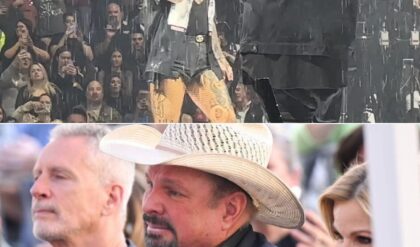
The 59th Annual CMA Awards, unfolding like a glittering tapestry of twang and triumph on November 19, 2025, at Bridgestone Arena, was already a masterclass in country’s multifaceted magic: Lainey Wilson’s hosting swagger sweeping up Entertainer of the Year honors, Zach Top’s beer-toasting New Artist victory igniting a rowdy revival, and duets from Miranda Lambert and Chris Stapleton that blurred the lines between heartbreak and harmony. But midway through the ceremony, as the house lights dimmed and the crowd settled into a reverent hush, the night pivoted from celebration to consecration. What began as a poignant musical tribute to Vince Gill—courtesy of Brandi Carlile and Patty Loveless’s spellbinding rendition of “When I Call Your Name”—escalated into one of award-show history’s most jaw-dropping surprises: George Strait, the reclusive King of Country, materializing from the shadows to present Gill with the Willie Nelson Lifetime Achievement Award. No advance whispers, no red-carpet sightings—just a sudden silhouette in the spotlight, Stetson tipped low, striding onstage to thunderous ovation. Jaws hit the floor; hearts hit overdrive. In a genre built on legends passing torches, this was no mere handover—it was a coronation, a rare convergence of titans that reminded 20,000 fans why country’s crown jewels endure.
The moment’s alchemy was as unexpected as it was electric. Gill, the Oklahoma-born virtuoso whose golden tenor and fleet-fingered guitar have defined decades of Nashville nights, had long been the CMA’s benevolent backbone: a record-tying 12-time host, an 18-time winner, and a Hall of Famer since 2007 whose 45 chart-toppers and 30 million albums sold whisper of a career that’s less a resume than a roadmap for the genre’s soul. At 68, with his silver mane and easy grin belying the battles—personal losses, industry shifts, the quiet toll of 50 years under the lights—Gill’s selection for the Willie Nelson Lifetime Achievement Award felt inevitable yet profoundly earned. Introduced in 2012 to honor outlaws and icons alike, the accolade has gilded the legacies of Kenny Rogers, Johnny Cash, Dolly Parton, Kris Kristofferson, Charley Pride, Loretta Lynn, Alan Jackson, and, just last year, Strait himself. “Vince isn’t just a voice or a virtuoso; he’s the glue,” CMA CEO Sarah Trahern had noted in the pre-show presser, her words a prelude to the poetry about to unfold. But no one—least of all the audience—anticipated the poetry’s pen would be wielded by Strait, the Poteet, Texas, phenom whose elusiveness rivals his excellence.

The buildup was a tearjerker in its own right, a velvet curtain-raiser that set the emotional stakes sky-high. As the arena’s massive screens flickered to life with a montage of Gill’s greatest hits—”Go Rest High on That Mountain” fading into “Whenever You Come Around,” clips of his Eagles tenure intercut with CMA hosting hijinks—the house band eased into the aching opening chords of “When I Call Your Name.” Enter Brandi Carlile, the Washington state wildfire whose folk-Americana blaze has scorched charts and Grammys alike (nine wins, including Album of the Year for 2021’s In These Silent Days). Dressed in a sleek maroon suit that evoked a modern-day troubadour, Carlile gripped the mic with the intensity of a confession, her voice—a crystalline alto laced with gravel—unfurling the 1989 ballad’s plea for lost love: “It still feels like our best times are together / I remember yesterday, I still can see your face.” The song, Gill’s breakout smash that netted him CMA Single and Song of the Year plus a Grammy, had always been a vessel for vulnerability; in Carlile’s hands, it became a vessel for veneration, her eyes locked on Gill in the front row, where he sat transfixed, wife Amy Grant at his side, her hand a quiet anchor on his knee.
Then, midway through the bridge—as the lyrics swelled to “But I guess each heart must find its way”—the stage lights softened, and Patty Loveless emerged like a ghost from country’s golden age. The Kentucky coal miner’s daughter, whose ’90s heyday yielded 28 Top 10 hits and a voice like smoked honey over heartache, hadn’t graced a major awards stage in years, her post-2001 retirement a deliberate retreat to Georgia’s green hills. Yet here she was, in a simple black sheath that belied her star power, harmonizing with Carlile in a duet that transcended tribute into transcendence. Loveless’s reedy timbre—rich with the ache of “Blame It on Your Heart” and “How Can I Help You Say Goodbye”—wove seamlessly with Carlile’s fire, their voices rising in a crescendo that hushed the arena: “When I call your name, baby / Jesus, Mary and Joseph, please / It’s a fool’s game / But I can’t forget your face.” Cameras caught Gill’s reaction—a slow blink, a hand to his chest, tears tracing silent paths—as the final note lingered like a lover’s goodbye. The crowd, a mosaic of Stetsons and sequins, rose in waves, applause crashing like thunder. “I am in heaven,” one fan tweeted mid-moment, her clip amassing millions of views by night’s end. It was a performance that didn’t just honor Gill; it humanized him, stripping the icon to the man who’d poured his soul into every string and stanza.
But the real shockwave hit seconds later, as the applause ebbed into expectant hush. From stage left, unannounced and unheralded, stepped George Strait—73, lean as a longneck bottle, his black hat casting a shadow over eyes that’ve seen it all. The King of Country, who’d shunned the CMA spotlight since his 2024 Lifetime Achievement win (where he’d quipped about preferring pastures to podiums), wasn’t supposed to be there. No pre-show interviews, no red-carpet reconnaissance; rumors had him ranching in Texas, far from Music City’s glare. Yet here he was, striding center stage with the quiet command of a man who’s sold 120 million records without breaking a sweat, his 60-plus No. 1s a testament to timeless troubadour truth. The arena detonated—screams piercing the air, phones thrusting skyward, Lainey Wilson pumping her fist from the host’s perch. “Nobody even knew George was in the building,” a wide-eyed attendee later recounted to Billboard, her voice still quaking. Strait, ever the stoic, cracked a rare grin as he clasped Gill’s hand, the two icons—mentors, peers, pillars—standing shoulder to shoulder like sentinels of the genre’s golden era.
What followed was a presentation laced with Strait’s signature restraint and reverence, a masterclass in why he’s the King: understated, unyielding, utterly authentic. “Vince Gill is not just a great singer—he’s an amazing songwriter, an incredible guitar player, and one of the finest humans I’ve ever known,” Strait drawled, his baritone a balm against the room’s electric hum. He ticked off Gill’s feats with affectionate awe: the 22 Grammys, the Eagles’ harmonies that bridged rock and roots, the hosting marathons that turned CMAs into family reunions. “He can sing higher than anybody I know,” Strait chuckled, drawing laughs that eased the lump in every throat. “And there’s not a more deserving person to receive this great honor, which bears the name of the true icon himself, Mr. Willie Nelson.” The nod to Willie—the award’s namesake, now 92 and still strumming from his Luck, Texas, enclave—drew misty cheers, a bridge to the outlaws who’d paved their paths. Strait’s words weren’t flowery; they were forged, a peer’s benediction that elevated the moment from moving to monumental.
Gill, rising to accept the gleaming crystal Willie (a nod to the Red-Headed Stranger’s enduring spirit), embodied the evening’s emotional core: humor as armor, heart as headline. “I’m pretty confident that I’m the only one that’s won this award that’s never smoked any weed,” he quipped, his Oklahoma drawl dripping dry wit as the arena roared with recognition—Willie’s hazy halo a legend in itself. The line, delivered with a wink to Strait, who stifled a laugh, lightened the load just enough for what came next: a speech that wove gratitude with grit. He thanked his wife Amy, “the kindest soul I’ve ever known,” crediting her for 25 years of grace amid the grind. He saluted his heroes—Willie for inspiring at 92, Strait for the quiet class that “makes us all try harder.” And in a nod to the genre’s next wave, he praised the night’s young guns: Zach Top’s raw revival, Ella Langley’s firecracker fusion. “Country music’s always been about stories,” Gill mused, his voice cracking on the edge of tears. “Mine’s been one hell of a ride—and tonight, y’all made it feel like the best chapter yet.” As he clutched the award, the ovation swelled anew, a standing sea of solidarity that blurred the lines between stage and seats.
The ripple effects were immediate and immense. Social media erupted like a powder keg primed with pixie sticks: #StraitSurprise trended worldwide within minutes, clips of Strait’s entrance racking up 25 million views by dawn. “Jaws on the floor—King George honoring the Prince? Iconic doesn’t cover it,” one fan posted, her video syncing the reveal with “Amarillo by Morning” for viral poetry. Forums buzzed with what-ifs—”Why no Strait-Gill duet? ‘Check Yes or No’ meets ‘Go Rest High’ woulda slayed”—while critics crowned it the night’s pinnacle. Rolling Stone dubbed it “the CMA’s most moving handover since Dolly’s bow,” praising how Strait’s sparsity amplified Gill’s sparkle. Variety hailed the Loveless-Carlile opener as “a harmony heaven-sent,” Loveless’s rare return a resurrection that underscored country’s communal cradle. Even skeptics, griping about the genre’s pop pivot, conceded: in an evening of Ella Langley and Riley Green’s chart-topping twang, this was the anchor, a tether to the timeless.
For Gill, the honor caps a 2025 of quiet conquests: his Guy’s All-Star band revival drawing sellouts, a bluegrass album tease with old pal Patty, and Eagles tours that keep his fretboard fire lit. Strait, meanwhile, slips back to his 3,000-acre Texas spread, his surprise a sovereign’s sally—proof that even kings emerge when legacy calls. In a CMA that balanced Wilson’s whirlwind wins with Brooks & Dunn’s record 20th Duo trophy, this segment stood singular: a surprise that stopped breaths, a tribute that started tears, a passing of the crown that promised country’s throne is wide enough for all. As the credits rolled and confetti rained, one truth twinkled brighter than any trophy: in Music City’s merry-go-round, the best surprises aren’t scripted—they’re sung, one heartfelt harmony at a time.