In the densely packed sprawl of Hong Kong’s New Territories, where towering concrete monoliths pierce the humid sky like defiant sentinels against the encroaching hills, a routine afternoon shattered into apocalypse on November 26, 2025. At the Wang Fuk Court housing estate in the northern district of Tai Po—a labyrinth of eight 31-story residential blocks home to over 4,600 souls—a spark ignited what would become the city’s most catastrophic fire in decades. Flames, fueled by the crackling fury of bamboo scaffolding draped across seven of the towers like tinder-dry veins, roared upward with voracious speed, swallowing apartments in a maelstrom of smoke and screams. By Thursday morning, November 27, as rescue crews sifted through the charred wreckage under a pall of acrid haze, authorities grimly announced the toll: 55 confirmed dead, with 279 individuals still unaccounted for in a nightmare that has exposed the fragile underbelly of one of the world’s most vertical cities. What began as a localized flare-up has ballooned into a humanitarian crisis, with three men arrested for alleged manslaughter, fingers pointing squarely at “gross negligence” in construction practices that turned maintenance scaffolds into death traps.
Wang Fuk Court, completed in the late 1980s as part of Hong Kong’s ambitious public housing push, stands as a testament to the city’s relentless verticality. Perched on the fringes of Tai Po—a suburban enclave of some 300,000 residents hugging the border with mainland China’s Shenzhen—the estate’s eight blocks rise like uniform giants amid pockets of greenery and bustling wet markets. Each tower, a self-contained hive of 250-odd units, buzzes with the rhythms of working-class life: elderly tai chi practitioners in the courtyards at dawn, schoolchildren in starched uniforms scampering to buses, and night-shift laborers grabbing congee from street vendors after graveyard shifts. The complex, managed by the Hong Kong Housing Authority, caters to a mosaic of families—elderly couples in cramped one-bedrooms, young professionals squeezing into subdivided flats, and multi-generational clans navigating the squeeze of space in a metropolis where the average living area per person hovers at a claustrophobic 15 square meters. Rents here, subsidized yet steep for the low-income bracket, reflect the broader housing crunch: queues for public units stretch years, forcing many into illegal rooftop shacks or subdivided “cage homes” that amplify the peril of such infernos.
The afternoon of November 26 unfolded with deceptive normalcy. It was a Wednesday, hump day in the workweek grind, and the estate hummed with the usual post-lunch lull. Scaffolding crews from a local construction firm, hired for routine facade repairs—patching concrete spalls and repainting weathered exteriors—were wrapping up their shifts around 2 p.m. Bamboo poles, lashed with plastic sheeting and tied in the traditional Cantonese style, encased Blocks 1 through 7 like skeletal exoskeletons, a common sight in Hong Kong’s perpetual state of urban renewal. The material, lightweight and earthquake-resistant, has long been a staple despite growing safety concerns; just last year, the government mandated a phase-out in favor of steel, citing flammability risks after a spate of scaffold-related mishaps. But here, in Tai Po’s balmy embrace—where temperatures nudged 28 degrees Celsius and humidity clung like a second skin—the poles stood unyielding, their dry fronds whispering in the breeze off the Tolo Harbour.
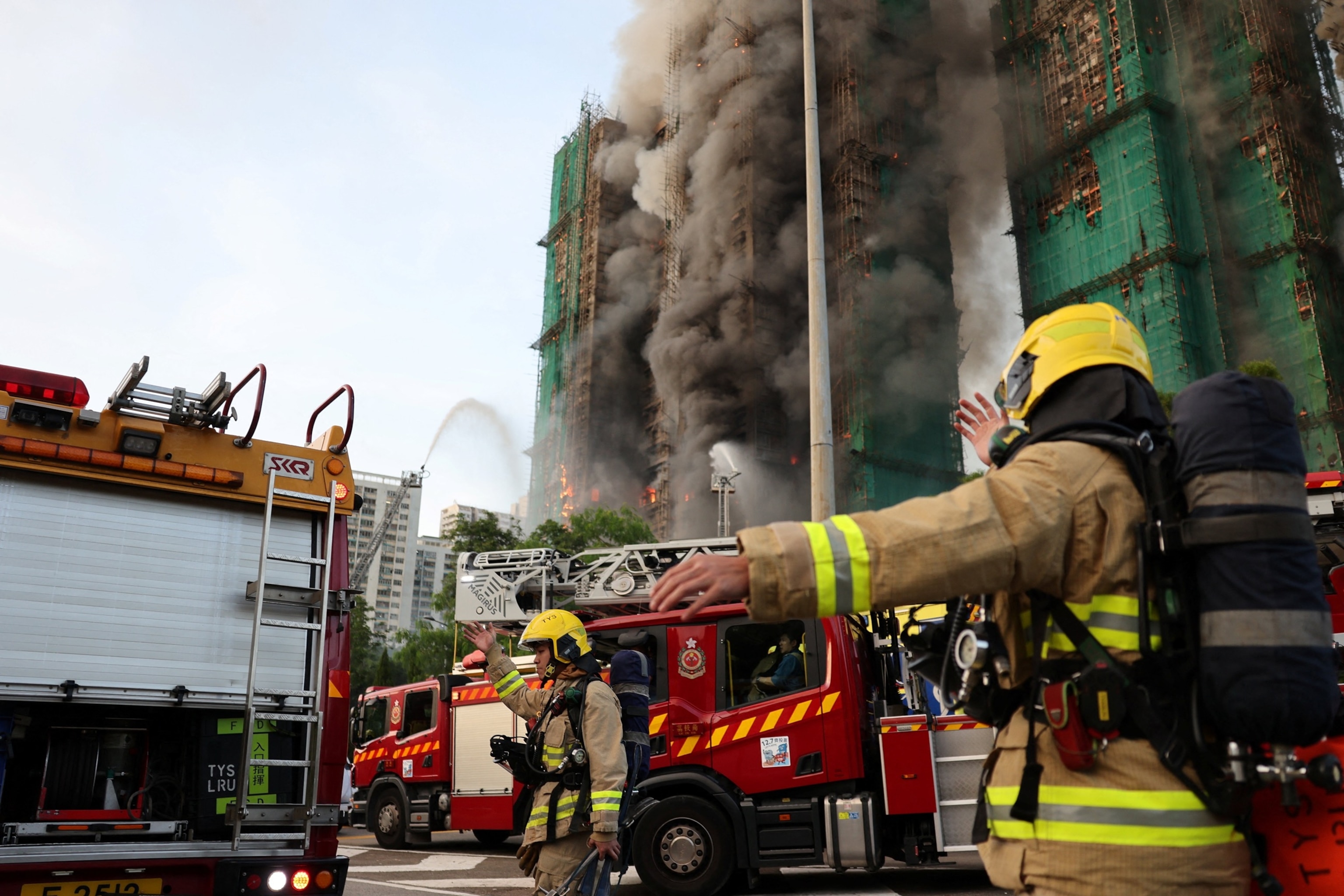
Eyewitnesses would later recount the spark as innocuous: a welder’s torch, perhaps, or an errant cigarette flick—details lost in the chaos but pinned preliminarily on faulty electrical wiring amid the scaffold’s cluttered web. Whatever the ignition, it caught with ferocious efficiency. By 2:15 p.m., flames licked upward from Block 3’s mid-levels, the bamboo igniting like matchsticks in a bonfire. Plastic coverings melted into dripping venom, accelerating the blaze as superheated gases funneled through the towers’ open corridors—Hong Kong’s “wind corridors” design, meant for ventilation, now a chimney for hellfire. Smoke, thick and black as bitumen, billowed skyward in a plume visible from Kowloon’s distant skyline, blotting out the sun and choking the air with the stench of burning insulation and synthetic fibers. Sirens wailed as the first 999 calls flooded in: “Fire! It’s spreading—help, the kids!” one frantic resident gasped to dispatchers, her voice cracking over the line.
Panic erupted in a symphony of desperation. In the towers’ bowels, families bolted for stairwells already thickening with acrid fog, elderly residents clutching canes and oxygen tanks as they navigated smoke-filled descents. Upper floors became fortresses of fear: windows flung open to gasping lungs, bedsheets twisted into improvised ropes dangled perilously over 20-story drops. Mobile footage, shaky and heart-wrenching, captured the horror—silhouettes against the inferno, pounding on glass as flames danced mere meters away; a mother shielding her toddler on a narrow balcony, flames curling like serpents below. “Jump? No, wait for the ladder!” a neighbor bellowed from across the void, but the fire’s vertical fury outpaced the response. Fire engines, 26 in total by evening, screeched into the estate’s forecourt, their hoses snaking through panicked crowds. Aerial platforms strained against the heat, ladders extending like accusatory fingers, but the blaze’s intensity warped metal and shattered glass, sending shards raining like deadly confetti.
Rescue operations, a Herculean ballet of bravery, stretched through the night into dawn. Over 500 firefighters and paramedics, clad in heat-resistant gear that bought them mere minutes in the scorch, breached smoldering lobbies and ascended staircases slick with runoff. Drones buzzed overhead, thermal imaging piercing the gloom to pinpoint heat signatures—faint blips of life amid the cooling embers. By midnight, 29 survivors had been hospitalized, seven in critical condition with burns spanning 60 percent of their bodies and smoke inhalation ravaging lungs. Ambulances ferried the wounded to Prince of Wales Hospital in nearby Sha Tin, where triage tents overflowed with the soot-streaked and shell-shocked. “It’s like Grenfell all over again,” muttered one triage nurse, invoking London’s 2017 tower inferno that claimed 72 lives, her hands trembling as she bandaged a child’s blistered arm. Community halls in Tai Po, repurposed as shelters, swelled to capacity—cots lining gymnasiums, volunteers dispensing hot congee and psychological first aid to the displaced. About 1,000 residents, bundled in MTR blankets and donated clothes, huddled under fluorescent lights, swapping fragments of stories: “My auntie was on the 18th floor—nothing since her last text at 3 p.m.”
As the sun crested on November 27, the human cost crystallized in cold arithmetic. Chief Executive John Lee, his face etched with uncharacteristic pallor, faced a phalanx of reporters outside the Government House. “This is a profound tragedy for our city,” he intoned, voice steady but eyes betraying the weight. The death toll, initially pegged at 13 by Wednesday evening, had surged to 55—51 perished at the scene, their bodies recovered from blackened interiors, while four succumbed in hospital beds to organ failure. Among them: a retired fisherman who’d lived in Block 5 for 30 years, his charred fishing hat found clutched in his lap; a pair of elderly sisters, inseparable in life, discovered entwined in a final embrace on the 22nd floor. The missing—279 souls reported via a dedicated hotline—represented a ledger of limbo: frantic relatives clutching faded photos at cordons, children scanning crowds for familiar faces. “We’ve attended to every report,” Lee assured, but the vagueness masked the grim reality—many presumed buried under collapsed ceilings or succumbed unseen in smoke-choked voids.
Blame, inevitable in such cataclysms, zeroed in on human frailty. Hours after the blaze was declared “under control” at 4 a.m., police announced the arrests of three men—two site supervisors and a subcontractor from the firm erecting the scaffolds—on suspicion of manslaughter. “Gross negligence,” thundered Commissioner Chris Tang at a terse briefing, his finger jabbing at blueprints projected on a screen. Investigations revealed shortcuts: substandard bamboo untreated for fire resistance, electrical cables jury-rigged without grounding, and ignored safety audits dating back to October. The firm, a mid-tier outfit with a history of minor violations, had lobbied against the steel mandate, citing costs in a city where construction bids are razor-thin. “They turned a routine job into a funeral pyre,” Tang seethed, vowing a full probe by the Fire Services Department taskforce. Public outrage simmered online, hashtags like #TaiPoInferno trending with calls for accountability: “How many more must die for profit?” one viral post demanded, racking up 50,000 shares.
This blaze, Hong Kong’s deadliest since the 1996 Garley Building inferno that scorched 41 lives in a Kowloon stairwell inferno, lays bare the perils of a city built skyward on reclaimed land and regulatory tightropes. High-rises, numbering over 9,000 and housing 40 percent of the population, are pressure cookers of risk: aging wiring in pre-2000 builds, flammable cladding retrofits lagging behind global standards, and a culture of deferred maintenance amid skyrocketing property values. The 2017 Grenfell parallels sting—both scaffolded facades as accelerants, both public housing tragedies underscoring inequality’s toll. In Hong Kong, where typhoons batter annually and land scarcity forces families into vertical stacks, fires claim an average of 50 lives yearly, but this scale demands reckoning. Experts, from the Hong Kong Institute of Architects to mainland fire safety consultants, decry the bamboo holdout: “It’s cultural, but deadly,” one structural engineer opined anonymously. The government’s steel phase-in, accelerated post-disaster, now faces scrutiny—will it retrofit the 40,000-odd scaffolds citywide, or merely bandage the wound?
Amid the rubble, glimmers of resilience pierce the gloom. Volunteers from the Tai Po Baptist Church, mere blocks away, ferried supplies through the night—nappies for displaced infants, chargers for phones pinging with desperate queries. Social workers fanned out, their clipboards heavy with psychosocial assessments, as grief counselors held circles in shelter corners. “We’ve lost our home, but not our spirit,” murmured Mrs. Leung, a 62-year-old evacuee cradling a singed photo album, her Block 4 flat reduced to skeletal rebar. Chief Executive Lee pledged aid: HK$200,000 per deceased family, temporary housing vouchers, and a review of building codes by year’s end. Yet for the missing’s kin, waiting is torment—a hotline that rings with hope and hangs up on hollow updates. DNA labs at the forensic center hum overtime, matching fragments to frantic submissions.
As November 27 wanes, Tai Po’s hills cast long shadows over the cordoned estate, where excavators claw at the debris like mourners at a grave. The air, once redolent of dim sum steam from nearby cha chaan tengs, now carries the faint char of loss. Hong Kong, phoenix of the East, has risen from colonial ashes and SARS quarantines, but this inferno scars deeper—a reminder that in a city of eight million squeezed into 1,100 square kilometers, safety is not a luxury but a lifeline. For the 4,600 Wang Fuk residents, scattered like ash on the wind, rebuilding means more than bricks: it’s reclaiming the everyday miracles—the laughter echoing in corridors, the harbor views at dusk—that fire sought to steal. In the quiet aftermath, as cranes silhouette against the setting sun, one truth endures: from these towers’ ruins, a fiercer vigilance will rise, lest the flames claim another dawn.