Mortal Shell 2 Gets Its First Huge Update: New Items, Major Buffs and Changes That Could Reshape the Meta
🔥 MORTAL SHELL 2 JUST GOT A MASSIVE SHAKE-UP — AND SOME BUILDS ARE ABOUT TO CHANGE FOREVER!
The first huge post-launch update has landed with NEW Fragile Tarstones, Shell respecs, major weapon buffs, an economy overhaul, better Ripostes, new exploration rewards… and changes that could completely rewrite the current meta.
But one change in particular has players asking: did the developers just make experimentation WAY easier — while secretly making several weapons and builds much stronger? 👀
🔥 See EVERYTHING that changed in Mortal Shell 2’s huge new update 👇
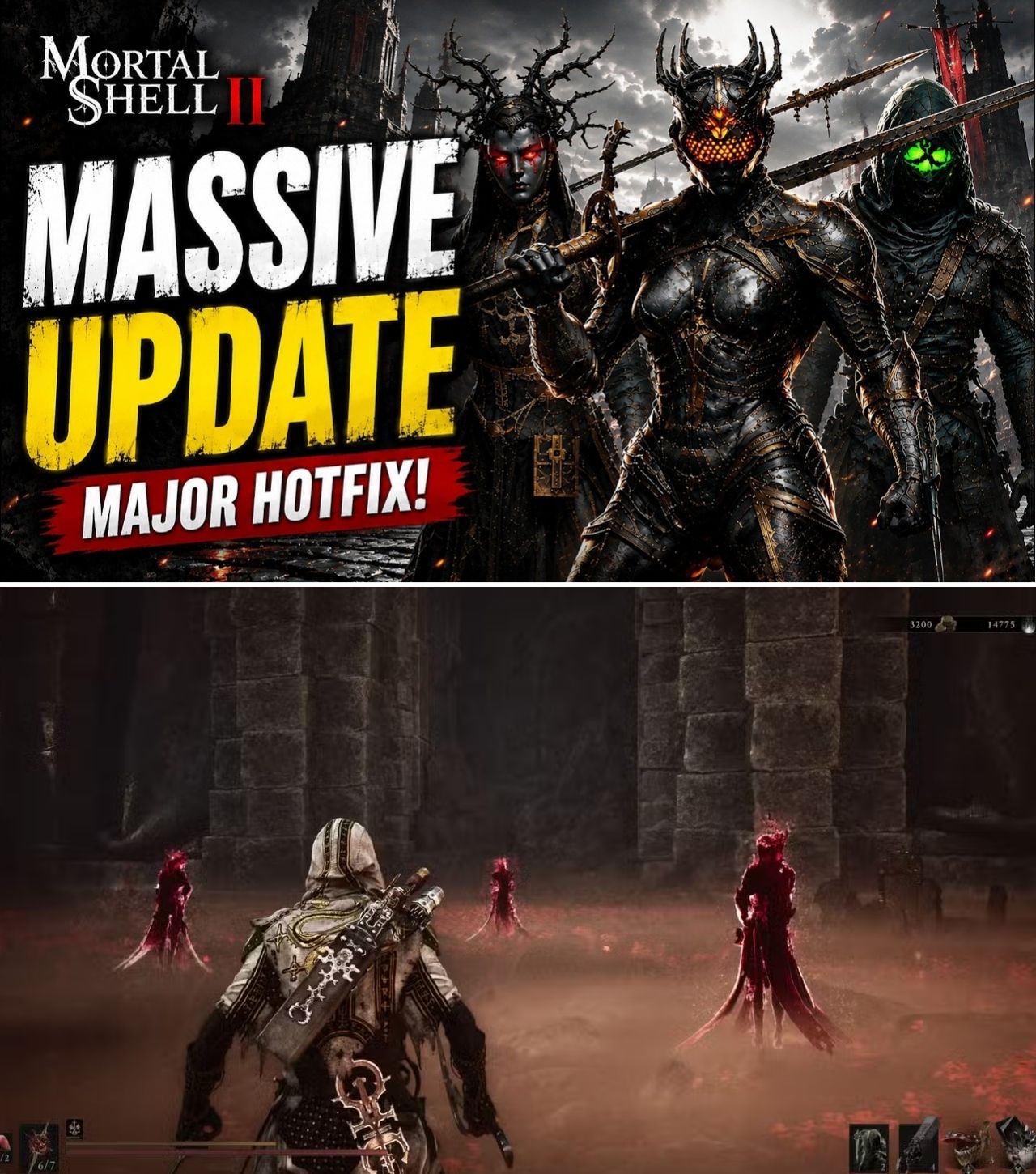
Mortal Shell II has received its first major post-launch update, and this is far more than a routine bug-fixing patch. New Tarstones, a Shell respec system, a revamped progression economy, weapon buffs, combat changes and exploration adjustments are giving players plenty of reasons to rethink their builds.
Mortal Shell II has only been in players’ hands for a short time, but the game’s first major update has already changed some of the assumptions surrounding its early meta.
Released on August 29, the Week 1 Update is the first major post-launch patch from Cold Symmetry and Playstack. The update introduces new items, makes significant changes to the Glimpses and Tarcores economy, reworks Ripostes, adjusts several weapons and Shell mechanics, adds exploration changes and fixes a large number of technical and gameplay problems.
For players who have spent the first week carefully investing their resources into a favorite Shell or weapon, however, the most important changes may not be the flashy ones.
The update fundamentally makes experimentation easier.
And that could have a major impact on how the Mortal Shell II community builds characters going forward.
This Is More Than a Balance Patch
The easiest way to misunderstand the Week 1 Update is to treat it as a simple collection of buffs and nerfs.
It is considerably broader than that.
The developers have touched almost every major part of the game’s progression loop.
There are new Fragile Tarstones.
There are new ways to obtain Glimpses and Tarcores.
There is now a dedicated way to respec Shells.
Several weapons have received substantial changes.
Ripostes have been given a full scaling and animation pass.
Enemy aggression has been retuned.
New Beacons have appeared.
Dungeon rewards have been revised.
And numerous bugs affecting combat, exploration, performance and progression have been addressed.
The official Steam announcement describes it as the game’s first major patch following launch, bringing new content alongside extensive fixes, performance improvements and combat refinements.
In other words, this is effectively the first major attempt to shape the game’s post-launch experience.
Fragile Tarstones Are the Biggest New Addition
Perhaps the most visible new feature is the introduction of Fragile Tarstones.
These work differently from conventional Tarstones because they have durability.
As players use them, that durability decreases.
Eventually the Tarstone breaks.
But instead of simply disappearing, the broken Tarstone produces a Tarcore.
That creates a new resource loop.
Players can now use the Tarstone during their playthrough while knowing that its eventual destruction provides additional progression resources.
The developers have also made these Fragile Tarstones non-unique, meaning players can find multiple copies rather than treating each one as a single irreplaceable item. Certain enemies and dungeons can now reward them, while Merrick has also added them to his inventory.
That is a meaningful change for players who previously had to be extremely careful with Tarcore spending.
It also gives exploration and combat another reason to matter.
Glimpse Stone Turns Combat Into a Resource Generator
Another new addition is the Glimpse Stone.
Its durability decreases as the player defeats enemies.
Once it breaks, it provides Glimpses.
That means a resource that was previously tied to particular progression opportunities can now be generated through a more active combat loop.
The system encourages players to actually use the item rather than simply hoard it.
It also creates an interesting choice.
Do you equip the Glimpse Stone and gradually wear it down through normal combat?
Or do you deliberately farm enemies to break it as quickly as possible?
Either way, the update gives players another route toward Shell progression.
Egon’s Stone Could Change Dungeon Runs
The update also introduces Egon’s Stone, one of the more interesting additions from a gameplay perspective.
The item provides a second chance when the player dies inside a dungeon.
Instead of immediately returning to the normal death loop, Egon’s Stone can revive the player at the dungeon entrance.
Its durability is consumed in the process.
When it breaks, the item also prevents that death from costing the player Gloom.
For a game built around high-risk exploration, this could be a substantial quality-of-life improvement.
Dungeons are where players are most likely to lose a significant amount of progress after making one bad decision.
Egon’s Stone effectively gives players another layer of insurance.
It does not remove the danger.
It simply makes failure less punishing.
And for newer players, that could be one of the most valuable additions in the entire update.
The Biggest Economic Change May Be the Least Flashy
One of the most consequential changes is hidden inside the patch’s economy section.
Glimpses and Tarcores are no longer finite resources.
That single change could fundamentally alter the way players approach character progression.
Before the update, players had to think carefully about where to spend their available resources.
Should they invest in Genessa?
Should they upgrade a different Shell?
Should they improve a particular Tarstone?
Those decisions carried an opportunity cost.
The updated economy removes much of that pressure.
The official patch notes explicitly state that Glimpses and Tarcores are no longer finite, allowing players to upgrade all Shells and Tarstones in a single playthrough.
That is enormous for build experimentation.
It means players can increasingly test multiple archetypes without worrying that investing heavily in one character will permanently prevent them from completing another.
For a build-focused Soulslike, that is a major philosophical shift.
Meet Mether’s Severance
The other major progression addition is Mether’s Severance.
This new item allows players to respec a Shell.
The process is straightforward: give Mether’s Severance to Zhirelle, the Shell keeper, and she resets the selected Shell while returning the Glimpses previously spent on it.
This could become one of the most important items in the post-patch meta.
Before, committing heavily to a Shell build could feel like a major decision.
Now?
Players have considerably more freedom to change direction.
A Genessa player can experiment with a different allocation.
A Smert player can test another build.
Someone who invested heavily in a defensive setup can potentially restructure their character for a more aggressive playstyle.
That means YouTube build guides may become considerably more useful because players no longer have to fear wasting an entire playthrough by following the wrong build.
Merrick’s Shop Is Getting More Important
The update also expands Merrick’s inventory.
Merrick can now sell Tarstones and Mether’s Severance, with his stock refreshing as players progress.
Once enough Ova have been gathered, his inventory can expand further to include Glimpse Stones, Egon’s Stones and Tarcores.
The Collector has also gained Tarcores in his inventory.
This is another subtle but important change.
Merchants are becoming more integrated into the game’s progression economy.
Instead of simply finding resources in the world, players can increasingly interact with a broader network of systems to obtain what they need.
That reduces the feeling that progression depends entirely on finding a specific item in a specific location.
Tarstones Are Now More Generous
The update also changes how many Tarcores players receive when breaking a Tarstone.
The developers increased the return.
And because this could have disadvantaged players who had already upgraded Tarstones before the patch, existing saves receive a compensatory cache of Tarcores.
That is an important detail for early adopters.
Players who invested heavily before the update are not simply being left behind.
The game is attempting to retroactively account for the changed economy.
That is generally good news for anyone who has already spent hours building their character.
Several Weapons Just Got Serious Attention
The update is not only about progression.
Weapons have also received significant changes.
The Obsidian Hammer received a full balance pass and now hits substantially harder.
The Great Martyr’s Blade received a damage increase.
Heavy weapons in general received changes to both poise and damage.
And the Axatana received an especially interesting adjustment: its weapon ability now grants invulnerability frames and inflicts Fragile stacks, while its combat Tarstone active now triggers correctly.
For the current build meta, the Axatana change is particularly noteworthy.
Genessa players have already gravitated toward the weapon because of its fast attack patterns and interaction with Resolve-focused builds.
Adding invulnerability frames and Fragile-stack application to its weapon ability gives players another reason to experiment with it.
That does not automatically make Axatana the best weapon in the game.
But it certainly makes it a weapon worth reassessing after the patch.
Heavy Weapons Are Getting More Respect
The heavy-weapon changes could also have a broader effect.
The developers specifically adjusted poise and damage for heavy weapons.
That could help close the gap between fast-hit builds and slower weapons that rely on fewer but more consequential attacks.
The change is particularly relevant because one of the recurring themes in early Mortal Shell II build discussions has been the value of rapid attacks.
Fast weapons can generate resources and status effects quickly.
Heavy weapons traditionally offer greater individual impact but expose players to more risk.
By adjusting damage and poise, the developers appear to be giving heavy weapons more room to compete.
The result could be a more diverse weapon meta.
The Trebuchaxe Was Too Much — So It Got Reworked
One of the more revealing changes involves the Salvaged Trebuchaxe.
The developers describe its Tiltshot ability as simultaneously overpowered and broken.
Rather than simply adjusting a number, they redesigned the ability.
That is significant because it demonstrates that the developers are willing to intervene when an interaction fundamentally disrupts the intended combat experience.
It also provides a warning to players chasing the latest “broken build.”
A setup that dominates the game today may not necessarily survive the next update.
The early meta is clearly being monitored.
Ripostes Have Been Reworked
Another major combat change involves Ripostes.
The update gives them a full scaling and animation pass.
That affects the fundamental rhythm of defensive combat because Ripostes are one of the game’s key ways of turning successful defensive play into offensive opportunities.
The exact effect will depend on individual weapons, Shells and player timing, but the broader goal appears clear: make Ripostes more consistent and better integrated into the game’s combat scaling.
For experienced Soulslike players, that could be one of the most important mechanical changes in the patch.
Enemy AI Has Also Been Adjusted
Players may notice that enemies behave differently even when their own builds have not changed.
The developers retuned base aggression and disengage ranges across the game.
They also addressed several enemy behavior problems, including enemies ignoring players while returning to patrol points, retreating excessively when unable to reposition and being unable to attack while locked onto another target.
These may sound like minor technical corrections.
They are not.
Enemy behavior determines the rhythm of nearly every combat encounter.
An enemy that disengages too far can make a fight artificially slow.
An enemy that refuses to attack under certain targeting conditions can make an encounter unintentionally easy.
An enemy that becomes overly aggressive can create the opposite problem.
The patch appears designed to bring those behaviors closer to the intended combat experience.
Weltcap Also Got Stronger
The Weltcap received improvements to both its active and passive effects.
That is another example of the patch expanding the number of viable tools rather than simply buffing the most popular builds.
It may not generate as much attention as the Axatana changes, but these smaller adjustments can have a major cumulative effect.
As more underused items become viable, the build meta becomes harder to predict.
And that is generally a healthy development for a game built around experimentation.
Exploration Has Been Reworked, Too
The update is not limited to combat.
New Beacons have appeared throughout Fainweald and Mammon, with these particular additions active during the day.
The developers have also added new world items and reset problematic chests.
A new teleporter has been added to one dungeon after the Grisha pit fight, removing the previously required walk back.
That may sound like a small convenience.
For players repeatedly exploring the same dungeon, it can save considerable time.
It also shows that the developers are paying attention to the game’s pacing rather than focusing solely on balance numbers.
Rewards Have Been Reworked
Several reward locations have also been revised.
Dungeon reward chests across the first two regions have been adjusted.
Reward placement in Mammon has changed.
Missing arena rewards have been restored.
Some world chests have been replaced with straightforward pickups.
And the Gloom Siphon now provides additional rewards, including Glimpses.
The developers also removed Glimpse rewards from Mini-Beacons.
Taken together, these changes suggest a broader attempt to make progression feel more deliberate.
The player should have clearer reasons to explore particular areas rather than simply wandering around hoping to stumble onto the right reward.
Genessa Players Have Plenty to Watch
For players following the current Genessa meta, this update is especially interesting.
Genessa’s signature Doubles received targeting improvements.
The developers fixed astral copies drifting away from their intended targets and improved target selection, including allowing Doubles to switch targets when their original enemy dies.
That matters because many of the strongest Genessa builds depend on her summons consistently contributing damage.
A Double that wanders away is wasted potential.
A Double that switches efficiently between targets is far more valuable.
So while the patch may not represent a straightforward Genessa damage buff, it can make her existing summoner archetypes feel considerably more reliable.
The New Meta May Be About Freedom, Not One “Best Build”
Perhaps the most interesting consequence of the update is that it could make the idea of a single strongest build less important.
If Glimpses and Tarcores are no longer finite, and Shell respecs are available through Mether’s Severance, players have far less reason to permanently commit to one configuration.
That encourages experimentation.
Try Genessa.
Respec.
Try Smert.
Change weapons.
Upgrade another Tarstone.
Test a heavy build.
Switch back.
For content creators, this is potentially huge.
It means players can follow multiple build guides without feeling that every choice is permanently consuming a limited resource pool.
The Community Reaction Is Already Strong
The official update announcement quickly generated substantial attention from the community.
A Reddit discussion of the full Week 1 patch notes received hundreds of votes shortly after publication, with players focusing heavily on the new economy, Fragile Tarstones, respec functionality and balance changes.
The response is understandable.
The update addresses one of the biggest concerns that can emerge in a build-heavy RPG: what happens when players want to experiment?
The answer after Week 1 is increasingly simple.
Experiment.
The game’s economy is being adjusted to support it.
This Could Change How the Game Is Played
The biggest impact of the update may therefore not be a single buff.
It may be the removal of progression anxiety.
Players no longer have to treat Glimpses and Tarcores as permanently finite resources.
They can respec Shells.
They have more ways to acquire progression materials.
Tarstones return more Tarcores.
Merchants have expanded inventories.
And weapons that previously struggled for attention have received meaningful buffs.
That creates a much more flexible environment.
Instead of asking:
“What is the safest build for an entire playthrough?”
Players can increasingly ask:
“What build do I want to play right now?”
That is a major difference.
The Update Also Raises New Questions
Of course, major patches create new problems as well as solving old ones.
When a weapon gets substantially stronger, players immediately ask whether it has become overpowered.
When a resource becomes renewable, players wonder whether progression has become too easy.
When Shell respecs become available, the value of long-term build decisions changes.
And when enemy aggression is retuned, players have to relearn encounters they may have already mastered.
That is the normal tension of live-service balancing, even for a primarily single-player action RPG.
The developers have to find a point where experimentation is encouraged without making every upgrade meaningless.
What Comes Next?
The Week 1 Update is unlikely to be the last major balance conversation surrounding Mortal Shell II.
The game launched only recently, and the developers have already shown a willingness to respond rapidly to player feedback.
The update fixes technical issues, adjusts combat systems and reworks parts of the game’s economy — all within the first major post-launch patch.
That means players should expect the meta to remain fluid.
Today’s strongest weapon may be replaced tomorrow.
A new Tarstone combination could emerge.
Genessa’s summoner builds may become even more consistent.
Smert players may discover new interactions.
Heavy weapons could make a comeback.
And the newly expanded resource economy could make all of those experiments much easier to test.
For now, however, the Week 1 Update represents a significant turning point for Mortal Shell II.
It is not simply a patch that fixes bugs.
It changes how players acquire resources, how they build Shells, how they approach weapons and how much freedom they have to experiment.
And perhaps the most important change of all is the simplest:
Players no longer have to be afraid of trying something new.
For a game built around discovering the perfect Shell, weapon and Tarstone combination, that could end up being the biggest buff of them all.