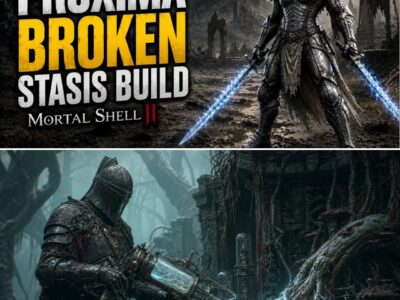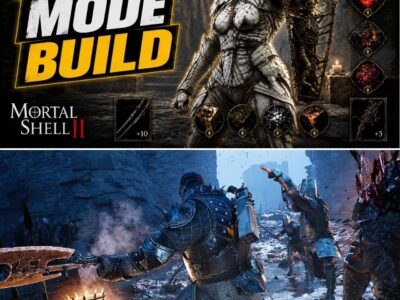
This INSANE Smert Build Is Turning Mortal Shell 2 Into a Damage-Stacking Nightmare
🔥 SMERT MAY HAVE A DAMAGE PROBLEM… AND PLAYERS ARE LOVING IT.
One Mortal Shell 2 build is turning Smert’s insane risk-reward mechanics into a brutal damage loop — freeze time, stack Chaos, then watch the entire setup explode into ridiculous burst damage.
But there’s a catch: this isn’t some brainless “press one button and win” build… and the moment you mess up the rotation, Smert can punish YOU just as hard. 👀
🔥 See the weapons, Tarstones and setup behind this INSANE Smert build 👇

Smert, the Apostate was designed around risk. But players are now discovering just how devastating that risk can become when Miracle, Chaos stacks, critical damage and the right Tarstones are pushed together.
Mortal Shell II has only been available for a short time, but its community is already doing what Soulslike players traditionally do after launch: taking the game’s most unusual mechanics, pushing them to their limits and searching for combinations that can make bosses look considerably less threatening.
One of the clearest examples is Smert, the Apostate.
A new wave of build guides and community discussions is putting Smert under the spotlight for a very specific reason: damage.
Unlike a conventional melee Shell that simply relies on stronger weapons or safer defensive tools, Smert’s design revolves around a much more volatile system involving Miracle, Chaos and Faith. The result is a character who can potentially produce enormous bursts of damage — but who also gives the player considerably less room for error.
That is what makes the “INSANE DAMAGE SMERT” build featured in the referenced gameplay clip particularly interesting.
The build is not simply about finding the weapon with the biggest number.
It is about creating a combat loop in which Smert builds toward a massive payoff, with the player’s timing determining whether the encounter becomes a devastating display of burst damage or a very quick trip back to the last checkpoint.
Smert’s Entire Identity Is Built Around Risk
Smert occupies an unusual position among Mortal Shell II’s eight permanent Shells.
Current tier-list analysis places Smert among the game’s strongest options for high-risk burst damage, rather than treating him as an all-purpose defensive or beginner-friendly Shell.
That distinction is important.
Smert isn’t designed to absorb punishment indefinitely.
Instead, his kit encourages players to manage a powerful offensive mechanic and turn that mechanic into explosive damage.
Recent build analysis describes his core loop in simple terms: activate Miracle, attack while time is effectively suspended, build Chaos, and then allow the accumulated effect to resolve when the Miracle sequence ends. One updated guide describes the potential payoff as a boss-melting burst when the setup is executed correctly.
It is an unusually aggressive design for a Soulslike.
Rather than asking, “How long can I survive?”
Smert effectively asks:
“How much damage can I prepare before the enemy gets another chance to fight back?”
The Chaos Mechanic Is the Real Star
The most important part of the build is not necessarily the weapon itself.
It is Chaos.
Current Smert build guides recommend using his Miracle window to land repeated unarmed attacks and accumulate Chaos stacks before allowing the sequence to conclude. One current guide specifically describes building toward 100 Chaos stacks, followed by a major burst when Miracle ends.
That creates a very different rhythm from normal combat.
The player does not simply attack until the boss staggers.
Instead, the player enters a preparation phase.
Miracle activates.
Time becomes the player’s advantage.
Smert attacks.
Chaos accumulates.
And the player waits for the moment when all of that preparation converts into damage.
That is where the build begins to look “broken.”
Not because every individual punch is necessarily absurd, but because multiple mechanics are being compressed into a single offensive sequence.
Why Unarmed Attacks Can Become So Dangerous
One of the more interesting aspects of the current Smert meta is that the most effective damage setup does not necessarily revolve around keeping a conventional weapon in Smert’s hands.
An updated Smert guide recommends a dedicated unarmed Chaos build, focusing on abilities such as Novertime and Striker, with additional investment into Devotion and Fervor. The recommended setup then combines those abilities with Auspicious Stone, Headsman’s Stone, Berserker’s Stone and Duality Stone.
That is a significant departure from how many players initially approach Mortal Shell II.
In a game filled with recognizable weapons, it is natural to assume that the strongest build should revolve around whichever weapon has the most impressive damage output.
Smert challenges that assumption.
His unique mechanics can make the character’s own attacks the centerpiece of the build.
And that is why weapon selection becomes a somewhat different question for Smert than it is for other Shells.
The Black Needle Still Has a Role
That does not mean weapons are irrelevant.
A separate Smert build guide recommends the Black Needle as the primary weapon, with Stillblade’s Stone and Arbiter’s Prize as its weapon Tarstones. The same setup pairs the weapon with the Caged Hystrix sidearm and Volatile Fragment.
The reasoning is straightforward.
Smert’s special unarmed sequence may represent the centerpiece of the damage strategy, but there are still moments when the player needs to fight normally.
Miracle is not simply an infinite resource.
If the player is waiting for the right opportunity to activate the offensive sequence, the regular weapon becomes the tool for surviving and controlling the battlefield between major bursts.
That makes the Black Needle setup more of a complete combat package than a simple “maximum DPS” experiment.
Tarstones Are Where the Build Starts to Snowball
The Tarstone selection is particularly important because Smert’s damage does not exist in isolation.
The current unarmed build recommends Auspicious Stone, Headsman’s Stone, Berserker’s Stone and Duality Stone.
These choices fit into the broader melee meta that has emerged around Mortal Shell II.
Community build tracking currently identifies Duality Stone as one of the most frequently discussed options for fast melee and status-oriented setups, while Headsman’s Stone is repeatedly associated with critical-focused builds.
That does not automatically make those Tarstones the universally strongest options.
It does, however, explain why they appear repeatedly in high-damage builds.
The philosophy is consistent:
Attack faster. Crit harder. Increase the value of every offensive window.
For Smert, that philosophy becomes even more extreme because the entire Shell is built around creating short periods where offensive output matters enormously.
The Health Problem Cannot Be Ignored
There is, however, a major downside.
Smert is not a traditional glass cannon in name only.
Recent build analysis describes him as having the lowest health pool among the Shells, while simultaneously giving him one of the game’s highest potential burst-damage ceilings when properly configured.
That creates a brutal trade-off.
A player who knows the encounter can make Smert look ridiculous.
A player who misses the timing can make Smert look extremely fragile.
This is why the build is unlikely to appeal equally to everyone.
Players who are comfortable memorizing boss attack patterns, understanding animation windows and committing to aggressive rotations can extract enormous value from Smert.
Players who prefer a forgiving Shell with substantial room for mistakes may find the same setup considerably less attractive.
The damage is real.
So is the risk.
The Build Is About a Rotation, Not Just Equipment
This distinction is easy to miss when watching showcase videos.
A damage showcase can make a build look as simple as:
equip these items → hit boss → enormous damage.
The reality is considerably more involved.
The Smert setup is essentially a rotation.
First, the player needs to create the right circumstances.
Then comes Miracle.
During that window, the player needs to maximize attacks and Chaos generation.
The player then needs to let the accumulated mechanics resolve at the correct moment.
If executed properly, the payoff can be enormous.
If the player wastes the Miracle window, fails to build enough Chaos or mistimes the sequence, much of the build’s potential disappears.
That makes the build highly dependent on execution.
And that is exactly why “INSANE DAMAGE” is a more accurate description than “easy mode.”
Week 1 Update Adds Another Layer
The timing of the build’s popularity is also interesting because Mortal Shell II has just received its first major post-launch update.
The Week 1 Update, released August 29, introduced new Fragile Tarstones, changed the Glimpses and Tarcores economy, added a Shell respec option and made numerous combat and gameplay adjustments. The developers also refined multiple weapons and Shell-specific mechanics.
The update included specific corrections involving Smert and other Shells, although the patch notes do not establish a universal ranking of the game’s builds.
That caveat matters.
The existence of a powerful Smert setup does not mean the developers have officially declared it overpowered.
Nor does a damage showcase prove that Smert is stronger than every other Shell in every encounter.
The game’s current build environment is still changing.
Smert Is Not Alone in the Damage Race
One reason the Smert discussion is becoming particularly interesting is that Mortal Shell II appears to have several legitimate high-damage archetypes.
Genessa, for example, has attracted attention for Faithful Doubles and high multi-hit damage.
Tiel has emerged as a critical-focused option.
Gragu can specialize in sustain and stagger pressure.
And Eredrim offers a more forgiving approach built around heavier weapons and posture damage. Current Shell tier lists place Genessa, Smert and Gragu among the game’s top-tier choices, although the exact ranking varies depending on what the player values.
That means the current discussion isn’t really about finding one objectively perfect character.
It is about discovering which Shell can best exploit the game’s systems for a particular playstyle.
Smert simply happens to have one of the most dramatic results when everything goes right.
Why Players Are Calling It “Insane”
The appeal of the build ultimately comes down to spectacle.
There is something inherently satisfying about watching a boss’s health disappear after the player spends several seconds setting up the perfect offensive sequence.
Smert’s mechanics amplify that feeling.
The build does not simply make attacks stronger.
It creates anticipation.
The player knows that every successful hit during Miracle is contributing toward something larger.
Every Chaos stack represents another step toward the payoff.
And once the sequence ends, the accumulated damage becomes visible all at once.
That makes Smert particularly well suited to gameplay showcases.
A normal build might look strong.
A perfectly executed Smert build can look absurd.
But “Broken” May Be the Wrong Word
Calling Smert broken would be premature.
There is a substantial difference between high damage and game-breaking balance.
The current evidence supports the first claim far more strongly than the second.
Community guides consistently identify Smert as a high-risk burst-damage Shell, and recent build experimentation demonstrates that his Miracle-and-Chaos mechanics can produce spectacular results.
But the build still has meaningful limitations.
Smert’s low health means mistakes are costly.
The player must understand the combat loop.
Miracle windows must be used efficiently.
And different bosses can create very different opportunities for building and cashing out Chaos.
That is not exactly a conventional “God Mode.”
It is closer to a high-skill damage engine.
The Bigger Question for Mortal Shell 2
The more interesting long-term question is what happens as players continue experimenting with Smert.
Mortal Shell II is still in its earliest post-launch period, and the Week 1 update has already demonstrated that Cold Symmetry is actively responding to player feedback and adjusting combat systems.
That means today’s strongest setup may not necessarily remain tomorrow’s strongest setup.
Tarstone interactions can be adjusted.
Shell abilities can be balanced.
Weapons can receive damage or functionality changes.
And, perhaps most importantly, players are still discovering combinations that were not obvious during the first days of release.
For now, however, Smert has established himself as one of the game’s most fascinating offensive experiments.
His best builds do not simply ask the player to hit harder.
They ask the player to understand exactly when to hit, how long to keep attacking and when to unleash the accumulated payoff.
That is what makes the build featured in the damage showcase so compelling.
Smert may have one of the lowest health pools in Mortal Shell II.
But when Miracle is active, Chaos is stacking and the entire build is firing on all cylinders, the question is no longer whether Smert can survive the fight.
It becomes whether the boss can survive Smert’s next few seconds.