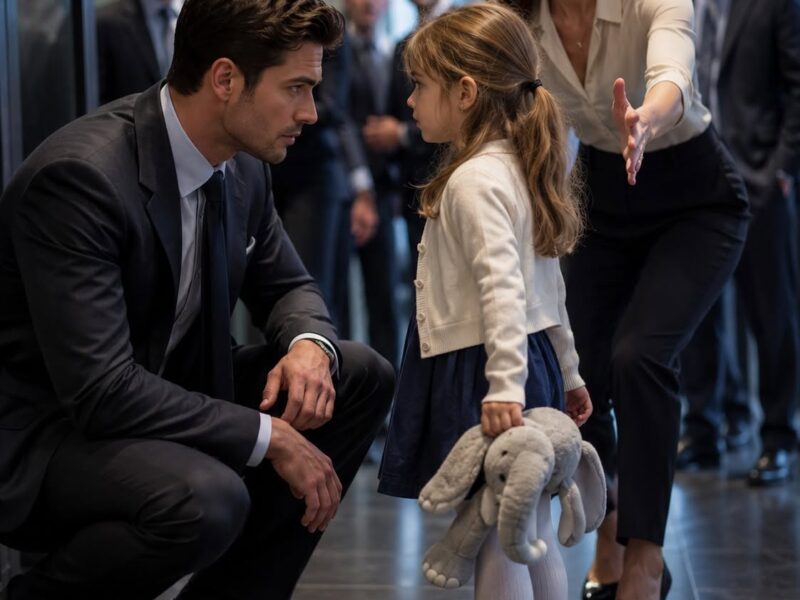
I stopped because Adrian Kane had finally stopped laughing
The moment my six-year-old daughter pointed at the most intimidating billionaire in Manhattan and announced, “I think you should be my daddy,” I knew two things with absolute certainty.
First, everyone on the executive floor had heard her.
Second, I was probably about to lose my job.
The hallway went so silent I could hear the faint hum of the elevators behind me.
Mia, completely unaware that she had just committed what was probably a corporate-level felony, stood with her tiny hands clasped behind her back and stared confidently at Adrian Kane.
“You’re too handsome to be alone,” she informed him.
I nearly choked.
Several senior executives nearby suddenly became very interested in the walls.
Adrian Kane—the man capable of reducing experienced department heads to nervous wrecks with nothing more than one raised eyebrow—just stared at her.
Then something impossible happened.
He laughed.
Not the controlled, courteous half-smile he occasionally offered investors.
Not the dry little exhale he sometimes made when someone attempted a joke during meetings.
He actually laughed.
Deeply.
Helplessly.
For two years, I had worked under Adrian Kane, and I had never heard that sound.
Apparently, all it took was my daughter destroying every professional boundary I had ever carefully maintained.
And somehow, it was the perfect ending to a morning that had been doomed from the beginning.
My phone had started ringing before six.
“Claire, I’m so sorry.”
Those were words no working mother wanted to hear from her nanny before sunrise.
A pipe had burst in her apartment building in Queens. Water had flooded two floors, including hers, and she needed to deal with emergency repairs.
I immediately called my mother.
No luck.
She was stranded in Atlanta after her flight was canceled.
My best friend?
Stuck in Denver for a conference.
By 6:30 a.m., I had exhausted every reasonable option.
There was nobody left to watch Mia.
And calling out wasn’t exactly realistic.
At thirty-three, I was a senior creative director at Blackwell & Reed, one of Manhattan’s most demanding luxury branding firms. That afternoon, our team was scheduled to present revised campaign concepts to the board for a client worth millions.
Missing that presentation could derail months of work.
Worse, the man overseeing everything was Adrian Kane.
At thirty-six, Adrian was the heir to Kane Global Holdings and the billionaire who had transformed Blackwell & Reed from a respected agency into an international powerhouse.
He was brilliant.
Controlled.
Terrifyingly observant.
And, unfortunately for every woman with functional eyesight, almost offensively handsome.
He was tall, broad-shouldered, dark-haired, and sharp-featured, with gray-blue eyes that seemed capable of identifying your worst mistake before you even realized you had made one.
He almost never smiled.
He definitely did not appreciate excuses.
Our relationship had always been strictly professional.
Efficient conversations.
Brief meetings.
Clear expectations.
Zero warmth.
Which was why bringing my six-year-old daughter into his carefully controlled corporate empire felt approximately as sensible as releasing a raccoon inside a jewelry store.
“You’re going to be invisible today,” I told Mia while she sat on our kitchen counter eating cereal.
She blinked at me.
“Like invisible invisible?”
“Like a ghost.”
She considered this seriously.
“Can ghosts have crackers?”
“Yes.”
“Can ghosts watch cartoons?”
“With headphones.”
Another thoughtful pause.
“Can ghosts ask your mean boss why he always looks angry?”
My spoon froze halfway to my mouth.
“Absolutely not.”
Mia smiled sweetly into her cereal.
That should have been my warning.
By 8:35, we were walking through the glass doors of our Park Avenue office tower.
I hurried Mia straight into my office before too many people could notice.
I created what I believed was an airtight containment strategy.
Coloring books.
An iPad.
Headphones.
Goldfish crackers.
Two juice boxes.
And Gerald, her beloved stuffed elephant.
I crouched beside her chair.
“Today, you are quiet.”
She nodded.
“You stay right here.”
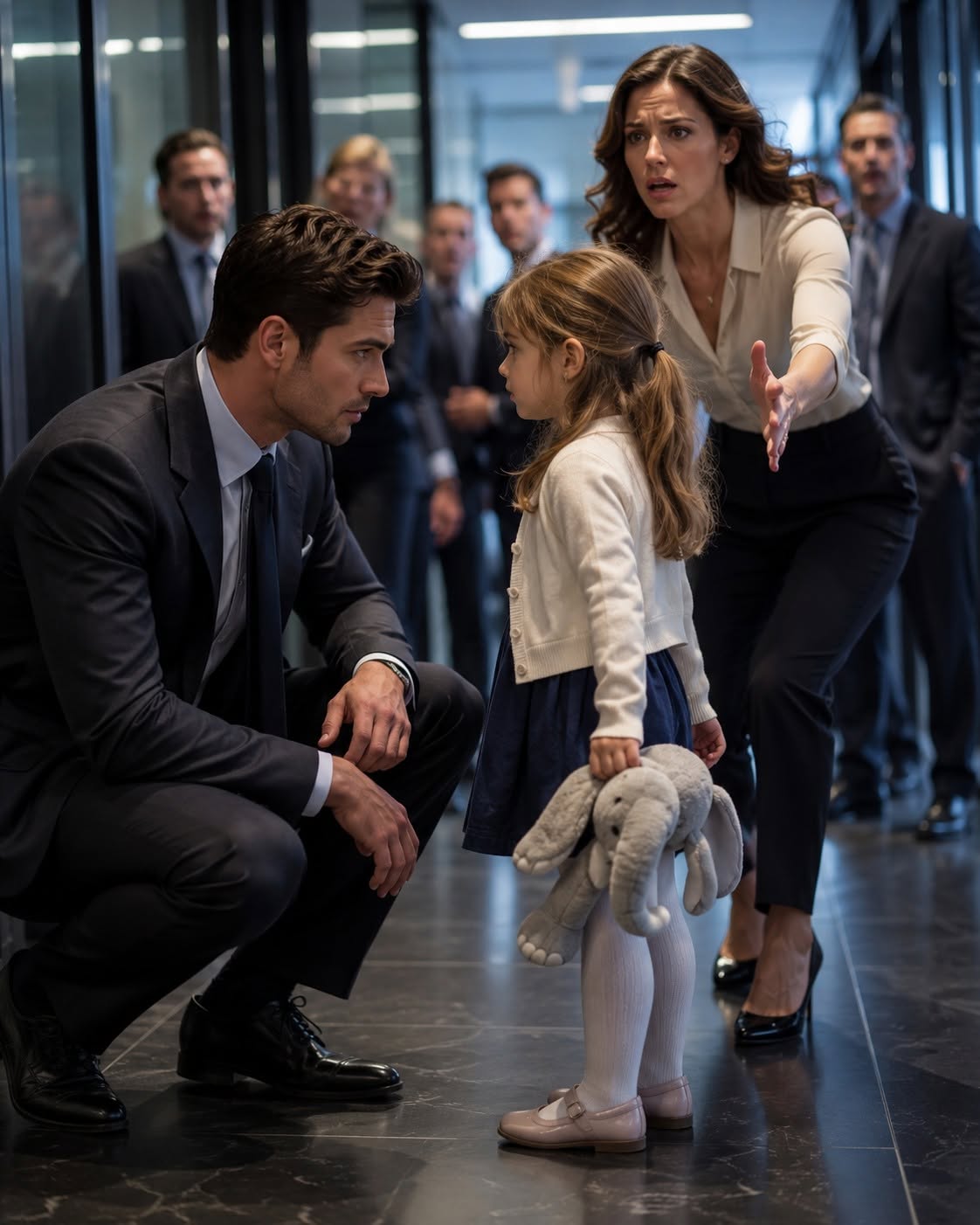
“I understand completely, Mom,” Mia had promised with absolute solemnity, her dark eyes wide and innocent. “I’m a ghost. Ghosts don’t talk to angry men in gray suits.”
And yet, exactly forty-five minutes later, here we were.
My heart hammered against my ribs like a trapped bird. I reached out, my fingers trembling slightly as I grabbed Mia’s tiny shoulder, pulling her back toward me.
“I am so, so sorry, Mr. Kane,” I babbled, the words tumbling over each other in a frantic rush of corporate self-preservation. “She’s been cooped up all morning, our nanny’s apartment flooded, and I couldn’t secure childcare—it won’t happen again, I’ll take her down to the lobby lounge immediately, or home, I can work remotely, just—please don’t hold this against the branding division—”
I stopped because Adrian Kane had finally stopped laughing.
The deep, resonant sound faded into a slow, enigmatic smile—a faint curve of his lips that somehow made him look even more dangerous than before. He crouched down until he was eye-level with Mia, ignoring my panic entirely.
“A ghost, huh?” Adrian asked, his voice a rich, smooth baritone that sent an involuntary shiver down my spine. He tilted his head, studying her stuffed elephant tucked under her arm. “And what does a ghost do when she meets a supposed mean man?”
Mia didn’t flinch. She leaned forward, inspecting his bespoke tie clip with critical scientific interest. “She decides if he needs a hug or a snack. You look like you need both.”
Several vice presidents behind him collectively choked on their breath.
Adrian’s gray-blue eyes flicked up from Mia to meet mine. There was a sudden, intense flicker of something unreadable in his gaze—something that stripped away ten years of corporate stiffness in a single heartbeat.
“What’s your name, little ghost?” he asked softly.
“Mia,” she answered promptly. “And this is Claire, but she’s my mom so you can’t have her.”
“Mia,” Adrian repeated, rolling the name over his tongue as if tasting it. He stood back up, adjusting the cuffs of his immaculate white shirt. He turned his attention back to me, the playful warmth in his eyes vanishing, replaced once more by the razor-sharp focus of the billionaire CEO.
“Ms. Bennett,” he said smoothly.
“Yes, Mr. Kane?” I whispered, bracing myself for the ax.
“Your presentation to the board is at two o’clock this afternoon.”
“I know. I can reschedule—”
“Reschedule a multi-million-dollar acquisition pitch?” He raised one dark eyebrow, cutting me off with effortless authority. “Unacceptable. Bring her to the boardroom.”
My jaw dropped. “Excuse me?”
“You heard me,” Adrian said, turning on his heel and walking down the hallway toward his private office, his broad shoulders shifting beneath his tailored jacket. Over his shoulder, he added, “And make sure Gerald gets a chair at the table. I won’t have guests sitting on the floor under my watch.”
The executives scrambled out of his way like parting waves.
I stood frozen in the middle of the executive corridor, my hand still resting on my daughter’s shoulder, utterly shell-shocked.
Mia looked up at me, blinking innocently. “See, Mom? I told you he was too handsome to be alone. And he likes elephants.”
By 1:50 PM, the glass-walled executive boardroom on the forty-fifth floor looked less like a corporate meeting room and more like a high-stakes hostage negotiation that had somehow been invaded by a six-year-old artist.
The long mahogany table was littered with glossy campaign mock-ups, financial spreadsheets, and sleek leather portfolios. Twenty senior board members sat in tense silence, whispering among themselves as they eyed the corner of the room.
There, sitting comfortably in an oversized leather armchair that swallowed her whole, sat Mia. She was deeply engrossed in coloring a picture of a purple unicorn, wearing oversized noise-canceling headphones, with a plate of gourmet sugar cookies the catering staff had personally rushed up at Adrian’s direct command.
At the head of the table sat Adrian Kane.
He hadn’t looked at his phone once since the meeting started. Every time I glanced up while presenting our luxury branding strategy, I caught his gray-blue eyes fixed not on the slides behind me, but on me—with a steady, calculating intensity that made my mouth dry.
“In conclusion,” I said, clicking to the final slide of our digital deck, my voice remarkably steady considering my heart was beating a frantic rhythm against my ribs, “this campaign positions Blackwell & Reed not just as a service provider, but as an exclusive lifestyle curator for the next decade.”
Silence blanketed the room.
For three terrifying seconds, nobody moved. The older members of the board exchanged cautious glances. This was the moment where the hardest questions usually dropped.
Then, from the corner of the room, the headphones slipped off Mia’s head.
She stood up, walked across the plush carpet, and stopped right beside Adrian’s chair. She tapped him softly on the sleeve of his jacket.
Adrian immediately leaned down, entirely breaking every rule of corporate decorum. “Yes, Mia?”
“Your pictures are very pretty,” she whispered loudly, pointing at the screen behind me. “But my mom spent all night working on them instead of sleeping. So you should say yes.”
A sharp intake of breath hissed through the room. One board member opened his mouth to scold her, but closed it instantly when Adrian raised a single finger.
Adrian looked down at Mia, a slow, genuine smile spreading across his face—a smile so devastatingly attractive it felt illegal in the state of New York.
“You know, Mia,” Adrian said, his deep voice carrying clearly to every corner of the silent boardroom, “your mother is exceptionally talented. And negotiation is much easier when you have a very persuasive advocate on your side.”
He looked up, locking eyes with me across the mahogany table.
“Motion to approve the campaign budget with a twenty percent increase for creative expansion,” Adrian announced clearly, never breaking eye contact with me.
Before the rest of the board could even process what had just happened, the senior managing director cleared his throat and nodded. “Seconded. Approved unanimously.”
Applause rippled through the room, stiff and stunned, but genuine.
Twenty minutes later, the boardroom emptied out until it was just the three of us. The evening sun was beginning to set over the Manhattan skyline, casting a warm golden glow across the glass table.
I packed up my laptop with trembling hands, feeling a mixture of exhaustion, triumph, and sheer disbelief.
Adrian walked over, standing just a few feet away from me. He looked down at Mia, who was carefully packing Gerald back into her backpack.
“You didn’t have to do that, Mr. Kane,” I said quietly, keeping my eyes on my screen. “The board might have approved it anyway based on the metrics—”
“They would have debated it for three weeks,” Adrian interrupted softly. He stepped closer, the crisp, clean scent of cedarwood and amber enveloping me. “And besides… I’m a man of my word.”
I finally looked up. His gray-blue eyes were impossibly close, filled with a warmth I had never seen there before.
“What word is that?” I asked, my breath catching.
Adrian glanced down at Mia, then back to me, the corner of his mouth twitching upward in a slow, charming smirk.
“Mia told me this morning that I was too handsome to be alone,” he murmured, his voice dropping into a register meant only for me. “And frankly… I’m starting to think your daughter is the smartest person on the executive floor. Dinner tonight? All three of us.”